
HDPE Pipes Suffer Stress Cracking in Strong Alkalis – Reinforced Nylon Pipes Are Engineered for Soda Ash and Chlor-Alkali
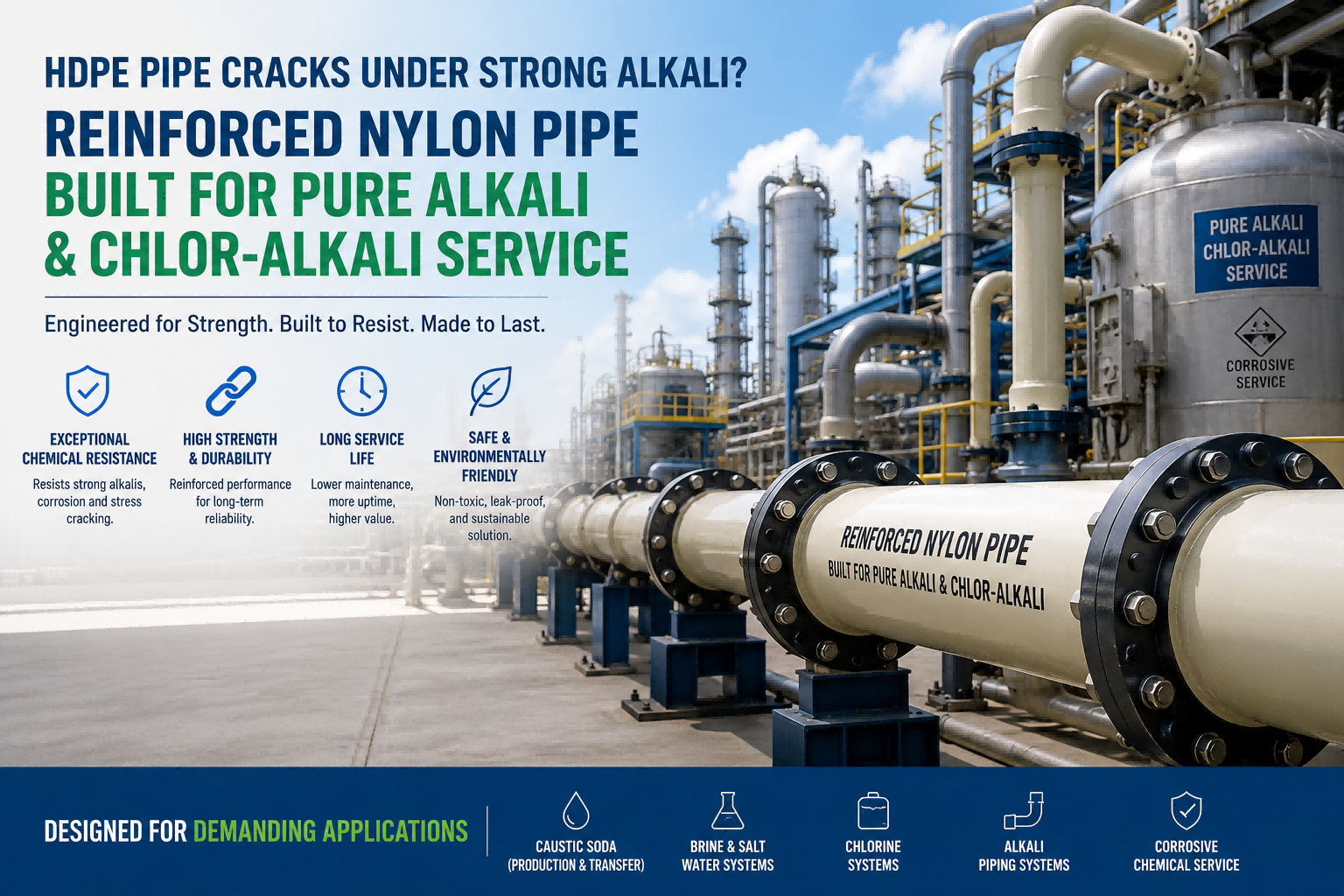
In the transport of strong alkaline media such as soda ash and chlor‑alkali, material selection for piping systems has always been a critical challenge for process engineers. Corrosion, stress cracking, high‑temperature degradation – each failure mode can lead to production downtime or even safety incidents. For a long time, HDPE (high‑density polyethylene) pipes have held a place in many industrial applications due to their good chemical resistance and cost‑effectiveness. However, when facing strong alkaline environments, a fatal weakness of HDPE gradually becomes apparent – **environmental stress cracking (ESC)**. Meanwhile, reinforced nylon pipes – especially reinforced MC nylon – are increasingly becoming the preferred upgrade for the soda ash and chlor‑alkali industries.
1. HDPE’s Achilles’ Heel: Environmental Stress Cracking in Strong Alkalis
As a thermoplastic polyolefin, HDPE does offer several advantages: good chemical stability, resistance to most inorganic acids, alkalis, and salt solutions; low density; light weight; and ease of installation. At ambient temperatures and with low‑concentration alkaline solutions, HDPE performs reasonably well.
But the problem lies in **environmental stress cracking**. ESC refers to the brittle cracking of polymeric materials under the combined action of **mechanical stress** (including external loads and residual internal stresses) and **chemically active media**. HDPE is precisely at risk in strong alkaline environments. Studies indicate that the stress‑cracking behavior of HDPE in alkaline conditions resembles that in acidic environments – in other words, **alkaline media do not “spare” HDPE**. More importantly, **elevated temperatures and increased loads significantly reduce HDPE’s resistance to stress cracking**.
In the soda ash and chlor‑alkali industries, high‑temperature concentrated alkalis are the norm. Engineering guidelines explicitly state that HDPE’s serviceability for caustic soda (NaOH) transport is generally limited to about **50‑60°C**, and caution is required against **caustic stress‑corrosion cracking** under high temperatures or high stress levels. Above this threshold, the mobility of HDPE’s molecular chain segments increases, and micro‑cracks accelerate their propagation under the penetration of alkaline media, eventually leading to pipe failure.
Furthermore, HDPE’s ESC resistance is closely linked to its molecular structure – a decrease in relative molecular mass leads to poorer ESCR performance. This means that even among HDPE materials, different grades and processes can exhibit markedly different behavior in strong alkaline environments, adding uncertainty to engineering selection.
2. Reinforced Nylon Pipes: Built for Strong Alkalis
Unlike HDPE, which merely “copes,” reinforced MC nylon pipes demonstrate an almost inherent suitability for strong alkaline environments.
**First, there is the “innate advantage” at the molecular level.** Nylon belongs to the polyamide family, with polar amide groups (-CONH-) along its main chain that form highly ordered crystalline structures through hydrogen bonding. This structure endows nylon with excellent mechanical strength and rigidity. **Reinforced MC nylon** – further modified from standard MC nylon – delivers substantially improved mechanical strength, rigidity, heat resistance, creep resistance, and fatigue resistance – its **fatigue resistance is 2.5 times that of unreinforced MC nylon**.
**Second, there is the “acquired expertise” in chemical tolerance.** Reinforced MC nylon pipes exhibit good adaptability to both acidic and alkaline environments, and **their corrosion resistance is particularly superior in alkaline media**. At ambient temperatures, they can be used with various acid, alkali, and inorganic salt solutions. Manufacturer data indicate that MC nylon products can be used over a long‑term temperature range of **‑40°C to 120°C**, and after reinforcement, the continuous service temperature can reach **150°C**, with an aging life of **40‑50 years**.
**Third, there is strong validation from engineering practice.** The development and application of reinforced MC nylon pipes have spanned more than two decades. They have found widespread use in the **petroleum industry, mining, soda ash, and chlor‑alkali sectors**. In soda ash production, reinforced MC nylon pipes have successfully replaced traditional cast iron and stainless steel piping. Over two years of industrial practice have demonstrated outstanding advantages, including **strong corrosion resistance, excellent erosion resistance, reduced scaling, and anti‑aging properties**.
3. Why Are Reinforced Nylon Pipes the “Right Answer” for Soda Ash and Chlor‑Alkali?
The process environments in soda ash (sodium carbonate) and chlor‑alkali (caustic soda / sodium hydroxide) industries share a common profile: **high concentration, strong alkalinity, and frequently high temperatures**. Under such conditions, piping materials face the **dual challenge of chemical corrosion and mechanical stress**.
HDPE’s failure mechanism is precisely the combined “chemical + stress” attack – alkaline media penetrate micro‑cracks within HDPE and accelerate crack growth under stress. Reinforced nylon pipes excel because they achieve higher performance on **both chemical resistance and mechanical strength**.
One detail worth noting: in actual chlor‑alkali plant operations, not only HDPE but also polypropylene (PP) pipes show aging embrittlement and weld cracking under NaOH solutions. This indicates that **strong alkaline environments are a comprehensive test for polymeric materials**, far beyond a simple “corrosion‑resistant” label. The ability of reinforced nylon pipes to hold up in such environments stems from their overall balanced performance.
From an economic perspective, reinforced nylon pipes have a specific gravity only **1/7 that of steel**, offering light weight and cost‑effectiveness, with convenient transport and installation. The high cost‑performance ratio reduces total project investment while ensuring operational reliability and product quality.
4. Conclusion: Choose the Right Material for the Right Job
Material selection for piping is never about “the more expensive the better” or “the cheaper the better” – it is about **choosing the right material for the right service conditions**.
HDPE pipes are indeed an economical and practical choice for general acid/alkali transport under conventional conditions, and their ESC resistance is acceptable in routine services. However, in **high‑temperature, concentrated alkali, and high‑stress** soda ash and chlor‑alkali duties, the risk of stress cracking in HDPE cannot be overlooked. Reinforced MC nylon pipes, with their **molecular‑level inherent advantages, performance leaps through reinforcement modification, and more than two decades of industrial track record**, have become the professional solution in this field.
As the industry saying goes: **Reinforced nylon pipes are engineered for soda ash and chlor‑alkali.** For engineers and plant managers facing the challenge of piping selection for strong alkaline media, this is not just a slogan – it is a proven technical pathway.
*About the author: This article focuses on technical selection and application analysis of industrial piping materials, aiming to provide valuable references for engineering practice.*
PE Pipe Accelerated Aging by UV Exposure – Nylon Pipe’s Weather Resistance Makes Outdoor Piping Last Longer
PE Pipe Pressure Rating Stuck at 1.6MPa? Steel‑Nylon Composite Pipe Handles 4.0MPa High Pressure with Ease
Related blog


SEND MESSAGE