
Salt Chemical Pipes Scrapped in Two Years? Try the 4.0 MPa Nylon-Steel Composite Pipe – Multiply Its Service Life Several Times

In the salt chemical, chlor-alkali, seawater salt production, and brine transport sectors, there's a "two-year curse" deeply hated by plant maintenance teams: a brand-new metal pipeline begins to leak, perforate, or even burst suddenly at weld seams or elbows in less than 24 months. Frequent shutdowns, emergency repairs, and replacements not only eat away at thin profit margins but also create serious safety and environmental hazards. While your team is still debating between the next batch of carbon steel pipes or upgrading to 316L stainless steel, is there a piping solution that can withstand both high-concentration chloride pitting corrosion and pressures up to 4.0 MPa, completely breaking the vicious cycle of replacement every two years?
The answer is: **Nylon-Steel Composite Pipe**. With its "steel outside, nylon inside" design philosophy, it is rewriting the lifespan rules for salt chemical pipelines.
1. Why Can't Your Pipes Survive Two Years? — The Fundamental Corrosion Mechanisms in Salt Chemical Environments
To understand the disruptive nature of nylon-steel composite pipe, you must first see the "destructive power" of salt chemical media. Pipelines in this industry often transport high-concentration brine, wet chlorine gas, hydrochloric acid, caustic soda, or chloride-containing slurries. The corrosion mechanisms are not single but multifaceted:
1. **Chloride Pitting and Crevice Corrosion**
Chloride ions are small and highly penetrating; they can easily destroy the passive film on carbon steel surfaces, forming tiny pits. Once pitting starts, a self-catalytic acidification environment forms inside the pit and rapidly digs deeper. A steel pipe with a 3 mm wall thickness can perforate within months. Even 316L stainless steel struggles in chloride-containing media above 50 °C, and stress corrosion cracking hangs over it like a sword of Damocles.
Chloride ions are small and highly penetrating; they can easily destroy the passive film on carbon steel surfaces, forming tiny pits. Once pitting starts, a self-catalytic acidification environment forms inside the pit and rapidly digs deeper. A steel pipe with a 3 mm wall thickness can perforate within months. Even 316L stainless steel struggles in chloride-containing media above 50 °C, and stress corrosion cracking hangs over it like a sword of Damocles.
2. **Synergistic Acceleration of Erosion and Corrosion**
Salt chemical pipelines often carry particulates or high-velocity flows. Erosive wear continuously strips away newly formed corrosion product layers, constantly exposing fresh metal. The corrosion rate increases geometrically. Wall thinning is especially rapid at elbows and reducers.
Salt chemical pipelines often carry particulates or high-velocity flows. Erosive wear continuously strips away newly formed corrosion product layers, constantly exposing fresh metal. The corrosion rate increases geometrically. Wall thinning is especially rapid at elbows and reducers.
3. **The Weak Spot of Welded Joints**
Most pipeline failures occur in the weld heat-affected zone. This area has an uneven microstructure, high residual stress, and compositional segregation, making its corrosion resistance far lower than that of the base metal. It becomes the breakthrough point for stress corrosion and intergranular corrosion.
Most pipeline failures occur in the weld heat-affected zone. This area has an uneven microstructure, high residual stress, and compositional segregation, making its corrosion resistance far lower than that of the base metal. It becomes the breakthrough point for stress corrosion and intergranular corrosion.
Simply put, in salt chemical environments, traditional metal pipes are **"running naked" from the day they leave the factory** — relying on their own limited intrinsic corrosion resistance to fight against long-term, ever-changing chemical attacks. Scrapping them in two years is not an exception; it is an inevitability of physical laws.
2. The Breakthrough Strategy: Let "the Right Material Do the Right Job" — The Technical Core of Nylon-Steel Composite Pipe
The design philosophy of the nylon-steel composite pipe is crystal clear: **let the steel bear the mechanical stress, and let the nylon isolate the corrosive medium**. It is not simply a plastic coating applied inside a steel pipe; instead, through a unique composite forming process, it creates a near "structurally integrated" reliable bond between modified engineering nylon and high-strength steel pipe.
**Key Performance Analysis:**
**The Corrosion-Resistant Shield — Nylon Layer**
The specially selected nylon is virtually inert to salt solutions, dilute acids and alkalis, chlorides, and many organic solvents. Laboratory data show that after long-term immersion in saturated brine at 80 °C, high-quality nylon liners exhibit extremely low permeability and swelling rates, with no tendency for pitting or stress cracking. This means that the chloride ions that are fatal to metal pipes find no point of attack on nylon. Nylon's compactness also blocks the electrochemical corrosion circuit, cutting off galvanic corrosion at the source.
The specially selected nylon is virtually inert to salt solutions, dilute acids and alkalis, chlorides, and many organic solvents. Laboratory data show that after long-term immersion in saturated brine at 80 °C, high-quality nylon liners exhibit extremely low permeability and swelling rates, with no tendency for pitting or stress cracking. This means that the chloride ions that are fatal to metal pipes find no point of attack on nylon. Nylon's compactness also blocks the electrochemical corrosion circuit, cutting off galvanic corrosion at the source.
**The Pressure-Bearing Skeleton — Steel Outer Layer**
The pipeline needs to withstand high pressure, negative pressure, and external impact — exactly where steel excels. By precisely designing the steel wall thickness, we can stably provide a product series with a **pressure rating of 4.0 MPa**, with burst pressures far exceeding this value. The outer steel shell resists soil pressure from underground burial, mechanical damage during lifting, and thermal expansion/contraction stresses, allowing the inner nylon liner to focus solely on corrosion protection.
The pipeline needs to withstand high pressure, negative pressure, and external impact — exactly where steel excels. By precisely designing the steel wall thickness, we can stably provide a product series with a **pressure rating of 4.0 MPa**, with burst pressures far exceeding this value. The outer steel shell resists soil pressure from underground burial, mechanical damage during lifting, and thermal expansion/contraction stresses, allowing the inner nylon liner to focus solely on corrosion protection.
**Non-Delaminating Bond Strength — From High-Temperature, Low-Pressure Centrifugal Integral Casting**
The biggest fear with composite pipes is "two-layer separation." Once the liner detaches, it can block pipelines and lose protection. We have abandoned common coating or loose lining methods and **adopted advanced high-temperature, low-pressure centrifugal integral casting technology**: A pre-treated steel pipe is placed on precision centrifugal equipment, and molten modified nylon is injected under programmed temperature control. The steel pipe rotates along its axis, and the nylon evenly penetrates and spreads under centrifugal force and low pressure, filling every micropore on the steel substrate surface. After cooling, a strong molecular-level anchoring and micro-mechanical interlocking forms between the nylon and the steel wall, with interfacial shear strength far exceeding 10 MPa. It is precisely this **"high-temperature, low-pressure centrifugal integral casting that tightly bonds the nylon and steel together"** that ensures the liner will not peel, bubble, or delaminate even under frequent temperature cycling and pressure fluctuations — this is the core foundation for multiplying the service life.
The biggest fear with composite pipes is "two-layer separation." Once the liner detaches, it can block pipelines and lose protection. We have abandoned common coating or loose lining methods and **adopted advanced high-temperature, low-pressure centrifugal integral casting technology**: A pre-treated steel pipe is placed on precision centrifugal equipment, and molten modified nylon is injected under programmed temperature control. The steel pipe rotates along its axis, and the nylon evenly penetrates and spreads under centrifugal force and low pressure, filling every micropore on the steel substrate surface. After cooling, a strong molecular-level anchoring and micro-mechanical interlocking forms between the nylon and the steel wall, with interfacial shear strength far exceeding 10 MPa. It is precisely this **"high-temperature, low-pressure centrifugal integral casting that tightly bonds the nylon and steel together"** that ensures the liner will not peel, bubble, or delaminate even under frequent temperature cycling and pressure fluctuations — this is the core foundation for multiplying the service life.
**Head-to-Head Comparison with Competitors:**
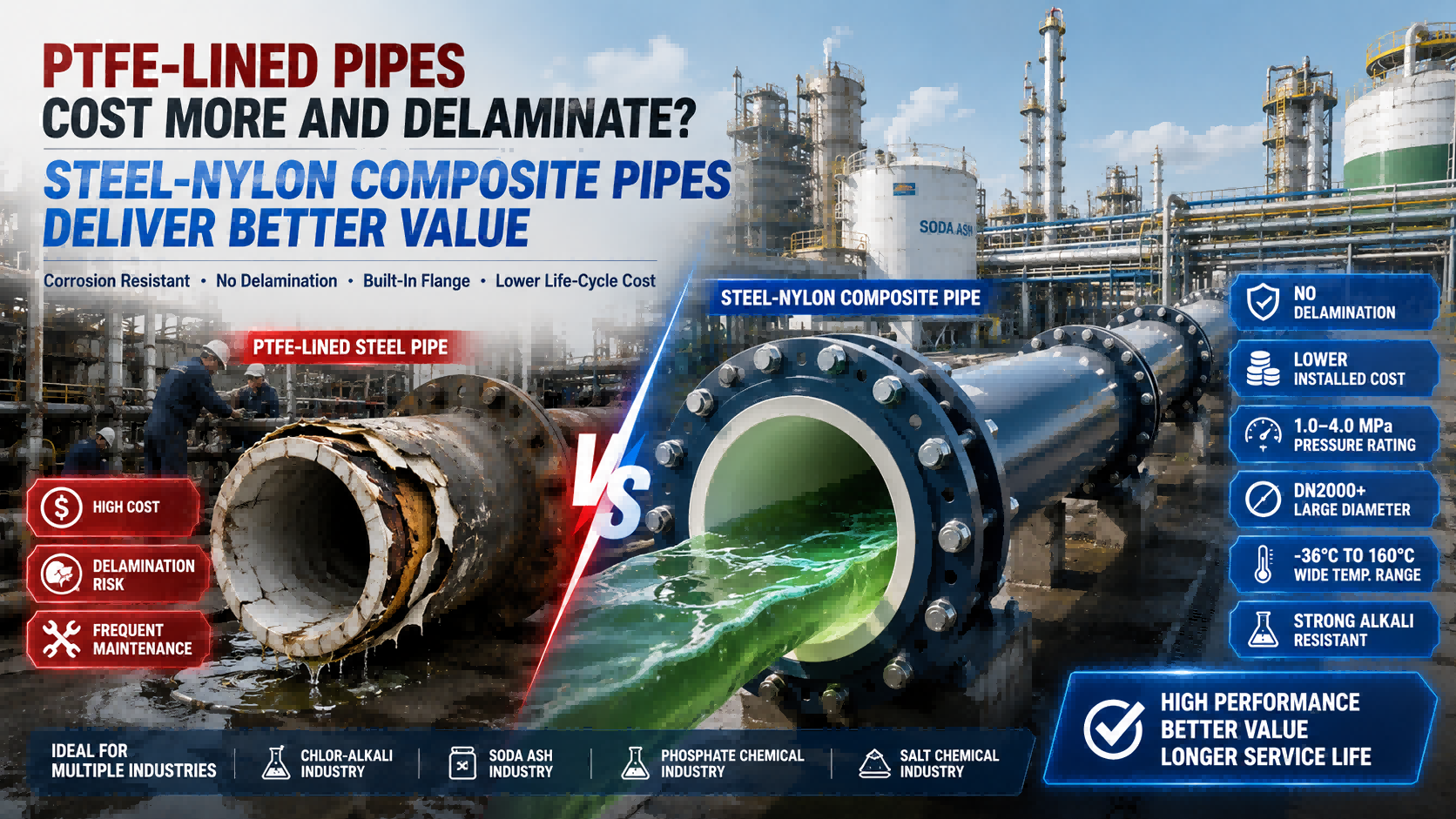
| Comparison Item | Carbon Steel Pipe | 316L Stainless Steel | Plastic/Rubber-Lined Steel | Nylon-Steel Composite Pipe |
|---|---|---|---|---|
| Chloride Corrosion Resistance | Poor, rapid perforation | Marginal use, sensitive to high temp & crevices | Liner easily damaged | Excellent, inert isolation |
| Pressure-Bearing Capacity | High | High | Limited by liner & structure | 4.0 MPa, equivalent to metal |
| Wear & Erosion Resistance | Average | Average | Thin liner, easily worn through | Nylon is self-lubricating & wear-resistant |
| Connection Reliability | Welds prone to failure | Welds prone to intergranular corrosion | Flanges or special fittings | Flange/weld connections, structural integrity |
| Full Life Cycle | Replacement within 2 years | Possible leakage in 3–5 years | Liner damage in 1–3 years | Continuous operation >10 years |
3. From "Replacement Every Two Years" to "Guaranteed for a Decade" — The In-Depth Economics & Real-World Scenarios
When we extend pipeline life from 2 years to over 10 years, the savings go far beyond just the cost of pipe materials. Take a brine transport mainline as an example: 200 meters long, pressure 3.5 MPa, originally using 20# carbon steel pipe, requiring extensive replacement every 18 months with 7 days of downtime each time. The combined losses are as follows:
Direct procurement and installation cost: approx. $22,000/time
Production loss due to downtime: $15,000/day × 7 days = $105,000
Hazardous waste disposal and environmental risk costs: variable
The total cost per replacement exceeds $127,000. Over ten years with six replacements, the cost soars to over $760,000.
Production loss due to downtime: $15,000/day × 7 days = $105,000
Hazardous waste disposal and environmental risk costs: variable
The total cost per replacement exceeds $127,000. Over ten years with six replacements, the cost soars to over $760,000.
After switching to nylon-steel composite pipe, although the initial purchase cost is about 60% higher than carbon steel pipe, there are zero replacements within ten years, with only one downtime for installation. The cumulative total cost is less than $200,000. **Multiply the lifespan several times, and the return is more than multiplied.** More importantly, it avoids environmental fines, safety accidents, and reputational damage caused by sudden leaks — these hidden costs are often far more terrifying than the numbers on the books.
In an actual case, a well-known domestic salt chemical enterprise trialed a 4.0 MPa nylon-steel composite pipe for their mine brine gathering network in 2015. After 8 years of operation, endoscopic inspection revealed that the nylon layer, formed by high-temperature low-pressure centrifugal integral casting, was still smooth as new, with zero corrosion thinning of the steel skeleton. The expected total lifespan easily exceeds 15 years. In contrast, a 316L stainless steel control pipe section installed at the same time had already shown multiple pitting leaks by the 4th year.
4. Choosing the Right Pipe Means Choosing the Right Supplier — We Deliver More Than Just Products
Not everything called "nylon-steel composite pipe" can deliver on these promises. The core differences lie in:
**The fundamental difference in bonding technology**: We insist on using **high-temperature, low-pressure centrifugal integral casting**, rather than simple internal coating or hand-pasted lining. This ensures the density, thickness uniformity, and interfacial bonding strength of the nylon liner reach optimal levels, eliminating hidden delamination risks.
**Nylon grade and modification formula**: Custom-formulated hydrolysis-resistant, high-temperature-resistant nylon tailored to the temperature and medium ensures no long-term embrittlement or water-absorption swelling.
**Authenticity of pressure ratings**: Our promised 4.0 MPa rating is based on full-scale hydrostatic burst tests and finite element fatigue analysis, with complete ASME/ISO certified test reports available.
**Supporting connection solutions**: We provide pre-formed flanged fittings, dedicated repair tools, and on-site guidance to prevent damage to the anti-corrosion layer from field processing.
**Nylon grade and modification formula**: Custom-formulated hydrolysis-resistant, high-temperature-resistant nylon tailored to the temperature and medium ensures no long-term embrittlement or water-absorption swelling.
**Authenticity of pressure ratings**: Our promised 4.0 MPa rating is based on full-scale hydrostatic burst tests and finite element fatigue analysis, with complete ASME/ISO certified test reports available.
**Supporting connection solutions**: We provide pre-formed flanged fittings, dedicated repair tools, and on-site guidance to prevent damage to the anti-corrosion layer from field processing.
As an industrial anti-corrosion composite pipe supplier focused on international trade, our nylon-steel composite pipes have been exported to numerous demanding applications, including South American lithium salt lakes, Middle Eastern seawater desalination, and Australian mine brine projects, withstanding verification across different climates and water qualities. Based on your specific salt chemical process parameters (temperature -20 °C to +90 °C, pH value, chloride ion concentration, flow rate and pressure), we can quickly match customized solutions for diameters DN50–DN600 and pressures 1.6–4.0 MPa, and provide full-process technical support from model selection and connection design to installation training.
**Let your pipes no longer be a plant-wide "consumable" and make every investment worry-free for a decade.**
The two-year scrapping curse can end today. If you would like to obtain the corrosion resistance data sheet for nylon-steel composite pipe, or request a sample for on-site coupon testing, please leave your operating parameters via the inquiry window on the right side of the website. Our engineers will contact you directly within 12 hours.
The two-year scrapping curse can end today. If you would like to obtain the corrosion resistance data sheet for nylon-steel composite pipe, or request a sample for on-site coupon testing, please leave your operating parameters via the inquiry window on the right side of the website. Our engineers will contact you directly within 12 hours.
Say goodbye to short-lived pipes, starting with a wise material decision. The 4.0 MPa nylon-steel composite pipe awaits your validation of its true long-life strength.
Mining, Power, and Desalination All Rely on It: A Complete Guide to the 5 Traffic-Driving Advantages of Nylon Specialty Composite Pipes
How to Extend the Lifespan of Urban Water Supply and Drainage Pipes by 50 Years? The Secret Lies in the Corrosion-Resistant Genes of Nylon Pipes
Related blog


SEND MESSAGE