
Internal and External Corrosion of Steel Pipes in Oilfield Produced Water Treatment: Nylon Pipes Offer Full Anti‑Corrosion Protection from Inside Out
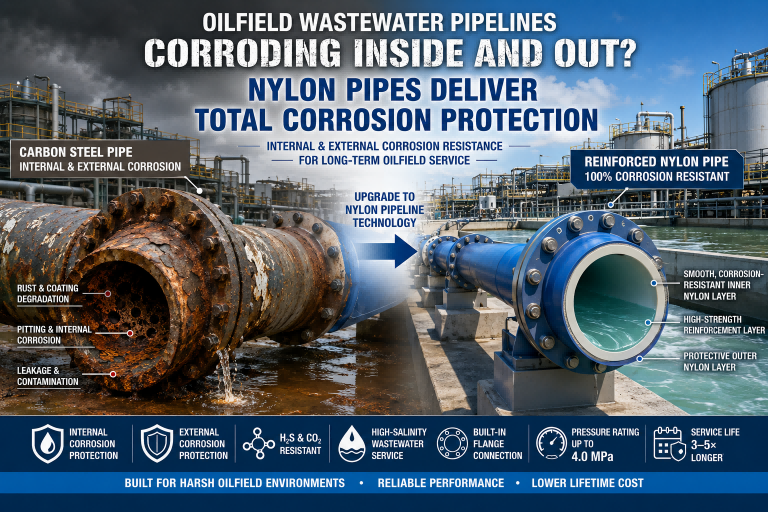
As oil and gas fields enter their mid‑to‑late development stages, water cut in produced fluids routinely exceeds 90%. This has brought the corrosion problem in oilfield produced‑water treatment systems to a tipping point. Statistics show that corrosion‑related incidents account for more than 25% of all pipeline accidents in the oil and gas sector. Perforation and leakage of water lines not only severely disrupt normal operations but also incur huge maintenance and replacement costs, along with environmental risks. In this protracted battle against corrosion, a solution that delivers full protection from the inside out – nylon pipes and nylon‑steel composite pipes – is increasingly becoming the choice of many oilfields.
**1. Oilfield Produced Water: A Perfect Storm for Pipe Corrosion**
Oilfield produced water is far from ordinary wastewater. For example, in a western oilfield, the total salinity of produced water generally exceeds 70,000 mg/L, with chloride ion concentrations above 45,000 mg/L. At the Guangli Combined Station in Shengli Oilfield, the gathering medium temperature reaches 60°C, salinity is 33,634 mg/L, chloride content is 26,079 mg/L, and pH is only 6.4. Such aggressive conditions make carbon steel pipes a veritable “breeding ground” for corrosion.
Internal corrosion of steel pipes results from the synergistic action of multiple factors. Carbon dioxide (CO₂) dissolves in water to form carbonic acid; hydrogen sulfide (H₂S) causes hydrogen‑induced cracking and sulfide stress cracking; and chloride ions (Cl⁻) act as catalysts that accelerate electrochemical reactions. Meanwhile, microorganisms such as sulfate‑reducing bacteria (SRB) thrive on the pipe inner wall, further intensifying localised pitting. The corrosion morphologies are complex and varied – uniform thinning, pitting, crevice corrosion, and stress corrosion cracking often occur together. Elevated temperatures only make matters worse.
External corrosion is equally serious. In the Bohai Bay saline‑alkali area where Shengli Oilfield is located, the soil contains large amounts of Cl⁻, Na⁺, Ca²⁺, Mg²⁺ and other saline ions that trigger strong electrochemical corrosion. Steel pipelines in such environments frequently leak due to external corrosion. In short, steel pipes in oilfield produced‑water systems suffer an “attack from both sides” – internally from high‑salinity corrosive media and externally from saline soils and stray currents.
**2. Traditional Anti‑Corrosion Measures: Each Has Its Shortcomings**
Faced with such severe corrosion challenges, oilfields have tried various anti‑corrosion solutions, but each has unavoidable weaknesses.
**Corrosion inhibitors** are currently the most commonly used measure – they are easy to apply and relatively low‑cost. However, they require continuous dosing, their effectiveness is significantly affected by temperature, pH, flow velocity and other factors, and they do nothing to address external pipe corrosion.
**Anti‑corrosion coatings** can theoretically isolate steel from corrosive media, but on‑site coating quality is difficult to control, and the welded joint areas remain vulnerable. Once a coating has pinholes or scratches, corrosive media penetrate directly, and corrosion often spreads beneath the coating without being easily detected.
**Stainless steel pipes** perform excellently, but their high cost makes them impractical for large‑scale pipeline networks.
**Fibreglass reinforced plastic (FRP) pipes** have good corrosion resistance, but they are unsuitable for high‑pressure service, have poor external pressure resistance, and are prone to damage from external forces.
**Steel‑lined PE pipes** have stringent temperature requirements – generally below 40°C to maintain good bonding between the liner and the pipe wall. Pilot tests show that when the temperature exceeds 50°C, the bonding strength of the PE liner drops markedly.
The common dilemma of these traditional methods is that they are mostly “remedial” or “partial” solutions – they cannot provide full‑lifecycle protection from the inner to the outer surface of the pipe. Conventional anti‑corrosion technologies are easily damaged by sand abrasion and erosion, creating weak points that trigger leakage. Their typical service life is often only 2–3 years, with some lasting 4–5 years at best.
**3. Nylon Pipes: Full Anti‑Corrosion from Inside Out**
The reason why nylon (polyamide, PA) materials stand out in oilfield corrosive environments lies in their molecular structure. The polar amide groups (–CONH–) on the main chain of nylon form a dense crystalline structure through hydrogen bonding. This structure endows nylon with excellent chemical stability – apart from strong oxidising acids such as concentrated nitric acid, fuming sulphuric acid and chlorosulphonic acid, nylon resists most organic and inorganic acids, alkalis and salts.
When nylon is fabricated into pipes for oilfield produced‑water systems, its anti‑corrosion advantages are comprehensive:
**Internal protection**: The smooth inner surface of nylon pipes resists scaling and paraffin deposition, fundamentally eliminating contact between corrosive media and the steel wall. CO₂, H₂S, Cl⁻ and other ions in the produced water are effectively blocked by the nylon layer, preventing electrochemical corrosion of the steel.
**External protection**: For buried pipelines, the nylon layer likewise isolates saline ions in the soil from the outer steel surface, completely cutting off the electrochemical corrosion circuit.
**Combined abrasion and corrosion resistance**: Oilfield produced water often carries sand and other solid particles that cause erosive wear. Reinforced MC nylon has a Rockwell hardness of 80–90 and excellent self‑lubricating properties, giving it far superior wear resistance to ordinary steel. In a carbonisation effluent line at Qingdao Soda Ash Plant, reinforced MC nylon pipes have been in normal operation for more than 22 years, whereas the cast‑iron elbows previously used were often worn through in less than 2 years.
**4. Nylon‑Steel Composite Pipes: The Best of Both Worlds**
While pure nylon pipes offer outstanding corrosion protection, they have limitations such as poor external pressure resistance and susceptibility to deformation. Nylon‑steel composite pipes cleverly combine the strengths of both materials – the steel pipe provides structural strength and external pressure resistance, while the nylon liner provides a full anti‑corrosion barrier.
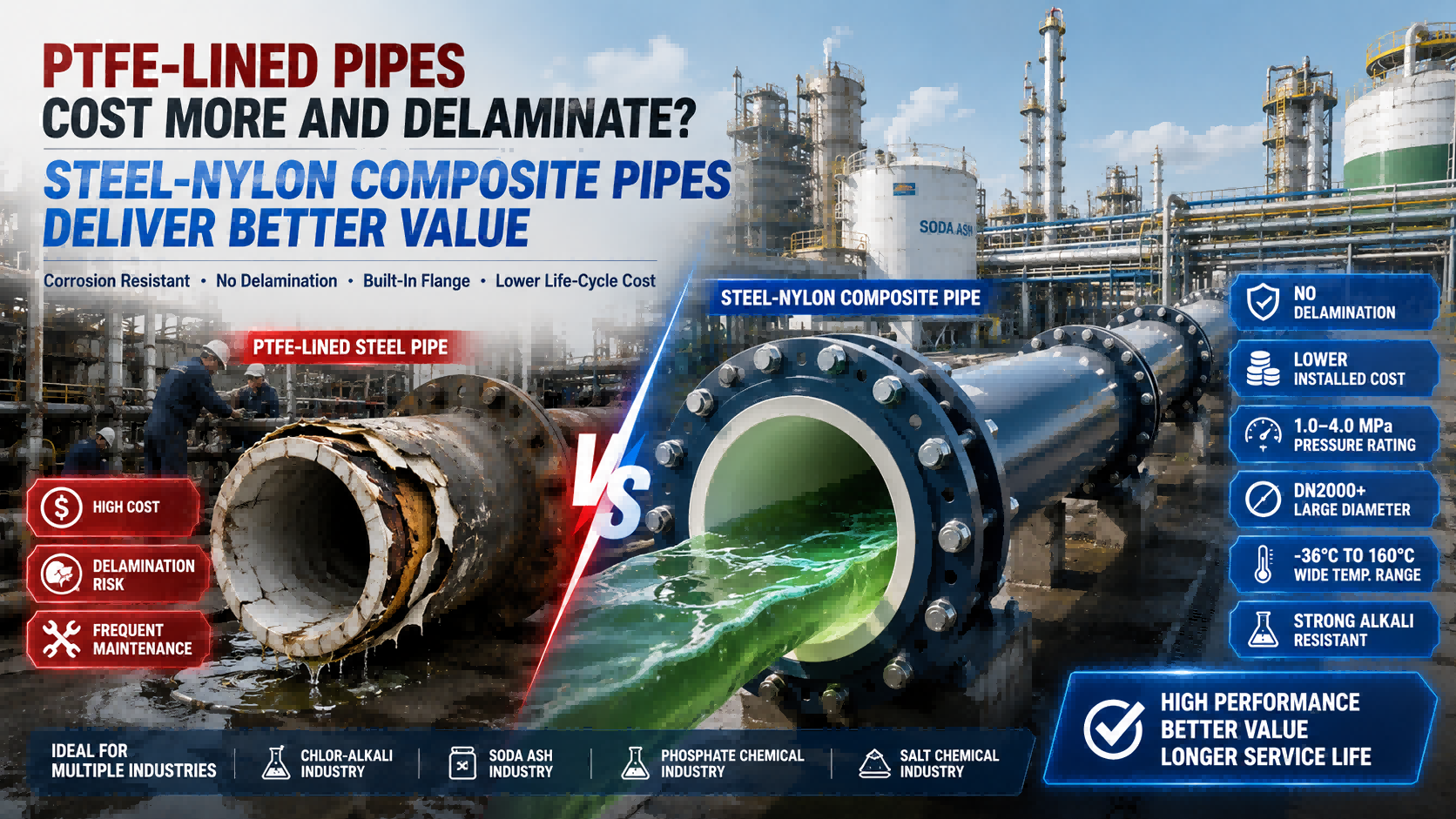
Taking PAMC (reinforced monomer casting nylon) nylon‑steel composite pipes as an example, the technology uses a centrifugal casting process in a controlled factory environment to integrally bond reinforced nylon material to the inner wall of the steel pipe, forming a single unified structure. This composite construction effectively overcomes the common problems of conventional coated pipes, such as difficult weld‑joint protection and dependence on installation quality. The pipes have a service temperature range of –36 to 160°C and cover nominal diameters from DN50 to DN2000 mm.
More importantly, nylon‑steel composite pipes achieve “inherent corrosion resistance” – corrosion protection is not a post‑coating or chemical‑dosing add‑on, but an intrinsic property of the material itself. This means that throughout their entire service life, they require no frequent maintenance, no continuous inhibitor injection, and no worry about coating disbondment.
**5. Field Evidence: Over Two Decades of Proven Performance**
Theory, however perfect, must stand the test of practice. At one of the most severely corrosive blocks in Shengli Oilfield – the Guangli Combined Station of Dongxin Production Plant – the industry established China’s first pilot test base for gathering pipeline corrosion control technology. Five types of non‑metallic pipes, including nylon composite pipes, underwent a one‑year pilot application and post‑examination evaluation. The results showed that nylon composite pipes exhibited outstanding anti‑corrosion and overall performance, and were rated as a suitable internal corrosion protection technology for oilfield gathering systems.
Even more compelling are the long‑term service data. PAMC nylon‑steel composite pipes have been installed cumulatively for over 40,000 metres in Shengli Oilfield (Sinopec), Southwest Oil & Gas Branch, and other units. The earliest installed pipes have now been in continuous operation for **23 years** with no corrosion‑related leakage.
This figure stands in stark contrast to the 2–5‑year service life of conventional steel pipes. In buried oil pipelines at Shengli Oilfield, reinforced MC nylon pipes installed in 1994 are still operating normally. In ammonia‑brine pipelines in the soda ash industry, nylon pipes have likewise demonstrated more than 20 years of service.
**6. Conclusion**
The corrosion problem in oilfield produced‑water pipelines is, at its core, a mismatch between materials and the service environment. Under harsh conditions of high temperature, high salinity and multiphase flow, traditional carbon steel pipes – no matter what coatings or inhibitors are applied – struggle to achieve long‑life, maintenance‑free safe operation.
Nylon pipes and nylon‑steel composite pipes offer a different path: rather than “fighting” corrosion, they make corrosion “impossible to occur”. From the inner wall to the outer wall, from the conveyed medium to the surrounding soil, nylon materials, with their stable chemical inertness and excellent physical properties, build an all‑round protective barrier.
More than two decades of field application have proven that this is not a laboratory ideal, but an engineering solution that has stood the test of time. For oilfield operators wrestling with pipeline corrosion, nylon pipes may well be the answer worth serious consideration.
Shutting Down for Pipeline Replacement Costing Millions? Corrosion‑Resistant Nylon Pipes Slash Maintenance Cycles from Months to Days
Carbon Steel Backfill Pipelines Wear Out Every Quarter? Reinforced Nylon Pipes Extend the Replacement Cycle to Three Years
Related blog


SEND MESSAGE