
Solving the Wear and Corrosion Challenge in Phosphorus Chemical Pipelines: How This High-Wear-Resistant Nylon-Steel Composite Pipe Saves Millions in Maintenance Costs

1. The "Invisible Strangling" of Phosphorus Chemical Pipelines
The phosphorus chemical industry is one of the heavy chemical sectors with the most demanding requirements for piping systems. From phosphate rock mining and beneficiation to phosphoric acid production, phosphate fertilizer manufacturing, and fine phosphorus chemicals, pipelines run through almost all process flows. The media transported by these pipes often involve a superposition of multiple "destructive forces."
Taking wet-process phosphoric acid production as an example, pipelines must withstand the dual attack of highly corrosive media like fluosilicic acid and phosphoric acid, combined with solid particulate matter. In the phosphoric acid production system of a certain enterprise, large-diameter pipelines (DN450 and above) transport media containing 22% fluosilicic acid, up to 52% phosphoric acid, and a solid content of 5%. Under these conditions, the inner wall of the pipe suffers simultaneously from chemical corrosion and physical scouring – academically termed "erosion-corrosion."
The damage mechanism of phosphorus chemical media on pipelines is not due to a single factor. Academic research shows that after long-term use in phosphate concentrate slurry transport, carbon precipitates along grain boundaries in the pipe, exhibiting a tendency toward embrittlement. The inner wall displays typical morphologies of pitting corrosion, general corrosion, and erosion wear. Ions such as F⁻, SO₄²⁻, and Cl⁻ in the transport medium corrode the inner wall, while liquids and solid particles continuously scour it, causing wear. In short, corrosion weakens the pipe wall, and wear removes the corrosion products, creating a vicious cycle of "corrosion-wear-re-corrosion."
In actual production, the speed of this destruction can be astonishing. During the commissioning of a grinding circuit in a beneficiation plant, the polypropylene pipe used for the underflow return of a cyclone classifier was completely worn through in about 4 hours, making continuous production impossible. Even stainless steel pipes lasted only about two days. At bends, reducers, and tees, where fluid direction and velocity change abruptly, erosion-corrosion is most severe, often making these the first failure points.
Even more challenging, many phosphorus chemical pipelines face more than just wear and corrosion. Calcium and magnesium ions, along with phosphate ions in the slurry, tend to form scale on the inner pipe wall, especially under conditions of temperature and pH changes. Hard scales, predominantly potassium fluosilicate and sodium fluosilicate, deposit rapidly. Scaling not only reduces the effective pipe diameter and increases transport energy consumption but can also trigger under-deposit corrosion – localized galvanic corrosion cells form due to oxygen concentration differences, potentially causing perforation while the pipe surface appears normal. Modern phosphorus chemical production often runs 24/7; any unplanned shutdown caused by a pipe leak or blockage results in production capacity losses far exceeding the value of the pipe itself.
Against such severe operating conditions, traditional pipe materials each have their shortcomings:
**Ordinary Carbon Steel Pipe:** Lowest cost but extremely poor corrosion resistance. It undergoes general corrosion rapidly in acidic media, with a lifespan measured in days.
**Stainless Steel Pipe (e.g., 304, 316L):** Better general corrosion resistance than carbon steel, but prone to pitting and stress corrosion cracking in acidic environments containing chloride and fluoride ions. Data shows that conventional stainless steel suffers an annual corrosion rate of 0.2 mm when transporting phosphoric acid, requiring replacement every 1-2 years. 316L may also fail due to intergranular corrosion in wet-process phosphoric acid environments.
**Ceramic-Lined Pipe:** Excellent wear resistance; the ceramic layer has a Vickers hardness of 1100-1500, with wear resistance over 20 times that of carbon steel. However, it is brittle, has poor impact resistance, and is prone to cracking under severe temperature changes or external impact, with relatively high engineering costs.
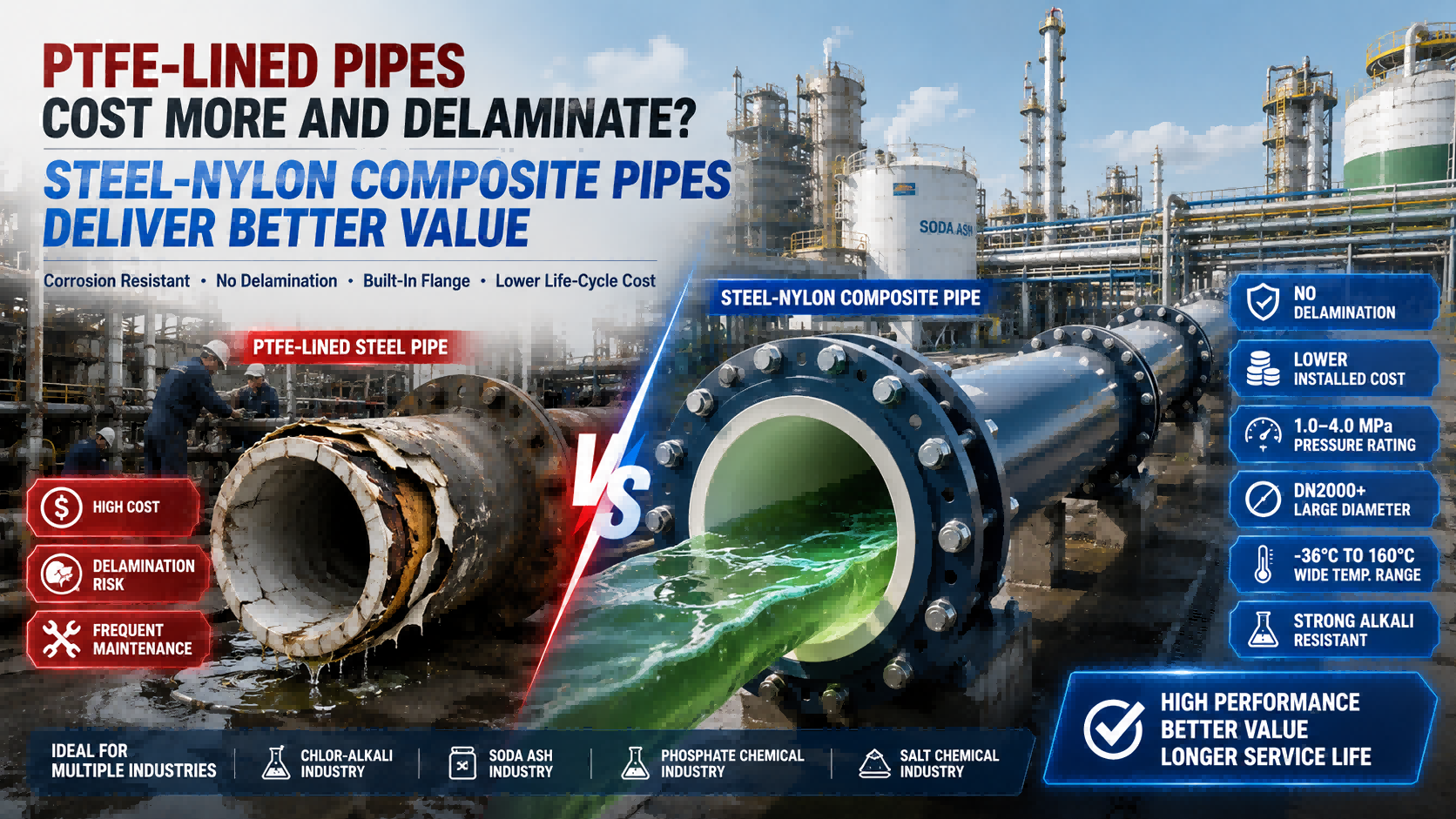
**Plastic-Lined / Rubber-Lined Pipe:** Good corrosion resistance but limited wear resistance, especially when transporting media containing high-hardness particles. The lining wears quickly, and there is a risk of lining delamination and detachment that could block the pipeline.
**Ultra-High Molecular Weight Polyethylene Pipe (UHMWPE):** Excellent wear and corrosion resistance with a very low friction coefficient, but its temperature resistance is limited (generally 80-90°C for long-term use), restricting its application in some high-temperature phosphorus chemical processes.
**Stainless Steel Pipe (e.g., 304, 316L):** Better general corrosion resistance than carbon steel, but prone to pitting and stress corrosion cracking in acidic environments containing chloride and fluoride ions. Data shows that conventional stainless steel suffers an annual corrosion rate of 0.2 mm when transporting phosphoric acid, requiring replacement every 1-2 years. 316L may also fail due to intergranular corrosion in wet-process phosphoric acid environments.
**Ceramic-Lined Pipe:** Excellent wear resistance; the ceramic layer has a Vickers hardness of 1100-1500, with wear resistance over 20 times that of carbon steel. However, it is brittle, has poor impact resistance, and is prone to cracking under severe temperature changes or external impact, with relatively high engineering costs.
**Plastic-Lined / Rubber-Lined Pipe:** Good corrosion resistance but limited wear resistance, especially when transporting media containing high-hardness particles. The lining wears quickly, and there is a risk of lining delamination and detachment that could block the pipeline.
**Ultra-High Molecular Weight Polyethylene Pipe (UHMWPE):** Excellent wear and corrosion resistance with a very low friction coefficient, but its temperature resistance is limited (generally 80-90°C for long-term use), restricting its application in some high-temperature phosphorus chemical processes.
Facing this harsh reality, the industry urgently needs a comprehensive solution that simultaneously offers **high wear resistance, high corrosion resistance, high strength, good temperature tolerance, anti-scaling properties, and reasonable economic viability**. Driven by this demand, the nylon-steel composite pipe was born.
2. A Design Concept Combining Rigidity and Flexibility
Understanding the failure mechanisms of phosphorus chemical pipelines makes it easy to grasp the underlying logic for material selection: **"Use softness to overcome hardness, combine rigidity with flexibility."**
A single material rarely meets both wear and corrosion requirements simultaneously. Metals offer high strength but poor corrosion resistance; plastics are corrosion-resistant but lack strength and wear resistance; ceramics are wear-resistant but brittle. The composite material approach "splices" the advantages of different materials, allowing each to do what it does best.
The nylon-steel composite pipe adopts exactly this layered composite strategy:
**Inner Layer (media-contacting layer) – Nylon:** Directly facing the corrosive and erosive media, responsible for wear resistance, corrosion resistance, self-lubrication, and anti-scaling.
**Outer Layer (structural pressure-bearing layer) – Steel Pipe:** Provides the mechanical strength, pressure-bearing capacity, and external impact protection required by the pipeline.
**Outer Layer (structural pressure-bearing layer) – Steel Pipe:** Provides the mechanical strength, pressure-bearing capacity, and external impact protection required by the pipeline.
This design philosophy stems from a crucial understanding: pipe failure often starts from the inner wall, while the structural safety of the pipeline depends on the outer layer. Decoupling "protection" and "load-bearing," allowing specialized layers to perform their dedicated functions, achieves a leap in overall performance.
Specifically regarding materials, nylon-steel composite pipes typically use MC nylon (Monomer Casting Nylon, also known as cast nylon) as the lining material. MC nylon is a special form of polycaprolactam (Nylon 6), formed directly inside the steel pipe through centrifugal casting polymerization, creating a uniform, dense, and smooth lining layer that integrates seamlessly with the base steel pipe. This "integrated" manufacturing method fundamentally solves the delamination and detachment problems common in traditional plastic-lined pipes.
To further enhance performance, special materials can be incorporated into the nylon matrix through nano-modification technology. Nanomaterials use their unique toughness to modify the nylon, giving it higher tensile strength and providing the lining with elastomeric properties – when solid and liquid media impact the composite layer, there is only temporary contraction, and wear is minimal; when the external force disappears, the composite layer returns to its original shape. This "using softness to overcome hardness" characteristic significantly reduces the intense scouring of the pipe wall by the medium, thereby minimizing direct wear on the inner wall.
3. Why This Pipe Material Can Solve the Wear and Corrosion Challenge
The nylon-steel composite pipe has become a preferred solution for wear and corrosion resistance in phosphorus chemical pipelines due to the following core aspects:
3.1 Outstanding Wear Resistance
MC nylon itself boasts excellent self-lubricating properties and a low friction coefficient. Its molecular structure allows it to absorb energy through elastic deformation upon particle impact, rather than being cut and worn away like metallic materials. The wear resistance of steel-skeleton-reinforced nylon pipes is 8-10 times that of carbon steel and stainless steel when transporting slurry. Other manufacturer data suggests its wear resistance is 3-4 times (conservative value) to 8 times (tested value) that of steel under equivalent conditions. With a low friction coefficient and high wear resistance, it possesses strong resistance to sliding friction, and its surface is non-stick and scale-resistant.
Crucially, nano-modified nylon linings possess elastomeric properties – upon particle impact, the inner lining surface undergoes microscopic elastic deformation, absorbing and dissipating impact energy; after impact, the surface returns to its original shape. This mechanism gives the nylon lining a much longer wear life than rigid materials when facing high-hardness quartz sand particles in phosphate ore slurry.
3.2 Excellent Chemical Corrosion Resistance
Nylon is a highly crystalline polar polymer material with stable chemical properties, resistant to various corrosive media and organic solvents, and free from electrochemical corrosion. MC Nylon 6 exhibits excellent tolerance to most alkalis, salts, as well as weak acid and weak alkali solutions. In the phosphoric acid, fluosilicic acid, and other media environments common in phosphorus chemical industry, the nylon lining effectively resists chemical attack, achieving a service life far exceeding that of stainless steel.
Simultaneously, as the outer steel pipe does not directly contact the corrosive medium, no additional anti-corrosion treatment is needed, greatly enhancing the overall pipeline's corrosion reliability.
3.3 Wide Temperature Range
Unlike some polymer material pipes, nylon-steel composite pipes have a very wide operating temperature range: the medium temperature can range from -40°C to +180°C, with a long-term use temperature of -36°C to 130°C. This allows it to adapt to low-temperature environments of northern winters (no cold brittleness at low temperatures) and meet the numerous medium and high-temperature process requirements in phosphorus chemical production. Its temperature adaptability significantly surpasses that of pure plastic pipes like UHMWPE (long-term use temperature generally limited to 80-90°C).
3.4 Excellent Anti-Scaling Capability
Scaling in phosphorus chemical pipelines is a pervasive and challenging issue. The nylon inner lining has a smooth surface with self-lubricating and non-stick properties, featuring a low friction coefficient. The smooth inner wall not only reduces fluid transport resistance (pipeline pressure loss under equivalent conditions is only 2/3 to 4/5 of metal pipes) but also significantly reduces the probability of scale adhesion, decreasing pigging maintenance work and downtime associated with scaling.
3.5 Integrated Composite Structure, Eliminating Delamination
One of the biggest risks with traditional plastic-lined pipes is the delamination and detachment of the lining layer from the steel substrate due to thermal expansion, contraction, or long-term use, ultimately leading to blockage or even safety incidents. Nylon-steel composite pipes achieve integrated formation through a centrifugal casting process: liquid MC nylon is injected into the steel pipe, evenly adheres to the inner wall under centrifugal force, and polymerizes and solidifies, forming a strong interfacial bond with the base steel pipe.
Some patented technologies further enhance interlayer bonding strength by using a metal skeleton made of threaded steel woven mesh embedded within the nylon layer. This design effectively resolves the delamination issue, ensuring reliable operation throughout the pipeline's lifecycle.
3.6 Lightweight Design Reduces Installation and Support Costs
Steel-skeleton-reinforced nylon pipes weigh only 1/7 to 1/2 of steel pipes, and their weight in water is only 1/48 to 1/3 of steel pipes. Lightweighting translates to lower transportation costs, simpler installation, and reduced expenses for supports and civil works. This advantage is particularly prominent for retrofitting existing lines in phosphorus chemical plants or in space-constrained installation scenarios.
4. More Than a Material Upgrade: Reducing Lifecycle Costs
Pipe selection should not focus solely on unit price but should be evaluated from a **lifecycle cost** perspective. Lifecycle cost encompasses initial procurement cost, installation cost, operational energy cost, maintenance and repair costs, unplanned downtime losses, and disposal costs. A seemingly expensive pipe solution on a unit basis may achieve a lower total cost of ownership by drastically reducing subsequent maintenance and downtime costs.
The cost-effectiveness of nylon-steel composite pipes is analyzed across six dimensions below:
| Cost Dimension | Problems with Traditional Solutions | Optimization by Nylon-Steel Composite Pipe |
|---|---|---|
| Initial Procurement | Ordinary steel pipes have the lowest unit price but shortest lifespan | Procurement cost is higher than ordinary steel, but the per-meter project cost is lower than that of wear-resistant alloy steel |
| Installation Cost | Steel pipes are heavy, incurring high handling and support costs | Weighing only 1/7-1/2 of steel, handling and support costs are significantly reduced |
| Operational Energy | Metal pipes have high inner wall roughness and fluid resistance | Smooth inner wall results in pipeline pressure loss only 2/3-4/5 of metal pipes |
| Maintenance & Replacement | Frequent shutdowns for replacement, each affecting production capacity | Service life greatly extended, replacement frequency drastically reduced |
| Unplanned Downtime | Production capacity loss from sudden perforation and leakage is hard to estimate | High reliability, leading to a significant decrease in sudden failure rates |
| Safety & Environment | Leakage may cause environmental pollution and safety incidents | Strong leakage prevention, lowering safety and environmental risks |
**Direct Benefit Estimation:** Referencing application cases of similar composite pipes in the industry, a phosphorus chemical group in Hubei adopted steel-lined PO pipes for transporting acid-containing media, achieving a pipe service life of 6 years and an 80% reduction in maintenance costs. A copper mine tailings transport system using high-molecular-weight wear-resistant pipes extended pipe life from 6 months to 3 years, reducing annual maintenance costs by 60%. Nylon-steel composite pipes are superior in wear and temperature resistance. If applied to phosphate rock slurry transport in the phosphorus chemical industry, a conservative estimate suggests the pipe replacement cycle could be extended from 1-3 months to over 5 years.
For a medium-sized phosphorus chemical enterprise, assuming approximately 2000 meters of critical wear and corrosion-resistant piping throughout the plant, with traditional carbon steel or stainless steel solutions, the annual replacement and maintenance costs (including labor and downtime losses) would be about 1.5-2 million RMB. By adopting nylon-steel composite pipes, the estimated annual maintenance cost could drop below 200,000 RMB, accumulating savings of 7-9 million RMB over a 5-year period. Adding the reduction in downtime losses, the actual comprehensive economic benefit of **saving millions is no exaggeration**.
**Indirect benefits are equally significant:**
**Improved Production Continuity:** Reduced unplanned downtime due to pipeline failures ensures stable production output.
**Reduced Safety Risks:** Effectively prevents chemical leakage accidents caused by corrosion perforation, lowering safety and environmental risks.
**Energy Saving & Consumption Reduction:** The smooth inner wall lowers transport energy consumption, saving considerable electricity costs over long-term operation.
**Improved Production Continuity:** Reduced unplanned downtime due to pipeline failures ensures stable production output.
**Reduced Safety Risks:** Effectively prevents chemical leakage accidents caused by corrosion perforation, lowering safety and environmental risks.
**Energy Saving & Consumption Reduction:** The smooth inner wall lowers transport energy consumption, saving considerable electricity costs over long-term operation.
5. The Technology is Good, But How to Choose a Reliable Supplier?
After understanding the technical advantages of nylon-steel composite pipes, how do you select a truly reliable product? Here are several key evaluation dimensions:
**1. Assess the Manufacturer's R&D Strength and Production Process**
The performance of nylon-steel composite pipes heavily depends on the production process. A quality manufacturer should possess independent R&D capabilities and master the integrated centrifugal casting process for MC nylon. It is advisable to check whether the manufacturer holds relevant patented technologies and has passed quality system certifications like ISO. Some leading enterprises have been independently developing and producing steel-skeleton-reinforced nylon pipes and fittings since 2006, integrating technologies like Reinforced MC nylon (RMC) and MC nylon pipe manufacturing.
**2. Verify Product Performance Parameters**
Before procurement, always request third-party testing reports from the manufacturer to verify key parameters:
Wear resistance (wear volume test data)
Temperature range (long-term use temperature and short-term tolerance temperature)
Working pressure rating
Chemical corrosion resistance data (especially for typical phosphorus chemical media like phosphoric acid and fluosilicic acid)
Interlayer bonding strength
Wear resistance (wear volume test data)
Temperature range (long-term use temperature and short-term tolerance temperature)
Working pressure rating
Chemical corrosion resistance data (especially for typical phosphorus chemical media like phosphoric acid and fluosilicic acid)
Interlayer bonding strength
**3. Understand Application Track Records and User Feedback**
A capable manufacturer should have actual application cases in the phosphorus chemical industry or similar operating conditions. Request a list of past projects and user contacts from the manufacturer, and if necessary, conduct on-site visits to observe the pipeline's performance under actual conditions. Typical phosphorus chemical applications include the transport of feed liquid and phosphogypsum slurry. If the manufacturer can provide over 3 years of operational data and prove a significant reduction in maintenance costs, that serves as the most compelling product endorsement.
**4. Pay Attention to After-Sales Service Capability**
Although wear and corrosion-resistant pipes have a long lifespan, different operating conditions require tailored pipe solutions. An excellent supplier should have the capability to provide customized solutions, including flexible adaptation of diameter, wall thickness, and connection methods (flanges, welding, quick couplings), along with professional installation guidance and after-sales technical support.
**5. Reasonably Evaluate Total Project Cost**
Don't be misled by a single price. Decisions should be made after comprehensively comparing the pipe material unit price, transportation costs, installation costs, expected service life, and maintenance costs to calculate the full lifecycle cost. Nylon-steel composite pipes, being lightweight, reduce handling and support costs. However, due to their high-temperature resistance, some manufacturers' product pricing may be 20-30% higher than standard anti-corrosion pipes. This incremental investment typically yields exceptional returns through maintenance cost savings over the long term.
6. Conclusion
The wear and corrosion challenge in phosphorus chemical pipelines stems from the "triple strangulation" of corrosive media, high solid-content particles, and high-velocity flow conditions. Traditional single-material pipes – whether metal, plastic, or ceramic – all exhibit significant performance shortcomings in some dimension. Through the design concept of "combining rigidity and flexibility," the nylon-steel composite pipe organically integrates MC nylon's wear resistance, corrosion resistance, and self-lubricating properties with the pressure-bearing structural strength of steel pipe, offering a truly comprehensive solution for the phosphorus chemical industry.
From a lifecycle cost perspective, although the initial procurement cost of nylon-steel composite pipes is higher than that of ordinary pipes, their exceptionally long service life, extremely low maintenance frequency, reduced downtime losses, and lower transport energy consumption make them a typical "high-investment, high-return" product. Driven by the dual imperatives of cost reduction, efficiency improvement, and green low-carbon transformation, choosing a wear and corrosion-resistant pipe that withstands the test of time is not only a technically correct decision but also a strategic choice for enterprise lean management and sustainable development.
If your enterprise also faces pipe wear and corrosion challenges in phosphorus chemical industry, you are welcome to discuss in the comments section or contact us for professional pipe selection advice and product technical solutions.
A Must-Read for Pipe Selection in the Soda Ash Industry: Why Non-Toxic, Weak-Acid-Resistant Nylon-Steel Composite Pipes Are the Top Safety Choice
A Powerful Tool for Pipeline Construction Efficiency: Why Nylon-Steel Composite Pipes with "Built-in Flanges + Welding-Free" Are Phasing Out Traditional Construction Methods
Related blog


SEND MESSAGE