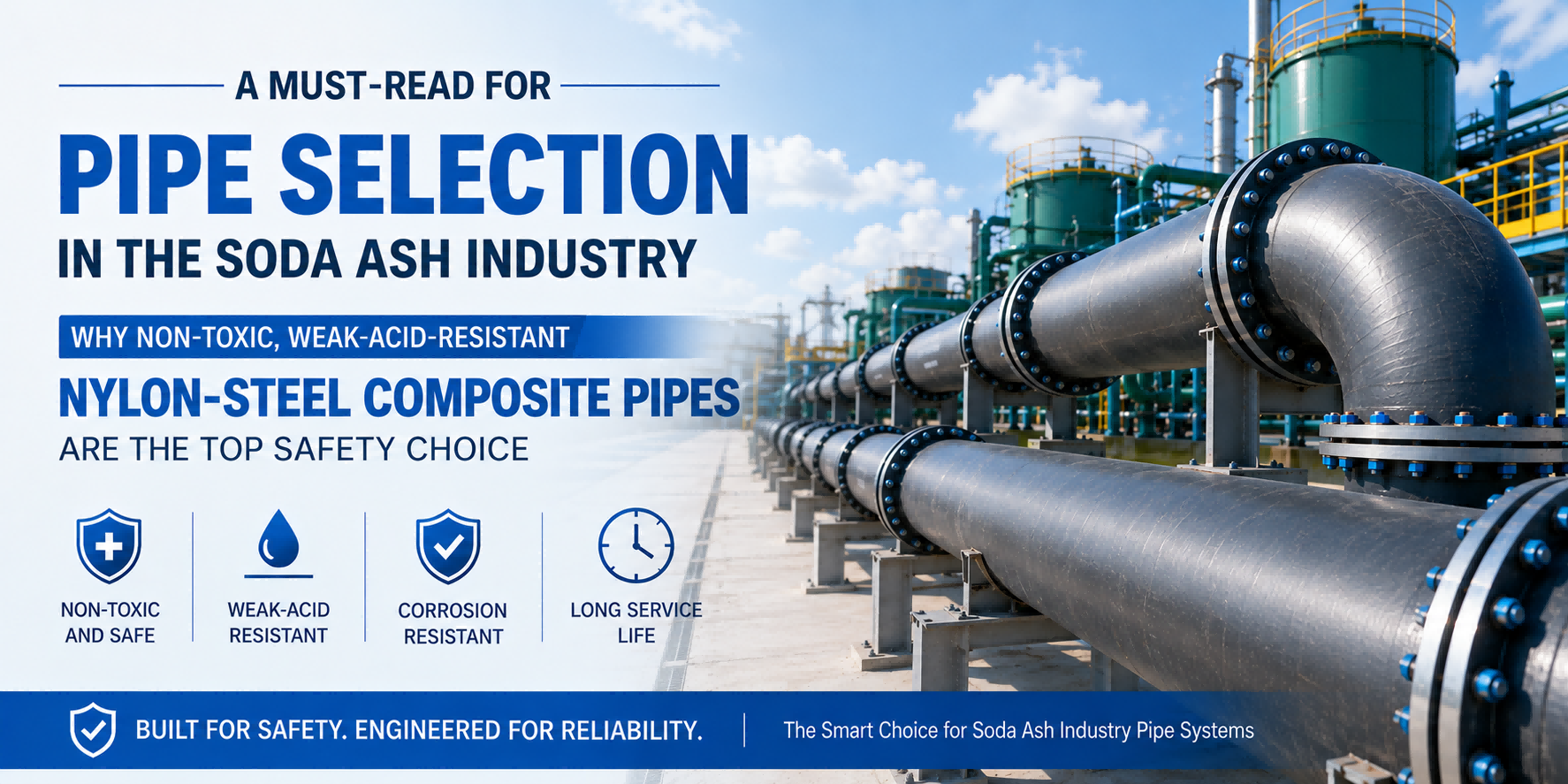
A Must-Read for Pipe Selection in the Soda Ash Industry: Why Non-Toxic, Weak-Acid-Resistant Nylon-Steel Composite Pipes Are the Top Safety Choice
In the field of soda ash production, pipe selection has always been a core issue that engineers and safety managers must handle with great care. For professional readers, the quality of piping materials directly affects product purity, production continuity, and even worker safety. In recent years, nylon-steel composite pipes, with their unique combination of **non-toxic, weak-acid-resistant, wear-resistant, and anti-corrosion** advantages, have stood out among numerous piping options. This article will delve into the technical details, safety characteristics, proven performance, and selection guidelines for this type of pipe, providing a detailed reference for international procurement and technical decision-makers.
1. Challenges Faced by Piping Systems in Soda Ash Production
1.1 The Corrosive Environment of Soda Ash Manufacturing
Soda ash (sodium carbonate) itself is a salt of a weak acid. When dissolved in water, it undergoes hydrolysis, making the solution alkaline and posing a certain corrosion risk to metal pipes. More critically, the media environment during soda ash production is far more complex than the pure soda ash solution itself—ammonium chloride mother liquor is highly corrosive, and the widespread presence of ions such as Na⁺, Cl⁻, HCO₃⁻, NH₄⁺, free ammonia, and dissolved oxygen in the process media significantly corrodes traditional metal materials like carbon steel and cast iron. This leads to high equipment failure rates and frequent occurrences of leaks and spills at the production site.
1.2 Limitations of Traditional Pipe Materials
Traditional soda ash production facilities widely use cast iron or carbon steel as the main material for equipment and piping. However, in actual operation, media containing solid particles cause multiple forms of damage to the pipes, including erosion-corrosion, electrochemical corrosion, and physical destruction. The actual service life of some pipes is less than one year. Scaling and fouling caused by corrosion not only block the pipes but can also increase the iron content in the product, directly affecting the quality of the soda ash. Taking a large soda ash enterprise as an example, just the cooling tubes of the carbonating towers alone require an annual replacement of up to 200 tons of cast iron due to corrosion, with nearly two hundred leak-stopping repairs per year.
Even stainless steel pipes, when exposed to the high-temperature ammonium chloride environment in soda ash production, are susceptible to pitting and crevice corrosion. Moreover, high-performance specialty stainless steels are difficult to procure on the market, limiting their large-scale application. These practical challenges have driven the soda ash industry to continuously explore better piping solutions.
2. Technical Characteristics of Nylon-Steel Composite Pipe
Nylon-steel composite pipe uses high-quality steel pipe as the base, lined with MC nylon 6 (polycaprolactam), a material with excellent chemical stability. Through a multi-step, precision manufacturing process, a uniform, dense, and smooth lining layer is formed and bonded integrally with the base steel pipe under centrifugal force. The pipe wall structure consists of three layers—from the inside out: a reinforced MC nylon layer, a steel pipe layer, and an outer anti-corrosion protective layer.
This "rigid-flexible" structural design retains the high strength advantages of steel while fully leveraging the excellent chemical corrosion resistance of the nylon material. It should be noted that this type of pipe complies with the industry standard HG20538-92, and the base pipe complies with the GB8163-1999 standard, ensuring product quality is based on established specifications.
3. Why Are Nylon-Steel Composite Pipes the "Top Safety Choice" for the Soda Ash Industry?
3.1 Non-Toxicity: Ensuring Soda Ash Product Purity and Food Safety
One of the most significant safety features of nylon-steel composite pipes is that they are **non-toxic and non-polluting**. MC nylon 6 itself is a highly crystalline, polar polymer material that is non-toxic, odorless, mildew-proof, and chemically stable. It is precisely this non-toxic characteristic that allows its use not only in the chemical industry but also in applications with extremely high hygiene requirements, such as beverages, food, pharmaceuticals, and tap water.
In soda ash production, the non-toxic nature of the pipe is directly related to the purity of the soda ash product. China Salt Kunshan Soda Ash Company adopted nylon pipes for mother liquor transport precisely because the stability and corrosion resistance of the nylon material effectively prevent impurities from entering the mother liquor, thereby ensuring product quality and avoiding the risk of secondary contamination caused by material leaching from the pipe.
3.2 Weak Acid Resistance: A Core Technical Advantage for Complex Chemical Media
Nylon 6 exhibits excellent tolerance to **weak acids and alkalis** and shows a considerable degree of resistance to dilute acids. Crucially, in weakly alkaline solutions containing sodium carbonate (soda ash), nylon 6 remains almost stable even under high-temperature conditions.
In the soda ash production process, pipes must alternately come into contact with alkaline solutions (refined brine, clear liquor from carbonating towers), weakly acidic media (acidified water), and ammonium chloride mother liquor, among various chemical environments. With its ability to resist a wide range of corrosive and organic media, nylon-steel composite pipes demonstrate outstanding chemical stability and are not subject to electrochemical corrosion. The smooth, non-scaling inner wall further ensures unimpeded material transport and stable product quality.
3.3 Long-Term Reliability Validated by the Industry
Moving from theoretical research to large-scale industrial application, nylon-steel composite pipes have been fully tested in practice. Guangdong Kejin Nylon Pipe Products Co., Ltd., the earliest domestic specialist enterprise to independently develop reinforced nylon products, has seen its products increasingly adopted by soda ash producers in China as replacements for cast iron and stainless steel pipes. Founded in 1984, the company has continuously deepened its focus on the reinforced MC nylon pipe sector and has now developed specialized pipe series for the soda ash, chlor-alkali, and salt chemical industries, with an annual output of up to 100,000 tons.
The results of practical validation are even more compelling: in the construction projects of several soda ash plants built since 2009, including Jiangsu Jingshen Co., Ltd., Kunshan Chemical, and Qinghai Wucai Mining, almost **all** piping, except for steam and water pipes, used reinforced MC nylon pipes or steel-lined nylon pipes. Based on the usage experience of dozens of soda ash enterprises across China, reinforced MC nylon pipes exhibit strong wear and corrosion resistance, long service life, and a significantly better cost-performance ratio than stainless steel.
Looking at specific application scenarios in soda ash production, nylon pipes have covered dozens of critical process pipeline nodes, including the calcium removal tower outlet line in the brine workshop, refined brine pipelines, circulating ammonium chloride brine pipelines in the soda ash workshop, carbonating tower connecting pipelines, clear liquor pipelines, acidified water lines in the compression workshop, and waste liquid pipelines in the purification workshop—demonstrating extremely broad application coverage.
This large-scale practice powerfully proves that the corrosion resistance, non-toxicity, and long-term stability of nylon-steel composite pipes have been widely recognized by the industry, making them the preferred pipe material for ensuring safe and efficient soda ash production.
4. From Material Selection to Installation: Full-Process Reliability
4.1 Material Science and Design: Multiple Advantages of the Composite Structure
The technical highlight of the nylon-steel composite pipe lies in its composite structural design. The inner reinforced MC nylon lining is responsible for resisting chemical attack, the external steel pipe body provides mechanical strength, supplemented by an outer anti-corrosion layer, forming a triple protection system. This structure endows the pipe with the following outstanding properties:
| Performance Dimension | Advantages |
|---|---|
| Wear Resistance | Low friction coefficient, good self-lubrication; when conveying slurry, wear resistance is 8-10 times that of carbon steel/stainless steel |
| Temperature Adaptability | Operating temperature range from -36°C to 160°C, superior to conventional non-metallic pipes |
| Compressive Strength | Steel skeleton reinforcement significantly enhances internal and external pressure bearing capacity, ensuring safe operation in high-pressure environments |
| Impact Resistance | Excellent dimensional stability and toughness, effectively withstands longitudinal stresses such as soil settlement and vehicle loads |
| Service Life | Under natural conditions, service life exceeds 50 years; the earliest installed pipes have operated continuously for 23 years without corrosion leakage |
In terms of **wear resistance**, the steel-reinforced nylon pipe's wear resistance when conveying slurry is 8-10 times that of carbon steel and stainless steel, and 6 times that of PE100, significantly extending service life. **Temperature adaptability** is equally outstanding, with a range of -36°C to 160°C, allowing stable operation in the severe cold of northern winters or high-temperature process media transport. For **compressive strength**, the steel wire skeleton reinforcement enables the pipe to withstand higher internal and external pressures, greatly enhancing safety under high-pressure conditions and effectively reducing pipe rupture accidents caused by excessive pressure. For **impact resistance**, the pipe is not only easy to transport and install but also effectively bears longitudinal loads caused by soil settlement, slippage, and surface vehicles, ensuring system reliability. In terms of **service life**, the product can last over 50 years under natural conditions; in actual industrial applications, the earliest installed pipes have been in continuous operation for 23 years without any corrosion leakage and are still in use today.
4.2 Economic Analysis: Lower Total Lifecycle Cost
From a total lifecycle cost perspective, while the initial purchase price of nylon-steel composite pipes may be slightly higher than that of ordinary steel pipes, their unit weight is only about 1/6 that of steel pipes, significantly reducing handling and support costs. The comprehensive economic benefit is more than six times that of steel pipes. More importantly, their excellent anti-corrosion and wear-resistant performance translates into less downtime for maintenance, lower replacement frequency, and more stable production operations—hidden benefits that are particularly valuable for soda ash enterprises focused on production continuity.
4.3 Key Points for Pipeline Design, Connection, and Installation
Nylon-steel composite pipes are provided with standard protection before leaving the factory, and packaging can also be customized according to user requirements to meet transportation and product safety needs. During installation, handle with care to ensure the flange and lining layer are not damaged; avoid strong collisions and striking the sealing surfaces. A rubber gasket should be added between the two flange connections, and when bolting, **tighten symmetrically with balanced force**. Connection methods are flexible, with flange connections or quick couplings available to adapt to different site conditions and pipeline layout needs.
4.4 Quality Control and Standards Compliance System
Nylon-steel composite pipes comply with the HG20538-92 steel-plastic composite pipe standard, and the base pipe complies with GB8163-1999, providing a unified industry specification for product parameters. Based on actual bidding requirements, mainstream manufacturers must possess independent legal entity status, valid ISO9001 quality system certification, and must have supply performance records in at least two domestic chemical or similar plants with over one year of operation and no quality issues. These entry barriers guarantee the reliability of product quality from the source.
5. Summary and Action Guide
Against the backdrop of the soda ash industry's pursuit of high-quality and high-safety standards, nylon-steel composite pipes, with their outstanding characteristics of being **non-toxic, weak-acid-resistant, wear-resistant, and anti-corrosion**, along with their proven reliability validated by extensive industrial practice, have gradually become one of the core solutions for industry pipe selection. They not only safeguard the quality and safety of soda ash products but also effectively reduce the total lifecycle cost of pipelines, providing a solid infrastructure foundation for long-term, stable enterprise operations.
For international procurement decision-makers and technical engineers, the following dimensions can be considered when selecting pipes for soda ash projects:
1. **Verify Credentials and Track Record**: Confirm that the manufacturer holds ISO9001 quality system certification and has a mature supply track record in soda ash or similar chemical plants.
2. **Clarify Technical Parameters**: Select the appropriate standard specifications based on the project's specific media composition, temperature range (typically -36°C to 160°C), and pressure rating (e.g., PN10), ensuring precise matching of pipe parameters with actual operating conditions.
3. **Pay Attention to Supporting Fittings**: The elbows, tees, reducers, and other supporting fittings for nylon-steel composite pipes are equally important; ensure material consistency across the entire piping system.
4. **Standardize Installation and Maintenance**: Strictly follow installation procedures, tighten flange bolts symmetrically and evenly, avoid damaging the inner lining, and ensure the long-term safe operation of the piping system.
5. **Conduct a Comprehensive Cost Assessment**: Do not focus solely on the purchase unit price. It is recommended to conduct a comprehensive evaluation from the perspective of total lifecycle cost, incorporating installation convenience, long-term maintenance costs, and production continuity benefits into the decision-making framework.
If you are seeking professional advice on pipe selection for soda ash or related chemical projects, **feel free to contact our technical team**. We will provide more targeted selection solutions and technical support based on your specific operating conditions, helping your project advance safely and efficiently.
Built-In Flange, Integrally Formed – Installation Twice as Fast: How Nylon Pipes Are Redefining Construction Efficiency for Chemical Pipelines
Solving the Wear and Corrosion Challenge in Phosphorus Chemical Pipelines: How This High-Wear-Resistant Nylon-Steel Composite Pipe Saves Millions in Maintenance Costs
Related blog