The Ultimate Guide to Oil & Gas Pipeline Selection: How to Meet High Pressure, Corrosion Resistance, and Low Temperature Simultaneously
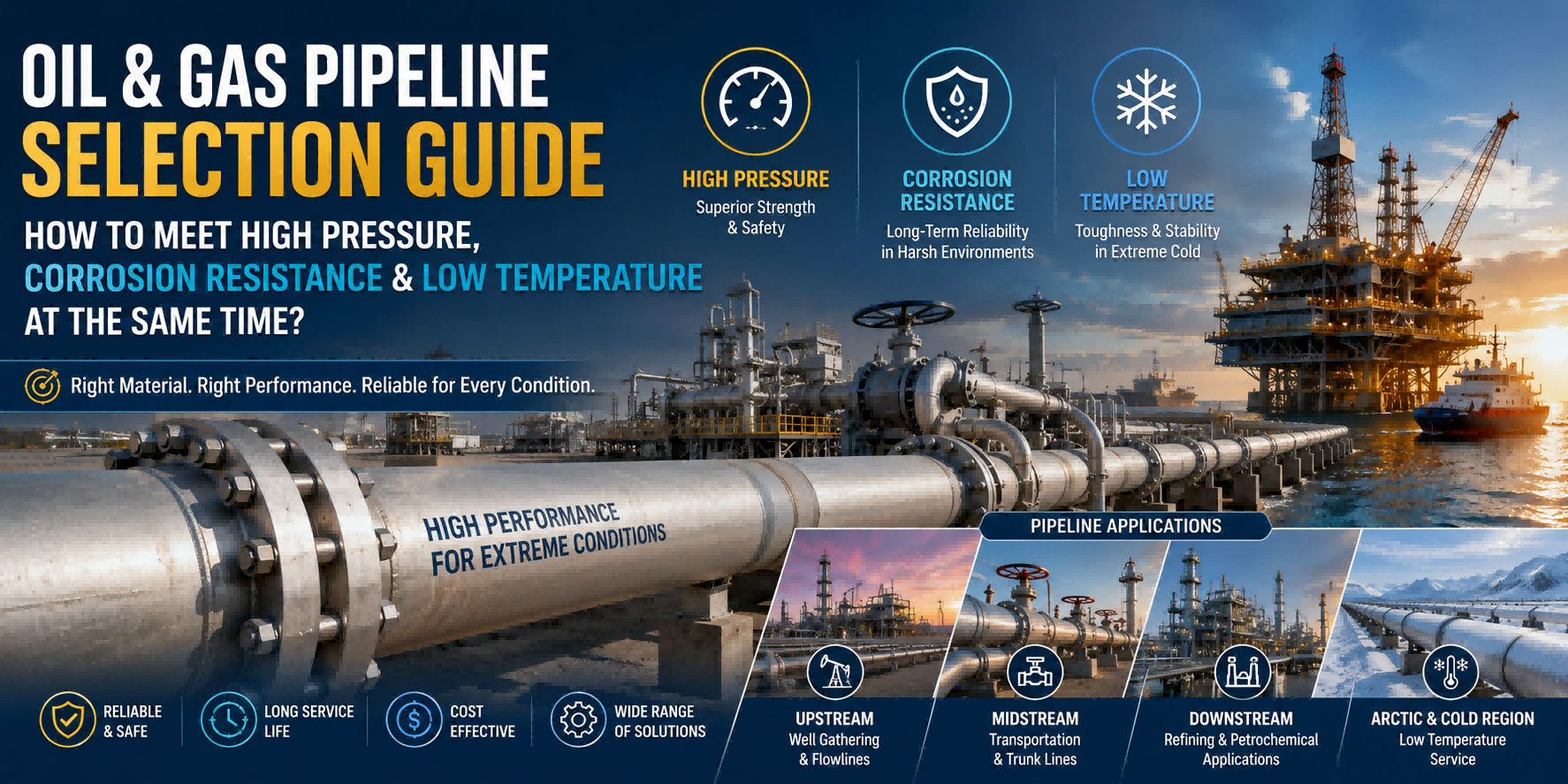
As oil and gas development pushes deeper into hostile formations, unconventional resources, and arctic frontiers, gathering and transmission networks now face unprecedented overlapping demands—wellhead pressures of tens of MPa, highly corrosive media loaded with H₂S, CO₂, chlorides, and bacteria, all while ambient temperatures may plummet to -36°C. The ability of a single pipe to withstand the triple threat of **high pressure, severe corrosion, and extreme cold** has become the decisive factor in project lifecycle cost and operational safety. As a manufacturer specializing in steel-nylon composite pipes, we present this guide to dissect the nature of this combined challenge from the perspective of engineering materials science, and to offer a truly rigorous selection logic. For our products, the nylon liner is primarily a **modified PA6** (polyamide 6), engineered to deliver a balance of properties that breaks the “impossible triangle”.
1. The Essence of the Triple Challenge: More Than a Simple Sum of Parameters
The three requirements of pressure, corrosion resistance, and low temperature do not merely coexist; they interact in ways that dramatically accelerate degradation.
**High Pressure**: This is not just about hydrostatic test values. It includes frequent pressure fluctuations, vibration from wellhead chokes, and high-velocity gas erosion. A pipe’s pressure capacity depends on yield strength and wall thickness. A purely thick-walled steel pipe can handle pressure, but it becomes excessively heavy, complicates welding, and offers no solution to internal corrosion.
**Corrosion**: In sour and CO₂-rich fields, the degradation picture is complex—sulfide stress cracking (SSC) and hydrogen-induced cracking (HIC) from H₂S, mesa-type localized attack from CO₂, pitting and crevice corrosion from high-salinity produced water, and under-deposit corrosion caused by bacteria. Using a monolithic corrosion-resistant alloy sends costs skyrocketing; relying on carbon steel with continuous inhibitor injection introduces a lifetime of operational complexity and often fails at low temperatures.
**Low Temperature**: Whether from freezing ambient conditions or from the Joule-Thomson cooling effect during high-pressure gas throttling, the material must possess excellent low-temperature toughness. Ordinary carbon steel has a ductile-to-brittle transition temperature; its Charpy impact energy plummets in the cold, dramatically raising the risk of catastrophic brittle fracture. Many polymeric materials also become stiff and lose their flexibility when cold, leading to liner cracking or disbondment.
**Corrosion**: In sour and CO₂-rich fields, the degradation picture is complex—sulfide stress cracking (SSC) and hydrogen-induced cracking (HIC) from H₂S, mesa-type localized attack from CO₂, pitting and crevice corrosion from high-salinity produced water, and under-deposit corrosion caused by bacteria. Using a monolithic corrosion-resistant alloy sends costs skyrocketing; relying on carbon steel with continuous inhibitor injection introduces a lifetime of operational complexity and often fails at low temperatures.
**Low Temperature**: Whether from freezing ambient conditions or from the Joule-Thomson cooling effect during high-pressure gas throttling, the material must possess excellent low-temperature toughness. Ordinary carbon steel has a ductile-to-brittle transition temperature; its Charpy impact energy plummets in the cold, dramatically raising the risk of catastrophic brittle fracture. Many polymeric materials also become stiff and lose their flexibility when cold, leading to liner cracking or disbondment.
When these three factors overlap, traditional selection falls into an “impossible triangle”: metals can bear the pressure but succumb to corrosion or low-temperature embrittlement; high-performance plastics resist corrosion and remain tough but lack the structural strength to withstand extreme pressure; bimetallic composite pipes offer a compromise but at exorbitant cost and with complex welding procedures that often introduce corrosion at the weld. The steel-nylon composite pipe, with a modified PA6 liner, is the engineered solution that resolves this deadlock.
2. The Shortcomings of Conventional Solutions: Why “Making Do” Is No Longer Viable
**Carbon Steel + Corrosion Inhibitor + Heat Tracing**: Low initial investment, but lifecycle expenses for inhibitor injection, monitoring, and failure remediation are crippling. At low temperatures, inhibitor atomization and film-forming ability deteriorate, while heat tracing consumes vast amounts of energy—and any failure immediately exposes the pipe to both ice plugging and cold embrittlement.
**Stainless Steel or Duplex Stainless Steel**: They can balance strength with some corrosion resistance, yet they face stress corrosion cracking thresholds in high-H₂S/CO₂ and high-Cl⁻ environments. Strict ferrite content control at low temperatures makes material and welding costs exceptionally high.
**Nickel-Alloy Bimetallic Composite Pipe**: Mechanically or metallurgically bonded liners of Alloy 825 or 625 provide excellent corrosion and low-temperature performance, but procurement costs are enormous, lead times are long, and field welding demands sophisticated procedures and weld overlay—unaffordable for most marginal fields.
**Pure Non-Metallic Pipe (RTP/FRP)**: Flexible reinforced thermoplastic pipe and fiberglass pipe struggle with joint sealing at low temperatures, resistance to external pressure, and aging. Their pressure and diameter ranges are limited, making them difficult substitutes for steel in high-pressure gathering trunk lines.
**Stainless Steel or Duplex Stainless Steel**: They can balance strength with some corrosion resistance, yet they face stress corrosion cracking thresholds in high-H₂S/CO₂ and high-Cl⁻ environments. Strict ferrite content control at low temperatures makes material and welding costs exceptionally high.
**Nickel-Alloy Bimetallic Composite Pipe**: Mechanically or metallurgically bonded liners of Alloy 825 or 625 provide excellent corrosion and low-temperature performance, but procurement costs are enormous, lead times are long, and field welding demands sophisticated procedures and weld overlay—unaffordable for most marginal fields.
**Pure Non-Metallic Pipe (RTP/FRP)**: Flexible reinforced thermoplastic pipe and fiberglass pipe struggle with joint sealing at low temperatures, resistance to external pressure, and aging. Their pressure and diameter ranges are limited, making them difficult substitutes for steel in high-pressure gathering trunk lines.
These traditional materials are not “impossible” to use, but they represent a severe imbalance between reliability and economics. The industry needs a structure that perfectly exploits the strength of steel while giving it an “internal armor” of corrosion resistance and low-temperature toughness.
3. Steel–Modified PA6 Composite Pipe: The Engineering Wisdom That Unpicks the “Impossible Triangle”
The structural concept is straightforward: an outer high-strength steel pipe bears all the hoop and axial stresses, while the inner wall is closely bonded with a layer of specially modified nylon—primarily **modified PA6**—acting as a functional liner. Dedicated flared ends or sealing joints ensure that no bare metal is exposed at the flanges. What makes this simple concept work is a breakthrough in material interface science and PA6 modification technology.
3.1 High Pressure – Let Steel Do What Steel Does Best
The steel carrier selection and wall thickness fully comply with ASME B31.8/B31.4 or GB 50251. Pressure ratings easily cover CL150 to CL2500 (PN20 to PN420). Our steel–nylon composite pipes use carbon steel or low-alloy steel grades such as L245, L360, or L415; with conventional wall thickness design, they can easily satisfy gathering demands of 25 MPa, 35 MPa, or even higher. The stress on the steel is not transferred to the modified PA6 liner, eliminating failure modes like creep or burst of the internal layer. This reduces the high-pressure problem entirely to mature steel strength design—a zero-risk proposition.
The steel carrier selection and wall thickness fully comply with ASME B31.8/B31.4 or GB 50251. Pressure ratings easily cover CL150 to CL2500 (PN20 to PN420). Our steel–nylon composite pipes use carbon steel or low-alloy steel grades such as L245, L360, or L415; with conventional wall thickness design, they can easily satisfy gathering demands of 25 MPa, 35 MPa, or even higher. The stress on the steel is not transferred to the modified PA6 liner, eliminating failure modes like creep or burst of the internal layer. This reduces the high-pressure problem entirely to mature steel strength design—a zero-risk proposition.
3.2 Anti-Corrosion – The Absolute Barrier of a Modified PA6 Liner
Modified PA6 is a semi-crystalline engineering thermoplastic with outstanding chemical inertness, especially after targeted formulation enhancements:
**Resistance to H₂S, CO₂, and brine**: In environments with up to 30% H₂S, saturated CO₂, and chloride concentrations of up to 200,000 ppm, the liner’s weight gain and mechanical property retention exceed 95%. It presents almost no electrochemical corrosion or hydrogen permeation risk. The liner, typically 2–4 mm thick, forms a continuous, seamless insulating layer, completely eliminating SSC, HIC, and pitting.
**No scaling, no wax deposition**: The surface energy of modified PA6 is extremely low and its friction coefficient is small, making it very difficult for calcium/magnesium scales, paraffin, and asphaltenes to adhere. Field data show a reduction in pigging frequency of over 70% under identical conditions.
**Eliminating bacterial and under-deposit corrosion**: The smooth internal surface removes the microscopic recesses where sulfate-reducing bacteria (SRB) colonize, eradicating microbiologically influenced corrosion at the source.
Modified PA6 is a semi-crystalline engineering thermoplastic with outstanding chemical inertness, especially after targeted formulation enhancements:
**Resistance to H₂S, CO₂, and brine**: In environments with up to 30% H₂S, saturated CO₂, and chloride concentrations of up to 200,000 ppm, the liner’s weight gain and mechanical property retention exceed 95%. It presents almost no electrochemical corrosion or hydrogen permeation risk. The liner, typically 2–4 mm thick, forms a continuous, seamless insulating layer, completely eliminating SSC, HIC, and pitting.
**No scaling, no wax deposition**: The surface energy of modified PA6 is extremely low and its friction coefficient is small, making it very difficult for calcium/magnesium scales, paraffin, and asphaltenes to adhere. Field data show a reduction in pigging frequency of over 70% under identical conditions.
**Eliminating bacterial and under-deposit corrosion**: The smooth internal surface removes the microscopic recesses where sulfate-reducing bacteria (SRB) colonize, eradicating microbiologically influenced corrosion at the source.
This means the pipeline interior requires no continuous inhibitor injection and no intensive inline inspection for internal defects—achieving genuinely “maintenance-free” corrosion protection.
3.3 Low Temperature – The Exceptional Toughness of Modified PA6
Through advanced elastomer-toughening technology, our modified PA6 achieves a low-temperature performance that was once only associated with specialty long-chain nylons. While standard PA6 becomes brittle below 0°C, the modified grade displays a ductile-brittle transition temperature well below -45°C. At -45°C, it can still maintain an elongation at break exceeding 100%, and its Charpy impact strength remains extraordinarily high. This delivers two decisive advantages:
**No cold cracking**: During start-up, transport, or ground movement in freezing environments, the liner retains its integrity without micro-cracks, ensuring a continuous corrosion barrier.
**Tolerates Joule-Thomson cooling**: When high-pressure gas throttling causes local internal wall temperatures to drop to -30°C or below, the modified PA6 liner remains ductile, resisting shrinkage, delamination, or cracking. The composite pipe’s low-temperature limit then depends solely on the steel outer pipe’s transition temperature; by selecting normalized fine-grain steel or low-temperature carbon steel, the entire assembly can be rated for service down to -60°C.
Through advanced elastomer-toughening technology, our modified PA6 achieves a low-temperature performance that was once only associated with specialty long-chain nylons. While standard PA6 becomes brittle below 0°C, the modified grade displays a ductile-brittle transition temperature well below -45°C. At -45°C, it can still maintain an elongation at break exceeding 100%, and its Charpy impact strength remains extraordinarily high. This delivers two decisive advantages:
**No cold cracking**: During start-up, transport, or ground movement in freezing environments, the liner retains its integrity without micro-cracks, ensuring a continuous corrosion barrier.
**Tolerates Joule-Thomson cooling**: When high-pressure gas throttling causes local internal wall temperatures to drop to -30°C or below, the modified PA6 liner remains ductile, resisting shrinkage, delamination, or cracking. The composite pipe’s low-temperature limit then depends solely on the steel outer pipe’s transition temperature; by selecting normalized fine-grain steel or low-temperature carbon steel, the entire assembly can be rated for service down to -60°C.
3.4 Interfacial Fusion – Eliminating Liner Collapse and Blistering
The bond between steel and modified PA6 is not a simple mechanical sleeve. We employ a high-temperature hot-melt adhesion and nano-anchoring technology that creates a micro-scale anchoring structure on the steel’s inner surface, achieving a near-molecular-level bond with the PA6 liner. The shear strength exceeds 15 MPa, enabling the liner to withstand the severe negative pressure generated by rapid gas depressurization, completely preventing collapse, blistering, or pull-out. This process has passed permeability and adhesion tests aligned with API 15S, and the interface remains robust even under thermal cycling shock.
The bond between steel and modified PA6 is not a simple mechanical sleeve. We employ a high-temperature hot-melt adhesion and nano-anchoring technology that creates a micro-scale anchoring structure on the steel’s inner surface, achieving a near-molecular-level bond with the PA6 liner. The shear strength exceeds 15 MPa, enabling the liner to withstand the severe negative pressure generated by rapid gas depressurization, completely preventing collapse, blistering, or pull-out. This process has passed permeability and adhesion tests aligned with API 15S, and the interface remains robust even under thermal cycling shock.
4. Practical Selection Guide: Three Steps to Lock in Your Steel-PA6 Composite Pipe Specification
As an engineer or procurement decision-maker, you can complete the selection by following these steps:
**Step 1 – Define the Pressure and Temperature Envelope**
Using the wellhead shut-in pressure and operating pressure, determine the design pressure and steel wall thickness class (e.g., PN100, PN150, PN250). Also record the minimum ambient temperature, the minimum media temperature, and the maximum operating temperature. The modified PA6 liner typically has a long-term service temperature range of -45°C to +80°C; if an instantaneous high temperature does not exceed 90°C, it can be accommodated through formulation adjustments.
Using the wellhead shut-in pressure and operating pressure, determine the design pressure and steel wall thickness class (e.g., PN100, PN150, PN250). Also record the minimum ambient temperature, the minimum media temperature, and the maximum operating temperature. The modified PA6 liner typically has a long-term service temperature range of -45°C to +80°C; if an instantaneous high temperature does not exceed 90°C, it can be accommodated through formulation adjustments.
**Step 2 – Characterize the Corrosive Constituents**
Provide the H₂S partial pressure, CO₂ partial pressure, chloride concentration, pH, and bacterial load. The modified PA6 corrosion barrier is practically immune to these parameters (almost universally applicable), but the data informs the selection of external components. Based on these values, we will recommend the steel grade and the anti-corrosion approach for sealing faces and external fittings.
Provide the H₂S partial pressure, CO₂ partial pressure, chloride concentration, pH, and bacterial load. The modified PA6 corrosion barrier is practically immune to these parameters (almost universally applicable), but the data informs the selection of external components. Based on these values, we will recommend the steel grade and the anti-corrosion approach for sealing faces and external fittings.
**Step 3 – Determine Diameter and Connection Type**
We can manufacture sizes from DN25 to DN600. The recommended connection method is raised-face (RF) or ring-type joint (RTJ) flanges, with the liner flared over the flange sealing face to create a “pure modified-PA6 sealing line”. For special requirements, we can supply weld-end connections using prefabricated steel–PA6 composite pup pieces with an internal weld overlay transition. After selection, we provide a full data sheet and a statement of applicability compliant with ISO 15156 / NACE MR0175.
We can manufacture sizes from DN25 to DN600. The recommended connection method is raised-face (RF) or ring-type joint (RTJ) flanges, with the liner flared over the flange sealing face to create a “pure modified-PA6 sealing line”. For special requirements, we can supply weld-end connections using prefabricated steel–PA6 composite pup pieces with an internal weld overlay transition. After selection, we provide a full data sheet and a statement of applicability compliant with ISO 15156 / NACE MR0175.
5. Field-Proven Performance: Feedback from Severe Service
**Northeastern Sichuan High-Sour Gas Field Trunkline**: Media with 8–14% H₂S, 6–10% CO₂, design pressure 16 MPa, minimum ambient temperature -20°C. L360 steel–modified PA6 composite pipe operated for 5 years with no internal corrosion, no scaling, and pigging only required to remove condensed liquids. The adjacent carbon steel pipeline exhibited a corrosion rate of 0.12 mm/year.
**Qinghai Oilfield Water Injection Network**: Produced water salinity of 180,000 mg/L, heavily laden with SRB. After replacing FRP with steel–PA6 composite pipe, joint leakage and cold-weather fracture were completely eliminated, and the first-time hydrotest pass rate reached 100%.
**Daqing Oilfield CO₂ EOR Pilot**: Pure CO₂ injection at 25 MPa, with media temperature cycling between -30°C and 40°C. Traditional carbon steel suffered severe low-temperature carbonic acid corrosion. The steel–PA6 composite pipe remained inert across the full temperature range and has been in stable injection service for over three years.
**Qinghai Oilfield Water Injection Network**: Produced water salinity of 180,000 mg/L, heavily laden with SRB. After replacing FRP with steel–PA6 composite pipe, joint leakage and cold-weather fracture were completely eliminated, and the first-time hydrotest pass rate reached 100%.
**Daqing Oilfield CO₂ EOR Pilot**: Pure CO₂ injection at 25 MPa, with media temperature cycling between -30°C and 40°C. Traditional carbon steel suffered severe low-temperature carbonic acid corrosion. The steel–PA6 composite pipe remained inert across the full temperature range and has been in stable injection service for over three years.
6. Lifecycle Economics: Putting Investment Where It Counts
On the surface, a steel–modified PA6 composite pipe costs 1.5 to 2 times as much as bare carbon steel upfront. But the return is crystal clear:
**Installation savings**: No internal coating, no pickling or passivation, no special welding procedures for flange connections—installation speed increases by more than 40%.
**Operating costs approach zero**: No continuous injection of inhibitor or biocide, no need for CP current to protect the internal surface, and no frequent inline inspection (ILI) runs.
**Lifespan cost distribution**: The design life can exceed 30 years, during which unplanned shutdowns from internal corrosion are virtually nonexistent.
Compared with nickel-alloy bimetallic composite pipe, the steel–PA6 solution saves 40–55% in material costs and dramatically shortens delivery lead times.
**Installation savings**: No internal coating, no pickling or passivation, no special welding procedures for flange connections—installation speed increases by more than 40%.
**Operating costs approach zero**: No continuous injection of inhibitor or biocide, no need for CP current to protect the internal surface, and no frequent inline inspection (ILI) runs.
**Lifespan cost distribution**: The design life can exceed 30 years, during which unplanned shutdowns from internal corrosion are virtually nonexistent.
Compared with nickel-alloy bimetallic composite pipe, the steel–PA6 solution saves 40–55% in material costs and dramatically shortens delivery lead times.
Faced with the triple demand for high pressure, corrosion resistance, and low-temperature resilience, pipe selection is ultimately a test of how deeply one understands materials science. A steel–modified PA6 composite pipe does not simply stack two materials together—it uses structure to assign strength and pressure resistance to steel, while assigning chemical inertness and low-temperature toughness to modified PA6, and then eliminates separation risk through reliable interfacial fusion. For the first time, it genuinely allows oil and gas pipelines to escape the dilemma of “either expensive or dangerous.”
If you are seeking a pipeline solution for a specific gathering, transportation, or water injection project, we welcome an in-depth discussion tailored to your operating conditions. Beyond the data sheet, we are ready to provide selection support backed by laboratory test data and a decade of field verification.
For Caustic Soda Transport in the Chlor-Alkali Industry: Which Pipe Combines Corrosion Resistance and Real Cost Savings?
Full Coverage for Weak Acids, Strong Alkalis, and Salt Media: A New Solution for Industrial Anti-Corrosion Piping
Related blog