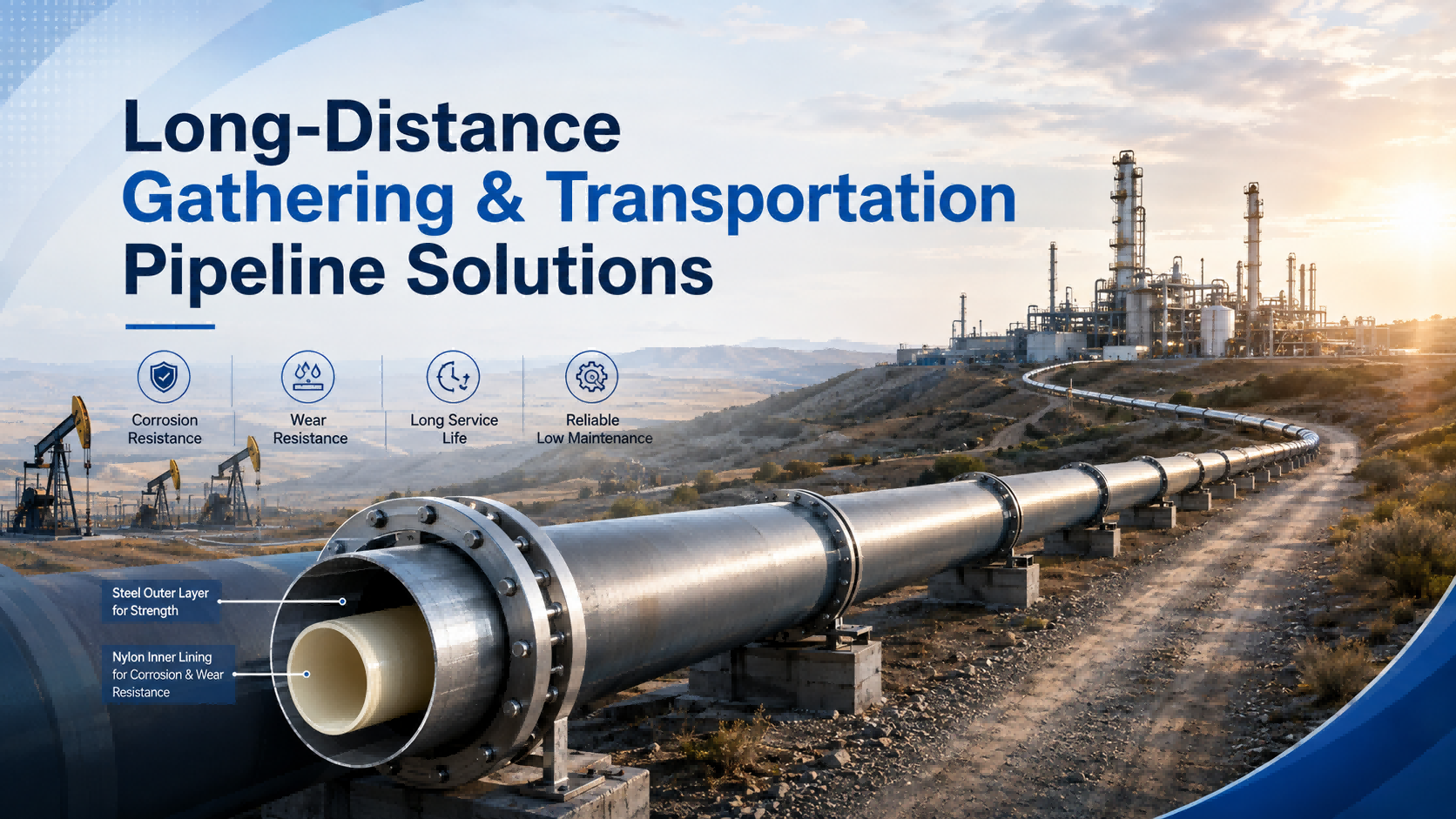
Oilfield Pipeline Corrosion Analysis: From Failure Mechanisms to Steel-Nylon Composite Pipe Solutions

Compared with ordinary industrial pipelines, however, oilfield pipelines operate under much more complex conditions.
High water cut, high salinity, CO₂, H₂S, chloride ions, sand, temperature fluctuations, pressure variations, and multiphase flow may all exist within the same pipeline system. As a result, corrosion is rarely caused by a single factor. Instead, it is often the combined result of chemical corrosion, electrochemical corrosion, erosion, abrasion, and microbiologically influenced corrosion.
For conventional carbon steel pipelines, these problems may eventually lead to:
-
Continuous wall-thickness loss
-
Localized pitting
-
Groove corrosion
-
Failure at welds and joints
-
Rapid wear at elbows and other high-velocity areas
-
Perforation and leakage
-
Unplanned shutdowns
-
Frequent repair and replacement
Therefore, the question that oilfield operators should ask is no longer simply:
“How can we reduce the corrosion rate?”
A more important question is:
“How can we reduce corrosion, wear, and long-term failure risks through the pipeline material system itself?”
This is precisely why Steel-Nylon Composite Pipe is increasingly worth considering for demanding oilfield transportation systems.
1. Why Are Oilfield Pipelines Particularly Susceptible to Corrosion?
When evaluating the corrosion risk of an oilfield pipeline, it is not enough to simply ask whether the pipeline carries crude oil or natural gas.
The real question is whether water is present, and what corrosive substances are contained in the aqueous phase.
Typical oilfield fluids may contain:
-
Crude oil
-
Natural gas
-
Formation water
-
Produced water
-
CO₂
-
H₂S
-
Cl⁻
-
Dissolved salts
-
Dissolved oxygen
-
Microorganisms
-
Sand and other solid particles
Under changing temperature, pressure, and flow conditions, these substances can interact and create a highly complex internal corrosion environment.
This is particularly important as an oilfield enters the middle or late stages of production, when water cut may continue to rise and corrosion becomes more severe.
Therefore, water, corrosive gases, dissolved salts, and solid particles can be regarded as four major factors behind internal oilfield pipeline failure.
2. CO₂ Corrosion: One of the Most Common Internal Corrosion Mechanisms in Carbon Steel Pipelines
In many oilfields, CO₂ enters the gathering and transportation system together with crude oil, natural gas, or formation water.
Dry CO₂ alone does not necessarily create severe carbon steel corrosion.
The real concern is:
CO₂ + H₂O
When CO₂ dissolves into water, it creates an acidic environment, which can trigger electrochemical corrosion of carbon steel.
The process can be simplified as:
CO₂ enters the water phase
↓
An acidic environment forms
↓
Electrochemical reactions occur on the carbon steel
↓
Iron gradually dissolves
↓
The pipe wall thins or localized corrosion develops
This is why high water cut often significantly increases CO₂ corrosion risk.
More importantly, CO₂ corrosion is not always uniform.
Under the combined effects of flow pattern, temperature, deposits, and local chemical conditions, some areas may suffer much more severe localized corrosion.
This means:
A moderate average corrosion rate does not necessarily mean there is no risk of local perforation.
3. H₂S Environments: More Than a Corrosion Problem
H₂S is another major concern in oil and gas production systems.
Operating conditions containing H₂S are commonly referred to as sour service.
H₂S-containing environments are more complex than ordinary CO₂ corrosion environments because, in addition to metallic corrosion, hydrogen-related material damage may also become relevant.
Engineering evaluations should therefore consider:
-
H₂S concentration and partial pressure
-
Temperature
-
Pressure
-
pH
-
Water content
-
Chloride concentration
-
Steel grade
-
Stress level
-
Welded areas
-
Material manufacturing quality
For this reason, simply upgrading conventional carbon steel to a higher grade does not automatically eliminate all risks associated with sour oil and gas service.
For Steel-Nylon Composite Pipe, one important design benefit is that the nylon inner layer reduces direct contact between the transported medium and the steel structural layer.
However, any sour-service application should still be evaluated according to the actual fluid composition, temperature, pressure, joint design, and material compatibility. Material selection should never be based solely on the phrase “corrosion resistant.”
4. Chloride Ions and High-Salinity Produced Water: Major Drivers of Long-Term Corrosion
Produced water in many oilfields is far from ordinary water.
It often contains significant concentrations of:
-
NaCl
-
CaCl₂
-
MgCl₂
-
Other inorganic salts and dissolved ions
As water production increases, these salts remain in continuous contact with the pipeline wall.
Chloride ions are especially important.
In some metallic materials, chloride ions can promote localized corrosion, causing the damage mechanism to shift from relatively predictable uniform corrosion toward pitting or other localized attack.
Therefore:
High water cut + high salinity + CO₂/H₂S
can be far more aggressive than any one of these factors alone.
This is also why some mature oilfields find that pipelines that once operated reliably begin to suffer increasing corrosion problems later in their service life.
It is not necessarily because the pipe suddenly became “worse.”
Rather, the operating environment has changed.
5. Why Is High Water Cut a Critical Factor in Oilfield Pipeline Life?
Crude oil itself is not the only factor that determines internal corrosion of carbon steel.
A more important factor is whether a continuous water phase develops.
At low water cut, water may exist as dispersed droplets.
As water content, flow pattern, and operating conditions change, however, water may begin to accumulate continuously at the bottom of the pipeline.
At that point:
Cl⁻ + CO₂ + H₂S + microorganisms + deposits
may all act together on the lower section of the pipe wall.
This creates a very common oilfield phenomenon:
The top of the pipe may appear normal while the bottom is already severely corroded.
This means that evaluating remaining pipeline life using only average wall thickness may not be sufficient.
For high-water-cut wells and gathering systems, the inherent resistance of the pipeline material to the actual transported medium becomes increasingly important.
6. Sand: Many Oilfield Pipeline Failures Are Not Purely Corrosion-Driven
If the pipeline only contains corrosive media, engineers mainly need to consider chemical and electrochemical corrosion.
But many oilfield fluids also contain sand.
At that point, the problem becomes:
Corrosion + Erosion + Abrasion
This is especially important at:
-
Elbows
-
Tees
-
Reducers
-
Valve upstream and downstream sections
-
Pump outlets
-
High-velocity sections
-
Areas with sudden changes in flow direction
Solid particles continuously impact the pipe wall and can damage surface protection layers.
Once the protective layer is damaged, fresh metal is exposed again to the corrosive medium.
The process then repeats:
Corrosion
→ Surface protection is damaged
→ Solid-particle erosion occurs
→ Fresh material is exposed
→ Corrosion begins again
This is the classic corrosion-erosion synergistic effect.
It also explains why some oilfields need to replace elbows repeatedly while adjacent straight pipe sections remain in service.
The fundamental reason is the difference in local flow conditions and wear intensity.
7. Microbiologically Influenced Corrosion: A Frequently Underestimated Risk
Wherever water exists in a pipeline system, conditions may exist for microbial activity.
Certain microorganisms can form biofilms on pipeline surfaces and alter the local chemical environment, thereby promoting or modifying corrosion.
This phenomenon is commonly known as:
MIC — Microbiologically Influenced Corrosion
MIC is more likely to occur in:
-
Low-flow areas
-
Pipeline low points
-
Dead legs
-
Locations with long-term water accumulation
-
Areas beneath deposits
-
Tank bottoms
-
Long-idle pipeline sections
One of the main engineering challenges is that:
MIC rarely occurs in isolation.
It may coexist with CO₂ corrosion, sour-service effects, under-deposit corrosion, and chloride-induced corrosion.
Therefore, professional oilfield corrosion management typically requires the combined evaluation of fluid chemistry, corrosion monitoring, microbiological testing, and operating data.
8. Under-Deposit Corrosion: Why the Bottom of the Pipe Can Be Especially Dangerous
Oil and gas multiphase pipelines often contain:
-
Sand
-
Corrosion products
-
Rust
-
Scale
-
Other solid deposits
When these materials accumulate at the bottom of the pipeline, they can create a local environment that is very different from the normally flowing fluid.
Under the deposits:
-
Oxygen concentration may differ
-
Ion concentration may differ
-
pH may differ
-
Microbial activity may differ
-
Chemical exchange may be restricted
This can create localized corrosion cells.
The major danger is:
The damaged area may look small from the outside, while corrosion penetrates deeply into the pipe wall.
As a result, it is possible for most of the pipe wall to remain relatively thick while a small area has already perforated.
This is one reason localized corrosion is more difficult to manage than uniform wall thinning.
9. External Corrosion Should Not Be Ignored
Oilfield pipelines are exposed not only to internal corrosion.
Buried, aboveground, or moisture-exposed steel pipelines may also be affected by the external environment.
Typical external corrosion factors include:
-
Soil corrosion
-
Groundwater
-
Salts
-
Humid environments
-
Coating damage
-
Electrochemical corrosion
-
Stray current
-
Marine and coastal conditions
Therefore, a complete oilfield pipeline corrosion-control strategy must address both:
Internal Corrosion + External Corrosion
10. Why Does Corrosion Protection for Conventional Carbon Steel Become More Expensive Over Time?
Carbon steel remains one of the most important pipeline materials in the oil and gas industry.
Its advantages are clear:
-
High strength
-
Low initial cost
-
Mature manufacturing technology
-
Good weldability
-
Broad availability
-
Well-established engineering practices
However:
Carbon steel has excellent structural strength, but it is not inherently resistant to complex corrosive fluids.
As a result, conventional systems often rely on:
Carbon Steel Pipe + Internal Coating + External Coating + Cathodic Protection + Corrosion Inhibitors + Periodic Inspection + Pigging + Maintenance
These technologies are mature and will continue to play an important role.
However, as oilfields enter high-water-cut, high-corrosion, and high-maintenance stages, operators need to evaluate more than just initial pipe cost.
They need to calculate:
Total Cost of Ownership (TCO)
A more realistic pipeline cost model includes:
**Purchase Cost
-
Installation Cost
-
Corrosion Protection Cost
-
Chemical Treatment Cost
-
Inspection Cost
-
Pigging Cost
-
Maintenance Cost
-
Replacement Cost
-
Downtime Loss**
This is why more industrial projects are reconsidering pipeline material selection.
11. The Core Logic of Steel-Nylon Composite Pipe: Do Not Ask One Material to Solve Every Problem
Conventional material selection often tries to find a single material that can simultaneously satisfy:
-
Strength
-
Pressure
-
Corrosion resistance
-
Wear resistance
-
Temperature
-
Installation requirements
In reality, it is difficult for one single material to be optimal in all these areas.
Steel-Nylon Composite Pipe follows a different materials-engineering concept:
Steel + Nylon
Different materials perform different functions.
Steel Structural Layer
Main functions include:
-
Withstanding internal pressure
-
Providing ring stiffness
-
Providing mechanical strength
-
Supporting large-diameter pipelines
-
Meeting industrial piping structural requirements
Nylon Inner Layer
Main functions include:
-
Isolating corrosive media
-
Improving wear resistance
-
Reducing scaling tendency
-
Reducing direct contact between the steel substrate and the medium
-
Improving long-term fluid-contact performance
This design philosophy can be summarized as:
Steel for Strength. Nylon for Corrosion and Wear Resistance.
12. How Does Steel-Nylon Composite Pipe Address Oilfield Corrosion?
The fundamental weakness of conventional carbon steel pipe is:
The corrosive medium directly contacts the steel surface.
Steel-Nylon Composite Pipe uses a nylon working layer to create a barrier between the transported medium and the steel structural layer.
The corrosion-control strategy therefore shifts from:
Protecting the steel
toward:
Reducing direct contact between corrosive media and the steel.
This change is important.
It means the corrosion resistance of the pipe does not rely solely on a thin coating layer. Instead, it depends more heavily on the chemical resistance of the functional inner layer and the integrity of the composite structure.
13. For Sand-Containing Oilfield Fluids, the Advantages Become Even More Significant
If corrosion is the only problem, engineers have many corrosion-control options.
But when:
Corrosion + Wear
occur simultaneously, material selection becomes more difficult.
Traditional internal coatings may provide corrosion protection, but if they are continuously exposed to high-velocity sand erosion, their long-term integrity must be carefully considered.
Nylon itself offers good wear resistance, making Steel-Nylon Composite Pipe particularly suitable for:
-
Sand-containing produced fluids
-
Crude oil gathering
-
Produced water
-
High-salinity water
-
Pump outlets
-
Elbows
-
Tees
-
Reducers
-
High-velocity pipeline sections
For these applications, the key requirement is not simply “corrosion resistance.”
It is:
Corrosion Resistance + Wear Resistance
This is one of the major advantages of the steel-nylon composite structure.
14. Why Can Steel-Nylon Composite Pipe Be More Suitable Than Conventional Plastic Pipe for Certain Oilfield Conditions?
Pure non-metallic pipes offer excellent corrosion resistance.
However, in high-pressure, large-diameter, and structurally demanding industrial systems, engineers must also consider:
-
Ring stiffness
-
Long-term pressure performance
-
Temperature
-
Pipe diameter
-
External loads
-
Long-distance installation
-
Flange and equipment connections
The steel structure in Steel-Nylon Composite Pipe provides mechanical support, allowing it to cover a broader range of heavy-duty industrial applications.
Depending on the specific pipe design, our Steel-Nylon Composite Pipe products can cover:
-
DN100–DN2000 and larger-diameter solutions
-
1.0–4.0 MPa pressure ratings
-
Approximate operating temperature range of -36°C to 160°C
-
Oilfield gathering systems
-
Chemical pipelines
-
Slurry transportation
-
Salt chemical industry
-
Chlor-alkali industry
-
Phosphate chemical applications
Actual allowable pressure and temperature should be confirmed according to pipe diameter, medium composition, service life requirements, and structural design.
15. Integrated Flange Connections: Another Important Advantage for Oilfield Installation
Traditional steel pipelines are commonly installed using extensive field welding.
This requires consideration of:
-
Hot work
-
Welder qualifications
-
Weld quality
-
Non-destructive testing
-
Corrosion-protection repair
-
Weather conditions
-
Construction schedule
For oilfields that remain in operation, hot-work management itself can increase construction complexity.
Steel-Nylon Composite Pipe can use an integrally formed flange connection structure, allowing straight pipe sections, elbows, tees, and reducers to be connected by flanges.
This can reduce field welding requirements.
It can be particularly valuable for pipeline retrofit projects.
Many oilfield projects do not require a completely new pipeline system.
Instead, they need to solve a more practical problem:
How can high-corrosion pipeline sections be replaced quickly while minimizing shutdown time?
16. You Do Not Always Need to Replace the Entire Pipeline: Start with the Highest-Risk 20%
Another practical question in oilfield pipeline upgrading is:
If an existing pipeline has already operated for many years, does the entire system need to be replaced?
In many cases, the answer is no.
A more effective approach is to identify:
-
Which areas leak most frequently?
-
Which elbows are replaced most often?
-
Which sections lose wall thickness fastest?
-
Which locations generate the highest maintenance costs?
-
Which areas create the largest production losses when they fail?
Then priority can be given to replacing:
Elbows
Changes in flow direction create high erosion risk.
Tees
Local turbulence and flow-direction changes are significant.
Reducers
Changes in velocity can cause localized erosion.
Pump Outlet Sections
Flow velocity and turbulence are often relatively high.
Valve Upstream and Downstream Sections
Local flow conditions can be highly complex.
100–500 m Trial Sections
For first-time adoption of a new material, a field trial section can be installed to verify performance under actual operating conditions.
This “high-risk section first” strategy can significantly reduce the barrier to adopting new pipeline materials.
17. Material Selection Logic for Common Oilfield Pipeline Materials
| Pipeline Material | Main Advantages | Key Considerations |
|---|---|---|
| Carbon Steel Pipe | High strength, mature technology, low initial cost | Internal corrosion, scaling, maintenance |
| Stainless Steel Pipe | Good corrosion resistance | Chloride environments, material cost, welding |
| HDPE / PE | Corrosion resistant, lightweight | Pressure, temperature, stiffness |
| FRP | Good chemical resistance | Impact, joint design, long-term structural integrity |
| Rubber-Lined Steel Pipe | Steel strength + rubber corrosion resistance | Wear, liner integrity |
| Steel-Nylon Composite Pipe | Corrosion resistance + wear resistance + high strength + flanged connection | Material compatibility should be verified for each medium |
No single pipeline material is suitable for every oilfield application.
Professional material selection should therefore follow this principle:
Select the material according to the operating conditions, rather than trying to find operating conditions for a preferred material.
18. Which Oilfield Conditions Are Particularly Suitable for Evaluating Steel-Nylon Composite Pipe?
Considering the characteristics of the steel-nylon composite structure, the following applications are especially worth evaluating:
1. High-Water-Cut Crude Oil Gathering Lines
Increasing water content can significantly increase internal corrosion of conventional carbon steel.
2. High-Salinity Produced Water Lines
These systems are continuously exposed to dissolved salts and chloride ions.
3. Sand-Containing Produced Fluid Transportation
Corrosion and wear occur simultaneously.
4. Elbows and Reducers with Frequent Replacement
Localized erosion may be severe.
5. Mature Oilfields with High Maintenance Costs
Pipeline networks may have operated for many years, while leakage and maintenance frequency continue to increase.
6. Retrofit Projects Requiring Reduced Field Welding
Integrated flange connections can simplify part of the field installation work.
7. Large-Diameter Industrial Oil and Gas Transportation Systems
These systems require both corrosion resistance and adequate structural stiffness and pressure performance.
19. What Operating Data Should Be Provided Before Selecting an Oilfield Pipeline?
Steel-Nylon Composite Pipe should not be selected simply by DN and pressure rating.
A reliable design process begins with analysis of the actual medium.
Project engineers and procurement teams are advised to provide:
Medium
-
Crude Oil
-
Produced Water
-
Natural Gas
-
Oil-Water Mixture
-
Slurry
Chemical Composition
-
CO₂
-
H₂S
-
Cl⁻
-
pH
-
Salt concentration
-
Other chemical components
Solid Particles
-
Sand concentration
-
Particle size
-
Solids content
Operating Parameters
-
DN
-
Working Pressure
-
Design Pressure
-
Operating Temperature
-
Maximum Temperature
-
Flow Velocity
Pipeline Conditions
-
Length
-
Aboveground or underground installation
-
Number of elbows
-
Flange standard
-
Required design life
Only after these parameters are understood can material suitability be properly assessed.
20. Oilfield Pipeline Selection Should Move from “Price per Meter” to “Cost per Year”
Many procurement decisions begin with:
Price per Meter
The price per meter is certainly important.
But for continuous-production oilfields, an even more important metric is:
Cost per Service Year
Consider two options.
Option A
Lower initial purchase cost, but repairs or replacement are required every three years.
Option B
Higher initial investment, but the pipeline can operate reliably for a much longer period.
The real question is not:
Which option is cheaper today?
It is:
Which option costs less over ten years?
A more realistic economic assessment should include:
TCO =
**Initial Pipe Cost
-
Installation
-
Corrosion Protection
-
Inspection
-
Maintenance
-
Replacement
-
Downtime Loss**
For large oilfields, the indirect cost of a single unplanned shutdown can sometimes exceed the initial difference in pipeline material price.
21. The Future Direction of Oilfield Pipeline Materials
From a long-term industry perspective, one trend is becoming increasingly clear:
Pipeline materials are evolving from single-material systems toward composite systems.
In the past:
Carbon Steel
Then:
Carbon Steel + Coating
And increasingly:
Steel + Polymer / Composite Functional Layer
The logic behind this transition is simple:
There is no need to force one material to perform every function.
Steel offers excellent mechanical properties.
Polymer materials can offer strong corrosion and wear resistance.
Combining them allows:
Steel to provide strength.
Polymer to provide protection.
This can create a more balanced industrial pipeline system.
Conclusion: Solving Oilfield Corrosion Requires Rethinking Materials, Not Just Repeating Repairs
Oilfield pipeline corrosion is not simply a matter of “steel rusting.”
It can result from the combined effects of:
**CO₂ corrosion
-
H₂S environment
-
Cl⁻
-
high water cut
-
high salinity
-
microorganisms
-
deposits
-
sand abrasion
-
multiphase-flow erosion**
When a pipeline repeatedly experiences:
Corrosion → Leakage → Repair → Replacement → Corrosion Again
continuous repair may only be treating the result, rather than addressing the root cause.
For oilfield pipelines that simultaneously face corrosion, wear, high pressure, and large-diameter requirements, Steel-Nylon Composite Pipe provides another technical approach.
Steel Outer Structure
Provides mechanical strength and pressure-bearing capability.
Nylon Functional Inner Layer
Provides corrosion and wear resistance.
Integrated Flange Connection
Reduces field welding and facilitates installation and local replacement.
This is the core value of composite pipeline design:
The goal is not to make steel impossible to corrode. The goal is to minimize direct contact between corrosive media and the structural steel layer.
For oilfields facing high water cut, sand erosion, recurring corrosion leakage, or frequent pipeline replacement, it may be more valuable to recalculate:
Pipeline Life-Cycle Cost
rather than simply comparing pipe price per meter.
Because the most expensive part of a pipeline is often not the pipe itself.
It is the maintenance, replacement, and production shutdowns that continue over the next ten years.
Need Help Selecting a Pipeline for Your Oilfield Project?
If your project is dealing with:
CO₂ corrosion, H₂S service, high-water-cut produced fluids, high-salinity produced water, sand erosion, frequent elbow replacement, or aging pipeline upgrades,
you can provide the following operating information:
Medium + DN + Pressure + Temperature + Flow Velocity + Chemical Composition
Based on these parameters, the suitability of Steel-Nylon Composite Pipe can be evaluated, together with the appropriate pipe diameter, pressure rating, connection method, and high-wear section solution.
Steel-Nylon Composite Pipe — Strength Outside. Corrosion & Wear Resistance Inside.
How to Solve H₂S Corrosion? A Pipeline Corrosion Protection and Material Selection Guide for High-Sulfur Oil & Gas Environments