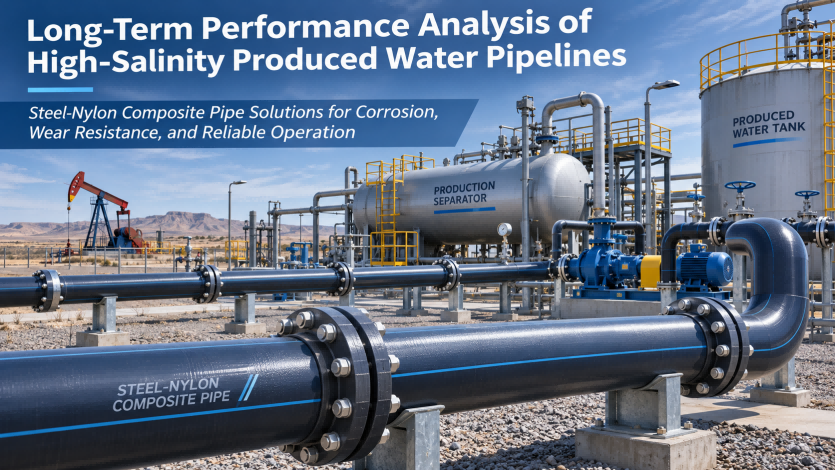
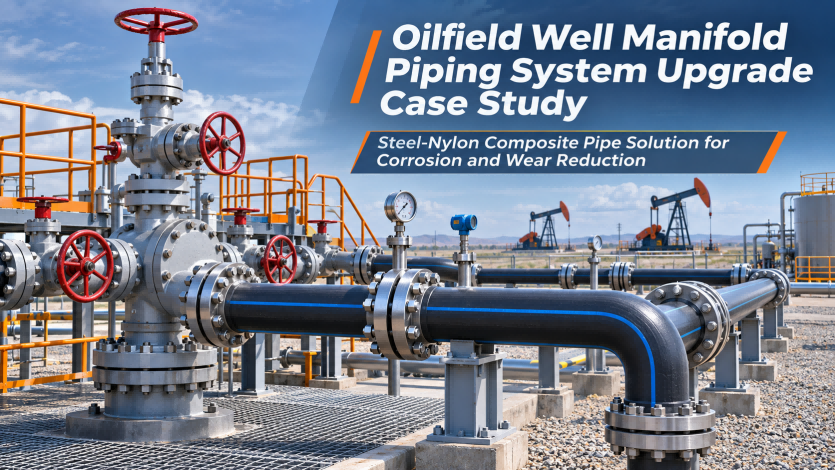
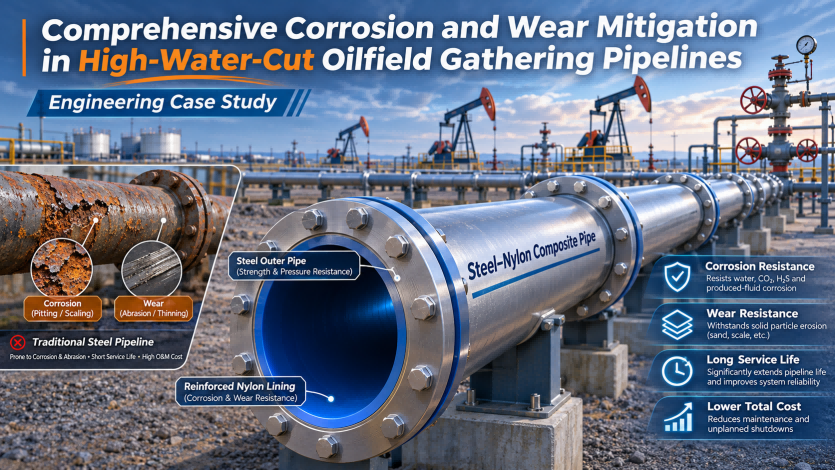
Oilfield Water Injection Pipelines: Reduce Maintenance Costs

Engineering Practices for Reducing Maintenance Frequency in Oilfield Water Injection Pipelines
1. Introduction: Why Do Oilfield Water Injection Pipelines Require Frequent Maintenance?
Water injection systems are essential infrastructure in modern oilfield development. They help maintain reservoir pressure, improve oil recovery, and support stable long-term production.
As oilfields enter their middle and late production stages, increasing volumes of treated produced water are reinjected into reservoirs. This water may contain high concentrations of dissolved salts, corrosive gases, suspended solids, and microorganisms, creating challenging operating conditions for water injection pipelines.
Conventional carbon steel pipelines may experience several problems during long-term operation:
-
Internal corrosion leading to localized pitting and perforation.
-
Erosion caused by sand, corrosion products, and suspended particles.
-
Scaling and sediment accumulation that increase hydraulic resistance.
-
Repeated leakage at welded joints, valves, and flange connections.
-
Frequent shutdowns for pipeline repairs.
-
Increasing maintenance, cleaning, corrosion protection, and replacement costs.
For oilfield operators, the critical issue is not simply the cost of an individual repair.
The real challenge is how to reduce pipeline failures at their source, extend maintenance intervals, and achieve more reliable continuous operation through improved materials and engineering practices.
Steel-Nylon Composite Pipes, combining the mechanical support of steel with the corrosion and wear resistance of reinforced nylon, offer a promising alternative for selected oilfield water injection and produced water transportation applications.
2. Five Major Causes of Frequent Maintenance in Oilfield Water Injection Pipelines
2.1 Internal Corrosion Caused by High-Salinity Injection Water
Oilfield injection water may originate from produced water, surface water, or mixtures of different water sources.
Depending on the water treatment process and reservoir conditions, injection water may contain:
-
Chloride ions and other dissolved salts.
-
Dissolved oxygen.
-
Carbon dioxide (CO₂).
-
Hydrogen sulfide (H₂S).
-
Suspended solids and corrosion products.
These substances can significantly affect the corrosion behavior of conventional carbon steel pipelines.
For example, dissolved oxygen can accelerate electrochemical corrosion, while CO₂ dissolved in water can create corrosive conditions.
H₂S-containing environments may introduce additional corrosion and material integrity concerns.
Sediment deposits can also create localized environments that promote under-deposit corrosion.
Over time, localized corrosion may cause pipeline perforation even when the overall pipe wall remains relatively thick.
This explains why certain water injection pipelines experience repeated leakage and require frequent localized repairs.
2.2 Microbiologically Influenced Corrosion (MIC)
Oilfield water injection systems may contain microorganisms such as sulfate-reducing bacteria (SRB) and acid-producing bacteria (APB).
These microorganisms can form biofilms on metallic surfaces and alter local electrochemical conditions.
Microbiologically influenced corrosion may become particularly significant in systems characterized by:
-
Frequent shutdowns.
-
Low-flow or stagnant sections.
-
Sediment accumulation.
-
Inadequate water treatment.
-
Long-term microbial activity.
MIC cannot always be identified through visual inspection alone.
Reliable diagnosis may require water analysis, microbial testing, corrosion product examination, and failure analysis.
Simply increasing pipe wall thickness or repeatedly repairing damaged sections may not eliminate the underlying corrosion mechanism.
2.3 Erosion Caused by Suspended Solids
Injection water can contain sand, rust, scale particles, and other suspended materials.
These particles may cause localized erosion, particularly where the flow changes direction or velocity.
High-risk locations often include:
-
Elbows.
-
Tees.
-
Reducers.
-
Valve connections.
-
Sections with locally elevated flow velocities.
Continuous particle impact can damage protective coatings and accelerate material loss.
When erosion and corrosion occur simultaneously, pipeline deterioration may become more severe.
Therefore, pipeline material selection should consider both corrosion resistance and wear resistance.
2.4 Scaling and Hydraulic Performance Deterioration
Oilfield injection water may contain calcium, barium, strontium, carbonate, and sulfate ions.
Changes in temperature, pressure, or water chemistry can promote the precipitation of mineral deposits.
Over time, scaling may reduce the effective internal diameter of pipelines and increase pressure losses.
This can lead to higher pumping energy consumption and reduced water injection efficiency.
Although pipe material selection can influence surface conditions and maintenance requirements, scaling is primarily controlled by water chemistry.
Consequently, corrosion-resistant pipeline materials should be combined with appropriate water treatment and scale management strategies.
2.5 Leakage and Maintenance Challenges at Pipeline Connections
Pipeline failures are not limited to straight pipe sections.
Welded joints, flange connections, fittings, and valve interfaces are also potential leakage locations.
In operating oilfield facilities, welding repairs may require:
-
Pipeline isolation and shutdown.
-
Hot work permits.
-
Flammable gas detection.
-
Welding quality control.
-
Weld inspection.
-
Corrosion protection restoration.
-
Pressure testing before recommissioning.
Reducing maintenance frequency therefore requires attention not only to pipe materials but also to connection reliability and installation methods.
3. Why Steel-Nylon Composite Pipes Are Suitable for Selected Oilfield Water Injection Applications
Steel-Nylon Composite Pipes are engineered to combine the complementary properties of structural steel and reinforced nylon.
Unlike conventional steel pipes relying solely on internal protective coatings, these composite pipes incorporate a reinforced nylon functional layer designed to separate the transported medium from the steel structure.
The fundamental design principle is:
The steel structure provides mechanical reinforcement and pressure-bearing support, while the reinforced nylon layer provides corrosion-resistant and wear-resistant protection on the fluid-contacting surface.
3.1 Reinforced Nylon Helps Reduce Internal Corrosion Risks
Steel-Nylon Composite Pipes manufactured by Guangdong Kejin New Materials Co., Ltd. utilize reinforced MC nylon technology, with Nylon 6 (PA6) as the primary nylon base material.
In suitable operating environments, the reinforced nylon layer acts as a non-metallic barrier between corrosive injection water and the steel structure.
Potential engineering advantages include:
-
Reducing direct exposure of steel to corrosive injection water.
-
Lowering the risk of internal corrosion-related perforation.
-
Reducing dependence on corrosion protection for exposed internal steel surfaces.
-
Supporting pipeline material selection for high-salinity water transportation.
-
Potentially extending intervals between corrosion-related repairs.
Unlike carbon steel, PA6 does not undergo the same electrochemical corrosion mechanism when exposed to water.
However, the chemical compatibility of reinforced nylon must still be evaluated for the actual fluid composition, operating temperature, chemical additives, and long-term exposure conditions.
3.2 Excellent Wear Resistance for Particle-Containing Fluids
Reinforced nylon is recognized for its favorable wear-resistant properties.
In applications involving suspended solids, its performance can help reduce damage caused by particle contact and abrasion under suitable operating conditions.
This is particularly relevant for:
-
Water injection pump discharge pipelines.
-
Injection water distribution systems.
-
Elbows and directional fittings.
-
Pipelines transporting water containing sand or suspended particles.
Rather than relying entirely on increased steel wall thickness, a wear-resistant functional layer can improve the material characteristics of the fluid-contacting surface.
Actual erosion and wear performance must still be evaluated based on particle size, solids concentration, velocity, temperature, and relevant testing.
3.3 Smooth Internal Surfaces Support Hydraulic Performance
Corrosion of conventional carbon steel pipelines can produce rough internal surfaces and corrosion deposits.
These conditions may increase hydraulic resistance and encourage additional sediment accumulation.
Reinforced nylon provides a relatively smooth internal surface and does not produce the same iron corrosion products as bare carbon steel.
Potential advantages include:
-
More stable internal surface conditions.
-
Reduced accumulation of corrosion-related deposits.
-
Improved resistance to corrosion-induced roughness deterioration.
-
Support for efficient long-term fluid transportation.
However, Steel-Nylon Composite Pipes cannot completely eliminate mineral scaling or biological fouling.
Proper water treatment, monitoring, and cleaning remain essential.
3.4 Steel Reinforcement Provides Structural Support
Conventional non-metallic pipes may require additional structural considerations depending on temperature, pressure, installation method, and pipe diameter.
Steel-Nylon Composite Pipes integrate metallic reinforcement with a corrosion-resistant non-metallic layer.
This combination can provide mechanical support while protecting the fluid-contacting surface.
Guangdong Kejin's Steel-Nylon Composite Pipe product range includes configurations with nominal pressure ratings of approximately 1.0–4.0 MPa, subject to product specifications and engineering verification.
The broader product family includes materials designed for temperatures ranging approximately from -36°C to 160°C.
However, these temperature limits must not be interpreted as allowable continuous operating conditions for every pressure rating or product configuration.
The actual design envelope must be verified based on pressure, temperature, diameter, fluid chemistry, and service duration.
Importantly, some oilfield water injection systems operate at pressures exceeding 4.0 MPa.
Steel-Nylon Composite Pipes should not be selected for applications exceeding their verified pressure ratings without additional engineering design and qualification.
3.5 Integrated Flange Connections Reduce On-Site Welding Requirements
One of the distinctive engineering advantages of Guangdong Kejin's Steel-Nylon Composite Pipes is the availability of integrated molded flange connections.
These connections enable prefabricated pipe sections and fittings to be assembled using mechanical flange connections rather than relying entirely on field welding.
For existing oilfield facilities, this can offer several practical benefits:
-
Reduced on-site welding requirements.
-
Less dependence on hot work operations.
-
Easier sectional replacement and disassembly.
-
Improved installation convenience.
-
Potentially shorter pipeline replacement schedules.
-
More flexible maintenance planning.
Nevertheless, flange reliability still depends on proper gasket selection, bolt tightening, alignment, and installation quality.
Integrated flanges are designed to improve connection practicality, but they do not automatically eliminate all leakage risks.
4. Engineering Practice: From Repeated Repairs to Systematic Maintenance Reduction
For oilfield water injection networks experiencing recurring corrosion, erosion, or leakage, a systematic pipeline rehabilitation strategy is generally more effective than repeatedly repairing individual failures.
A practical approach involves identifying high-risk sections, evaluating suitable materials, implementing phased replacements, and measuring long-term performance.
The following framework describes a representative engineering methodology rather than verified results from a specific project.
Step 1: Establish a Pipeline Failure Database
Before replacing existing pipelines, operators should review historical maintenance records.
Important data include:
-
Number and frequency of pipeline failures.
-
Pipeline material and service age.
-
Operating and design pressures.
-
Injection water composition.
-
Temperature and flow conditions.
-
Locations and causes of previous failures.
-
Cleaning, chemical treatment, and shutdown records.
This information helps identify pipeline sections with unusually high maintenance requirements.
For example, repeated elbow failures near a water injection distribution station may indicate localized erosion rather than general deterioration of the entire pipeline network.
Step 2: Evaluate Fluid Compatibility and Material Requirements
The suitability of Steel-Nylon Composite Pipes should be determined through a detailed operating-condition assessment.
| Engineering parameter | Key evaluation requirements |
|---|---|
| Design pressure | Normal, maximum, and transient pressure |
| Operating temperature | Continuous and peak temperatures |
| Injection water chemistry | Salinity, pH, dissolved gases, and ions |
| Suspended solids | Concentration, particle size, and velocity |
| Chemical additives | Compatibility with biocides, inhibitors, and scale-control chemicals |
| Connection design | Flange ratings, gaskets, and dimensions |
| External conditions | Soil corrosion, structural loads, and thermal expansion |
| Pipeline fittings | Elbows, tees, reducers, valves, and transitions |
Special attention should be given to the long-term behavior of reinforced PA6 under the combined influence of temperature, fluid exposure, and mechanical loading.
Material qualification should include appropriate chemical compatibility evaluations and mechanical performance testing when required.
Step 3: Prioritize High-Maintenance Pipeline Sections
Rather than replacing an entire pipeline network immediately, oilfield operators can begin with sections experiencing the highest maintenance burdens.
Priority areas may include:
Corrosion-prone sections
Pipelines transporting high-salinity injection water or sections with repeated internal corrosion failures.
Erosion-prone sections
Pipelines and fittings exposed to suspended solids, frequent changes in flow direction, or elevated local velocities.
Difficult-to-maintain sections
Areas within operating facilities where welding and shutdown activities are particularly challenging.
Repeated failure locations
Pipeline sections requiring frequent replacement of pipes, elbows, tees, or connection components.
A phased replacement strategy allows operators to evaluate material performance while managing project investment.
Step 4: Ensure Proper Installation and Connection Quality
Even corrosion-resistant and wear-resistant pipelines require correct installation.
Critical installation considerations include:
-
Integrity of the reinforced nylon functional layer.
-
Flange alignment.
-
Gasket material compatibility.
-
Bolt tightening sequence and torque.
-
Adequate pipe supports.
-
Thermal expansion allowances.
-
External corrosion protection for metallic components.
-
Pressure testing and leak inspection.
Connections must also be designed to prevent unintended exposure of vulnerable steel surfaces to corrosive fluids.
Before commissioning, all pipeline sections should be inspected and tested in accordance with applicable engineering specifications and manufacturer requirements.
Step 5: Monitor Long-Term Pipeline Performance
A successful pipeline upgrade should be evaluated using measurable operating data.
Recommended performance indicators include:
-
Annual maintenance events per unit pipeline length.
-
Unplanned shutdown frequency.
-
Flange and fitting leakage records.
-
Pipeline pressure losses.
-
Injection flow stability.
-
Inspection and cleaning frequency.
-
Total maintenance expenditure.
-
Long-term integrity of the composite structure.
Performance reviews should be conducted during initial operation, established service intervals, and scheduled maintenance periods.
Comparisons between old and new pipelines should account for differences in operating conditions, pipeline length, and exposure severity.
5. Comparing Steel-Nylon Composite Pipes with Conventional Pipeline Materials
| Evaluation factor | Carbon steel pipe | Stainless steel pipe | Conventional non-metallic pipe | Steel-Nylon Composite Pipe |
|---|---|---|---|---|
| Internal corrosion resistance | Requires corrosion management | Depends on alloy and fluid | Generally favorable for compatible media | Reinforced nylon provides a fluid barrier |
| Wear resistance | Susceptible to erosion | Depends on operating conditions | Material-dependent | Reinforced nylon provides a wear-resistant surface |
| Structural support | High | High | Depends on pipe construction | Steel-reinforced structure |
| Connection methods | Welding and flanges | Welding and flanges | Material-dependent | Integrated flange options |
| Field welding requirements | Depends on design | Depends on design | Often avoidable | Can be reduced through prefabrication |
| Main maintenance concerns | Corrosion, erosion, welds | Localized corrosion and connections | Joints, aging, structural performance | Sealing and composite integrity |
HDPE, FRP, reinforced thermoplastic pipes, and other non-metallic pipeline systems also have established oilfield applications.
Steel-Nylon Composite Pipes should therefore be evaluated as an alternative for projects where corrosion resistance, wear resistance, structural support, and installation convenience are required simultaneously.
The optimal material depends on verified engineering performance and total lifecycle costs.
6. How to Quantify Maintenance Cost Savings
For oilfield operators, pipeline procurement costs represent only one component of overall expenditure.
Potential long-term costs include:
-
Labor and repair services.
-
Replacement pipe sections and fittings.
-
Unplanned production or injection interruptions.
-
Excavation, welding, and inspection.
-
Leakage response and environmental management.
-
Cleaning and corrosion protection activities.
A more comprehensive evaluation uses Total Cost of Ownership (TCO).
6.1 Total Cost of Ownership
TCO = Initial Procurement and Installation Costs + Operating and Maintenance Costs + Failure-Related Shutdown Costs + Inspection and Replacement Costs + End-of-Life Costs
For long-term projects, future costs should also be discounted appropriately.
6.2 Annual Maintenance Frequency
Annual Maintenance Frequency = Total Maintenance Events ÷ Pipeline Length ÷ Years of Operation
For large pipeline networks, this can be expressed as maintenance events per 100 kilometers per year.
This metric helps operators compare maintenance performance across different materials and pipeline sections.
6.3 Annual Maintenance Savings
Annual Maintenance Savings = Estimated Annual Maintenance and Failure Costs of the Existing System − Estimated Annual Maintenance and Failure Costs of the Upgraded System
If Steel-Nylon Composite Pipes reduce corrosion-related and wear-related failures under suitable operating conditions, associated maintenance expenses may decrease.
However, the actual savings percentage must be established using project-specific operational data.
6.4 Simple Payback Period
Simple Payback Period = Additional Initial Investment ÷ Estimated Annual Net Cost Savings
For major infrastructure investments, a Net Present Value (NPV) analysis is recommended to account for the time value of money, maintenance costs, shutdown risks, and replacement schedules.
A pipeline system with a higher initial purchase price may still deliver better long-term economic performance if it reduces repeated repairs and unplanned operational interruptions.
7. Maintenance Reduction Requires More Than Material Replacement
Upgrading pipeline materials is an important step, but long-term reliability also depends on effective water treatment, hydraulic design, and operational management.
7.1 Maintain Appropriate Injection Water Quality
Operators should control suspended solids, corrosive components, microbial activity, and scaling potential according to reservoir and facility requirements.
Corrosion-resistant materials complement water treatment systems but do not replace them.
7.2 Control Pressure Surges and Hydraulic Transients
Pump startups, rapid valve closures, and sudden operating changes can generate transient pressure fluctuations.
Pipeline design should consider maximum operating pressure, pressure cycling, and potential water hammer.
The composite structure, flanges, gaskets, and pipe supports must be qualified for the expected service conditions.
7.3 Evaluate the Entire Pipeline System
Pipeline reliability depends on more than straight pipe sections.
Elbows, tees, reducers, flanges, valves, and transition fittings must be considered as part of an integrated system.
Replacing straight pipes while retaining unsuitable connection components may leave critical failure mechanisms unresolved.
7.4 Continue Necessary Inspection and Cleaning
Systems with significant scaling, sedimentation, or microbiological risks should maintain appropriate monitoring and cleaning programs.
If mechanical pigging is planned, the compatibility of pigging equipment with the nylon lining, flange connections, and fittings must be confirmed in advance.
Only by integrating material selection, connection design, installation quality, and operational management can oilfield operators achieve sustainable maintenance improvements.
8. Engineering Advantages of Guangdong Kejin Steel-Nylon Composite Pipes
Guangdong Kejin New Materials Co., Ltd. specializes in the development and manufacturing of reinforced MC nylon pipes and Steel-Nylon Composite Pipes for industrial fluid transportation applications.
For oilfield water injection systems, our product development focuses on several key engineering advantages.
8.1 Corrosion-Resistant Material Technology
Reinforced nylon functional layers help isolate steel structures from corrosive injection water, reducing the risk of direct internal corrosion in compatible applications.
8.2 Wear-Resistant Composite Construction
The combination of reinforced nylon and structural steel provides a material solution for selected fluid transportation applications involving suspended solids and potential abrasion.
8.3 Pressure Ratings from 1.0 to 4.0 MPa
Our product range includes pipe configurations designed for nominal pressure classes from approximately 1.0 to 4.0 MPa.
Specific allowable pressures depend on product design, operating temperature, pipe diameter, and engineering qualification.
8.4 Large-Diameter Manufacturing Capabilities
Our manufacturing capabilities include large-diameter industrial pipeline products and specialized development of ultra-large-diameter composite pipelines.
These capabilities support pipeline selection for suitable oilfield surface facilities, water transportation networks, and related industrial projects.
8.5 Integrated Molded Flange Connections
Integrated flange structures can reduce the need for on-site welding, improving installation convenience and supporting maintenance-friendly pipeline designs.
8.6 Lifecycle Cost Optimization
Rather than focusing exclusively on the initial purchase price, our engineering approach emphasizes:
-
Long-term corrosion protection.
-
Improved resistance to wear-related deterioration.
-
Reduced maintenance requirements.
-
Reliable pipeline connections.
-
Practical installation and replacement.
-
Total lifecycle cost considerations.
Our objective is not simply to supply a different pipe material, but to help customers develop more reliable industrial pipeline systems with lower maintenance requirements and improved long-term operating performance.
9. Frequently Asked Questions (FAQ)
Q1: Can Steel-Nylon Composite Pipes be used in all oilfield water injection pipelines?
No.
Pipeline suitability depends on design pressure, operating temperature, injection water chemistry, pressure fluctuations, and installation requirements.
High-pressure water injection systems exceeding the qualified pressure rating of the selected product require alternative solutions or additional engineering qualification.
Q2: How can Steel-Nylon Composite Pipes help reduce maintenance frequency?
The reinforced nylon functional layer helps limit direct exposure of steel to corrosive injection water and provides wear-resistant characteristics for suitable particle-containing fluids.
Integrated flange connections can also simplify certain installation and replacement activities.
Actual maintenance improvements depend on the full pipeline design and operating environment.
Q3: Are Steel-Nylon Composite Pipes completely maintenance-free?
No.
Although the nylon functional layer can help address certain internal corrosion mechanisms, external metallic components may still require corrosion protection.
Flanges, seals, pipe supports, and composite integrity should be inspected according to an appropriate maintenance program.
Q4: Which pipeline sections should be upgraded first?
Operators should prioritize sections with repeated leakage, severe corrosion or erosion, difficult repair conditions, and high maintenance expenditure.
Phased replacement allows performance to be verified before wider deployment.
Q5: How can operators verify that a pipeline upgrade has reduced maintenance costs?
Operators should compare consistent indicators before and after upgrading, such as maintenance events per unit pipeline length, unplanned shutdowns, maintenance spending, hydraulic performance, and inspection results.
Reliable conclusions require comparable operating conditions and an appropriate monitoring period.
10. Conclusion: Long-Term Pipeline Reliability Is the Key to Reducing Oilfield Maintenance Costs
Frequent maintenance of oilfield water injection pipelines is rarely caused by a single factor.
Internal corrosion, particle erosion, mineral scaling, connection failures, and operational practices can all contribute to pipeline deterioration.
Traditional maintenance strategies often focus on repairing damaged sections after failures occur.
A more effective engineering approach is to reduce the probability of failure through improved material selection, targeted pipeline rehabilitation, reliable connection design, and continuous performance monitoring.
Steel-Nylon Composite Pipes combine structural steel reinforcement with a corrosion-resistant and wear-resistant nylon functional layer.
For suitable oilfield water injection applications, this design offers potential advantages including:
-
Reduced frequency of corrosion-related repairs.
-
Improved resistance to wear-related damage.
-
Reduced on-site welding requirements.
-
More convenient pipeline rehabilitation.
-
Improved long-term operating reliability.
-
Better lifecycle cost optimization.
For oilfield operators, EPC contractors, and engineering companies planning pipeline rehabilitation or new injection water transportation projects, Steel-Nylon Composite Pipes deserve consideration as part of a comprehensive technical and economic evaluation.
Contact Guangdong Kejin New Materials Co., Ltd.
Are your oilfield water injection pipelines experiencing frequent corrosion, leakage, abrasive wear, or increasing maintenance costs?
Guangdong Kejin New Materials Co., Ltd. provides reinforced MC nylon pipes and Steel-Nylon Composite Pipes for suitable industrial fluid transportation applications.
Our team can assist with preliminary material selection and technical evaluation based on your project's fluid composition, design pressure, operating temperature, pipe diameter, and installation requirements.
Website: //www.nylonpipeline.com
Steel-Nylon Composite Pipes — Engineered for Lower Maintenance Requirements and Longer, More Reliable Service Life.
High-Salinity Produced Water Pipelines: Long-Term Case Study