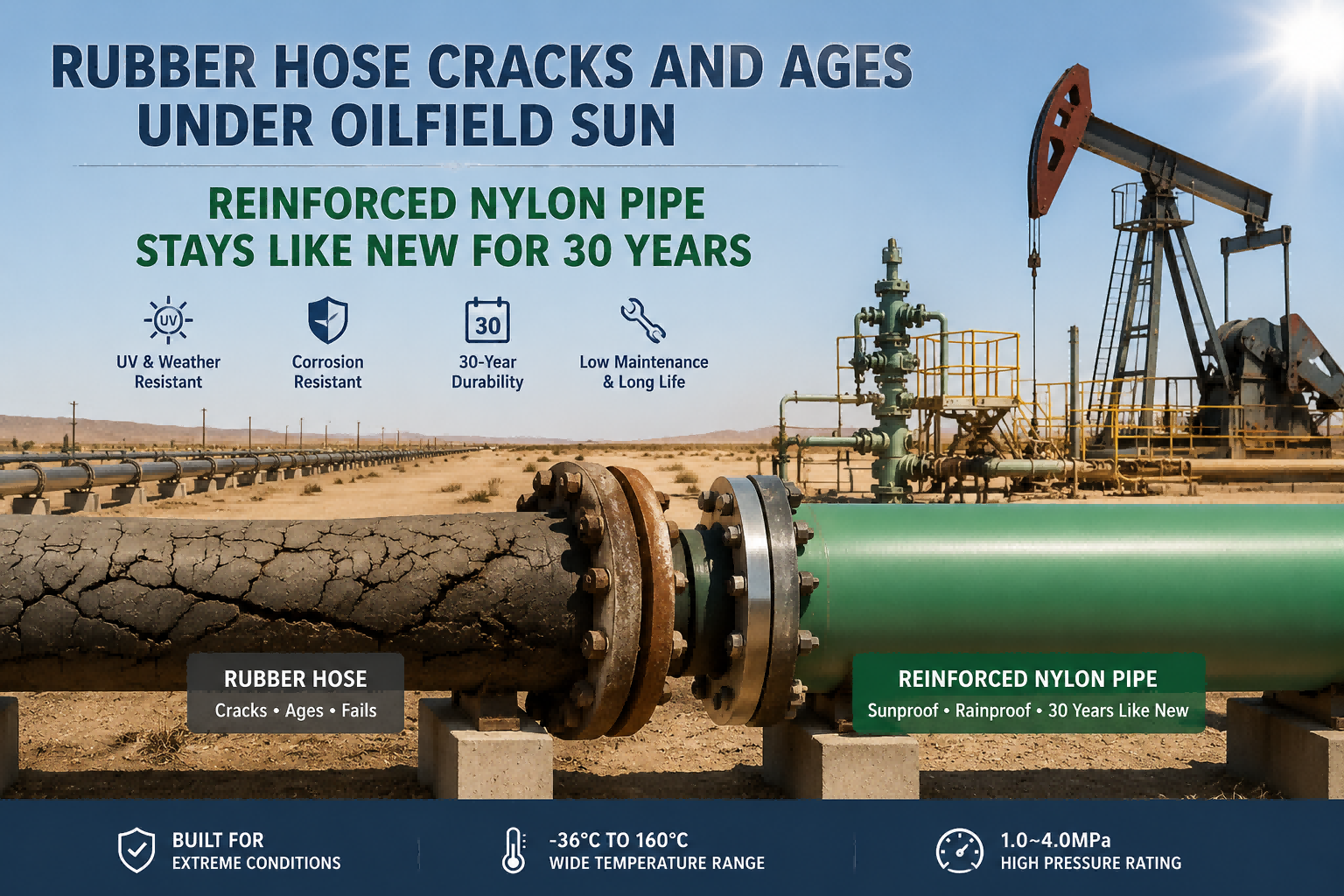
PE Pipe Accelerated Aging by UV Exposure – Nylon Pipe’s Weather Resistance Makes Outdoor Piping Last Longer
Outdoor piping systems are constantly exposed to sunlight, wind, rain, and temperature fluctuations. The issue of material aging is therefore a core consideration that cannot be overlooked during engineering material selection. Among the many polymeric pipe materials, polyethylene (PE) pipes dominate the market due to their cost advantages and good overall performance, while nylon (polyamide, PA) pipes are gaining ground in high‑end outdoor applications thanks to their excellent weather resistance. When pipelines must be installed in the open air, the fate of these two materials under ultraviolet (UV) radiation could hardly be more different.
UV Radiation: The Invisible Killer of Polymeric Pipes
The degradation mechanism of UV radiation on polymers is well understood, yet it is extremely damaging. Sunlight’s UV rays can excite polyethylene molecules, triggering photo‑induced chemical degradation that leads to chain scission of the molecular chains. The free radicals generated after chain scission are unstable and readily react with oxygen, forming carbonyl groups, hydroperoxides, and other oxygen‑containing functional groups. The appearance of these groups signals material disintegration at the molecular level – the regular structure of the polymer is disrupted, and mechanical properties decline accordingly.
What is more concerning is that the aging of PE pipes is not uniform. Studies have shown that under natural weathering, the outer surface of a PE pipe receives direct sunlight, experiences higher temperatures, and is exposed to a much wider range of UV radiation, making oxidation reactions far more intense than on the inner surface or middle layer. The oxidation induction time of the outer surface shortens significantly after just 90 days of exposure, and flexural strength also drops markedly. In other words, UV damage to PE pipes starts at the “skin” and gradually penetrates inward – yet the structural integrity of the pipe depends precisely on that protective outer layer.
Some research has used accelerated aging tests with fluorescent UV lamps to simulate the photo‑oxidative aging of HDPE pipes under natural sunlight. The results show that the service life of heat‑fusion joints in PE pipes is 33.76% shorter than that of the pipe body itself – which means that in outdoor PE piping systems, the weakest link often fails much earlier than expected.
PE Pipe’s “Sunscreen”: The Limitations of Carbon Black
Of course, PE pipes are not completely defenceless against UV radiation. In industry, it is common practice to add 2% to 2.5% of uniformly dispersed carbon black to polyethylene as a light stabiliser that absorbs UV rays. Under ideal conditions, carbon‑black‑containing PE pipes can be stored or used outdoors for up to 50 years without damage from UV radiation.
However, this claim carries several important caveats. First, the protective effect of carbon black depends on its uniform distribution throughout the pipe – any minor process fluctuations during production can lead to locally insufficient protection. Second, as aging progresses, the additives themselves are consumed and decomposed; surface defects form, oxygen penetrates deeper into the pipe wall, and degradation reactions take over. Third, the “50‑year” lifespan is often extrapolated from idealised accelerated aging data in the laboratory, whereas real outdoor environments – with their combined effects of UV intensity, temperature swings, and humidity variations – are far harsher than laboratory conditions.
The Molecular Advantage of Nylon Pipe: From Structure to Performance
The weather‑resistance advantage of nylon (polyamide) pipes originates first and foremost from their molecular structure. Nylon molecular chains contain polar amide groups (–CONH–), and the intermolecular hydrogen bonds make the chain packing tighter and more ordered, resulting in a higher degree of crystallinity. This dense molecular structure itself constitutes a physical barrier against UV penetration – UV radiation must overcome stronger intermolecular forces to break the nylon molecular chains.
In contrast, polyethylene molecular chains are non‑polar and held together only by weak van der Waals forces, making them more flexible. The same UV energy can more readily cause chain scission and crosslinking reactions in PE.
This difference at the molecular level is clearly reflected in quantitative testing. Weathering test standards for nylon pipes are quite stringent: under UV aging tests of 1000 hours at an irradiance of 0.76 W/m² at 340 nm, the tensile strength retention rate is required to be no less than 75% to 85%, and impact strength retention no less than 80%. The colour difference (ΔE) must be kept within 3.0, and surface crazing ratings must meet high standards. Some high‑performance nylon corrugated pipes even pass 1000‑hour UV resistance tests with a 100% success rate.
Furthermore, nylon pipes offer additional outdoor adaptability beyond weather resistance: a wide operating temperature range from ‑40°C to 100°C (with short‑term tolerance to even higher temperatures); excellent resistance to chemicals and oils; and outstanding abrasion resistance with a low coefficient of friction. These properties give nylon pipes a more comprehensive survivability in complex outdoor environments.
Outdoor Material Selection: The Application Scenario Determines the Answer
This does not mean that PE pipes are without merit. In buried pipelines, indoor systems, or applications with adequate sunshade protection, PE pipes – with their excellent flexibility, good chemical resistance, and significant cost advantage – remain a rational and economical choice. The flexibility of PE also makes installation easier in applications requiring frequent bending.
However, when pipelines must be exposed to the outdoors and endure day‑after‑day direct sunlight – whether in open‑air industrial lines, outdoor equipment piping, or exposed building water supply and drainage systems – the weather‑resistance advantage of nylon pipes shifts from being a “nice‑to‑have” to a “must‑have.” UV radiation does not weaken because of a limited project budget, and aging does not slow down for construction convenience. In the equation of outdoor pipeline service life, the intrinsic weather resistance of the material is the most reliable variable.
Choosing nylon pipes is, in essence, buying an “UV insurance policy” for your outdoor piping system – trading molecular‑level stability for decades of trouble‑free operation.
Insufficient Ring Stiffness Causing Deformation in Large-Diameter HDPE Pipes? Steel–Nylon Composite Pipes Offer Both Rigidity and Flexibility
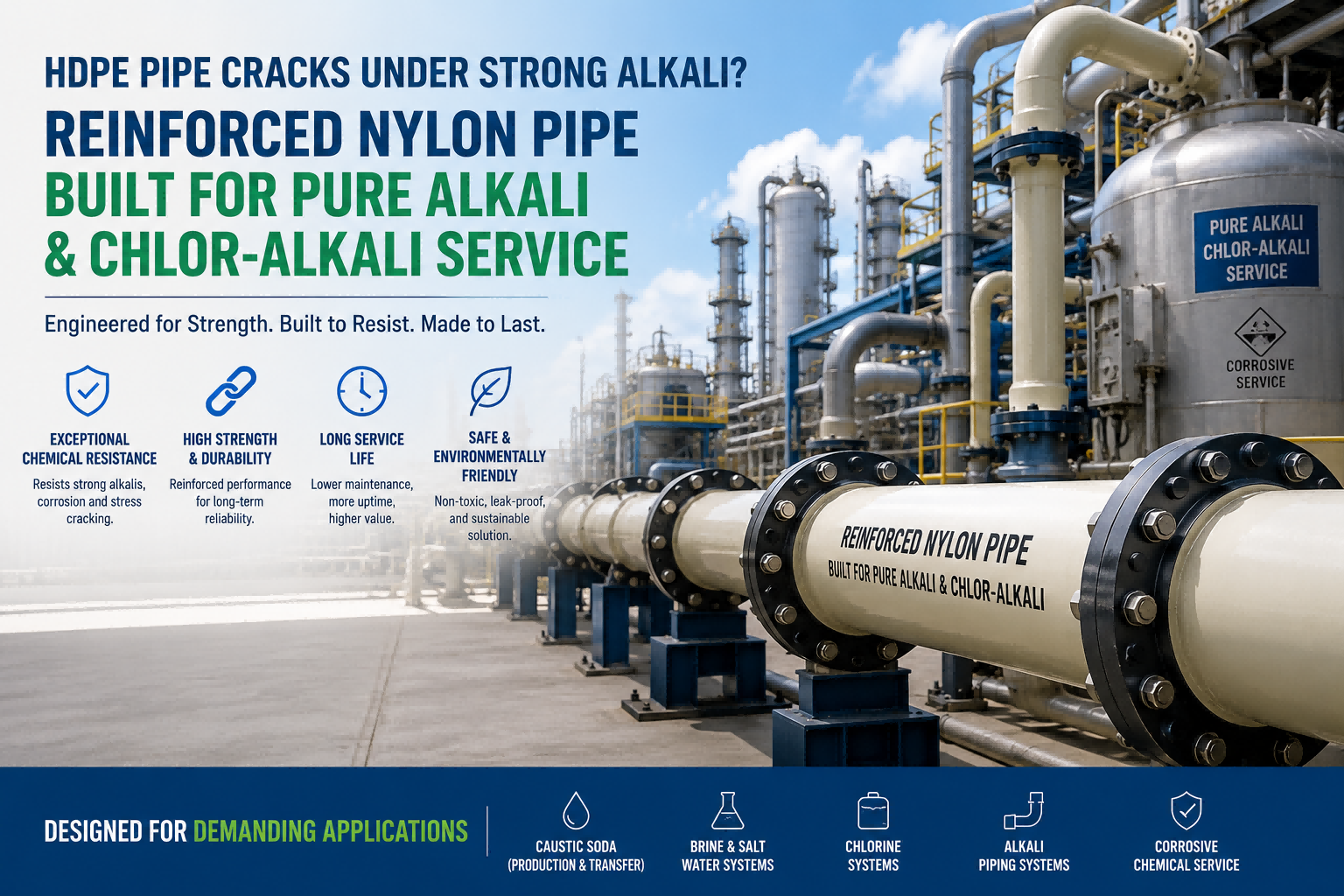
HDPE Pipes Suffer Stress Cracking in Strong Alkalis – Reinforced Nylon Pipes Are Engineered for Soda Ash and Chlor-Alkali
Related blog