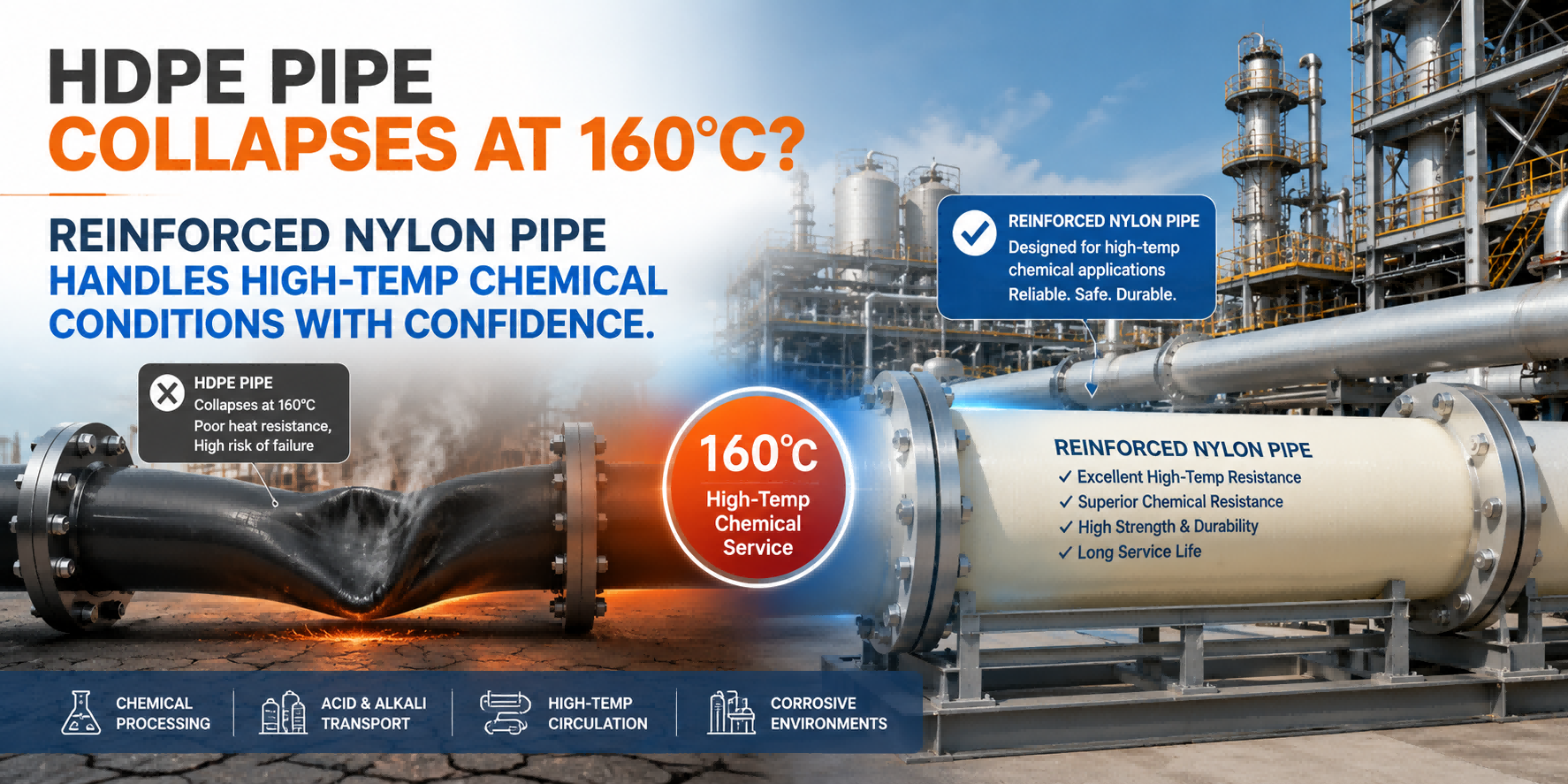
HDPE Pipe Collapses at 160°C? Reinforced Nylon Pipe Handles High‑Temperature Chemical Conditions with Ease
Introduction
In chemical production, the reliability of piping systems is directly tied to the safe operation and efficiency of the entire plant. Temperature is often one of the most demanding parameters for pipe materials. When process temperatures climb to 160°C or even higher, many conventional plastic pipes begin to reveal fatal weaknesses—and HDPE (high‑density polyethylene) is a prime example. **High‑temperature collapse, deformation, and drastic loss of strength**—behind these problems lie fundamental limitations in materials science. So, under high‑temperature chemical conditions where HDPE falls short, which pipe material can cope with confidence? Reinforced nylon pipe is providing the answer.
1. The Temperature Ceiling of HDPE: Not All Plastics Can “Take the Heat”
HDPE pipes are widely used in water supply, drainage, gas transmission, and agricultural irrigation, thanks to their excellent corrosion resistance, good impact strength, and relatively low cost. However, when we turn our attention to high‑temperature chemical applications, HDPE’s shortcomings become glaringly obvious.
From a material standpoint, HDPE has a melting point of about 120–130°C and a heat deflection temperature typically around 90°C. Industry standards clearly specify that, for unpressurised systems, the fluid temperature range for HDPE pipes is 0°C to 65°C, with instantaneous drainage temperatures not exceeding 95°C. In general engineering practice, the working temperature of HDPE pipes is usually **no more than 60°C**.
When temperatures exceed this range, the thermal stability of HDPE drops significantly, leading to pronounced **softening and creep**. The pipe’s rigidity and structural strength are consequently lost. Even more concerning, elevated temperatures accelerate the depletion of antioxidants in the material, shortening service life and increasing the likelihood of failure.
A real‑world case underscores this risk: in an industrial park, wastewater temperatures of 25–35°C caused HDPE pipes, after long‑term immersion, to gradually soften and lose their support, ultimately resulting in a **complete collapse**. Although this incident occurred under moderate temperature conditions, it clearly demonstrates HDPE’s inherent vulnerability to heat. It is not hard to imagine that at 160°C, the consequences would be far more severe.
2. 160°C High‑Temperature Conditions: HDPE “Collapse” Is No Accident
Returning to the “collapse at 160°C” mentioned in the title—this temperature is far beyond HDPE’s material limits. At 160°C, HDPE has already exceeded its melting point. The pipe will not only undergo significant **thermal deformation and creep**; under internal pressure or external loads, it may even suffer **structural failure**.
The failure mechanisms of HDPE can be understood on three levels:
**First, intensified molecular chain movement.** Near its melting point, the thermal motion of polyethylene chain segments increases dramatically, transitioning the material from a glassy or rubbery state to a viscous flow state. Macroscopically, this manifests as a steep drop in stiffness and strength.
**Second, exponential growth in creep rate.** High temperatures greatly accelerate creep deformation under sustained stress, causing the pipe to gradually lose its designed dimensions and load‑bearing capacity over long‑term service.
**Third, sharply increased risk of environmental stress cracking.** The combined effect of high temperature and certain chemical media can induce **environmental stress cracking** in HDPE, leading to brittle fracture at stresses far below the design values.
Thus, using HDPE pipes in 160°C high‑temperature chemical conditions is essentially a losing gamble with materials. The collapse is not accidental—it is the inevitable outcome when the material’s physical limits are exceeded.
3. Reinforced Nylon Pipe: An Engineering Plastic Built for High‑Temperature Service
In stark contrast to HDPE, reinforced nylon pipe demonstrates outstanding stability at elevated temperatures. Nylon (polyamide) itself has good heat resistance, and through **glass‑fibre reinforcement** and other modifications, its thermal performance can be dramatically improved.
3.1 Thermal Performance: Reaching Temperatures Beyond HDPE’s Reach
Unreinforced nylon typically withstands temperatures in the range of 90–100°C, but with glass‑fibre reinforcement, its heat resistance can be raised to **150°C or even higher**. Some high‑performance reinforced nylon materials exhibit heat deflection temperatures of **over 220°C**, with continuous service temperatures spanning –40°C to 180°C. For example, glass‑fibre‑reinforced PA66 can achieve a heat deflection temperature of **above 250°C**.
This means that at 160°C—where HDPE would have long since softened and collapsed—reinforced nylon pipe still maintains stable structural strength and dimensional accuracy.
Unreinforced nylon typically withstands temperatures in the range of 90–100°C, but with glass‑fibre reinforcement, its heat resistance can be raised to **150°C or even higher**. Some high‑performance reinforced nylon materials exhibit heat deflection temperatures of **over 220°C**, with continuous service temperatures spanning –40°C to 180°C. For example, glass‑fibre‑reinforced PA66 can achieve a heat deflection temperature of **above 250°C**.
This means that at 160°C—where HDPE would have long since softened and collapsed—reinforced nylon pipe still maintains stable structural strength and dimensional accuracy.
3.2 More Than Just Heat Resistance: Comprehensive Superiority
The advantages of reinforced nylon pipe go far beyond high‑temperature resistance. In chemical high‑temperature environments, pipes are often simultaneously exposed to **corrosive media, mechanical stress, and abrasion**. Reinforced nylon excels in these dimensions as well:
**Chemical corrosion resistance**: Reinforced MC nylon pipe is suitable for various acidic and alkaline media, with particularly good resistance in alkaline environments. It can be widely used for conveying acidic and alkaline solutions, inorganic salt solutions, and many organic solvents.
**Excellent mechanical strength**: The tensile and flexural strengths of glass‑fibre‑reinforced nylon are far superior to those of unmodified general‑purpose plastics. For instance, centrifugally cast MC nylon pipe can withstand working pressures up to 10.0 MPa, and its wear resistance is 8 times that of steel and 10.3 times that of fibre‑reinforced plastic.
**Aging resistance and long service life**: Reinforced nylon pipe exhibits good resistance to aging and a long service life, maintaining stable operation even under harsh chemical conditions.
The advantages of reinforced nylon pipe go far beyond high‑temperature resistance. In chemical high‑temperature environments, pipes are often simultaneously exposed to **corrosive media, mechanical stress, and abrasion**. Reinforced nylon excels in these dimensions as well:
**Chemical corrosion resistance**: Reinforced MC nylon pipe is suitable for various acidic and alkaline media, with particularly good resistance in alkaline environments. It can be widely used for conveying acidic and alkaline solutions, inorganic salt solutions, and many organic solvents.
**Excellent mechanical strength**: The tensile and flexural strengths of glass‑fibre‑reinforced nylon are far superior to those of unmodified general‑purpose plastics. For instance, centrifugally cast MC nylon pipe can withstand working pressures up to 10.0 MPa, and its wear resistance is 8 times that of steel and 10.3 times that of fibre‑reinforced plastic.
**Aging resistance and long service life**: Reinforced nylon pipe exhibits good resistance to aging and a long service life, maintaining stable operation even under harsh chemical conditions.
3.3 Real‑World Applications: From Laboratory to Industrial Sites
Reinforced nylon pipe is not merely a “lab material” confined to theory; it has been maturely applied across multiple industrial sectors. MC nylon pipe, as a new type of engineering plastic piping, is widely used in **crude oil, natural gas, and petroleum product transmission; mineral slurry conveying in metallurgical mines; fly‑ash slurry transport in thermal power plants; and brine solution conveyance**, among others.
In the oil extraction industry, there are nylon pipeline products specifically designed for demanding conditions, capable of withstanding **temperatures of 93.3°C and pressures of 500 PSI**, with wear resistance **more than 25 times higher** than that of HDPE pipe. In extreme ultra‑high‑temperature well‑flushing operations, copolymer nylon‑lined composite pipes can endure **200°C** while maintaining their original shape without deformation.
These real‑world examples fully demonstrate that reinforced nylon pipe can not only handle the 160°C challenge but also maintain reliable operation at even higher temperatures and in more complex media.
Reinforced nylon pipe is not merely a “lab material” confined to theory; it has been maturely applied across multiple industrial sectors. MC nylon pipe, as a new type of engineering plastic piping, is widely used in **crude oil, natural gas, and petroleum product transmission; mineral slurry conveying in metallurgical mines; fly‑ash slurry transport in thermal power plants; and brine solution conveyance**, among others.
In the oil extraction industry, there are nylon pipeline products specifically designed for demanding conditions, capable of withstanding **temperatures of 93.3°C and pressures of 500 PSI**, with wear resistance **more than 25 times higher** than that of HDPE pipe. In extreme ultra‑high‑temperature well‑flushing operations, copolymer nylon‑lined composite pipes can endure **200°C** while maintaining their original shape without deformation.
These real‑world examples fully demonstrate that reinforced nylon pipe can not only handle the 160°C challenge but also maintain reliable operation at even higher temperatures and in more complex media.
4. Selection Decisions: When to Choose Reinforced Nylon Pipe?
In practical engineering selection, the decision to replace HDPE with reinforced nylon pipe should be based on a comprehensive evaluation of process conditions. The following are key decision guidelines:
**When the process temperature exceeds 80°C**, the risk for HDPE pipes rises significantly, and reinforced nylon or other high‑temperature materials should be prioritised.
**In the 100–160°C range**, HDPE pipes are essentially unsuitable, and reinforced nylon is the ideal choice among plastic pipes.
**When the application involves both high temperature and corrosive media**, the chemical resistance of reinforced nylon further enhances its advantages.
**When the pipe must withstand high pressure or external loads**, the far superior mechanical properties of reinforced nylon make it a more reliable option.
Of course, reinforced nylon pipe is generally more expensive than HDPE. Therefore, in applications with lower temperatures and less demanding mechanical requirements, HDPE remains an economically sound choice. The essence of material selection lies in **finding the optimal balance between performance and cost for the specific operating conditions**.
Conclusion
The collapse of HDPE pipe at 160°C is not a quality issue—it is a material‑science inevitability. Every material has its performance boundaries, and understanding and respecting those boundaries is the most fundamental professional duty of an engineer.
Reinforced nylon pipe, with its outstanding high‑temperature resistance, excellent mechanical strength, and good chemical corrosion resistance, offers a reliable plastic piping solution for high‑temperature chemical applications. When temperatures rise to levels that HDPE cannot reach, reinforced nylon pipe still handles the challenge with composure—this is not a marketing slogan, but a confidence grounded in materials science.
In today’s chemical industry, which increasingly pursues **safety, reliability, and long‑term operation**, selecting the right pipe material is a commitment to production safety. Reinforced nylon pipe is writing that commitment with its proven performance.
PE Pipe Pressure Rating Stuck at 1.6MPa? Steel‑Nylon Composite Pipe Handles 4.0MPa High Pressure with Ease
Power Plant Desulfurization Carbon Steel Pipe Scaling and Blockage – Steel‑Nylon Composite Pipe with Smooth Inner Wall Never Scales
Related blog