Reinforced Nylon Pipe vs FRP Pipe: A Comprehensive Comparison for Industrial Pipeline Selection
In industries such as chemical processing, mining, power generation, oil & gas, and seawater desalination, pipeline systems are constantly challenged by:
-
Corrosion from aggressive chemicals
-
Abrasive wear from solid particles
-
Pressure fluctuations
-
Temperature variations
-
High maintenance costs
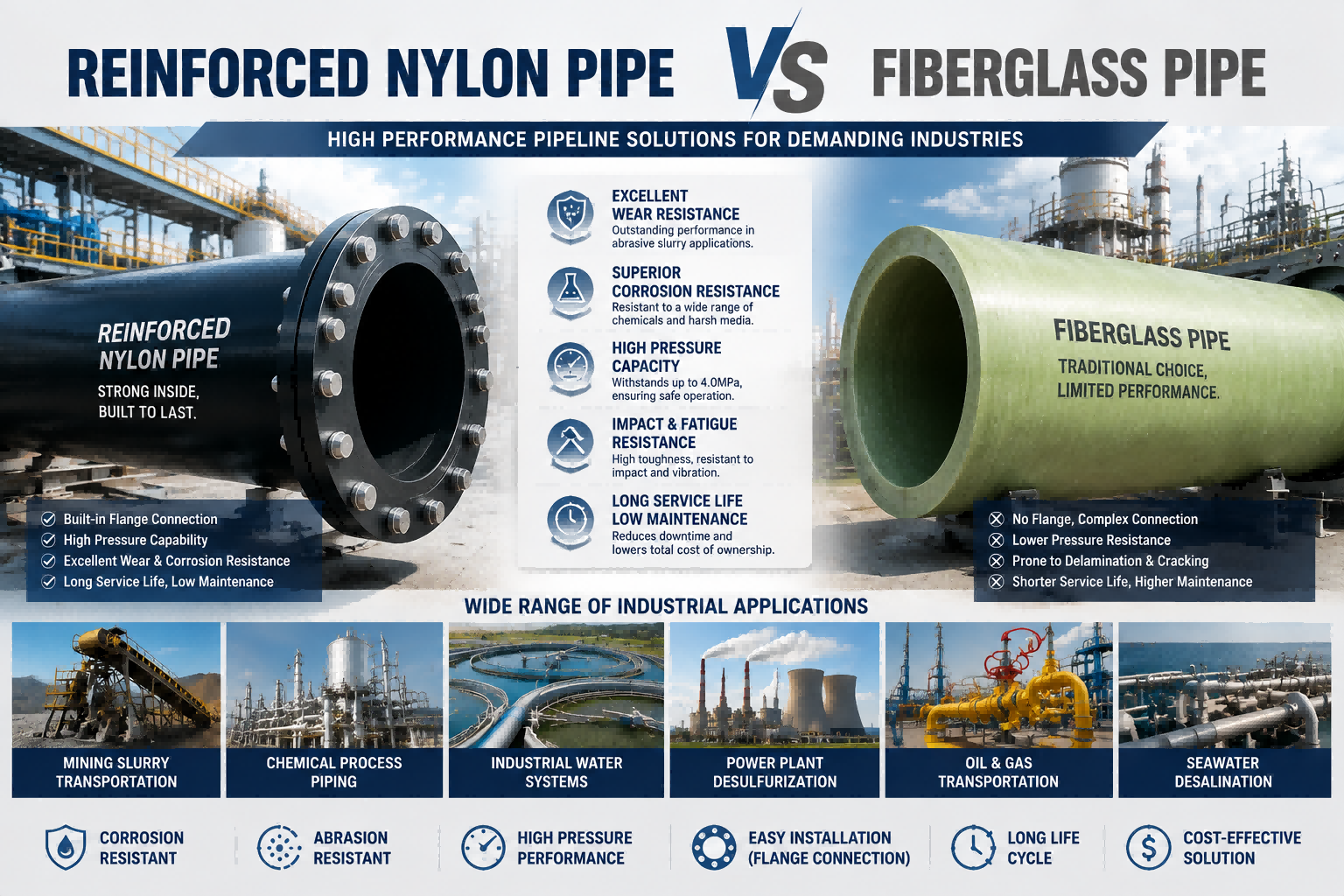
Fiberglass Reinforced Plastic (FRP/GRP) pipes have been widely used for decades due to their lightweight structure, high strength, and corrosion resistance. However, as industrial operating conditions become more demanding, especially in high-wear slurry transportation, high-pressure systems, complex chemical environments, and long-term continuous operation, some limitations of traditional FRP pipes have become increasingly apparent.
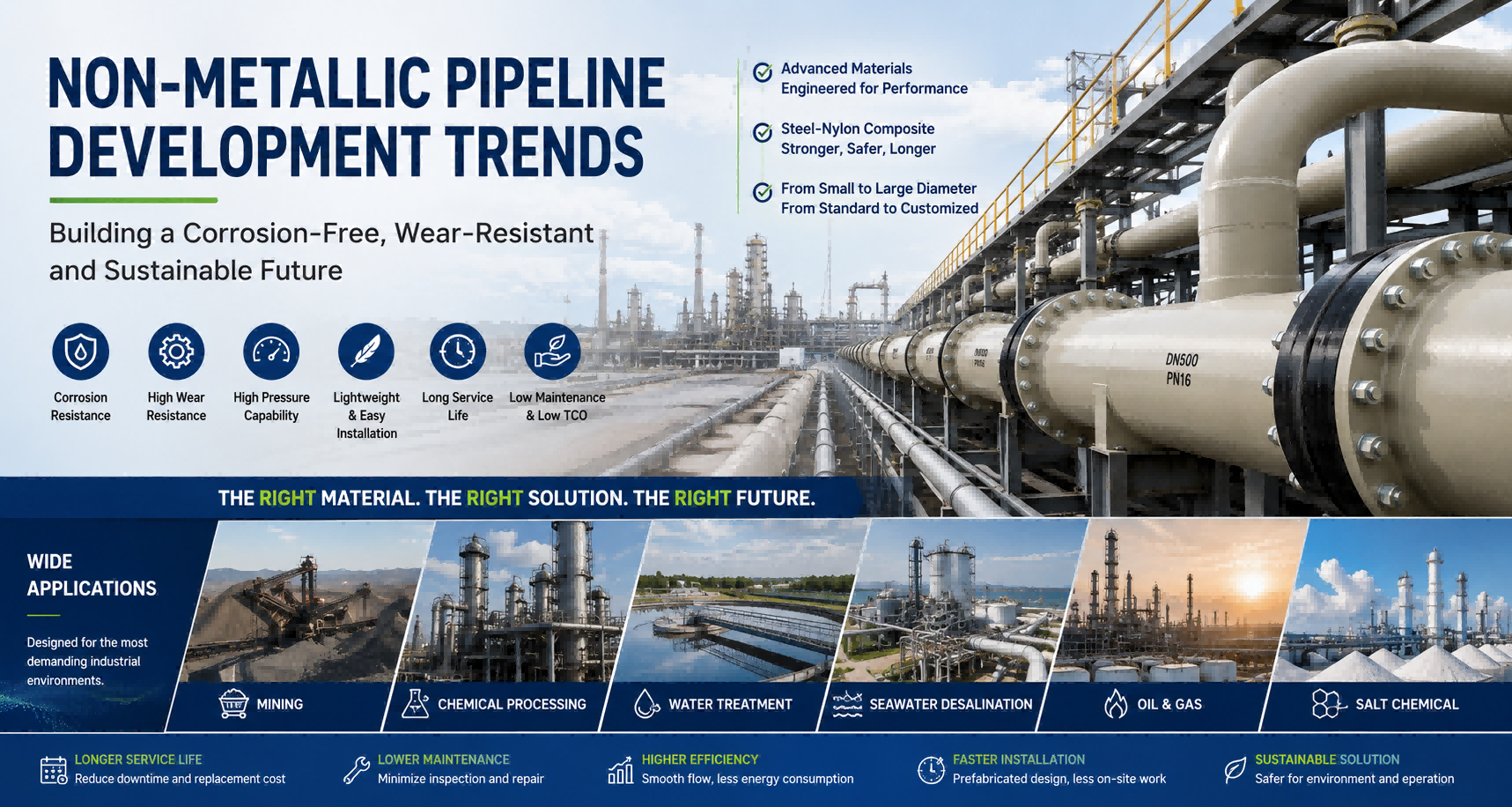
Reinforced Nylon Pipe, as an advanced high-performance non-metallic pipeline material, combines modified nylon technology with reinforcement structures to provide outstanding advantages in wear resistance, corrosion resistance, impact resistance, and long service life.
For industrial pipeline systems requiring long-term reliability, the comparison between Reinforced Nylon Pipe and FRP Pipe is not only a material selection decision—it is a lifecycle cost optimization decision.
1. Structural Difference Between Reinforced Nylon Pipe and FRP Pipe
1.1 Structure Characteristics of FRP Pipe
FRP pipe is mainly composed of:
-
Glass fiber reinforcement
-
Resin matrix
-
Inner corrosion-resistant liner
Its mechanical strength mainly comes from glass fibers, while resin acts as the bonding medium. However, the resin layer can also become a potential weak point during long-term operation.
Typical structure:
Outer fiberglass reinforcement layer → Resin structural layer → Anti-corrosion liner
Main advantages:
-
Lightweight
-
Good initial corrosion resistance
-
Convenient installation
However, during long-term service, FRP pipes may experience:
-
Delamination
-
Blistering
-
Inner liner failure
-
Fiber exposure
-
Cracking under impact
1.2 Structural Advantages of Reinforced Nylon Pipe
Reinforced Nylon Pipe uses high-performance modified nylon materials combined with reinforcement technology to improve mechanical properties.
Typical structure:
Integrated reinforced nylon structure
Unlike FRP pipes that rely on bonding between different layers, reinforced nylon provides a more uniform structure, reducing the risk of failure caused by interface separation.
Main advantages:
-
Excellent wear resistance
-
High toughness
-
Strong impact resistance
-
Corrosion resistance
-
Long-term operational stability
2. Corrosion Resistance Comparison: Which Material Performs Better in Chemical Applications?
Industrial pipeline corrosion usually comes from:
-
Acid and alkali solutions
-
Salt water
-
Chemical fluids
-
Oxidizing environments
2.1 Corrosion Challenges of FRP Pipe
Although FRP pipes are corrosion-resistant, their performance depends heavily on:
-
Resin type
-
Liner quality
-
Manufacturing process
-
Operating temperature
During long-term operation:
-
Resin may age
-
Inner liners may crack
-
Chemicals may penetrate into the reinforcement layer
The failure process can become:
Chemical penetration → Delamination → Strength reduction → Leakage
Especially in strong alkaline, high-salt, and high-temperature environments, FRP pipe selection requires careful evaluation of resin compatibility.
2.2 Corrosion Resistance Advantages of Reinforced Nylon Pipe
Reinforced nylon materials provide excellent chemical stability and are widely used in:
-
Salt chemical industries
-
Chlor-alkali plants
-
Alkali solution transportation
-
Mining slurry systems
-
Industrial circulating water systems
Its integrated structure reduces the possibility of corrosive media penetrating into the internal structure.
For continuous industrial operation, reinforced nylon pipelines significantly reduce maintenance caused by corrosion failures.
3. Wear Resistance Comparison: A Critical Factor in Slurry Transportation
In industries such as mining, mineral processing, power plants, and chemical slurry transportation, the biggest threat to pipeline life is often not corrosion but:
Particle erosion and abrasive wear.
3.1 Wear Limitations of FRP Pipe
The wear resistance of FRP pipes mainly depends on the resin inner layer.
When pipelines operate under:
-
High solid concentration
-
High flow velocity
-
Hard abrasive particles
the resin layer gradually wears away.
Once glass fibers become exposed:
-
Wear accelerates
-
Structural strength decreases
-
Risk of pipe failure increases
3.2 Wear Resistance Advantages of Reinforced Nylon Pipe
Nylon materials naturally provide excellent wear resistance.
Compared with conventional steel pipes, reinforced nylon pipes offer:
-
Lower friction coefficient
-
Stronger resistance to particle impact
-
Smoother internal surfaces
They are particularly suitable for:
-
Mine tailings transportation
-
Coal slurry pipelines
-
Phosphate slurry systems
-
Salt slurry transportation
In severe wear environments, reinforced nylon pipes can significantly extend replacement cycles.
4. Mechanical Performance Comparison: Reliability Under Pressure and Impact Conditions
Industrial pipelines often experience:
-
Pressure fluctuations
-
Equipment vibration
-
Water hammer effects
-
Installation impact
4.1 Limitations of FRP Pipe
FRP is a relatively rigid material.
Advantages:
-
High stiffness
Limitations:
-
Limited impact resistance
-
Higher brittleness compared with nylon materials
External impacts may cause:
-
Cracks
-
Local damage
-
Hidden structural defects
4.2 Advantages of Reinforced Nylon Pipe
Reinforced nylon provides:
-
Better toughness
-
Higher impact resistance
-
Better fatigue resistance
It is especially suitable for:
-
Outdoor pipe galleries
-
Mining environments
-
Long-distance transportation pipelines
5. Temperature Performance Comparison
Modern industrial processes increasingly require wider temperature capability.
| Performance | Reinforced Nylon Pipe | FRP Pipe |
|---|---|---|
| Operating temperature range | -36℃ to 160℃ | Generally around -30℃ to 100℃ |
| High-temperature stability | Excellent | Depends on resin system |
| Low-temperature toughness | Excellent | More sensitive |
For cold climate applications, reinforced nylon maintains better impact resistance and mechanical stability.
For certain high-temperature chemical applications, reinforced nylon also provides a wider application range.
6. Installation Comparison: Reducing Construction Risks
6.1 FRP Pipe Installation
Common connection methods include:
-
Flange connections
-
Adhesive bonding
-
Field repair
Installation quality has a significant impact on service life.
Potential issues include:
-
Strict installation requirements
-
Connection reliability challenges
6.2 Advantages of Steel-Nylon Composite Pipe Installation
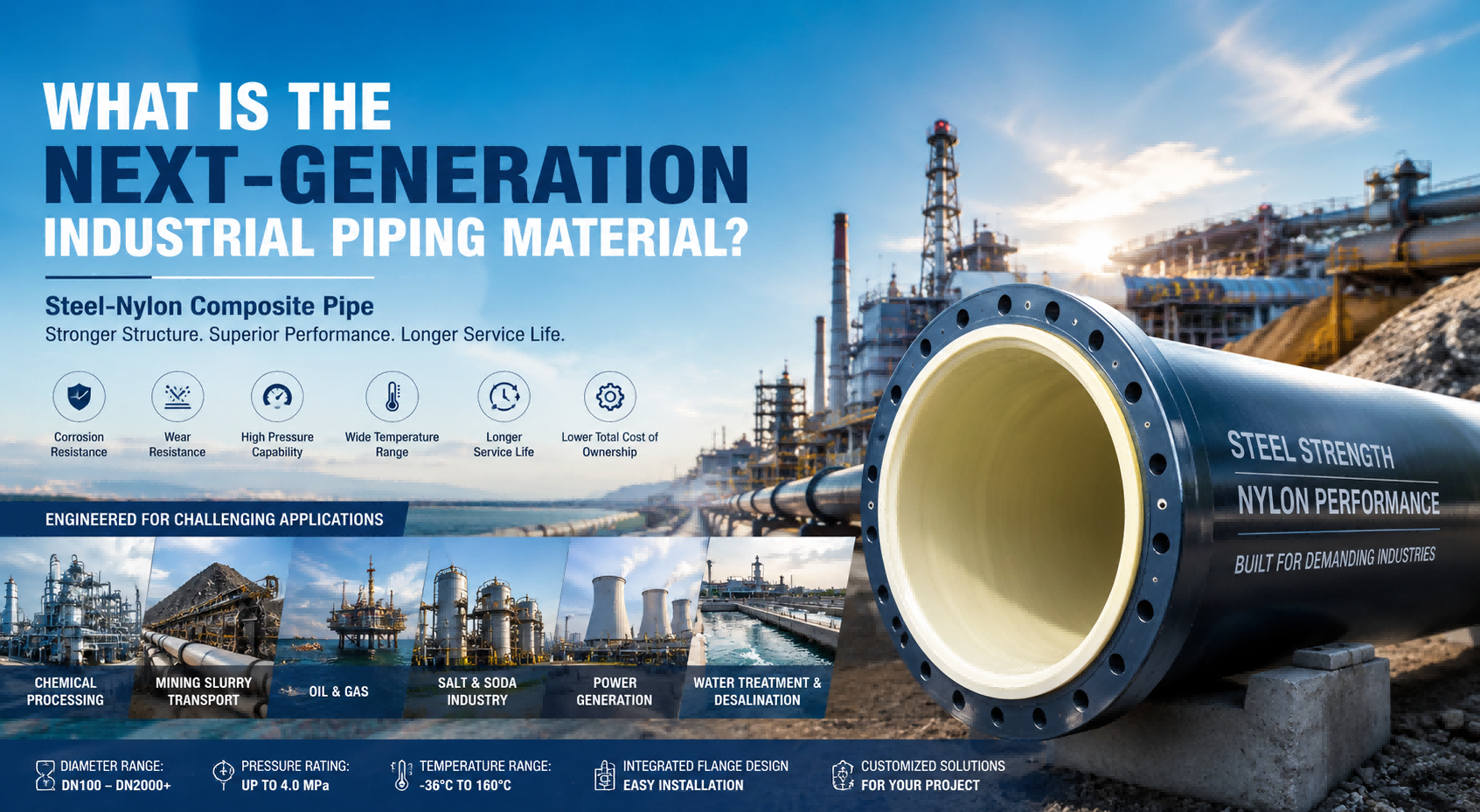
Our Steel-Nylon Composite Pipe adopts:
Steel reinforcement structure + Nylon corrosion-resistant layer + Integrated forming technology
Key advantages:
1. Built-in Flange Design
No on-site welding required:
-
Reduces welding risks
-
Shortens installation time
-
Minimizes leakage points
2. Standardized Connection
Provides easier:
-
Pipeline replacement
-
Equipment connection
-
Maintenance operations
This makes it highly suitable for large industrial projects requiring fast and reliable installation.
7. Lifecycle Cost (TCO) Comparison
Many projects focus only on initial purchase prices. However, the real cost of industrial pipelines includes:
-
Material cost
-
Installation cost
-
Production downtime
-
Maintenance expenses
-
Replacement costs
FRP Pipe
Advantages:
✔ Lower initial investment
Potential long-term costs:
-
Aging-related maintenance
-
Liner repair
-
Damage replacement
-
Production losses caused by failures
Reinforced Nylon Pipe
Advantages:
✔ Longer service life
✔ Lower maintenance requirements
✔ Higher operational reliability
Although the initial investment may be higher than conventional FRP pipes, reinforced nylon pipelines often provide lower total lifecycle costs.
For:
-
Chemical plants
-
Mining operations
-
Energy projects
the long-term economic benefits are more significant.
8. Why Steel-Nylon Composite Pipe Is Becoming an Industrial Pipeline Upgrade Solution
Steel-Nylon Composite Pipe combines the advantages of two materials:
Steel Advantages:
-
High mechanical strength
-
High pressure capability
-
Excellent dimensional stability
Nylon Advantages:
-
Corrosion resistance
-
Wear resistance
-
Impact resistance
-
Low friction characteristics
Creating an ideal industrial pipeline solution:
"Strong outside, corrosion-resistant inside."
Our products cover:
-
DN100–DN2000+
-
Pressure ratings from 1.0–4.0 MPa
Applications include:
-
Chemical transportation
-
Mining slurry pipelines
-
Oilfield gathering systems
-
Power plant desulfurization
-
Salt chemical industries
-
Industrial water supply systems
9. Application Value: From Frequent Replacement to Long-Term Reliability
Traditional pipeline management:
Pipeline failure → Shutdown → Replacement → Production recovery
Modern industrial management focuses on:
Correct material selection → Stable long-term operation → Reduced lifecycle cost
Reinforced Nylon Pipe and Steel-Nylon Composite Pipe perfectly match this industrial trend.
Conclusion: Reinforced Nylon Pipe Is an Advanced Alternative to FRP Pipe
FRP Pipe remains a mature industrial pipeline material. However, for applications requiring:
-
High wear resistance
-
High pressure performance
-
Strong chemical resistance
-
Long service life
Reinforced Nylon Pipe provides significant advantages.
For industrial projects seeking:
✅ Longer service life
✅ Fewer maintenance requirements
✅ Lower total operating costs
✅ Higher pipeline reliability
Reinforced Nylon Pipe and Steel-Nylon Composite Pipe are becoming important alternatives for upgrading traditional FRP pipeline systems.
Enhanced Nylon Pipe VS PE Pipe: A Comprehensive Guide to Industrial Pipeline Material Selection
Steel-Nylon Composite Pipe vs Plastic Lined Steel Pipe: A Better Choice for Corrosive and Abrasive Industrial Applications