Reinforced Nylon Pipe vs Stainless Steel Pipe: A Comprehensive Material Selection Analysis for Corrosive and Wear Applications

In industrial pipeline system design, stainless steel has long been considered a high-performance material. With excellent mechanical strength, attractive appearance, and good corrosion resistance, stainless steel pipes such as 304 and 316L are widely used in chemical processing, food, pharmaceutical, energy, and other industries.
However, as industrial production moves toward more demanding conditions — including high corrosion, severe wear, temperature fluctuations, high pressure, and long-term continuous operation — traditional stainless steel pipelines are increasingly facing limitations:
-
Risk of pitting corrosion in chloride-containing environments;
-
Limited wear resistance under high-concentration slurry transportation;
-
High initial investment costs;
-
Complex welding installation processes;
-
Welded areas becoming potential weak points for corrosion and leakage;
-
Increasing long-term maintenance expenses.
As a result, more and more industrial projects are turning to a new generation of pipeline materials that combine high mechanical strength with excellent corrosion resistance — Reinforced Nylon Pipe.
This article provides a detailed comparison between Reinforced Nylon Pipe and Stainless Steel Pipe from the perspectives of corrosion resistance, wear resistance, mechanical performance, temperature capability, installation efficiency, and total lifecycle cost (TCO), helping engineers make better pipeline material decisions.
1. Material Structure Comparison: Metal Material vs High-Performance Polymer Material
Characteristics of Stainless Steel Pipe
Stainless steel pipes are mainly manufactured from austenitic stainless steel grades, including:
-
304 Stainless Steel
-
316 Stainless Steel
-
316L Stainless Steel
Their corrosion resistance mainly comes from the chromium oxide passive film formed on the surface.
However, stainless steel is still a metal material, and it has limitations under special industrial conditions:
-
Chloride ions can damage the passive layer and cause pitting corrosion;
-
Strong acids may attack the protective film;
-
High-temperature alkaline environments may reduce material performance.
Characteristics of Reinforced Nylon Pipe
Reinforced Nylon Pipe is manufactured using high-performance MC nylon materials with advanced reinforcement technologies to improve:
-
Tensile strength;
-
Impact resistance;
-
Dimensional stability;
-
Wear resistance.
Compared with conventional plastic pipes, reinforced nylon pipes provide significantly higher pressure resistance and longer service life.
Typical structure:
High-strength reinforced nylon pipe wall + integrated forming design
Key advantages:
-
No metal corrosion;
-
Smooth inner surface;
-
No rust contamination;
-
Suitable for complex industrial media.
2. Corrosion Resistance Comparison: Reinforced Nylon Pipe Provides Superior Protection
Corrosion is one of the leading causes of industrial pipeline failure.
Corrosion Risks of Stainless Steel Pipe
Although 316L stainless steel provides excellent corrosion resistance, problems may still occur in the following environments:
Chloride-Containing Media
Examples:
-
Brine transportation;
-
Seawater desalination;
-
Chlor-alkali industries.
Chloride ions can destroy the passive film of stainless steel and cause localized corrosion.
Strong Alkaline Conditions
Examples:
-
Caustic soda production;
-
Alkaline circulation systems.
High-temperature and high-concentration NaOH solutions may create corrosion risks.
Corrosion Resistance Advantages of Reinforced Nylon Pipe
Reinforced Nylon Pipe does not experience electrochemical corrosion like metal pipelines.
It is suitable for:
-
Weak acids;
-
Strong alkalis;
-
Brine solutions;
-
Chemical mother liquor;
-
Mining slurry;
-
Corrosive industrial wastewater.
Due to its non-metallic characteristics, reinforced nylon pipes provide:
✅ No rusting
✅ No corrosion products
✅ No anti-corrosion coating maintenance
✅ No electrochemical corrosion damage
3. Wear Resistance Comparison: A Key Advantage in Slurry Transportation
For mining, power generation, chemical, and mineral processing industries, wear can be more destructive than corrosion.
Wear Problems of Stainless Steel Pipe
Although stainless steel has relatively high hardness, long-term high-speed particle impact can cause:
-
Wall thickness reduction;
-
Severe elbow erosion;
-
Localized pipeline failure.
This is especially common in:
-
Mining slurry transportation;
-
Fly ash transportation;
-
Phosphate slurry pipelines.
Traditional metal pipelines often require frequent replacement.
Wear Resistance Advantages of Reinforced Nylon Pipe
Reinforced nylon materials provide excellent:
-
Self-lubricating properties;
-
Impact resistance;
-
Particle impact absorption capability.
During slurry transportation:
When solid particles hit the pipe wall, the nylon layer absorbs and reduces impact energy, significantly lowering wear rates.
Therefore, reinforced nylon pipes are particularly suitable for:
-
Mine backfilling pipelines;
-
Tailings transportation systems;
-
Chemical slurry pipelines;
-
High-sand crude oil transportation.
4. Temperature and Pressure Performance Comparison
Stainless Steel Pipe
Advantages:
-
Excellent high-temperature capability;
-
Wide pressure range.
However, high-temperature resistance does not always mean the best engineering solution because:
-
Material costs increase;
-
Welding requirements become stricter;
-
Corrosion risks may still exist.
Reinforced Nylon Pipe
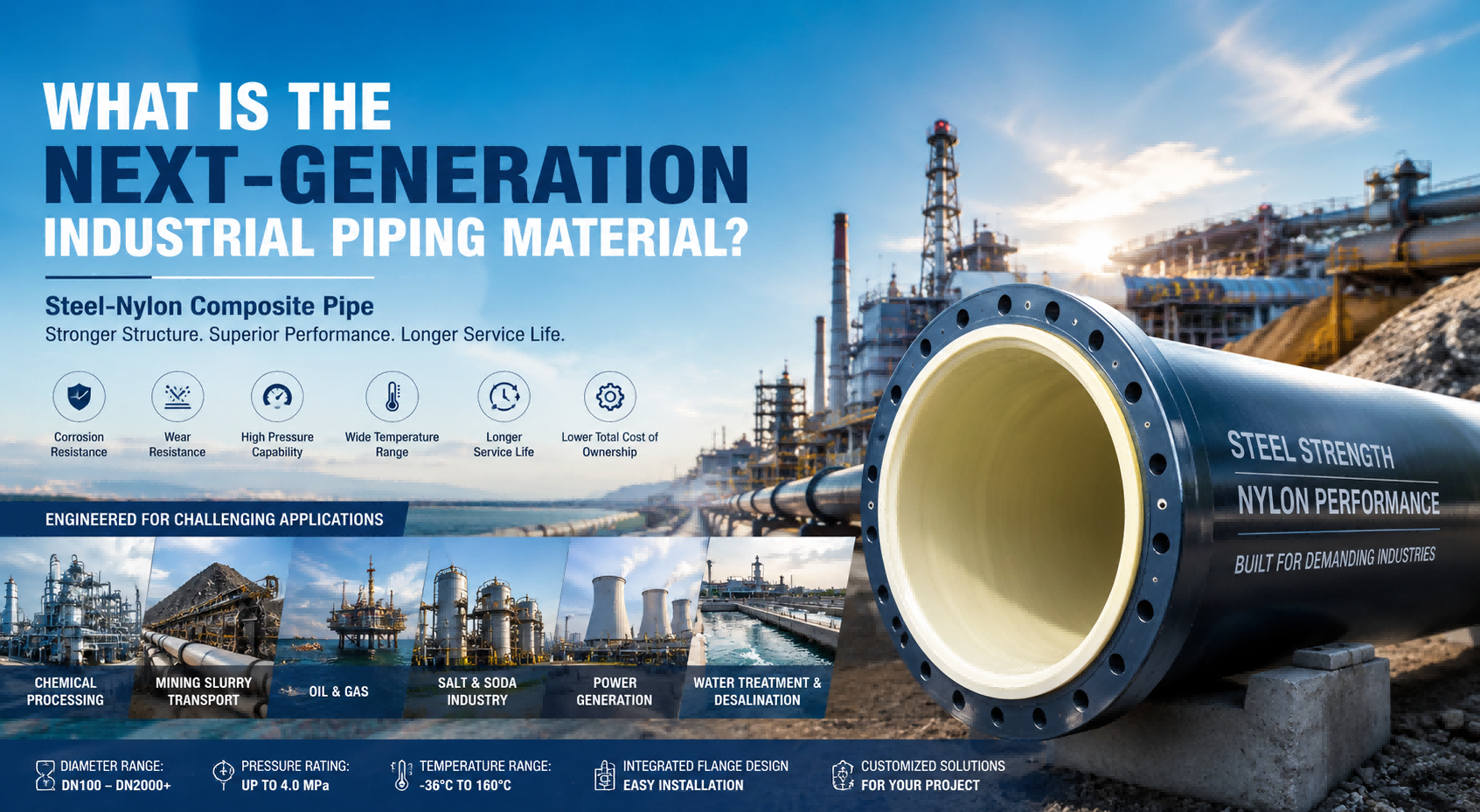
With advanced material modification technology, reinforced nylon pipes can achieve:
-
Operating temperature:
-36°C to 160°C -
Working pressure:
1.0–4.0 MPa -
Diameter range:
DN100–DN2000+
This allows reinforced nylon pipes to cover a wide range of industrial transportation applications.
5. Installation Comparison: Integrated Flange Design Reduces Construction Costs
Stainless Steel Pipe Installation
Traditional stainless steel pipeline installation usually requires:
-
Cutting;
-
Welding preparation;
-
Welding;
-
Non-destructive testing;
-
Corrosion protection treatment.
This results in longer construction periods.
Furthermore:
Welded areas often become potential corrosion and leakage points.
Installation Advantages of Reinforced Nylon Pipe
Reinforced Nylon Pipe adopts:
Integrated Flange Design
Features:
-
No field welding required;
-
Fewer installation steps;
-
Lower construction risks;
-
Reduced leakage points.
It is especially suitable for:
-
Large-diameter pipelines;
-
Long-distance outdoor transportation systems;
-
Pipeline renovation projects.
6. Total Lifecycle Cost (TCO) Comparison
Many projects focus only on initial purchase costs, but the real pipeline cost includes:
-
Material investment;
-
Installation expenses;
-
Production downtime losses;
-
Maintenance costs;
-
Replacement costs.
| Item | Reinforced Nylon Pipe | Stainless Steel Pipe |
|---|---|---|
| Initial investment | Lower | Higher |
| Corrosion maintenance | Minimal | May be required |
| Welding installation | Not required | Required |
| Wear resistance | Excellent | Moderate |
| Corrosion risk | Extremely low | Depends on media |
| Overall operating cost | Lower | Higher |
For long-term industrial operations, reinforced nylon pipes often provide higher economic value.
7. Industrial Application Examples
Case 1: Oilfield Produced Fluid Transportation System
An oilfield transportation system faced:
-
High water content;
-
High crude oil viscosity;
-
High sand content.
Traditional metal pipelines suffered from:
-
Corrosion;
-
Wear;
-
Frequent maintenance.
After adopting nylon composite pipelines and reinforced nylon solutions:
-
Pipeline operation became more stable;
-
Maintenance frequency was reduced;
-
Service life was extended.
Case 2: Soda Ash Industry Mother Liquor Transportation System
Soda ash production environments typically involve:
-
High chloride concentration;
-
Strong alkaline conditions;
-
Solid particle erosion.
Reinforced nylon pipes provide:
-
Excellent corrosion resistance;
-
Superior wear resistance;
-
Long-term reliable operation.
8. Why Reinforced Nylon Pipe Is Becoming the Next Generation Industrial Pipeline Solution
Compared with stainless steel pipes, reinforced nylon pipes provide:
① Superior Corrosion Resistance
Eliminates many metal corrosion problems.
② Better Wear Performance
Ideal for abrasive media transportation.
③ Lower Lifecycle Cost
Reduces maintenance and downtime losses.
④ Faster Installation
Integrated flange design simplifies construction.
⑤ Wider Industrial Applications
Suitable for:
-
Chemical industries;
-
Mining;
-
Oil & gas;
-
Power plants;
-
Seawater desalination;
-
Municipal engineering.
Conclusion: Pipeline Selection Should Focus on Long-Term Value
Stainless steel remains an important material for many clean, high-temperature, and high-pressure applications. However, in industrial environments where corrosion and wear occur simultaneously, metal strength alone cannot solve all pipeline challenges.
Reinforced Nylon Pipe combines:
Metal-level mechanical strength + Polymer corrosion resistance + Excellent wear performance
making it an increasingly valuable alternative for industrial pipeline upgrades.
For projects requiring long-term reliability, reduced maintenance costs, and improved operational efficiency, reinforced nylon pipes are becoming a high-value solution for replacing traditional stainless steel pipelines.
Why Do FRP Pipes Easily Delaminate?In-Depth Analysis of Fiberglass Pipe Failure Causes and the Advantages of Steel-Nylon Composite Pipes
Reinforced Nylon Pipe vs Ductile Iron Pipe: How a New Generation of Industrial Pipelines Achieves Performance Upgrades