Common Failure Modes of Rubber-Lined Steel Pipes: Why Do Their Corrosion and Wear Resistance Decline Over Time?
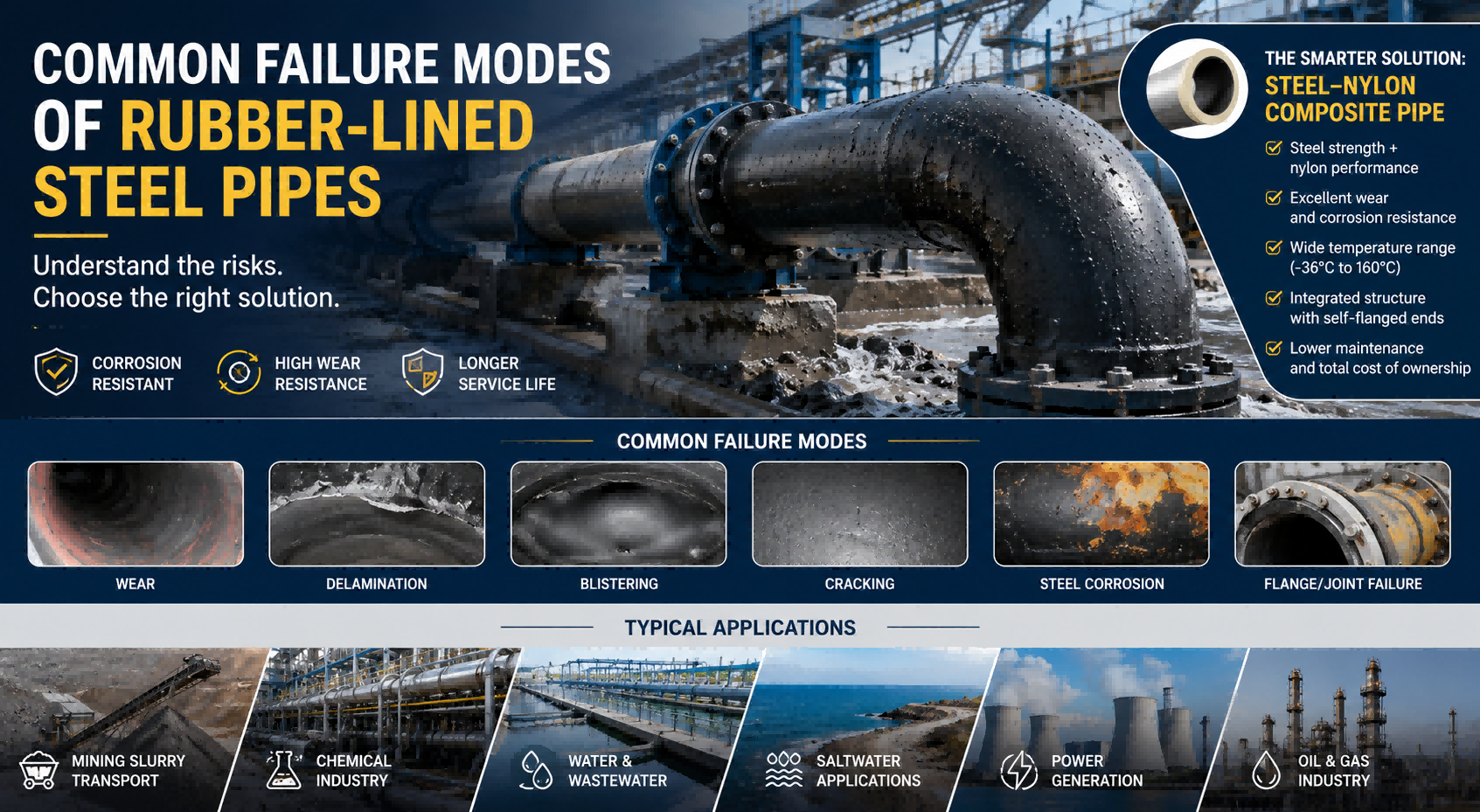
However, during long-term operation, the rubber lining may experience wear, delamination, blistering, cracking, peeling, and other forms of damage. Once the rubber lining fails, the corrosive medium can come into direct contact with the steel substrate, potentially leading to accelerated corrosion, leakage, and even pipeline failure.
Therefore, evaluating whether rubber-lined steel pipe is suitable for a specific industrial application requires more than simply considering the chemical resistance of the rubber. Factors such as medium characteristics, flow velocity, particle erosion, temperature, interfacial bonding, pressure fluctuations, and structural stress must also be considered.
For applications requiring long-term resistance to both corrosion and wear, steel-nylon composite pipe offers a different engineering approach.
1. Why Do Rubber-Lined Steel Pipes Fail?
A rubber-lined steel pipe typically consists of an external steel pipe and an internal rubber lining.
The steel pipe provides the primary mechanical strength and pressure-bearing capacity, while the rubber lining isolates the corrosive medium from the steel substrate and provides a certain level of impact and wear resistance.
This “steel + rubber” structure can perform well under suitable operating conditions, but its long-term reliability depends heavily on the integrity of the rubber lining.
Once localized damage occurs, failure may develop through a progressive chain:
Localized wear → lining defects → medium penetration → interface damage → steel corrosion → leakage or structural failure.
Therefore, one of the key risks of rubber-lined steel pipe is the long-term integrity of the rubber lining and the bonding interface between the lining and steel pipe.
2. Failure Mode #1: Rubber Lining Wear
In the transportation of mineral slurry, tailings, coal slurry, sand-containing water, saltwater, and other solid-liquid two-phase media, the rubber lining is continuously exposed to particle erosion.
Wear is often more severe at locations such as:
-
Elbows
-
Tees
-
Reducers
-
Pump discharge sections
-
Upstream and downstream valve sections
-
Pipeline diameter transitions
-
Areas with significant changes in flow direction
When solid particles travel at relatively high velocity and impact the pipe wall, they create continuous erosive forces.
If the medium contains hard particles or the flow velocity remains high for extended periods, the rubber lining can gradually become thinner.
It is important to note that average flow velocity alone does not determine wear rate.
Particle concentration, particle size, hardness, shape, impact angle, and local turbulence can all significantly affect actual erosion.
Therefore, simply increasing rubber lining thickness does not necessarily solve the fundamental problem in severe wear applications.
3. Failure Mode #2: Rubber Lining Delamination
Delamination is one of the typical failure modes of rubber-lined steel pipes.
Delamination occurs when the bonding interface between the rubber lining and steel substrate is damaged, creating a gap between the rubber and steel.
Several factors can contribute to delamination.
1. Insufficient Bonding Quality
Rubber lining processes generally involve steel surface preparation, adhesive application, vulcanization, and precise control of temperature and pressure.
If the steel surface is not properly prepared or contaminants remain on the bonding surface, the bonding strength may be reduced.
2. Temperature Changes
During operation, frequent temperature changes can cause the steel and rubber to deform differently because they have different coefficients of thermal expansion.
Repeated thermal cycling can therefore place additional stress on the interface.
3. Pressure and Vacuum Fluctuations
Pressure fluctuations, startup and shutdown shocks, and localized negative pressure can increase the deformation risk of the lining.
4. Localized Wear
As the rubber lining becomes thinner, its ability to withstand deformation decreases, making further interface damage more likely.
Once delamination occurs, a cavity can form behind the rubber lining. Continued operation may then cause blistering, vibration, and eventually local tearing.
4. Failure Mode #3: Rubber Lining Blistering
Blistering generally indicates localized debonding or penetration of the medium between the rubber lining and steel substrate.
If liquid enters the interface through a small defect, pressure may accumulate locally between the rubber and steel.
As operating time increases, this pressure can cause the lining to deform outward and form a visible blister.
Blistering can further develop into:
Blistering → localized stress concentration → rubber cracking → further medium penetration → expansion of delamination.
If blistering occurs in high-impact areas such as elbows or pump discharge sections, failure can progress more rapidly.
5. Failure Mode #4: Rubber Lining Cracking
Rubber does not maintain unlimited durability under all temperatures and chemical environments.
During long-term operation, rubber may be affected by:
-
High temperature
-
Low temperature
-
Chemical exposure
-
Ultraviolet radiation
-
Oxidation
-
Thermal cycling
-
Mechanical fatigue
These factors can gradually cause the rubber to harden, age, or lose elasticity.
As the elasticity of the rubber decreases, temperature changes, pressure fluctuations, and mechanical vibration can make cracking more likely.
For pipelines transporting corrosive media, even a small crack can become an entry point for the medium and initiate corrosion of the steel substrate.
6. Failure Mode #5: Corrosion of the Steel Substrate
One of the most important risks to consider is that:
Once the lining fails, the steel substrate can enter an accelerated corrosion stage.
Under normal conditions, the rubber lining isolates the corrosive medium from the steel.
However, if the lining develops pinholes, cracks, wear-through, or localized delamination, the medium may come into direct contact with the steel substrate.
In environments containing chloride ions, acidic media, saltwater, or other corrosive substances, localized corrosion can progress rapidly.
Therefore, the actual service life of a rubber-lined steel pipe depends significantly on:
How long the rubber lining can maintain its integrity under actual operating conditions.
This is an important factor that is sometimes overlooked when evaluating the long-term reliability of rubber-lined pipelines.
7. Failure Mode #6: Flange and Connection Failure
A pipeline is not simply a continuous straight pipe.
Flanges, elbows, tees, reducers, and valve connection sections are often the most structurally complex parts of the system.
In traditional rubber-lined pipelines, connection areas may involve:
-
Changes in lining thickness
-
Rubber edge treatment
-
Uneven sealing surfaces
-
Flange installation stress
-
Uneven bolt preload
-
Thermal expansion and contraction
These factors can combine to cause leakage or localized lining damage.
Therefore, pipeline design should not focus only on the material performance of straight pipe sections. The reliability of fittings and the entire connection system must also be considered.
8. Why Consider Steel-Nylon Composite Pipe as an Alternative?
To address some of these challenges, steel-nylon composite pipe uses a different structural concept.
It is not simply a conventional steel pipe coated with ordinary plastic. Instead, it combines the high mechanical strength of steel with the wear and corrosion resistance of nylon to form a composite pipeline structure.
The fundamental concept is:
The steel substrate provides structural strength, while the nylon inner layer handles contact with the medium and provides wear and corrosion resistance.
Compared with traditional rubber-lined structures, steel-nylon composite pipe can be engineered for high-wear, corrosive, and complex conveying environments.
9. Wear Resistance of Steel-Nylon Composite Pipe
Nylon offers excellent wear resistance and is particularly suitable for conveying fluids containing solid particles.
For mineral slurry, tailings, saltwater, sand-containing water, and certain chemical slurries, the internal pipe surface can be continuously exposed to particle erosion.
The nylon inner layer helps prevent corrosive media and solid particles from directly acting on the steel substrate.
For high-wear locations, specific attention can be given to:
-
Elbows
-
Tees
-
Reducers
-
Pump discharge sections
-
Upstream and downstream valve sections
This makes it possible to develop not only straight pipes but also wear-prone fittings and localized replacement solutions for critical areas.
10. Corrosion Resistance of Steel-Nylon Composite Pipe
In corrosive conveying applications, one of the primary risks of conventional steel pipe is direct contact between the steel and the process medium.
Steel-nylon composite pipe uses the nylon inner layer to isolate the conveying medium from the steel substrate, reducing the possibility of direct corrosion of the steel.
For weak acids, strong alkalis, saltwater, and certain chemical media, nylon can provide good corrosion resistance.
However, it is important to emphasize that:
No pipeline material should be selected based solely on the phrase “corrosion resistant.”
The actual medium, concentration, temperature, pressure, flow velocity, and operating conditions must all be evaluated during material selection.
11. Temperature Performance of Steel-Nylon Composite Pipe
Industrial pipelines frequently experience temperature changes.
If a material experiences significant degradation as temperature changes, its long-term service life can be affected.
Depending on the specific material system and design, steel-nylon composite pipe can be used across a relatively wide operating temperature range, with certain products capable of handling approximately -36°C to 160°C.
For industrial pipelines exposed to elevated temperatures, ambient temperature variations, or seasonal thermal cycling, this can provide greater flexibility in material selection.
Actual application should still be evaluated according to the specific medium, pressure, temperature, and pipeline design.
12. Structural Advantages of Steel-Nylon Composite Pipe
Material performance is only one part of pipeline reliability. Pipeline structure and connection design are equally important.
Steel-nylon composite pipe can be manufactured using an integrated forming structure and, depending on project requirements, can be supplied with integrally formed self-flanged connections.
This provides several practical advantages.
1. Reduced Field Welding
Reducing field welding can lower installation workload and minimize problems associated with welding operations and heat-affected areas.
2. Fewer Potential Leakage Points
A properly engineered integrated structure can reduce vulnerable connection areas associated with conventional multi-layer pipeline structures.
3. Systematic Fitting Design
Straight pipes, elbows, tees, reducers, pump discharge sections, and valve upstream/downstream sections can be designed as an integrated pipeline system rather than treated as isolated components.
13. From “Pipeline Life” to Total Cost of Ownership
When selecting an industrial pipeline, purchase price should not be the only consideration.
The more meaningful indicator is the total lifecycle cost:
TCO = Purchase Cost + Installation Cost + Maintenance Cost + Downtime Cost + Replacement Cost
For example, a lower-priced pipeline may eventually become more expensive if it requires frequent:
-
Lining repairs
-
Delamination inspections
-
Leakage repairs
-
Local replacement
-
Shutdown maintenance
-
Emergency repairs
For continuous-production industries such as chemical processing, mining, salt chemical production, oil & gas, and power generation, long-term operating reliability can be more valuable than a lower initial purchase price.
14. Which Applications Should Consider Steel-Nylon Composite Pipe?
Steel-nylon composite pipe is particularly worth evaluating in the following applications:
| Application | Main Challenge | Potential Value of Steel-Nylon Composite Pipe |
|---|---|---|
| Mineral slurry | Particle erosion and wear | Highly wear-resistant inner layer |
| Sand-containing water | Continuous particle erosion | Reduced direct wear on steel substrate |
| Saltwater | Chloride-related corrosion | Nylon barrier against the medium |
| Chemical media | Corrosion | Corrosion-resistant inner layer |
| Long-distance transportation | Difficult maintenance access | Improved operational reliability |
| Large-diameter pipelines | Structural and installation requirements | Steel substrate provides high strength |
| Wear-prone fittings | Rapid wear at elbows and tees | Targeted wear-resistant fitting design |
15. Conclusion: Pipeline Failure Is About More Than Corrosion Resistance
The failure of rubber-lined steel pipe is rarely caused by a single factor.
Wear, delamination, blistering, cracking, medium penetration, and steel substrate corrosion can form a continuous failure chain.
Therefore, when selecting an industrial pipeline, the key question should not simply be:
“Is this material corrosion resistant?”
A more important question is:
“Can this pipeline maintain structural integrity under my actual temperature, pressure, flow velocity, particle concentration, and corrosive environment for the required service life?”
Steel-nylon composite pipe combines the high strength of steel, the wear and corrosion resistance of nylon, an integrated composite structure, and systematic fitting design, providing an alternative engineering solution to some of the common failure mechanisms associated with traditional rubber-lined steel pipe.
For industrial pipeline systems exposed to corrosion, abrasion, pressure, and continuous operation, steel-nylon composite pipe is worth including in the material selection process and total cost of ownership analysis.
The goal of pipeline material selection is not to find one material that is “universally the best,” but to identify the solution that delivers reliable long-term performance and the lowest practical lifecycle cost under the actual operating conditions.
Which Industrial Pipe Has the Lowest Total Cost? A Deep Analysis of Lifecycle Cost
Why Do Steel Rubber Composite Pipes Wear Quickly? A Deep Analysis of Wear Mechanisms and a Better Wear-Resistant Pipeline Solution