Stainless Steel Pipes Worn Through in Phosphorus Chemical Processing: Steel–Nylon Composite Pipe Delivers 5× Better Abrasion Resistance

In the phosphorus chemical industry, pipeline wear and corrosion have always been a headache for engineering teams – especially when the common belief that “stainless steel equals durability” meets harsh reality. A heavy blow for many plants: expensive 316L stainless steel pipes were worn through after only a few months of conveying phosphate rock slurry. This is not an isolated case. During a follow-up with an overseas client, a large phosphate fertilizer plant in Southeast Asia complained that their stainless steel pipe replacement frequency almost matched their equipment maintenance intervals – until they tried a **steel–nylon composite pipe** and saw its service life extended by more than five times.
What exactly creates such a huge performance gap? And why has the steel–nylon composite pipe become the “go-to answer” for wear-resistant piping in phosphorus chemicals? This article provides an in-depth analysis.
1. The “Hellish” Operating Conditions in Phosphorus Chemical Pipelines: More Than Just Wear
Many people assume stainless steel is simply being ground down by hard phosphate rock particles. In reality, the conveyed medium in phosphorus chemicals is far more complex – it is a classic **synergistic corrosion–abrasion field**:
**Solid particle erosion**: Phosphate rock slurry contains a large amount of irregular hard particles (Mohs hardness can reach 5–7), which cause micro-cutting and ploughing on the pipe wall under high-velocity flow.
**Acidic medium corrosion**: In wet-process phosphoric acid production, sulfuric acid, phosphoric acid, and fluosilicic acid are often present, with pH values as low as 1–3. Stainless steel relies on a dense chromium oxide passive film for corrosion protection.
**The deadly synergy**: Fast-flowing slurry particles continuously scour the surface and instantly strip away the freshly formed passive film. The exposed fresh metal substrate is then rapidly corroded in the acidic environment, creating a loose corrosion layer, which is then easily carried away by the next wave of abrasion. **This vicious cycle of “corrosion accelerating wear, and wear exposing fresh substrate” causes the wear rate of stainless steel to increase exponentially.** This is why 316L performs passably in static acid but is so “fragile” in flowing slurry.
**Acidic medium corrosion**: In wet-process phosphoric acid production, sulfuric acid, phosphoric acid, and fluosilicic acid are often present, with pH values as low as 1–3. Stainless steel relies on a dense chromium oxide passive film for corrosion protection.
**The deadly synergy**: Fast-flowing slurry particles continuously scour the surface and instantly strip away the freshly formed passive film. The exposed fresh metal substrate is then rapidly corroded in the acidic environment, creating a loose corrosion layer, which is then easily carried away by the next wave of abrasion. **This vicious cycle of “corrosion accelerating wear, and wear exposing fresh substrate” causes the wear rate of stainless steel to increase exponentially.** This is why 316L performs passably in static acid but is so “fragile” in flowing slurry.
2. Material Showdown: Why Can Nylon Outperform Stainless Steel?
The structural philosophy of the steel–nylon composite pipe is to **“assign the specialized work to the specialized material.”** It uses a high-quality carbon steel or alloy steel outer layer for pressure containment, lined with a defined thickness of modified engineering nylon. **(The nylon discussed here is primarily a specially formulated modified PA6.)**
In phosphorus chemical slurry transport, the physical properties of the nylon liner achieve a “dimensional blow” over stainless steel:
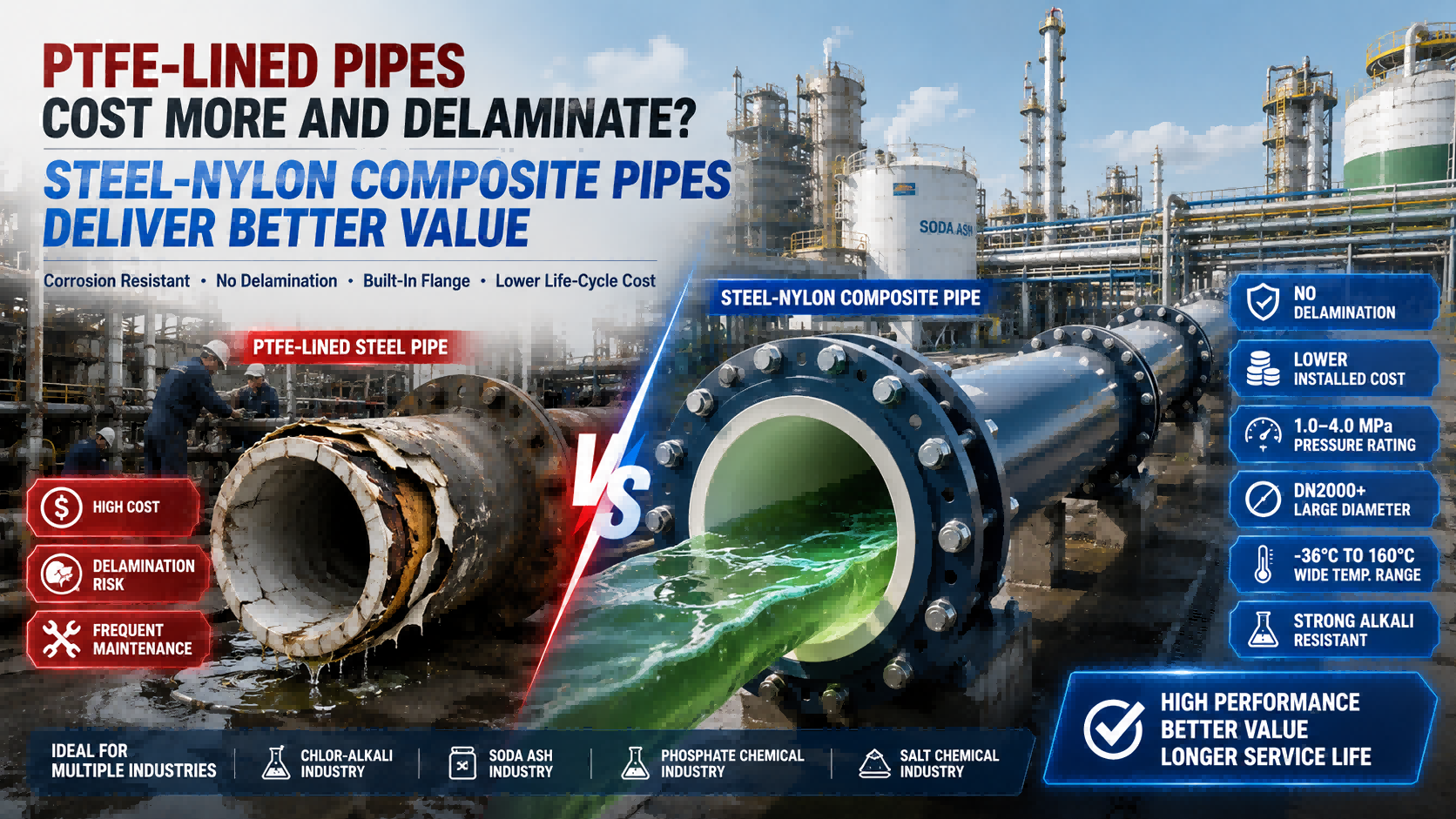
| Performance Dimension | Stainless Steel Pipe (316L) | Steel–Nylon Composite Pipe (Modified PA6 Liner) | Advantage Analysis |
|---|---|---|---|
| Wear Mechanism | Hard-on-hard contact; the surface oxide film is hard but brittle | Tough molecular chains; high energy-absorbing elastomer | Nylon exhibits excellent rebound resilience. When hard particles impact, the nylon layer absorbs the impact energy and springs back, rather than being rigidly cut like stainless steel. |
| Corrosion Resistance | Dependent on passive film; not resistant to halide ions or erosion | Inherent resistance to acids and alkalis; chemically inert | Modified PA6 does not rely on an oxide film. It is intrinsically stable against weak acids, alkalis, and salt solutions, and does not undergo electrochemical corrosion – completely breaking the corrosion–wear chain. |
| Friction Coefficient | 0.3–0.5 (relatively rough) | 0.1–0.15 (self-lubricating) | Conveying resistance is minimal, which not only saves energy but also reduces sliding friction of particles on the pipe wall, lowering wear at the source. |
| Anti-Scaling | Hydrophilic, scales easily, causing cross-section reduction | Very low surface energy, non-stick | Gypsum and calcium/magnesium scales common in phosphorus chemicals find it difficult to adhere firmly to the nylon surface, keeping the pipe bore as clean as new over long-term operation. |
3. The Data and Mechanism Behind “5× Wear Resistance”
The claim of **“5× better wear resistance”** is not marketing hype but a rigorous conclusion based on standard abrasion tests and field coupon data.
In slurry abrasion tests conducted according to GB/T 3960 (similar to ASTM G99) or comparable standard methods, the wear volume of modified PA6 is typically only 15%–20% of that of 316L stainless steel. In a bypass test with real phosphogypsum slurry (30% solids content, 60°C), we recorded the following comparison:
**316L stainless steel pipe**: 4 mm wall thickness, worn through first at the elbow after approximately 4 months of operation, with deep grooves also appearing in straight sections.
**Steel–nylon composite pipe** (6 mm thick modified PA6 liner): Under identical conditions, ran for over 20 months with the inner liner surface remaining smooth and showing no significant wear marks. Total expected service life reaches 5–6 times that of stainless steel.
**Steel–nylon composite pipe** (6 mm thick modified PA6 liner): Under identical conditions, ran for over 20 months with the inner liner surface remaining smooth and showing no significant wear marks. Total expected service life reaches 5–6 times that of stainless steel.
**The deeper mechanism lies in laminar boundary layer protection**: The self-lubricating nature of nylon creates a gentler velocity gradient near the pipe wall, forming a thicker “boundary layer.” This fluid film acts like a shield, preventing large particles from directly impacting the pipe wall body, thereby achieving the principle of “overcoming hardness with softness.”
4. From a Foreign Trade Perspective: Lighter, Easier to Install, Lower Total Lifecycle Cost
For overseas engineering projects, the steel–nylon composite pipe offers strong engineering economics beyond superior performance, which is often the key to winning over procurement managers:
**40%–60% lighter weight**: Compared with seamless stainless steel pipe of the same specification, the composite pipe is significantly lighter. This reduces both ocean freight costs and on-site lifting/bracket load requirements, making it especially suitable for overseas infrastructure projects.
**No cathodic protection or coating needed**: In some environments, stainless steel still requires coating or cathodic protection, whereas the composite pipe has an inherently anti-corrosive and wear-resistant inner layer – no risk of rusting.
**Flexible connection methods**: Flanged connections, grooved couplings and other solutions greatly shorten on-site installation time overseas and solve the pain point of a shortage of skilled welders.
**Total cost of ownership only about 1/3**: Although the purchase price per meter may be close to or slightly higher than stainless steel, factoring in 5× longer service life, reduced downtime and replacement costs, plus the indirect benefits of being maintenance-free, the total cost of ownership advantage is enormous.
**No cathodic protection or coating needed**: In some environments, stainless steel still requires coating or cathodic protection, whereas the composite pipe has an inherently anti-corrosive and wear-resistant inner layer – no risk of rusting.
**Flexible connection methods**: Flanged connections, grooved couplings and other solutions greatly shorten on-site installation time overseas and solve the pain point of a shortage of skilled welders.
**Total cost of ownership only about 1/3**: Although the purchase price per meter may be close to or slightly higher than stainless steel, factoring in 5× longer service life, reduced downtime and replacement costs, plus the indirect benefits of being maintenance-free, the total cost of ownership advantage is enormous.
5. Success Case and Selection Advice
In a North African phosphate fertilizer project, the client initially insisted on using 316L pipe to convey extraction slurry and had to shut down the entire line every six months to replace elbows. After trialing our **steel-lined modified PA6 composite pipe**, no leakage points appeared over three years of continuous operation. When the project was later expanded, 90% of the slurry pipelines were specified as steel–nylon composite pipe solutions.
**Selection Note**: Not all nylons suit the same conditions. Our primary nylon lining is modified PA6, which performs excellently for standard wet-process phosphoric acid slurry (temperature <80°C, pH 1–4). When the conveyed medium temperature exceeds 90°C or contains high concentrations of strongly oxidizing acids, we recommend consulting our engineers to select special heat-resistant nylon grades (such as PA12) or adopt a steel–UHMWPE composite solution.
**Conclusion: Say Goodbye to Blindly Using High-Grade Material and Embrace the Composite Material Mindset**
Stainless steel being worn through in phosphorus chemical slurry is not because stainless steel isn’t good enough, but because it was used in the wrong place. The **steel–nylon composite pipe** – using low-cost carbon steel for mechanical strength and high-performance modified PA6 to tackle corrosion and abrasion – represents a consensus rapidly gaining ground in global mining and chemical wear-resistant piping selection.
If you are looking for a high-performance solution that can truly end frequent pipe replacements and dramatically reduce operating costs per ton of product, please contact our engineering team to obtain a customized wear-resistant pipe recommendation and product samples. Let our advanced composite pipe technology extend your clean conveying cycle by more than five times.
Say Goodbye to Stainless Steel Welded Pipe Leak Worries – Eliminate Hot Work with Flanged Steel-Nylon Composite Pipe
316L Stainless Steel Can't Resist Chloride Ions? Steel-Nylon Composite Pipe Outperforms Precious Metals in Salt Chemical Processing
Related blog