
How Are Fluctuating Stainless Steel Prices Affecting Industrial Pipe Material Selection?
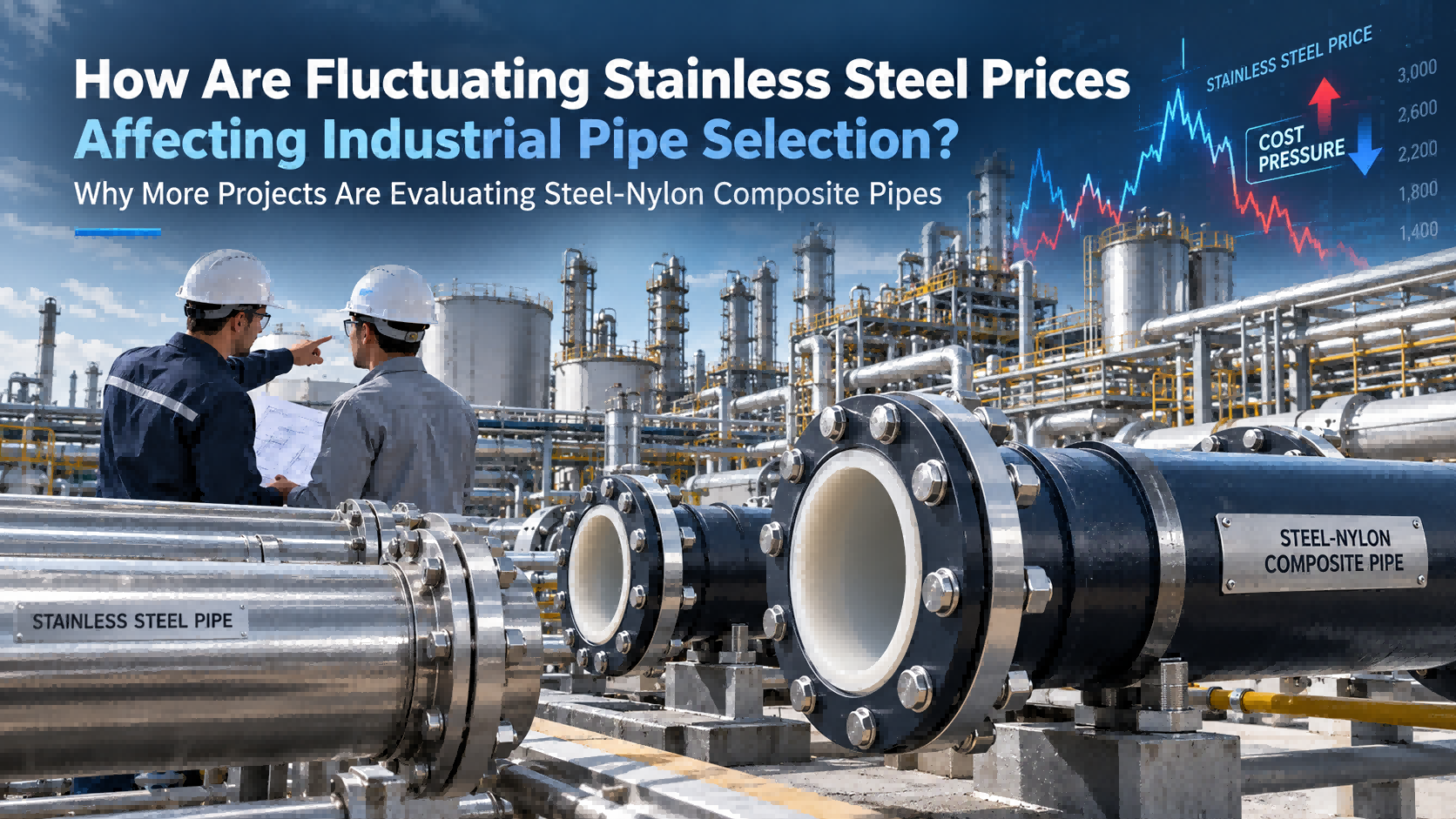
From 304/316L Stainless Steel Cost Volatility to the Long-Term Economic Value of Steel-Nylon Composite Pipes
Introduction: Industrial Pipe Selection Is Shifting from Material Performance to Cost and Risk Management
Stainless steel has long been one of the most widely used materials for industrial piping systems in the chemical, oil and gas, mining, power generation, and water treatment industries.
In particular, 304 and 316L stainless steel pipes are commonly specified because of their mechanical strength, corrosion resistance, and established manufacturing technologies.
However, fluctuations in the prices of nickel, chromium, molybdenum, and other alloying elements, combined with changes in global supply chains, energy costs, and manufacturing expenses, have introduced greater uncertainty into industrial piping budgets.
For industrial companies, the critical question is no longer simply:
"How much have stainless steel prices increased?"
Instead, procurement teams and engineering contractors are increasingly asking:
"Is it technically and economically necessary to use expensive stainless steel for every industrial piping application?"
This question is particularly relevant in 2026.
According to data released by worldstainless in August 2026, global stainless steel melt shop production reached approximately 33 million metric tons in the first half of 2026, representing a year-on-year increase of 5%.
However, increased production does not necessarily translate into lower stainless steel prices across all regions and grades.
For example, published alloy surcharge data from Italian steel supplier Bettinelli Acciai showed that the alloy surcharge for 316L stainless steel increased from €4.34/kg in March 2026 to €5.13/kg in October 2026.
It is important to emphasize that these figures represent alloy surcharges published for a specific market rather than the final selling prices of 316L stainless steel pipes. They should not be interpreted as a global increase in finished pipe prices.
Nevertheless, such changes illustrate how fluctuations in alloy costs can influence stainless steel procurement.
As a result, industrial project owners and engineering contractors are increasingly considering several important questions:
-
Which applications genuinely require 304, 316L, or higher-grade stainless steel?
-
Which corrosive or abrasive applications could potentially use composite piping systems?
-
How can industrial projects reduce their exposure to fluctuations in nickel and molybdenum prices?
-
How can pipe material selection reduce both initial investment and long-term maintenance costs?
-
Can alternative pipe materials provide comparable reliability at a more competitive total cost?
Among the materials worth evaluating, steel-nylon composite pipes offer a promising solution for selected industrial applications involving corrosion, abrasion, and demanding mechanical requirements.
1. Why Do Stainless Steel Price Fluctuations Affect Industrial Piping Projects?
1.1 Nickel and Molybdenum Are Important Cost Drivers for Stainless Steel
Industrial stainless steel is not a single material. Different grades contain different combinations of alloying elements.
| Stainless Steel Grade | Typical Alloy Characteristics | Common Applications | Major Cost Factors |
|---|---|---|---|
| 304 Stainless Steel | Typical composition of approximately 18% chromium and 8% nickel | General industrial water and process piping | Nickel, chromium, manufacturing |
| 304L Stainless Steel | Low-carbon version of 304 | Welded industrial piping systems | Nickel, chromium, processing |
| 316L Stainless Steel | Typically contains 10–14% nickel and 2–3% molybdenum | Chemical processing, water treatment, chloride-containing media | Nickel, molybdenum, chromium |
| 2205 Duplex Stainless Steel | Combination of chromium, nickel, molybdenum, and nitrogen | More demanding chloride-containing environments | Multiple alloying elements and manufacturing |
Note: The chemical compositions shown are typical or approximate values. Actual requirements should be verified against applicable material standards and mill certificates.
316L stainless steel contains molybdenum, which generally provides improved resistance to chloride-induced pitting corrosion compared with 304 stainless steel.
However, this improved performance also increases its sensitivity to changes in certain alloying element prices.
For projects requiring substantial quantities of 316L pipes, elbows, tees, flanges, and other fittings, fluctuations in raw material costs can have a meaningful impact on procurement budgets.
1.2 Stainless Steel Procurement Prices Are Not Always Fixed
International stainless steel suppliers may use pricing structures that include base prices, product premiums, and alloy surcharges.
In some markets, alloy surcharges are adjusted regularly according to changes in raw material costs.
Consequently, several problems may arise between preliminary engineering and final procurement:
-
Material prices used in early project budgets may become outdated.
-
Procurement quotations may need to be revised.
-
Suppliers may shorten quotation validity periods.
-
International projects may face additional currency and transportation cost exposure.
-
Engineering teams may need to reassess whether 316L is necessary for every pipeline.
These challenges can be particularly significant for large chemical plants, mining operations, and water treatment facilities with extended project development and construction schedules.
1.3 Large-Diameter Piping Projects Face Greater Absolute Cost Exposure
As industrial facilities expand their fluid transportation capacities, the demand for large-diameter industrial pipelines continues to develop.
Increasing pipe diameter generally requires more material, although the actual quantity depends on wall thickness, design pressure, density, and pipe structure.
For large-diameter stainless steel piping projects, even moderate changes in material prices can result in substantial differences in total procurement costs.
Therefore, engineers and procurement teams should evaluate piping systems based on more than the price per metric ton.
A more comprehensive approach considers:
Installed cost per unit length, operating performance, maintenance requirements, expected service life, and total lifecycle cost.
2. Five Ways Stainless Steel Price Volatility Is Changing Industrial Pipe Procurement
2.1 From Single-Material Specifications to Multi-Material Evaluation
Traditionally, some industrial projects specify 304 or 316L stainless steel during the initial engineering stage.
However, using the same material throughout an entire facility may result in unnecessary material costs or performance mismatches.
For example, a chemical processing plant may include:
-
High-temperature, high-pressure process pipelines
-
Ambient-temperature brine transportation lines
-
Corrosive industrial wastewater pipelines
-
Abrasive slurry transportation systems
-
Cooling and circulating water pipelines
These applications have very different operating requirements.
High-temperature and high-pressure process lines may require metallic piping materials.
Meanwhile, certain corrosive aqueous solutions and abrasive slurry transportation systems may be suitable for evaluation using steel-nylon composite pipes or other non-metallic and composite piping systems.
Selecting materials according to actual operating conditions can help avoid unnecessary expenditure without compromising engineering safety.
2.2 From Initial Purchase Price to Total Cost of Ownership
The economic value of stainless steel piping cannot be determined solely by its purchase price.
Even when initial investment is relatively high, stainless steel may deliver good lifecycle economics if it provides excellent reliability and a long service life under the specified conditions.
Conversely, if a piping system experiences recurring corrosion, abrasion, or maintenance problems, a higher purchase price does not necessarily result in lower operating costs.
For this reason, industrial companies are increasingly evaluating piping materials through Total Cost of Ownership (TCO) analysis.
2.3 From Uniform Material Selection to Application-Specific Optimization
Some industrial facilities can benefit from combining different pipe materials within the same project.
For example:
Critical high-temperature and high-pressure pipelines may continue using stainless steel that satisfies applicable engineering standards.
At the same time, selected ambient-temperature or moderate-temperature corrosive liquid pipelines may be evaluated for steel-nylon composite pipe applications.
This strategy is not about eliminating stainless steel.
Instead, it allows each material to be used where its performance characteristics offer the greatest value.
2.4 Greater Attention to Maintenance and Downtime Risks
For continuously operating chemical plants, mines, and oilfields, the consequences of pipe failure extend far beyond the replacement cost of the damaged pipe.
Additional expenses may include:
-
Unplanned production shutdowns
-
Maintenance labor and equipment
-
Leakage containment and cleanup
-
Reduced operating efficiency
-
Environmental remediation
-
Production schedule disruptions
In many cases, reducing the frequency of pipeline failures can provide greater economic benefits than simply lowering the initial material cost.
2.5 Supply Chain Stability Becomes Part of Material Selection
When a piping system depends heavily on certain alloying elements, procurement teams must consider the availability and price stability of those materials.
Evaluating multiple technically acceptable pipe materials can help diversify some procurement risks.
However, composite pipes are also affected by steel prices, polymer costs, energy expenses, and manufacturing conditions.
Therefore, composite piping should not be considered completely immune to material price fluctuations.
3. Are 304 and 316L Stainless Steel Still the Best Choices for Corrosive Industrial Pipelines?
The answer depends on the operating environment.
3.1 Stainless Steel Still Offers Important Engineering Advantages
304 and 316L stainless steel have well-established applications in industrial piping.
Their advantages include:
-
Good mechanical strength
-
Mature welding and fabrication technologies
-
Broad temperature capability
-
Corrosion resistance in compatible environments
-
Extensive availability of standardized pipes and fittings
-
Established engineering design procedures
For high-temperature, high-pressure, and safety-critical applications, stainless steel remains an important material.
3.2 Stainless Steel Is Not Resistant to Every Type of Corrosion
The corrosion resistance of stainless steel depends largely on the formation of a protective passive film on its surface.
Under certain chloride concentrations, temperatures, pH conditions, oxidizing environments, or crevice geometries, localized corrosion may occur.
Several corrosion mechanisms deserve particular attention.
Pitting Corrosion
Chloride ions can locally disrupt the passive film, resulting in concentrated areas of corrosion.
Crevice Corrosion
Restricted areas around flanges, gaskets, and other connections may develop localized chemical environments that accelerate corrosion.
Stress Corrosion Cracking
Under specific combinations of tensile stress, temperature, and corrosive conditions, certain austenitic stainless steels may experience stress corrosion cracking.
Combined Erosion and Corrosion
When fluids contain suspended solid particles, mechanical erosion can damage protective surface films and accelerate metal loss.
316L stainless steel generally provides better chloride pitting resistance than 304 stainless steel.
However, it cannot guarantee reliable performance in every high-salinity, high-temperature, or highly corrosive environment.
More demanding conditions may require duplex stainless steel, super duplex stainless steel, or other specialized materials.
3.3 A Higher Material Price Does Not Always Mean Better Performance
Some industrial projects select more expensive metallic materials to improve reliability.
However, operational problems may still occur due to localized corrosion, abrasion, or failure at pipeline connections.
This demonstrates that material price alone cannot determine pipeline performance.
The most appropriate industrial pipe material should be selected based on chemical compatibility, structural safety, operating conditions, lifecycle economics, and maintenance requirements.
4. Why Are Steel-Nylon Composite Pipes Worth Considering as an Alternative?
Steel-nylon composite pipes are not simply plastic pipes replacing steel pipes.
They are engineered composite piping systems designed to combine the advantages of different materials.
Their fundamental design principle is:
Use steel components to provide mechanical support and structural strength while using a nylon functional layer to provide corrosion and abrasion resistance in suitable operating environments.
This structure offers an alternative approach for industrial applications where conventional metallic pipes experience corrosion or wear-related challenges.
4.1 Reducing Direct Contact Between Corrosive Fluids and Steel
In conventional metallic piping systems, the internal metal surface is directly exposed to the transported fluid.
In a properly designed steel-nylon composite pipe, a continuous and chemically compatible nylon lining can provide a protective barrier between the transported medium and the steel structure.
For suitable applications involving brine, industrial wastewater, and certain chemical process liquids, this design can help reduce the risk of internal metal corrosion.
However, nylon materials are not universally resistant to all strong acids, strong alkalis, oxidizing agents, or organic solvents.
Chemical compatibility must be verified according to:
-
Chemical composition
-
Concentration
-
Operating temperature
-
Design pressure
-
Exposure duration
-
Nylon formulation
-
Impurities and additional chemical components
4.2 Abrasion-Resistant Design for Slurry Transportation
Mining, mineral processing, tailings transportation, and other solid-liquid handling systems frequently expose piping surfaces to abrasive particles.
Specially formulated reinforced nylon materials can be considered for certain abrasive environments.
Steel-nylon composite pipes combine a wear-resistant functional layer with the mechanical support provided by steel components.
Potential benefits include:
-
Reduced internal wear under suitable conditions
-
Lower maintenance requirements for abrasion-prone pipelines
-
Longer maintenance intervals where verified by operating data
-
Targeted upgrades for elbows, tees, and pump discharge sections
-
Improved lifecycle economics in certain slurry transportation applications
The actual wear performance depends heavily on particle size, particle shape, solids concentration, flow velocity, and impact angle.
Therefore, any claimed abrasion resistance advantage should be supported by relevant laboratory tests or comparable operating experience.
4.3 Combining Structural Strength with Composite Material Performance
Some conventional non-metallic pipes face design limitations involving structural stiffness, creep behavior, joint design, or external loading conditions, particularly in certain large-diameter and elevated-pressure applications.
Steel-nylon composite pipes provide another engineering option by combining polymer functional properties with steel reinforcement.
Our products are developed for industrial transportation applications involving corrosion, abrasion, and mechanical loading.
Different pipe diameters, pressure classes, and connection structures can be evaluated according to project requirements.
However, the final operating pressure and temperature limits must be established using the actual composite pipe design, product testing, and applicable engineering standards.
The individual properties of steel or nylon should not be treated as the pressure and temperature ratings of the complete piping system.
4.4 Flanged Connections Can Simplify Certain Installation Requirements
On-site installation costs are often underestimated during industrial piping procurement.
Traditional metallic pipeline construction may require extensive field welding, weld inspection, and related safety procedures.
For suitable composite piping applications, our products can incorporate flanged connections and integrally formed flange designs.
These solutions may reduce the amount of field welding required.
This can be particularly valuable for:
-
Industrial plant renovation projects
-
Facilities with restrictions on hot work
-
Maintenance projects with limited shutdown windows
-
Industrial piping installations with demanding construction schedules
Flanged systems must still comply with relevant engineering requirements for bolt tightening, sealing, pipe supports, and pressure testing.
4.5 Potential for Lower Long-Term Maintenance Costs
The economic value of steel-nylon composite pipes is not limited to their potential initial cost advantages.
In appropriate environments, their corrosion-resistant and abrasion-resistant characteristics may reduce maintenance requirements and extend service intervals.
For industrial facilities operating continuously, these benefits can be especially important.
5. 304 vs. 316L Stainless Steel vs. Steel-Nylon Composite Pipes
Choosing the most suitable industrial pipe material requires evaluating performance and cost together.
The following comparison highlights important differences.
| Comparison Factor | 304 Stainless Steel | 316L Stainless Steel | Steel-Nylon Composite Pipe |
|---|---|---|---|
| Material structure | Austenitic stainless steel | Molybdenum-containing austenitic stainless steel | Steel structure with nylon functional layer |
| Major cost drivers | Nickel, chromium, manufacturing | Nickel, molybdenum, chromium, manufacturing | Steel, nylon materials, composite manufacturing |
| Chloride corrosion resistance | Limited by chloride concentration, temperature, and other conditions | Generally better than 304 but still susceptible to localized corrosion | Depends on nylon compatibility and protective structure |
| Abrasion performance | Requires erosion assessment | Requires erosion assessment | Can be optimized for selected abrasive conditions |
| High-temperature capability | Broad application range | Broad application range | Limited by nylon and composite structure |
| Pressure resistance | Established metallic piping design methods | Established metallic piping design methods | Requires composite-specific pressure design |
| Connection methods | Welding, flanges, and others | Welding, flanges, and others | Engineered flanged connections |
| Maintenance requirements | Depend on corrosion and service conditions | Depend on corrosion and service conditions | Potential for reduced maintenance in suitable applications |
| Large-diameter applications | Available, but cost should be evaluated | Available, but cost should be evaluated | Worth evaluating for suitable projects |
| Lifecycle economics | Application-dependent | Application-dependent | Requires project-specific TCO analysis |
The key point is that steel-nylon composite pipes do not need to outperform stainless steel in every technical category to provide superior economic value.
If a composite pipe can safely meet the operating requirements, achieve the desired service life, and reduce total system costs, it may offer a more economical solution for a particular application.
This is the fundamental principle of effective industrial pipe material optimization.
6. Which Industries Could Benefit from Steel-Nylon Composite Pipes?
6.1 Chlor-Alkali and Salt Chemical Industries
Common transported media include:
-
Brine
-
Brine sludge
-
Selected alkaline process liquids
-
Chemical mother liquor
-
Saline industrial wastewater
These fluids may contain high concentrations of dissolved salts, corrosive components, or suspended solids.
When stainless steel is used, engineers must consider potential corrosion mechanisms and long-term material performance.
For compatible operating conditions, steel-nylon composite pipes can help separate corrosive fluids from the steel structure.
They are particularly worth evaluating in industrial transportation systems operating at moderate temperatures and within the verified pressure limits of the piping system.
6.2 Oil and Gas Industry
Oilfield gathering and water injection systems may handle:
-
High-salinity produced water
-
Injection water
-
Chloride-containing industrial fluids
-
CO₂- and H₂S-containing environments
-
Fluids containing suspended solid particles
Conventional metallic pipelines may experience internal corrosion in some of these conditions.
For applications compatible with composite materials, steel-nylon composite pipes can be evaluated as an alternative.
However, sour service, high-pressure applications, gas transportation, and complex chemical environments require additional verification.
Important factors include gas permeability, rapid decompression effects, sealing performance, material aging, and compliance with relevant project standards.
6.3 Mining Slurry and Tailings Transportation
Mining pipelines must resist both mechanical loading and long-term abrasive wear.
In iron ore, copper ore, tailings, and certain backfill slurry transportation systems, abrasion can significantly affect maintenance schedules.
Steel-nylon composite pipes provide an approach that combines a wear-resistant functional layer with structural reinforcement.
For long-distance or continuously operating slurry pipelines, project evaluations should consider:
-
Pipe purchase cost per unit length
-
Elbow and tee service life
-
Maintenance frequency
-
Annual downtime
-
Pumping energy consumption
-
Pipeline replacement costs
A comprehensive comparison can help determine whether steel-nylon composite pipes offer lifecycle advantages.
6.4 Power Generation and Industrial Water Treatment
Power plant circulating water systems, selected flue gas desulfurization applications, and industrial wastewater pipelines may encounter corrosion, scaling, and abrasive particles.
Composite pipes with chemically compatible, relatively smooth internal surfaces may help address certain corrosion-related problems.
However, scaling also depends on water chemistry, temperature, biological activity, and operating velocity.
Changing the pipe material alone cannot eliminate every scaling mechanism.
6.5 Seawater Transportation and Desalination Pretreatment
Seawater contains significant concentrations of chloride ions.
For seawater intake, pretreatment, and certain low-pressure transportation systems, pipe material selection requires a careful assessment of corrosion resistance, flow capacity, pipe diameter, and installation costs.
Steel-nylon composite pipes can be considered where seawater compatibility has been demonstrated.
For high-pressure reverse osmosis applications, additional verification of design pressure, long-term pressure resistance, temperature capability, and applicable engineering standards is essential.
Low-pressure seawater piping specifications should not be applied directly to high-pressure reverse osmosis systems.
7. How Much Can Stainless Steel Price Fluctuations Affect Industrial Project Costs?
Understanding the financial impact requires a structured cost sensitivity analysis.
7.1 Simplified Procurement Cost Sensitivity Model
Consider a hypothetical industrial project with a stainless steel piping procurement budget of RMB 3 million.
Assume that 60% of this budget represents costs sensitive to raw material price changes.
If the affected portion increases by 15%, while other costs remain unchanged, the additional cost would be:
Additional Cost = RMB 3,000,000 × 60% × 15%
Additional Cost = RMB 270,000
In this example, the project would face an additional RMB 270,000 in procurement expenses.
This calculation is illustrative.
It does not represent the actual increase in stainless steel prices during 2026, nor does it imply that a 15% increase in nickel prices would automatically cause finished stainless steel pipe prices to rise by the same percentage.
Actual cost transmission depends on supplier quotations, contract terms, material composition, and manufacturing costs.
7.2 What Happens When Multiple Pipe Materials Are Considered?
Suppose an engineering team determines that some pipelines do not require 316L stainless steel.
The project can then classify pipelines into different groups.
Category A: Critical Pipelines Requiring Metallic Materials
Examples include certain high-temperature, high-pressure, or safety-critical process pipelines.
Category B: Pipelines Suitable for Composite Material Evaluation
Examples include selected corrosive industrial water, brine, and abrasive slurry transportation systems.
Category C: Pipelines Suitable for Targeted Material Upgrades
Examples include elbows, tees, and pump discharge sections requiring frequent maintenance.
This approach can potentially reduce the project's dependence on high-alloy stainless steel while ensuring that critical applications continue using materials suitable for their engineering requirements.
8. Why Is Total Cost of Ownership More Important Than Stainless Steel Pipe Prices?
The actual economic cost of an industrial pipeline extends far beyond its initial purchase price.
A simplified Total Cost of Ownership model can be expressed as:
TCO = Initial Procurement Cost + Installation Cost + Operating Energy Cost + Maintenance Cost + Replacement Cost + Downtime Losses + Net End-of-Life Disposal Cost
For rigorous long-term comparisons, future cash flows should also be discounted to a common reference date.
8.1 Initial Investment
Initial costs include:
-
Pipes and fittings
-
Flanges and gaskets
-
Pipe supports
-
Transportation
-
Installation
-
Inspection and testing
Comparing pipe prices per metric ton is not sufficient to determine which piping system is more economical.
8.2 Maintenance Costs
Maintenance expenses may include:
-
Routine inspections
-
Corrosion-related maintenance
-
Replacement of worn components
-
Repair labor
-
Specialized maintenance equipment
In corrosive or abrasive applications, maintenance expenses can accumulate significantly over time.
8.3 Production Downtime
For continuously operating industrial facilities, unexpected shutdowns may create substantial financial losses.
A piping system that supports longer maintenance intervals and reliable operation can provide meaningful operational value.
8.4 Energy Consumption
Pipe internal diameter, surface condition, length, fittings, and fluid characteristics influence hydraulic resistance.
Under suitable conditions, steel-nylon composite pipes may maintain favorable internal surface characteristics.
However, actual energy savings must be calculated using comparable flow conditions, effective internal diameters, and verified roughness data.
A smooth nylon surface alone does not justify claiming a fixed percentage reduction in pumping energy.
8.5 Long-Term Economics Determine Investment Value
Industrial pipelines are frequently designed for operation over many years or decades.
In such applications, initial procurement cost represents only one component of the investment decision.
If steel-nylon composite pipes meet the required safety and operating conditions while reducing maintenance and replacement expenses, they may provide better lifecycle economics than some stainless steel solutions.
Actual savings and return on investment must be calculated from verified project data rather than assumed universal percentages.
9. How Can Engineers Determine Whether Steel-Nylon Composite Pipes Can Replace 316L?
For engineering companies, EPC contractors, and procurement teams, material substitution should follow a structured technical evaluation.
Step 1: Identify the Actual Operating Medium
The following information should be collected:
-
Fluid name and complete chemical composition
-
Chemical concentrations
-
Maximum and minimum operating temperatures
-
Design pressure and pressure fluctuations
-
Presence of suspended solids
-
Particle size, shape, and concentration
-
Flow velocity
-
Oxidizing agents, solvents, or other special components
Descriptions such as "brine" or "industrial wastewater" are generally insufficient for final material selection.
Step 2: Confirm Structural and Mechanical Requirements
The design evaluation should include:
-
Nominal pipe diameter (DN)
-
Design pressure and pressure class
-
Transient pressure and water hammer
-
Pipe support spacing
-
Thermal expansion and contraction
-
Flange and sealing structure
-
External loading
-
Fire safety and other special requirements
Step 3: Verify Material Compatibility and Performance
For steel-nylon composite pipes, important evaluation criteria include:
-
Chemical stability of the nylon layer
-
Long-term pressure and temperature capability
-
Abrasion resistance
-
Integrity of the composite interface
-
Dimensional stability
-
Joint sealing performance
-
Pressure testing and cyclic loading behavior
For critical applications without sufficient operating history, material testing or a pilot pipeline installation may be appropriate.
Step 4: Compare Quotations Under Equivalent Design Conditions
At least three categories of solutions can be evaluated:
-
304 or 316L stainless steel piping
-
Steel-nylon composite piping
-
Other technically suitable metallic, composite, or non-metallic alternatives
All options should be compared using equivalent design conditions, expected service lives, and installation scopes.
Step 5: Calculate Lifecycle Cost and Procurement Risk
The economic assessment should cover:
-
Initial investment differences
-
Expected maintenance expenses
-
Failure probability and downtime exposure
-
Procurement price sensitivity
-
Estimated replacement intervals
-
Future maintenance and repair strategies
Only after these technical and financial evaluations can an engineering team determine whether material substitution offers genuine value.
10. Future Industrial Piping Trends: From High-Alloy Dependence to Material Optimization
Fluctuating stainless steel prices will not eliminate stainless steel from industrial piping.
304, 316L, duplex stainless steel, and other metallic materials will continue to play essential roles in numerous industrial applications.
The more important development is the growing value of application-specific material selection instead of using one expensive material throughout an entire piping system.
Several trends deserve attention.
10.1 Multi-Material Piping System Design
Different sections of an industrial facility can use different materials according to their operating temperatures, pressures, chemical exposure, and structural requirements.
This approach supports more efficient allocation of engineering resources.
10.2 Combining Corrosion Resistance with Abrasion Resistance
Many industrial fluids create complex operating environments.
Corrosion resistance alone may not be sufficient, particularly when solid particles are also present.
Composite piping materials that combine multiple performance characteristics may offer practical advantages in selected applications.
10.3 Increasing Focus on Maintenance Rather Than Purchase Price
Industrial customers are placing greater importance on:
-
Unplanned shutdown risks
-
Inspection and repair costs
-
Operating efficiency
-
Asset reliability
-
Long-term maintenance requirements
Piping systems that demonstrate reliable performance and reduced maintenance requirements can create measurable economic value.
10.4 Continued Development of Large-Diameter Composite Pipes
Advances in composite manufacturing and engineering verification may create additional opportunities for composite pipes in large-diameter industrial transportation projects.
However, each application must satisfy its specific structural and operating requirements.
10.5 From Pipe Supply to Complete Engineering Solutions
Industrial pipe manufacturers must increasingly provide more than physical products.
They need to understand:
-
Fluid chemistry
-
Operating temperature
-
Pressure requirements
-
Transportation flow rates
-
Installation conditions
-
Maintenance expectations
-
Lifecycle economics
Manufacturers capable of offering comprehensive technical support are better positioned to meet the requirements of demanding industrial projects.
11. How Our Steel-Nylon Composite Pipes Create Value for Industrial Customers
As a manufacturer specializing in steel-nylon composite pipes and related industrial piping products, we focus on the long-term operating value of our solutions rather than simply competing on initial purchase price.
Our engineering approach emphasizes several important areas.
Corrosion Resistance
For compatible applications involving brine, industrial wastewater, and selected corrosive fluids, our steel-nylon composite pipes combine a protective nylon functional layer with a steel structure.
This design provides an alternative approach to managing certain internal corrosion risks.
Abrasion Resistance
For mining slurry, tailings, and other particle-containing fluids, our composite piping solutions are developed with abrasion resistance as an important design consideration.
Material and structural selection can be optimized according to actual operating conditions.
Structural Strength and Pressure Resistance
The steel structure provides mechanical support, while the complete composite system is evaluated according to the required operating pressure and engineering conditions.
Flanged Connections and Installation
Our piping solutions can incorporate flanged connections and integrally formed flange structures to support industrial installation and maintenance requirements.
This approach may reduce certain on-site welding requirements and improve installation flexibility.
Lifecycle Cost Optimization
We help industrial customers evaluate pipe materials based on their actual operating conditions, maintenance requirements, structural design, and long-term economic objectives.
Our goal is not to replace every stainless steel pipeline with steel-nylon composite pipes.
Instead, we aim to help engineering customers answer a more valuable question:
"Which pipelines can achieve the required safety, reliability, and service life with a more economical and maintenance-efficient material solution?"
12. Frequently Asked Questions (FAQ)
Q1: Are steel-nylon composite pipes always cheaper than 316L stainless steel pipes?
Not necessarily.
Actual costs depend on pipe diameter, structural design, order quantity, manufacturing requirements, transportation, and installation expenses.
However, steel-nylon composite pipes are worth considering as an alternative for selected large-diameter, corrosive, and abrasive applications.
A project-specific quotation and lifecycle cost comparison are necessary.
Q2: Can steel-nylon composite pipes completely replace 316L stainless steel?
No.
Certain high-temperature, high-pressure, chemically aggressive, or safety-critical applications may still require 316L or higher-grade metallic materials.
The suitability of steel-nylon composite pipes depends on chemical compatibility, operating temperature, design pressure, abrasion conditions, and applicable engineering standards.
Q3: Are steel-nylon composite pipes suitable for brine and chemical wastewater?
They may be suitable for certain brine and industrial wastewater applications.
However, the compatibility of the nylon material with the actual transported medium must be verified.
Important considerations include chemical concentration, temperature, pH, and the presence of additional chemical components.
Q4: Why should industrial buyers evaluate more than the price per meter?
Because a piping system also generates installation, energy, maintenance, replacement, and downtime costs.
For long-term industrial applications, a Total Cost of Ownership analysis provides a more comprehensive basis for procurement decisions.
Q5: How can industrial projects reduce their exposure to stainless steel price volatility?
Several strategies can help:
-
Update material quotations regularly.
-
Plan procurement schedules carefully.
-
Consider appropriate price adjustment mechanisms in supply contracts.
-
Avoid specifying unnecessarily expensive material grades.
-
Evaluate composite piping alternatives where technically appropriate.
-
Compare lifecycle costs rather than focusing exclusively on initial material prices.
The objective is to reduce unnecessary cost exposure without compromising engineering safety.
Conclusion: Stainless Steel Price Volatility Is Encouraging Smarter Industrial Pipe Material Selection
Changes in stainless steel raw material prices and manufacturing costs are encouraging industrial customers to reconsider the economics of traditional piping materials.
304 and 316L stainless steel remain essential industrial materials.
However, their technical advantages do not mean that every pipeline must be manufactured from stainless steel.
For selected corrosive, abrasive, and large-diameter transportation applications, steel-nylon composite pipes provide an alternative worth evaluating.
By combining the mechanical support of steel with the corrosion-resistant and abrasion-resistant characteristics of suitable nylon materials, these composite piping systems may help industrial facilities reduce certain maintenance requirements and improve lifecycle economics.
The future of industrial pipe material selection is not simply a price competition between 304 stainless steel, 316L stainless steel, and composite materials.
It is about identifying which material can deliver safe, reliable, long-term performance at the most reasonable total cost for each specific application.
Looking for a Cost-Effective Alternative to 316L Stainless Steel Pipes?
If your project involves chemical processing, brine transportation, oilfield produced water, mining slurry, industrial wastewater, power plant circulating water, or seawater transportation, our team can help evaluate the suitability of steel-nylon composite piping solutions.
To support your material selection process, please provide:
-
Transported medium and chemical composition
-
Operating and design temperatures
-
Working and design pressures
-
Nominal pipe diameter (DN)
-
Required flow rate
-
Expected project service life
-
Installation and environmental conditions
Our team can assist with material compatibility evaluation, piping structure selection, connection design, and lifecycle cost assessment.
Contact us today to discuss your industrial piping requirements and request technical support or a quotation for steel-nylon composite pipes.
Why More Industrial Buyers Are Calculating the 10-Year Total Cost of Pipeline Ownership


