Industrial Anti-Corrosion Piping Comparison: Why Steel-Nylon Composite Pipes Are More Cost-Effective Than 316 Stainless Steel in Strong Alkaline and Weak Acidic Environments?

In the field of industrial fluid transportation, material selection has always been a high-stakes balancing act among performance, lifespan, and cost.
When it comes to corrosion resistance, the intuitive reaction of many piping designers is simply to "upgrade to stainless steel." However, in complex industrial environments where strong alkalinity (such as high-concentration $\text{NaOH}$ or $\text{KOH}$) and specific weak acidity (such as low-concentration organic acids or carbonic acid) alternate or coexist, blindly choosing 316L Stainless Steel (316SS) often leads to a high-investment, high-risk trap.
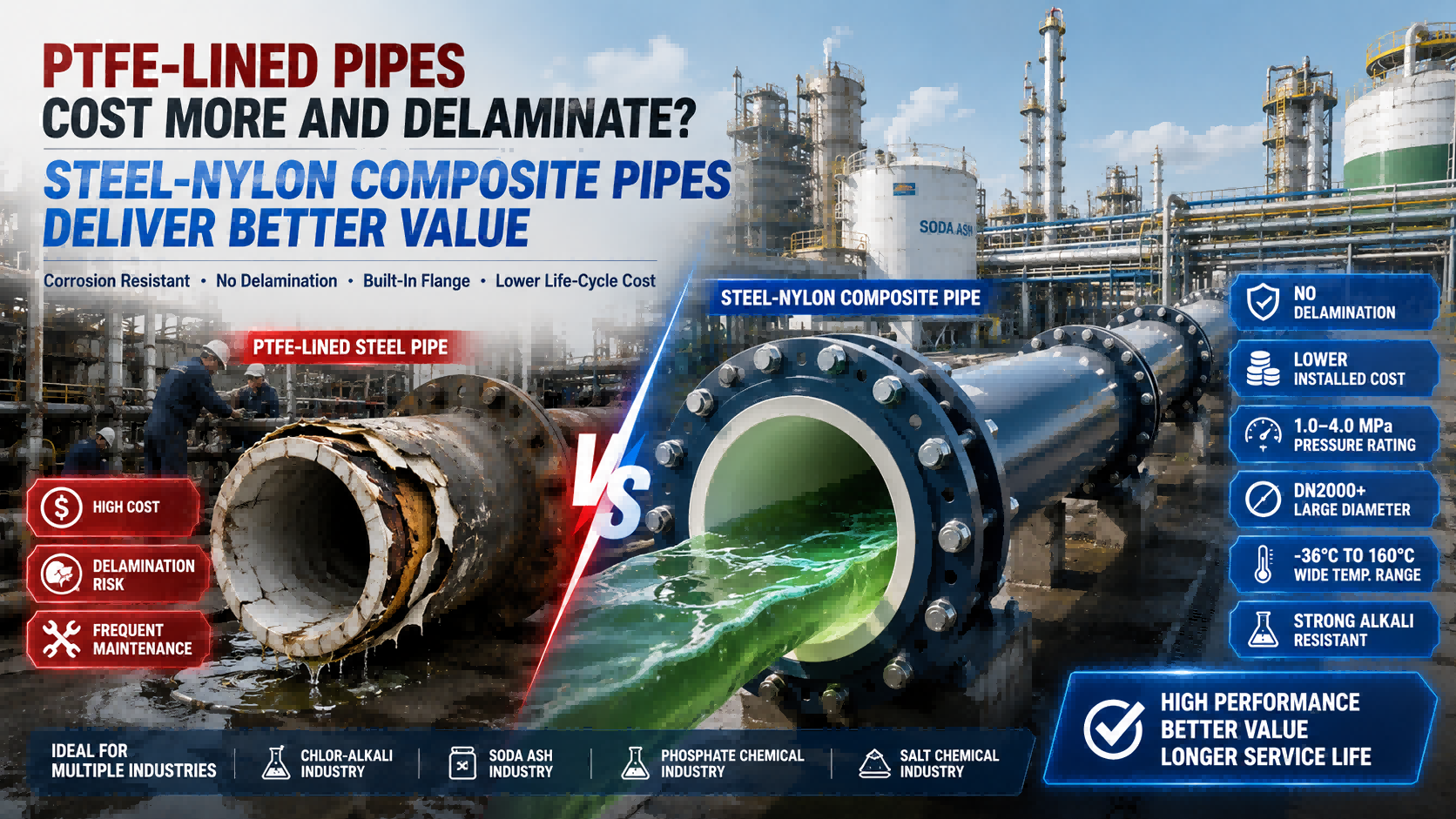
In this deep-dive blog, we will analyze two materials from three dimensions—material science, electrochemical corrosion mechanisms, and Life Cycle Cost (LCC)—to explain why Steel-Nylon Composite Pipes not only perfectly replace 316 stainless steel but also offer far greater cost-effectiveness in strong alkaline and weak acidic environments.
1. Core Mechanisms: Anti-Corrosion Principles from a Material Science Perspective
To understand cost-effectiveness, we must first understand the underlying corrosion resistance logic of both materials in specific media.
The Achilles' Heel of 316 Stainless Steel: Passivation Film Limitations
316 stainless steel relies entirely on a chromium-rich passivation film ($\text{Cr}_2\text{O}_3$), which is only a few nanometers thick, to resist corrosion. However, this film is far from omnipotent:
-
Strong Alkaline Environments ($pH > 12$): Highly alkaline solutions (like high-concentration sodium hydroxide) degrade amphoteric metal oxides. The passivation film on the stainless steel surface dissolves under strong alkaline conditions, exposing the substrate and causing a sharp increase in the general corrosion rate.
-
Localized Corrosion Risks: Industrial wastewater often contains trace amounts of chloride ions ($\text{Cl}^-$). In weakly acidic environments with trace chlorides, 316 stainless steel is highly susceptible to pitting and crevice corrosion. This type of corrosion is highly deceptive; the pipe may look perfectly intact on the outside while already being perforated on the inside.
The "Rigid yet Flexible" Strategy of Steel-Nylon Composite Pipes
Steel-Nylon composite pipes utilize a dual-layer structure: a carbon steel outer shell for pressure resistance combined with a modified nylon (PA11/PA12) inner liner for corrosion protection.
-
Unmatched Alkali Resistance: Nylon is a semi-crystalline thermoplastic. The amide bonds in its molecular chain exhibit extremely high chemical stability in strong alkalis (such as $50\%$ $\text{NaOH}$ solutions), showing virtually no hydrolysis and minimal swelling.
-
Chemical Inertness in Weak Acids: In weakly acidic environments (such as acetic acid, citric acid, and dilute phosphoric acid), modified nylon does not undergo electrochemical reactions like metals do. As a non-conductor, it completely eliminates electrochemical corrosion.
2. Performance vs. Cost: A Deep Dive into Four Core Dimensions
Dimension 1: Initial Capital Expenditure (CAPEX)
With fluctuations in the prices of noble metals like nickel (Ni) and molybdenum (Mo), the raw material cost of 316 stainless steel remains high, and the processing cost for large-diameter pipes escalates exponentially.
-
The core structural component of a Steel-Nylon Composite Pipe is standard carbon steel (such as 20# steel or Q235B), making its base substrate cost significantly lower than that of 316 stainless steel.
-
The nylon liner is applied using advanced rotational molding or thermal spraying techniques. The overall material and processing costs are typically only $60\% \text{ to } 80\%$ of 316 stainless steel (the larger the pipe diameter, the more pronounced this cost advantage becomes).
Dimension 2: Operational and Flow Resistance Costs (OPEX)
When fluids are transported through a pipeline, frictional resistance directly dictates pump power consumption.
-
316 Stainless Steel: Over time, as scaling or minor corrosion occurs, the internal surface roughness ($\varepsilon$) increases from an initial $0.05\,\text{mm}$, leading to a year-over-year rise in pumping energy consumption.
-
Nylon Liner: It features an exceptionally smooth surface (with a friction coefficient only about $1/3$ that of stainless steel) and boasts excellent anti-scaling properties. In strong alkaline scaling media, it is extremely difficult for materials to adhere to the nylon surface. This means the system maintains a minimal pressure drop over years of operation, directly saving electricity costs.
Dimension 3: Water Hammer and Impact Resistance
-
While 316 stainless steel has high strength, it is a rigid monolith. When subjected to water hammer shocks caused by industrial pump startups and shutdowns, the stress is borne entirely by the pipe wall, making it prone to fatigue cracking in the vulnerable weld heat-affected zones.
-
In Steel-Nylon Composite Pipes, the modified nylon liner possesses a certain elastic modulus, allowing it to absorb and cushion the shock waves of water hammer, protecting the outer steel pipe from instantaneous overpressure damage.
Dimension 4: Installation and Construction Costs
-
Welding 316 stainless steel requires highly experienced, certified welders, necessitating TIG welding and post-weld passivation; otherwise, the weld seams are highly prone to premature corrosion.
-
Steel-Nylon composite pipes are typically joined using flanges, grooves, or quick bimetallic connections. No on-site welding is required, which not only accelerates construction but also reduces reliance on highly skilled labor, significantly cutting installation labor costs.
3. Comprehensive Comparison
To provide a clearer view of the cost-performance ratio in alternating strong alkaline / weak acidic environments, we have quantified the comparison below:
| Evaluation Metric | 316L Stainless Steel Pipe | Steel-Nylon (PA) Composite Pipe | Winner |
| Strong Alkali Resistance ($pH 11-14$) | Poor (Passivation film dissolves easily) | Excellent (Chemically inert, no hydrolysis) | Steel-Nylon Composite |
| Weak Acid Resistance | Good (But vulnerable to chloride pitting) | Excellent (Zero electrochemical corrosion) | Steel-Nylon Composite |
| Initial Material Cost | High (Highly volatile due to Ni/Mo prices) | Moderate (Carbon steel base + Nylon liner) | Steel-Nylon Composite |
| On-site Installation Difficulty | High (Requires precise welding & post-treatment) | Low (Flange/groove joints, fast deployment) | Steel-Nylon Composite |
| Anti-scaling / Flow Resistance | Fair (Flow resistance increases over time) | Excellent (Ultra-smooth inner wall, resists scaling) | Steel-Nylon Composite |
| Expected Lifespan | 3-5 years (Prone to pinhole leaks in harsh conditions) | 10-15+ years (Non-metallic layer does not degrade) | Steel-Nylon Composite |
Conclusion: Focus on the Life Cycle Cost (LCC)
In modern industrial engineering, savvy procurement and design engineers no longer look solely at the upfront price tag. Instead, they calculate:
In specific industrial applications where strong alkalinity and weak acidity coexist—such as chemical wastewater treatment, metallurgical dyeing, paper mill black liquor transportation, and light industrial fermentation:
Steel-Nylon Composite Pipes utilize the strength of carbon steel as the backbone and the insulation and corrosion resistance of nylon as the armor, successfully shattering the traditional misconception that "high performance equals high price." It not only saves a massive chunk of your budget during initial procurement but also continuously unlocks cost efficiencies over the next decade through its maintenance-free, low-energy characteristics.
The era of blindly worshiping noble metal materials is over. Tailor-made composite materials represent the future of industrial fluid transportation.
If you are currently torn over material selection for your process pipelines, or if you need to obtain chemical compatibility data sheets for Steel-Nylon composite pipes in specific media, feel free to leave a comment below or contact our technical application engineers.
Chlor-Alkali Piping: Integrated Flanges Help Prevent Leakage
Why Are More and More Companies Abandoning 316L Stainless Steel in Favor of Steel-Nylon Composite Pipes?