
Power Plant Desulfurization Carbon Steel Pipe Scaling and Blockage – Steel‑Nylon Composite Pipe with Smooth Inner Wall Never Scales
1. The Invisible Killer of FGD Piping: Scaling and Plugging
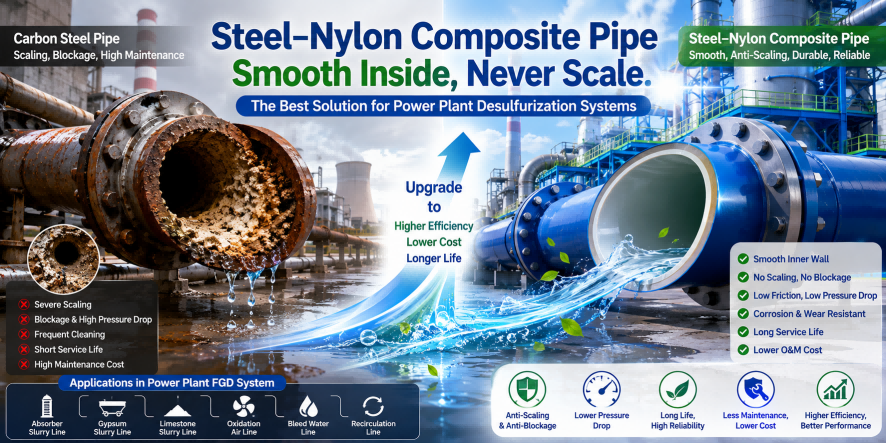
In coal‑fired power plants, wet flue gas desulfurisation (FGD) systems rely heavily on pipelines to transport corrosive media such as limestone slurry and gypsum slurry. However, scaling and clogging have persistently plagued the stable operation of these systems. Statistics show that wet FGD accounts for more than 85% of the total installed FGD capacity. Whether pipes and equipment scale or clog has become a decisive factor in the reliable operation of desulphurisation units.
Carbon steel pipes have long been widely used in FGD slurry transport due to their high mechanical strength and relatively low cost. Yet these pipes face a dual challenge under desulphurisation conditions: on one hand, acidic species in the slurry cause chemical and electrochemical corrosion of the carbon steel; on the other hand, and even more troublesome, is scaling – deposits continuously accumulate and thicken on the inner wall, drastically reducing the effective flow area, sharply increasing pumping resistance, and in severe cases completely blocking the pipeline, forcing the unit to run at reduced load or even shut down for maintenance.
2. Physicochemical Mechanisms of Scaling: Why Carbon Steel Pipes Cannot Escape
The scaling mechanisms in wet FGD piping are complex and can be broadly grouped into the following pathways:
**First, supersaturation crystallisation.** In the FGD slurry, Ca(OH)₂, CaCO₃, CaSO₃ and CaSO₄ can crystallise out of solution under certain conditions. When the calcium sulphite concentration is high, it co‑precipitates with calcium sulphate to form mixed crystals [Ca(SO₃)x·(SO₄)x·½H₂O]. These deposits grow at specific rates on the inner walls of absorbers and pipes, gradually forming flaky scale layers. Slurry pH plays a critical role – at high pH, the solubility of sulphites decreases, leading to soft scale formation, while operation under alkaline pH promotes hard calcium carbonate scale.
**Second, solid particle sedimentation.** Besides reaction products, FGD slurry contains large amounts of fly ash entrained from flue gas and unreacted sorbent particles. When pipeline design velocities are suboptimal or the slope of gravity lines is insufficient, solid particles settle out. These deposits are especially dangerous during shutdowns – solids in the slurry readily settle on internal linings, triggering further scaling and blockages.
**Third, wet‑dry interface scaling.** In certain areas of the piping system, such as the gas inlet of the absorber or zones with fluctuating slurry levels, wet‑dry alternating conditions exist. As water evaporates, salts crystallise out; hydrated salts can expand several times or even more in volume, exerting significant compressive stress on the pipe wall.
Carbon steel pipes are particularly prone to scaling because their inner surfaces have inherent microscopic roughness. These surface imperfections provide ideal “anchor points” for heterogeneous nucleation of scale crystals. Once initial nuclei form, the scale layer continues to grow and thicken, eventually becoming hard deposits that are difficult to remove. Studies have confirmed that scale readily adheres to carbon steel and alloy steel surfaces alike.
3. From “Reactive Cleaning” to “Proactive Prevention”: The Breakthrough of Steel‑Nylon Composite Pipes
Conventional strategies to combat scaling in carbon steel pipes have largely focused on operational optimisation and post‑event cleaning – adjusting slurry pH, controlling flow velocity, installing flushing systems, and performing regular mechanical descaling. While these measures have some effect, they are fundamentally **reactive** – scaling still occurs and pipes still block, only with different frequency and severity.
The introduction of **steel‑nylon composite pipes** (steel‑lined nylon pipes) shifts the paradigm from reactive cleaning to **proactive prevention**. This new type of thermoplastic composite pipe uses a carbon steel outer shell for structural strength and a nylon inner liner for superior surface properties.
The core principle behind its “never‑scale” performance lies in the **ultra‑smooth surface** and **self‑lubricating characteristics** of the nylon liner. The extremely low surface energy and low friction coefficient make it difficult for solid particles in the slurry to adhere or deposit on the wall – no adhesion means no deposition, and no deposition prevents subsequent crystal growth and scale accumulation. The smooth inner surface also reduces flow resistance, fundamentally breaking the scaling chain.
Moreover, steel‑nylon composite pipes offer a range of comprehensive advantages highly compatible with FGD service conditions:
**Excellent corrosion resistance:** Except for strong oxidising acids like concentrated nitric acid, fuming sulfuric acid, and chlorosulfonic acid, the nylon liner resists most organic and inorganic acids, alkalis, and salts. In the complex acid‑base alternating environment of desulphurisation slurry, its chemical stability far surpasses that of carbon steel.
**Outstanding abrasion resistance:** When transporting slurries, the wear resistance of nylon is 8‑10 times that of carbon steel or stainless steel – a critical advantage for high‑solids gypsum slurry service.
**Reliable mechanical strength:** The outer carbon steel shell provides the same pressure‑bearing capacity and impact resistance as standard steel pipes, overcoming the strength shortcomings of pure plastic pipes.
**Wide temperature range:** It can operate continuously from ‑30°C to 180°C, accommodating typical FGD temperature variations.
**Outstanding abrasion resistance:** When transporting slurries, the wear resistance of nylon is 8‑10 times that of carbon steel or stainless steel – a critical advantage for high‑solids gypsum slurry service.
**Reliable mechanical strength:** The outer carbon steel shell provides the same pressure‑bearing capacity and impact resistance as standard steel pipes, overcoming the strength shortcomings of pure plastic pipes.
**Wide temperature range:** It can operate continuously from ‑30°C to 180°C, accommodating typical FGD temperature variations.
4. Long‑Term Value: From a “Cost Centre” to an “Efficiency Driver”
For power plant operators, pipe material selection is not merely a technical question – it is an economic decision involving total life‑cycle costs.
Carbon steel pipes may appear cheap initially, but their hidden costs are substantial: frequent shutdowns for descaling reduce power generation; material replacement and labour for corrosion‑induced failures add up; and reduced desulphurisation efficiency due to blocked pipes may lead to environmental compliance risks. These “invisible costs” accumulate over the years of operation.
Steel‑nylon composite pipes, while having a higher upfront investment than ordinary carbon steel, deliver lasting economic returns through their scale‑free performance: reduced maintenance outages, lower pumping energy consumption due to smooth inner walls, and extended service life thanks to superior corrosion and wear resistance. From a total cost of ownership (TCO) perspective, the composite pipe solution often proves more competitive over the full lifecycle.
5. Conclusion
Scaling and blockage in power plant desulphurisation pipelines essentially arise from the interaction between the pipe material’s surface characteristics and the physicochemical environment of the FGD slurry. Carbon steel, with its rough inner surface, provides a fertile ground for scale crystals to take hold. In contrast, steel‑nylon composite pipes, with their ultra‑smooth, self‑lubricating liner, cut off the scaling chain at its root. “Never scales” is not hyperbole – it is a faithful expression of materials science: when scale crystals cannot find a foothold, scaling simply cannot occur.
As environmental standards tighten and power plants demand ever‑higher operational reliability, the mindset for pipe selection is shifting from “good enough” to “optimal solution.” Steel‑nylon composite pipes, combining anti‑scaling, anti‑corrosion, and anti‑wear properties, are increasingly becoming the preferred upgrade choice for FGD systems. For plants still struggling with recurring pipe scaling and blockages, this may well be the game‑changing solution worth serious consideration.
Please let me know if you need any adjustments to tone, length, or specific technical details. I’m happy to refine further.
HDPE Pipe Collapses at 160°C? Reinforced Nylon Pipe Handles High‑Temperature Chemical Conditions with Ease
Shutting Down for Pipeline Replacement Costing Millions? Corrosion‑Resistant Nylon Pipes Slash Maintenance Cycles from Months to Days
Related blog


SEND MESSAGE