Full Coverage for Weak Acids, Strong Alkalis, and Salt Media: A New Solution for Industrial Anti-Corrosion Piping

In industrial sectors such as petrochemicals, salt chemicals, marine engineering, and mining/metallurgy, pipeline corrosion has always been one of the core challenges plaguing production operations. The superimposition of multiple corrosive factors—high temperature, high salinity, strong alkalinity, and weak acidity—causes conventional pipe materials to frequently suffer from perforation, leakage, and premature failure. These issues not only result in enormous economic losses but also pose severe safety hazards and environmental risks. In response to this challenge, the steel-nylon composite pipe—which combines the strength of steel with the anti-corrosion performance of nylon—is emerging as an important technological direction in industrial corrosion-resistant piping, thanks to its ability to provide "full coverage" against weak acids, strong alkalis, and salt media.
1. The Harsh Reality of Industrial Corrosion
Take oil and gas field production as an example. In high-temperature, high-salinity oilfields, the water cut in produced fluids often exceeds 90%, with salinities reaching tens of thousands or even hundreds of thousands of mg/L, temperatures above 50°C, and in some heavy-oil reservoirs, even above 60°C. Unconsolidated sandstone reservoirs are also prone to sand production, and some blocks contain certain concentrations of hydrogen sulfide. The superposition of multiple corrosive factors makes internal pipeline corrosion extremely severe, and pipeline perforation failures are a frequent occurrence.
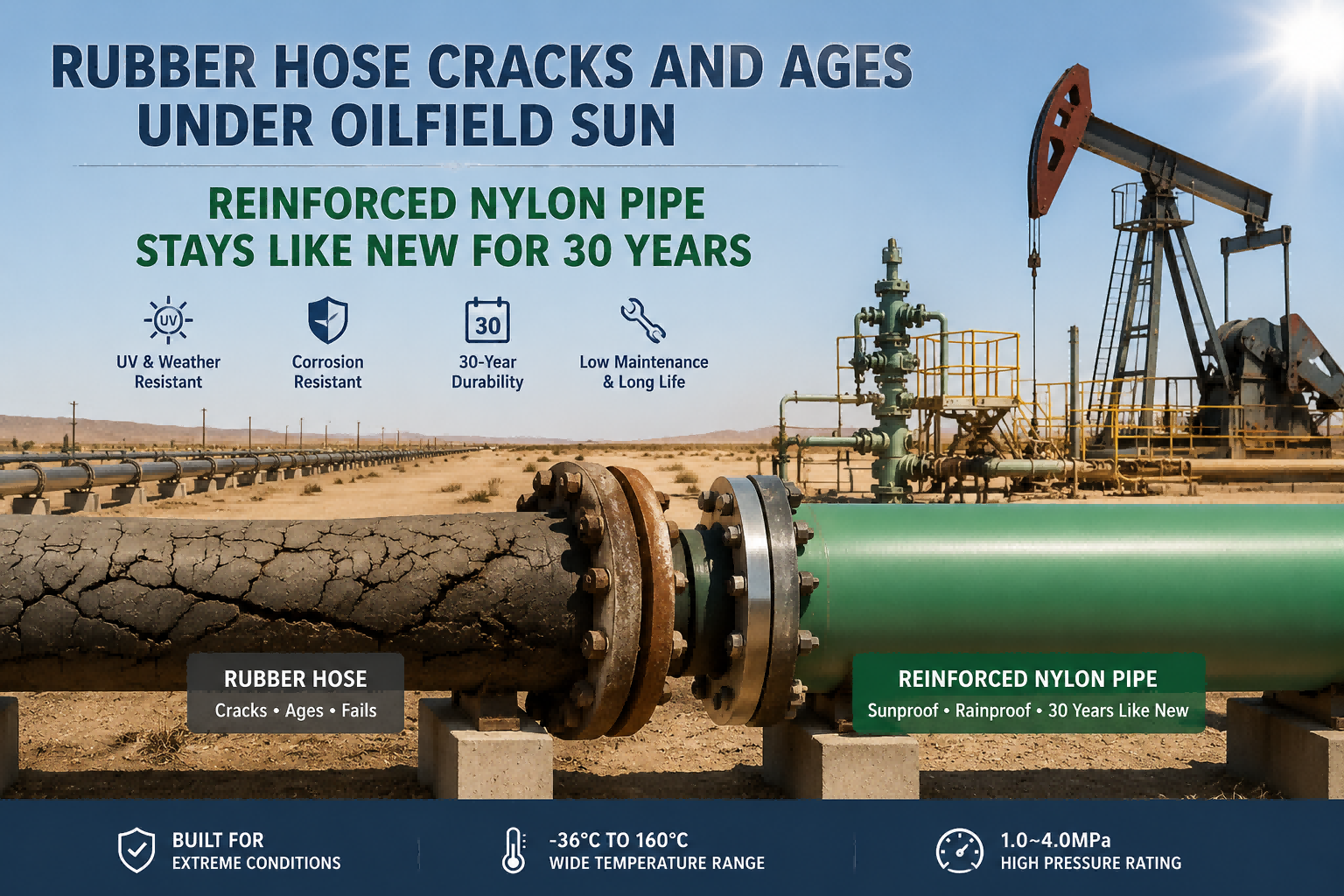
Each traditional anti-corrosion solution has its own shortcomings: non-metallic pipes are corrosion-resistant but have poor external pressure resistance and are vulnerable to mechanical damage; stainless steel pipes offer excellent performance but are prohibitively expensive for widespread use; steel-lined PE pipes have strict temperature limitations, generally operating below 40°C; conventional coating technologies are prone to damage and localized weak points under sand scouring and erosion, which then trigger corrosion leaks, with service lives typically as short as 2–3 years and rarely exceeding 4–5 years.
Similar challenges exist in salt chemicals, marine engineering, metallurgy, and other industries—whether the conveyed medium is strongly alkaline brine, high-salinity seawater, or weakly acidic wastewater. No single metallic or plastic pipe can simultaneously satisfy the requirements of strength, temperature resistance, and corrosion protection across all these conditions.
2. Steel-Nylon Composite Pipe: Coupling the Strengths of Two Materials
The core concept of the steel-nylon composite pipe is to integrate the high strength and toughness of steel pipes with the salt resistance, wear resistance, and anti-corrosion functionality of nylon materials. This "rigid-flexible" composite structure enables the pipe to possess both the load-bearing capacity and structural strength of steel and the chemical stability and corrosion resistance of nylon.
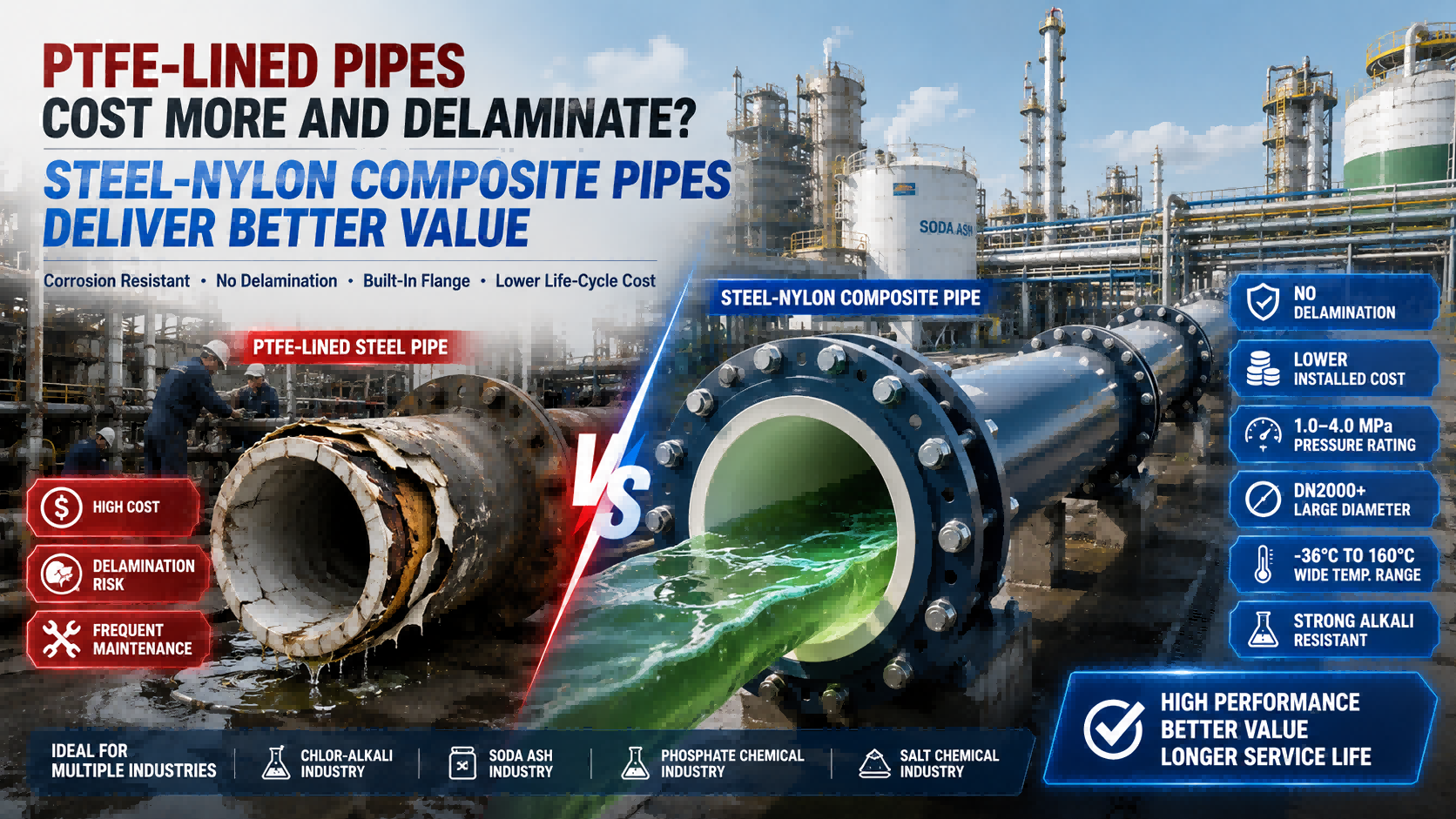
From a structural design perspective, steel-nylon composite pipes typically use a steel pipe as the reinforcing skeleton and nylon (mostly MC nylon or reinforced PAMC) as the inner liner. Some products also feature nylon layers on both the inner and outer surfaces of the steel pipe. After a roughening treatment (e.g., profiling) on the inner wall of the steel pipe, the adhesion between the nylon layer and the steel pipe is significantly enhanced, preventing delamination. This integrated composite structure ensures that the inner and outer layers do not separate over long-term service, greatly extending the pipe's service life.
In terms of manufacturing processes, centrifugal casting is the mainstream forming technique for steel-nylon composite pipes. After thermally melting and dehydrating caprolactam, the nylon material is uniformly polymerized and tightly bonded to the inner wall of the steel pipe under atmospheric pressure using centrifugal or static casting processes. This one-step forming process produces composite pipes and fittings with integral flanges. Since the entire process is completed in a factory-controlled environment, it effectively overcomes the field-coating problems of difficult weld-joint repair and quality variability due to on-site construction conditions.
Currently, steel-nylon composite pipes are available in a complete range from DN50 to DN2000, capable of meeting diverse requirements from long-distance transmission pipelines to complex station piping such as manifolds and vessels.
3. Weak Acids, Strong Alkalis, Salt Media: Full-Spectrum Corrosion Resistance
The most core value of steel-nylon composite pipes lies in their "full-coverage" corrosion resistance against weak acids, strong alkalis, and salt media.
**Weak Acid Media:** Nylon materials exhibit good resistance to most organic and inorganic acids. Specifically, steel-lined nylon pipes can withstand 50% sulfuric acid at 80°C, 30% hydrochloric acid at 100°C, 50% acetic acid and saturated oxalic acid at 80°C, and 50% hydrofluoric acid at 80°C. With the exception of strongly oxidizing acids such as concentrated nitric acid, fuming sulfuric acid, and chlorosulfonic acid, steel-nylon composite pipes can resist corrosion from the majority of organic and inorganic acids.
**Strong Alkali Media:** In highly alkaline environments, steel-nylon composite pipes also perform excellently. They can withstand 55% potassium hydroxide at 100°C, 10%–30% sodium hydroxide at 80°C, and saturated calcium hydroxide solution at 100°C. This capability to tolerate high-temperature strong alkalis gives them a distinct advantage in industries such as alkali chemicals, papermaking, and alumina production.
**Salt Media:** Nylon is inherently chemically inert toward salt media. It resists strong salts and inorganic salts, and another important characteristic is its cathodic non-connectivity, which provides excellent cathodic electrochemical protection for the metal substrate. When the nylon layer covers the metal surface, it effectively isolates the medium and atmosphere, eliminating the conditions for electrochemical corrosion reactions on the metal matrix. This makes steel-nylon composite pipes irreplaceable in seawater desalination, salt-chemical brine transportation, marine engineering, and similar applications.
In summary, the corrosion resistance coverage of steel-nylon composite pipes is extremely broad: aside from a few strongly oxidizing acids, they can withstand most acids, alkalis, salts, and organic solvents. In one study, eight types of pipeline internal anti-corrosion technologies were subjected to a one-year pilot application and post-evaluation dissection; the results showed that nylon composite pipes ranked among the top in overall performance, while PE-lined pipes exhibited localized aging and liner detachment.
4. Beyond Corrosion Protection: Comprehensive Performance Advantages
The advantages of steel-nylon composite pipes extend far beyond corrosion resistance. In terms of wear resistance, their performance in slurry conveyance is 8–10 times that of carbon steel and stainless steel, and 6 times that of PE100. Under identical working conditions, their abrasion resistance is 8 times that of steel and over 10 times that of FRP. This characteristic makes them exceptionally suitable for high-wear applications such as ore slurry and fly ash transport.
In terms of weight, steel-nylon composite pipes weigh only 1/6 to 1/7 of steel pipes, and their weight in water is merely 1/45 of steel pipes. This lightweight nature not only reduces transportation and installation difficulty but also lowers investments in pipe supports and ancillary facilities.
Regarding frictional resistance, the nylon inner surface is smooth with a low friction coefficient (as low as 0.03), and it is non-sticking and non-scaling. The pressure loss is only about 2/3 that of metal pipes, significantly reducing pumping energy consumption.
In temperature adaptability, steel-nylon composite pipes have a long-term service temperature range from –36°C to 130°C, with some products even capable of withstanding –50°C to 180°C. This wide temperature tolerance allows stable operation in both northern and southern climates as well as in high-temperature process media.
In terms of service life, with anti-aging formulations, steel-nylon composite pipes can achieve a natural service life exceeding 50 years. Among the PAMC nylon-steel composite pipes already in operation, the earliest installations have been running continuously for 23 years without any corrosion leakage issues.
5. Industry Applications and Future Outlook
The application fields of steel-nylon composite pipes are rapidly expanding. In the oil and gas sector, this technology has been deployed for over 40,000 meters at Sinopec Shengli Oilfield and Southwest Oil & Gas Company, and over 10,000 meters at Qingdao Refinery and Tianjin Refinery. Shengli Oilfield has continuously included nylon-steel composite pipes in its framework procurement agreements for many years.
In the chemical industry, steel-nylon composite pipes are widely used to transport various corrosive liquids and gases, such as acids, alkalis, salt solutions, and petroleum products. In the mining sector, their use in concentrate/tailings transportation and beneficiation processes is well established. In salt chemicals and seawater desalination, their resistance to salt corrosion makes them an ideal choice for brine and seawater piping.
With the publication of group standards such as T/ACCEM 818-2026 *Steel Skeleton Reinforced Nylon Pipe*, and the continuous refinement of industry standards like SY/T 6662.3-2012 *Non-metallic Composite Pipes for Petroleum and Natural Gas Industry—Part 3: Reinforced MC Nylon Pipes and Nylon-Steel Composite Pipes*, the design, manufacturing, inspection, and application of steel-nylon composite pipes are becoming increasingly standardized.
Looking at industry trends, as the demands for pipeline safety, durability, and cost-effectiveness continue to rise, steel-nylon composite pipes—which combine steel strength with nylon corrosion resistance—are emerging as an important alternative to stainless steel pipes, rubber-lined pipes, and FRP pipes. Their "full coverage" against weak acids, strong alkalis, and salt media, together with their lightweight nature, long service life, and low maintenance requirements, positions them for broad application prospects in corrosive media transmission scenarios across petrochemicals, salt chemicals, marine engineering, and mining/metallurgy.
In the journey of industrial corrosion protection, the selection of piping materials is never a single-dimensional trade-off, but a comprehensive balance of strength, corrosion resistance, temperature tolerance, abrasion resistance, and economy. The steel-nylon composite pipe, with its unique material-coupling logic and manufacturing innovation, offers a solution that is both deep and broad for this classic challenge—letting steel bear the pressure, nylon block the corrosion, and enabling industrial pipelines to perform steadily and reliably through the "triple test" of weak acids, strong alkalis, and salt media.
The Ultimate Guide to Oil & Gas Pipeline Selection: How to Meet High Pressure, Corrosion Resistance, and Low Temperature Simultaneously
Mining, Power, and Desalination All Rely on It: A Complete Guide to the 5 Traffic-Driving Advantages of Nylon Specialty Composite Pipes
Related blog