Steel-Nylon Composite Pipe vs 304 Stainless Steel Pipe: A New Choice for Industrial Pipeline Upgrading

In industrial sectors such as chemical processing, oil & gas, mining, power generation, and environmental engineering, 304 stainless steel pipe has long been considered a reliable corrosion-resistant piping material. With good mechanical strength, excellent fabrication performance, and reasonable corrosion resistance, 304 stainless steel pipes are widely used in industrial fluid transportation systems.
However, as modern industries continue to demand:
-
Higher corrosion resistance;
-
Better wear resistance;
-
Larger diameter pipelines;
-
Higher pressure capability;
-
Longer service life with lower maintenance costs;
traditional 304 stainless steel pipes are showing limitations in some challenging operating conditions.
Common problems include:
-
Corrosion caused by aggressive chemical media;
-
Erosion from solid particles in slurry transportation;
-
Pitting corrosion in chloride environments;
-
High material costs for large diameter pipelines;
-
Long installation periods caused by welding requirements.
Therefore, many industrial projects are searching for upgraded alternatives to 304 stainless steel pipe.
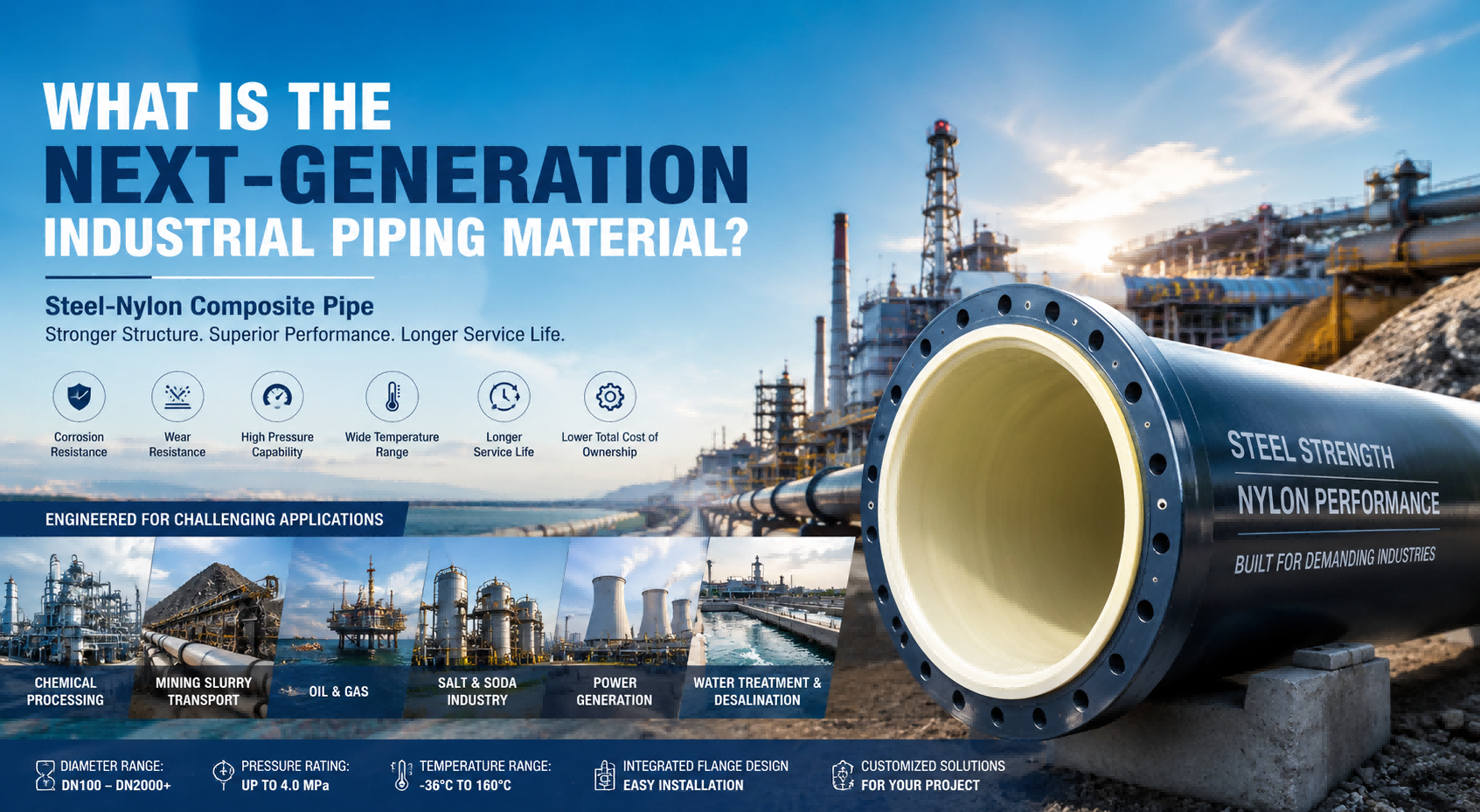
Among these solutions, Steel-Nylon Composite Pipe has become an advanced option by combining:
Steel structural strength + Nylon corrosion resistance and wear resistance.
1. Structural Difference Between Steel-Nylon Composite Pipe and 304 Stainless Steel Pipe
304 Stainless Steel Pipe: Corrosion Resistance Through Metal Alloy
304 stainless steel pipe is a single-metal structure.
304 Stainless Steel Pipe

Outer structure:
304 stainless steel body

↓

Fluid directly contacts the metal surface
Advantages:
-
High mechanical strength;
-
Good temperature resistance;
-
Smooth inner surface;
-
Easy fabrication and welding.
However, corrosion resistance depends heavily on:
-
Chemical composition of the medium;
-
Operating temperature;
-
Chloride concentration;
-
PH value;
-
Welding quality.
In environments containing chloride ions or aggressive chemicals, 304 stainless steel may experience:
-
Pitting corrosion;
-
Crevice corrosion;
-
Localized damage.
Steel-Nylon Composite Pipe: Combining Strength and Protection
Steel-Nylon Composite Pipe uses a multi-layer structure:
Steel-Nylon Composite Pipe

Outer layer:
High-strength steel structure

↓

Reinforced pressure-bearing layer

↓

High-performance nylon inner liner

↓

Transport medium
The design principle is:
Steel provides pressure strength, while nylon provides corrosion and wear protection.
This solves the traditional problem of metal pipes:
High strength and excellent corrosion resistance are difficult to achieve simultaneously.
2. Corrosion Resistance Comparison: Steel-Nylon Has Advantages in Chemical Applications
Application Limits of 304 Stainless Steel
304 stainless steel performs well in:
-
Clean water systems;
-
Food processing;
-
General industrial applications;
-
Mild chemical environments.
However, in the following conditions:
| Operating Condition | Performance of 304 Stainless Steel |
|---|---|
| High concentration alkali | Increased corrosion risk |
| Chloride-containing water | Pitting risk |
| High-temperature corrosive media | Reduced durability |
| Particle-containing slurry | Internal erosion |
higher-grade materials such as 316L stainless steel may be required, significantly increasing project costs.
Advantages of Steel-Nylon Composite Pipe
The nylon liner provides excellent:
-
Acid and alkali resistance;
-
Saltwater corrosion resistance;
-
Chemical resistance;
-
Anti-permeability performance;
-
Wear resistance.
It is especially suitable for:
-
Chlor-alkali industry;
-
Soda ash industry;
-
Salt chemical industry;
-
Phosphate chemical industry;
-
Mining slurry transportation;
-
Oil & gas gathering systems.
In many industrial applications, pipeline failure is not caused by insufficient pressure strength, but by:
corrosion + abrasion + frequent maintenance.
Steel-Nylon Composite Pipe is designed specifically to solve these problems.
3. Wear Resistance Comparison: A Major Advantage in Slurry Transportation
Many industrial pipelines fail not because of corrosion, but because of continuous abrasion.
Typical applications include:
-
Mining tailings slurry;
-
Phosphate slurry;
-
Coal slurry;
-
Sand-containing crude oil;
-
Chemical crystallization solutions.
Although 304 stainless steel has good mechanical properties, long-term particle impact can cause:
-
Wall thickness reduction;
-
Severe elbow erosion;
-
Shortened service life.
Why Steel-Nylon Composite Pipe Performs Better
① Excellent Wear Resistance
The nylon liner reduces:
-
Particle impact damage;
-
Friction loss;
-
Localized erosion.
② Low Friction Coefficient
Benefits include:
-
Lower flow resistance;
-
Reduced energy consumption;
-
Less material accumulation.
③ Protection of High-Wear Components
Especially suitable for:
-
Elbows;
-
Tees;
-
Pump outlet sections;
-
Valve upstream and downstream sections.
4. Installation Efficiency Comparison: Faster Construction Without Field Welding
Installation of 304 Stainless Steel Pipe
Traditional stainless steel pipeline installation usually requires:
-
Cutting;
-
Bevel preparation;
-
Welding;
-
Weld inspection;
-
Pickling and passivation.
Potential issues:
-
High welding workload;
-
Difficult high-altitude welding;
-
Weld corrosion risks;
-
Longer installation time.
Installation Advantages of Steel-Nylon Composite Pipe
Steel-Nylon Composite Pipe adopts:
integrally formed flange connection technology.
Advantages:
No Field Welding Required
Reducing:
-
Hot work operations;
-
Welding defects;
-
Construction risks.
Integrated Flange Design
Helps reduce:
-
Leakage points;
-
Installation time;
-
Maintenance requirements.
For large industrial pipeline systems:
DN100–DN2000 pipelines
the construction efficiency advantage becomes even more significant.
5. Large Diameter Pipeline Cost Comparison
For small diameter pipelines, 304 stainless steel may remain competitive.
However, as diameter increases:
DN500
DN800
DN1200
DN1600+
the cost of stainless steel pipelines rises rapidly.
Reasons include:
-
Higher material consumption;
-
Increased pipe weight;
-
Higher transportation costs;
-
More welding work.
Steel-Nylon Composite Pipe achieves cost optimization through:
-
Steel reinforcement for pressure resistance;
-
Nylon liner for corrosion and wear protection.
This reduces the dependence on expensive metal materials while maintaining reliable performance.
It is especially suitable for:
-
Long-distance transportation pipelines;
-
Large chemical plant pipe racks;
-
Mining slurry systems.
6. Total Cost of Ownership (TCO) Comparison
Many companies only consider:
"How much does one meter of pipe cost?"
However, industrial projects should consider:
"What is the total operating cost over 20 years?"
304 Stainless Steel Pipe
Initial investment:
★★★★☆
Maintenance cost:
★★★
Service life:
Depends heavily on operating conditions
Potential risks:
-
Corrosion;
-
Weld problems;
-
Production downtime.
Steel-Nylon Composite Pipe
Initial investment:
★★★
Maintenance cost:
★★★★★
Advantages:
-
Longer service intervals;
-
Reduced replacement frequency;
-
Lower downtime losses;
-
Lower lifecycle cost.
7. Typical Applications of Steel-Nylon Composite Pipe
1. Chemical Industry
Applications:
-
Mother liquor transportation;
-
Acid and alkali pipelines;
-
Brine systems;
-
Process circulation pipelines.
2. Oil & Gas Industry
Applications:
-
Oil gathering systems;
-
Well-site pipelines;
-
Sand-containing crude oil transportation.
3. Mining Industry
Applications:
-
Tailings slurry pipelines;
-
Mine backfill pipelines;
-
Mineral slurry transportation.
4. Power and Environmental Engineering
Applications:
-
Desulfurization systems;
-
Wastewater pipelines;
-
Cooling water circulation systems.
8. Key Advantages of Steel-Nylon Composite Pipe
| Performance | Steel-Nylon Composite Pipe | 304 Stainless Steel Pipe |
|---|---|---|
| Pressure resistance | ★★★★★ | ★★★★★ |
| Corrosion resistance | ★★★★★ | ★★★★ |
| Wear resistance | ★★★★★ | ★★★ |
| Large diameter application | ★★★★★ | ★★★ |
| Installation efficiency | ★★★★★ | ★★★ |
| Field welding requirement | No | Required |
| Lifecycle cost | Excellent | Higher |
Conclusion: Not Replacing 304, but Upgrading Pipeline Solutions for Tougher Conditions
304 stainless steel pipe remains an excellent industrial material. However, it is not always the most economical or reliable choice for every application.
When projects require:
-
Strong corrosion resistance;
-
High wear resistance;
-
Large diameter transportation;
-
Long service life;
-
Reduced maintenance costs;
Steel-Nylon Composite Pipe provides a more advanced pipeline solution.
With:
Steel pressure-bearing structure + Nylon corrosion and wear-resistant liner + Integrated flange connection
Steel-Nylon Composite Pipe is becoming an important upgrade solution for industrial pipeline systems in:
-
Chemical plants;
-
Mining operations;
-
Oil & gas projects;
-
Power generation;
-
Environmental engineering.
SEO Keywords
-
Steel Nylon Composite Pipe
-
Nylon Lined Steel Pipe
-
304 Stainless Steel Pipe Alternative
-
Corrosion Resistant Industrial Pipe
-
Wear Resistant Pipeline
-
Chemical Pipeline Material Selection
-
Industrial Pipe Replacement Solution
-
Large Diameter Composite Pipe
-
High Pressure Nylon Pipe
-
Stainless Steel Pipe Alternative
Steel-Nylon Composite Pipe VS Duplex Steel Pipe: A Deep Comparison for Industrial Pipeline Applications
Steel-Nylon Composite Pipe vs. 316L Stainless Steel Pipe: Which Is the Better Choice for Industrial Fluid Transportation?