
316L Stainless Steel Can't Resist Chloride Ions? Steel-Nylon Composite Pipe Outperforms Precious Metals in Salt Chemical Processing
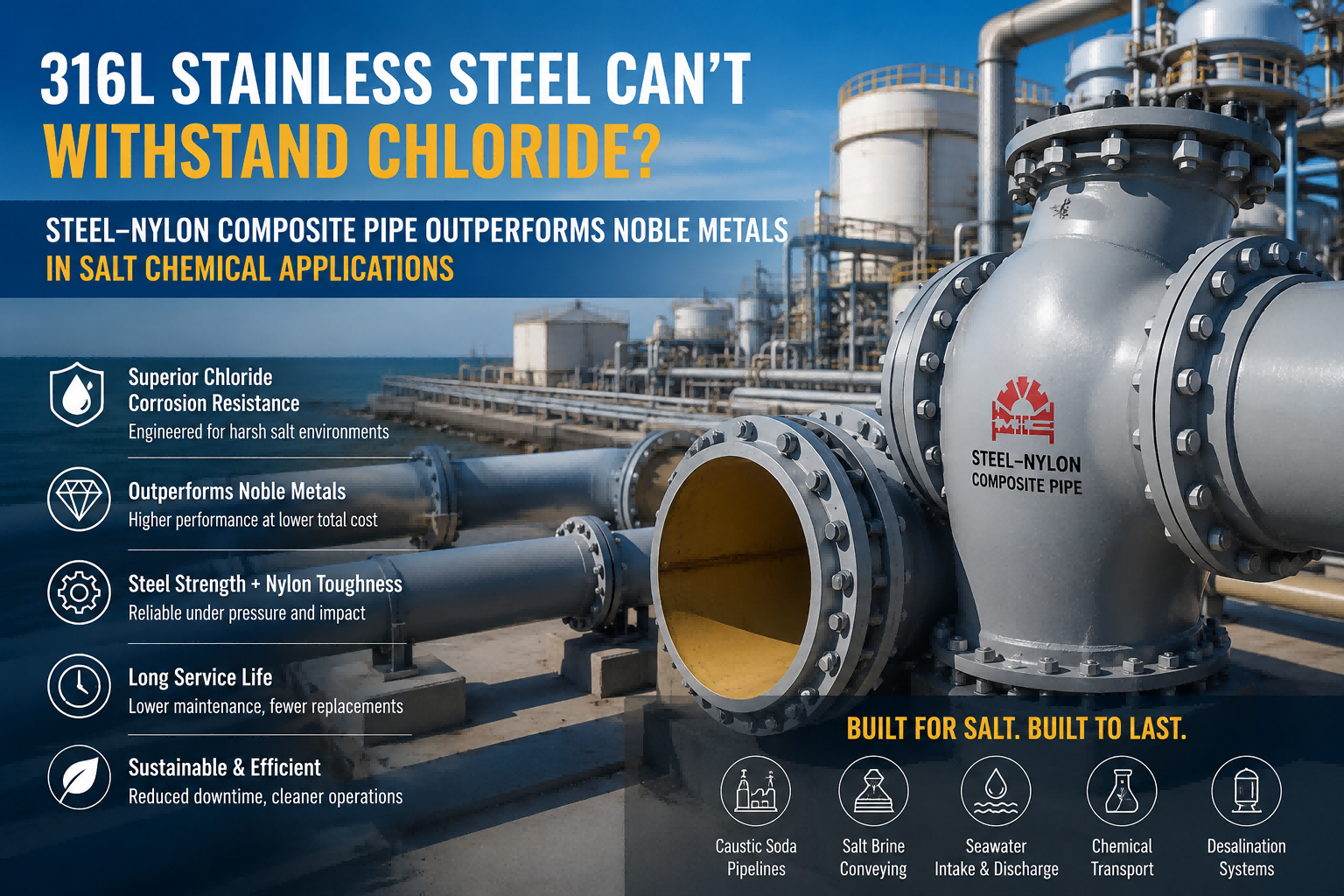
In the salt chemical production environment, there is an invisible enemy that gives countless engineers a headache — chloride ions. Whether it’s solar salt production from seawater, potassium chloride extraction, or brine refining in the chlor-alkali industry, high-concentration chloride media are almost everywhere. Faced with such conditions, many people instinctively turn to 316L stainless steel, believing that the word “stainless” means corrosion resistance. The reality, however, is that 316L often fails rapidly under sustained chloride attack. On the other hand, upgrading to precious metals such as titanium or Hastelloy can solve the corrosion problem but sends equipment investment costs skyrocketing. So, is there a solution that completely tames chloride ions without incurring the prohibitive expense of precious metals? The proven application of steel-nylon composite pipe is delivering a surprisingly compelling answer.
Chloride Ions — The Achilles’ Heel of Stainless Steel
To understand the failure of 316L stainless steel, one must start with the corrosion mechanism of chloride ions. 316L is an austenitic stainless steel that relies on a dense chromium oxide passive film on its surface to resist corrosion. However, chloride ions have a small radius and extremely strong penetrating power. They preferentially adsorb onto defects in the passive film, displacing oxygen atoms and causing localized film breakdown. Once the film is breached, the exposed base metal and the surrounding passive area form a small-anode–large-cathode galvanic cell, and pitting corrosion progresses inward at a rapid pace until the pipe wall is perforated. Even more insidious are crevice corrosion and stress corrosion cracking — under gasket seating surfaces, at threaded connections, or beneath weld reinforcement, a crevice of just tens of microns can allow chloride ions to concentrate and create an acidic environment, causing 316L to suffer brittle fracture at stresses far below its design limits.
In actual salt chemical operating conditions, the media are often high-concentration brines, magnesium chloride, or calcium chloride solutions, with chloride ion concentrations easily exceeding 100,000 ppm and temperatures ranging from ambient to 120 °C. Yet, the chloride tolerance of 316L stainless steel at room temperature is only about 200 ppm; when the temperature rises above 50 °C, even 100 ppm can trigger pitting. A brine transport pipeline at one salt production enterprise provided a painful lesson: originally designed with 316L seamless pipe, after only six months of operation, dense pinhole-like perforations appeared near welds and on the inner wall. The leaking brine corroded the entire pump station foundation, and the whole line ultimately had to be replaced. That accident not only caused downtime losses but also starkly exposed the inability of stainless steel to withstand chloride ion environments.
Why Precious Metals Are “Precious” and Hard to Use
After recognizing the limitations of 316L, end users often turn their attention to higher-grade materials. Among the grades resistant to chloride corrosion, titanium (e.g., TA2), duplex stainless steels (2205, 2507), and nickel-based alloys (Hastelloy C276, Monel 400) are commonly referred to as “precious metals.”
**Commercially pure titanium (TA2)** exhibits excellent corrosion resistance in most chloride solutions, with almost no pitting, and is a favorite for salt plant evaporator vessels and brine preheaters. But titanium is not flawless: it is quite sensitive to crevice corrosion, especially under gaskets or deposits. When the temperature exceeds 80 °C, the risk of crevice corrosion rises significantly. More crucially, its material cost is 15 to 20 times that of ordinary carbon steel. Welding requires rigorous argon shielding, fabrication is difficult, and on-site repair is nearly impractical. Furthermore, titanium carries risks of hydrogen embrittlement and ignition in dry chlorine gas and high-temperature oxygenated chlorides.
**Duplex stainless steel 2507** has a pitting resistance equivalent number (PREN) greater than 40 and can serve long-term in medium-to-high concentration brines. However, it still has a critical crevice corrosion temperature, above which it can also fail. And while the price of 2507 is lower than that of titanium, it is still 8 to 10 times that of stainless steel. For pipelines stretching several kilometers, the initial investment is daunting.
**Hastelloy C276** is even more extreme, with corrosion resistance covering nearly all harsh media in salt chemical processing, but its unit price is more than 30 times that of ordinary steel. It is typically reserved for only the most critical, small-diameter valves and fittings and cannot be widely deployed.
**Duplex stainless steel 2507** has a pitting resistance equivalent number (PREN) greater than 40 and can serve long-term in medium-to-high concentration brines. However, it still has a critical crevice corrosion temperature, above which it can also fail. And while the price of 2507 is lower than that of titanium, it is still 8 to 10 times that of stainless steel. For pipelines stretching several kilometers, the initial investment is daunting.
**Hastelloy C276** is even more extreme, with corrosion resistance covering nearly all harsh media in salt chemical processing, but its unit price is more than 30 times that of ordinary steel. It is typically reserved for only the most critical, small-diameter valves and fittings and cannot be widely deployed.
In other words, precious metals do solve the corrosion problem, but they push the “precious” dilemma onto the project budget and return on investment. Salt chemical processing generally belongs to the basic industrial sector with limited profit margins. Over-reliance on precious metals makes equipment costs surge, and many projects are rejected even at the feasibility study stage. The market urgently needed a cost-effective material that could deliver chloride resistance on par with precious metals while keeping overall project costs under control. This is the logic behind the rapid rise of steel-nylon composite pipe.
Steel-Nylon Composite Pipe — The Perfect Marriage of Strength and Flexibility
The structure of steel-nylon composite pipe appears simple but embodies an ingenious collaborative design. The outer layer is carbon steel or low-alloy steel pipe, responsible for bearing internal pressure and external loads, providing mechanical strength and structural rigidity. The inner layer is a special nylon (typically high-polymerization modified nylon PA6, MC nylon, or semi-aromatic nylon) tightly bonded through a special process. This inner liner acts as a corrosion barrier, directly contacting the medium. The two layers are joined using hot-melt bonding, cold-drawing shrink-fit, or centrifugal casting composite processes, forming a reliable molecular-level or mechanical interlock interface that completely eliminates the delamination and blistering defects common in traditional plastic-coated pipes.
The chemical resistance spectrum of nylon is uniquely suited to this application. It is almost completely inert to chloride ions. Whether saturated sodium chloride or potassium chloride solutions, or hygroscopic salt solutions such as magnesium chloride and calcium chloride, the nylon liner shows no swelling, degradation, or stress cracking under long-term immersion. At the same time, the inner wall of nylon is far smoother than metal, with a low friction coefficient that resists salt scale adhesion. For pipelines in salt chemical processing that are prone to crystalline deposits like Glauber’s salt or carnallite, this means less frequent pigging and higher transport efficiency. The typical operating temperature range is -40 °C to 100 °C, and special heat-resistant grades of nylon can work long-term at 120 °C — precisely covering most core process temperatures in salt chemical production, from raw brine and purified brine to evaporation and salt discharge.
More importantly, the nylon liner completely eliminates the possibility of galvanic corrosion. Because the medium never contacts the metal substrate, no corrosion cell can form, and there will be no pitting or intergranular corrosion. The corrosion-resistant life of the pipe depends solely on the integrity of the liner, and a high-quality nylon layer is often designed for a service life exceeding 20 years.
How Steel-Nylon Composite Pipe Outperforms Precious Metals
The term “outperforms” does not mean that steel-nylon composite pipe is a universal solution, but rather that in the chloride-ion conditions most commonly encountered in salt chemical processing, it comprehensively surpasses precious metals in terms of performance, economy, and ease of installation.
**1. Higher Corrosion Resistance Reliability**
Nylon is inert to chloride ions, eliminating constraints like “critical chloride concentration” or “critical pitting temperature” that apply to metals. Whether it is ambient-temperature brine or high-temperature concentrated brine at 90 °C, the performance of the nylon liner remains virtually unchanged. In contrast, the crevice corrosion risk of titanium increases in high-temperature, high-concentration brines, and duplex stainless steel requires precise control of flow velocity and avoidance of stagnant zones. With a nylon liner, engineers no longer need to worry about minor fluctuations in medium concentration and temperature.
Nylon is inert to chloride ions, eliminating constraints like “critical chloride concentration” or “critical pitting temperature” that apply to metals. Whether it is ambient-temperature brine or high-temperature concentrated brine at 90 °C, the performance of the nylon liner remains virtually unchanged. In contrast, the crevice corrosion risk of titanium increases in high-temperature, high-concentration brines, and duplex stainless steel requires precise control of flow velocity and avoidance of stagnant zones. With a nylon liner, engineers no longer need to worry about minor fluctuations in medium concentration and temperature.
**2. Dramatic Reduction in Total Cost**
Taking one kilometer of DN200 pipeline as an example: using TA2 titanium pipe, the material procurement cost alone could easily exceed one million RMB; duplex stainless steel 2507 would also be above half a million. A steel-nylon composite pipe of the same specification costs only about one-eighth to one-fifth of the titanium pipe, and is even lower than the total cost of ownership for carbon steel pipe that requires periodic shutdowns and replacement. Additionally, nylon liners require no cathodic protection or coating repair, and daily maintenance is nearly zero, giving them a significant advantage in lifecycle cost.
Taking one kilometer of DN200 pipeline as an example: using TA2 titanium pipe, the material procurement cost alone could easily exceed one million RMB; duplex stainless steel 2507 would also be above half a million. A steel-nylon composite pipe of the same specification costs only about one-eighth to one-fifth of the titanium pipe, and is even lower than the total cost of ownership for carbon steel pipe that requires periodic shutdowns and replacement. Additionally, nylon liners require no cathodic protection or coating repair, and daily maintenance is nearly zero, giving them a significant advantage in lifecycle cost.
**3. Simple and Fast Installation and Connection**
Precious metal pipelines usually require special welding procedures and certified welders, along with rigorous post-weld non-destructive testing and pickling passivation. The construction period is long, and on-site modifications are difficult. Steel-nylon composite pipe, on the other hand, can be joined using lap-joint flanges or press-fit connections. The pipe itself only needs to be cut to length, flared, or pre-fitted with flanges. The installation speed is several times that of metal pipe, making it especially suitable for long-distance field pipelines and retrofitting old lines.
Precious metal pipelines usually require special welding procedures and certified welders, along with rigorous post-weld non-destructive testing and pickling passivation. The construction period is long, and on-site modifications are difficult. Steel-nylon composite pipe, on the other hand, can be joined using lap-joint flanges or press-fit connections. The pipe itself only needs to be cut to length, flared, or pre-fitted with flanges. The installation speed is several times that of metal pipe, making it especially suitable for long-distance field pipelines and retrofitting old lines.
**4. Energy Savings Through Hydraulic Advantage**
The absolute roughness of the nylon liner is extremely low, typically around 0.0015–0.003 mm, whereas metal pipes, even after polishing, can hardly maintain such a smooth surface over the long term. The smooth inner wall not only reduces the energy consumption of transfer pumps but also inhibits salt crystal adhesion — a highly valuable feature for scale-prone media in salt chemical processing. Statistics show that after switching to steel-nylon composite pipe, the flow rate under the same pump power can increase by 8% to 12%, or power consumption can be reduced at the same flow rate.
The absolute roughness of the nylon liner is extremely low, typically around 0.0015–0.003 mm, whereas metal pipes, even after polishing, can hardly maintain such a smooth surface over the long term. The smooth inner wall not only reduces the energy consumption of transfer pumps but also inhibits salt crystal adhesion — a highly valuable feature for scale-prone media in salt chemical processing. Statistics show that after switching to steel-nylon composite pipe, the flow rate under the same pump power can increase by 8% to 12%, or power consumption can be reduced at the same flow rate.
**5. Quick Supply, Free from Strategic Resource Constraints**
Metals such as titanium and nickel are subject to international market price fluctuations and export controls, with delivery cycles frequently extending to 3–6 months. In contrast, the main raw materials for steel-nylon composite pipe are ordinary carbon steel and engineering nylon, enabling short production cycles and flexible batch supply that can respond more rapidly to the needs of salt chemical projects.
Metals such as titanium and nickel are subject to international market price fluctuations and export controls, with delivery cycles frequently extending to 3–6 months. In contrast, the main raw materials for steel-nylon composite pipe are ordinary carbon steel and engineering nylon, enabling short production cycles and flexible batch supply that can respond more rapidly to the needs of salt chemical projects.
Field Cases: Quality Verified by Time
**Brine Transport Pipeline at a Large Northern Sea Salt Field**
The original design used 316L stainless steel to convey saturated brine with 180 g/L sodium chloride at 40–60 °C. Within one year, the line suffered multiple shutdowns due to pitting perforation. During a technical retrofit, 3.5 kilometers of the main pipeline were replaced entirely with steel-lined PA6 composite pipe. It has now operated continuously for five years without a single corrosion leak. Inspections show the nylon liner surface remains as smooth as new, with virtually zero wall thickness reduction, and the estimated remaining service life exceeds 15 years. The total retrofit cost was only one-seventh of the titanium pipe proposal, with an investment payback period of less than a year.
**Brine Transport Pipeline at a Large Northern Sea Salt Field**
The original design used 316L stainless steel to convey saturated brine with 180 g/L sodium chloride at 40–60 °C. Within one year, the line suffered multiple shutdowns due to pitting perforation. During a technical retrofit, 3.5 kilometers of the main pipeline were replaced entirely with steel-lined PA6 composite pipe. It has now operated continuously for five years without a single corrosion leak. Inspections show the nylon liner surface remains as smooth as new, with virtually zero wall thickness reduction, and the estimated remaining service life exceeds 15 years. The total retrofit cost was only one-seventh of the titanium pipe proposal, with an investment payback period of less than a year.
**Magnesium Chloride Mother Liquor Pipeline in Potash Fertilizer Production**
The magnesium chloride waste liquor in a potassium chloride flotation plant reaches 95 °C and contains large amounts of chlorides and a small quantity of solid particles. The original plan was to use duplex stainless steel 2507. After technical evaluation, heat-resistant steel-nylon composite pipe was selected instead, saving 60% on cost. After three years of operation, the liner remains intact, and thanks to the smooth inner wall, there has been no crystalline blockage, significantly reducing cleaning frequency.
The magnesium chloride waste liquor in a potassium chloride flotation plant reaches 95 °C and contains large amounts of chlorides and a small quantity of solid particles. The original plan was to use duplex stainless steel 2507. After technical evaluation, heat-resistant steel-nylon composite pipe was selected instead, saving 60% on cost. After three years of operation, the liner remains intact, and thanks to the smooth inner wall, there has been no crystalline blockage, significantly reducing cleaning frequency.
**Condensate Recovery Line from Secondary Steam in a Vacuum Salt Plant**
The condensate contains low-concentration chloride ions but the temperature ranges between 80 and 100 °C. The heat-affected zones of stainless steel welds often suffered knife-line corrosion. After switching to steel-nylon composite pipe, the weak points introduced by welding were completely eliminated, system reliability was markedly enhanced, and the salt producer saves over a hundred thousand RMB in annual maintenance costs.
The condensate contains low-concentration chloride ions but the temperature ranges between 80 and 100 °C. The heat-affected zones of stainless steel welds often suffered knife-line corrosion. After switching to steel-nylon composite pipe, the weak points introduced by welding were completely eliminated, system reliability was markedly enhanced, and the salt producer saves over a hundred thousand RMB in annual maintenance costs.
Material Selection Insights and Future Directions
Of course, every material has its application boundaries. The success of steel-nylon composite pipe in the salt chemical industry is built on scientific material selection. It is not suitable for strong oxidizing acids (such as concentrated sulfuric acid or nitric acid), nor is it recommended for long-term use in conditions exceeding 120 °C. However, within the vast spectrum of chloride-containing media — brine, salt solutions, chloride solutions, seawater desalination brine, de-icing salt solutions, and more — the balance it strikes between corrosion resistance and economy can justly be described as “outperforming” precious metals.
Looking at industry trends, with continuous advances in modified nylon technology, nylon liners with higher temperature ratings, lower water absorption, and greater abrasion resistance are emerging, which will further expand the application range of steel-nylon composite pipe in salt chemical processing. At the same time, the maturation of modular prefabrication and quick-connection technologies makes it even more attractive for overseas projects and installations in complex terrain.
For salt chemical enterprises troubled by chloride corrosion, or for engineering contractors wrestling with the daunting price tags of precious metal piping, steel-nylon composite pipe may well be the high-scoring path that avoids the dilemma of “either not durable enough or too expensive.” If you require technical consultation or customized solutions for your specific operating conditions, please feel free to contact our professional engineering team — let the right material choice become the cornerstone of your project’s reliability and profitability.
Stainless Steel Pipes Worn Through in Phosphorus Chemical Processing: Steel–Nylon Composite Pipe Delivers 5× Better Abrasion Resistance
The Ultimate Showdown in Seawater Circulation Piping: FRP Water Absorption Swelling vs. the “Wet-State Survival Rules” of PA6 Nylon Pipe
Related blog


SEND MESSAGE