Steel-Nylon Composite Pipe VS Duplex Steel Pipe: A Deep Comparison for Industrial Pipeline Applications
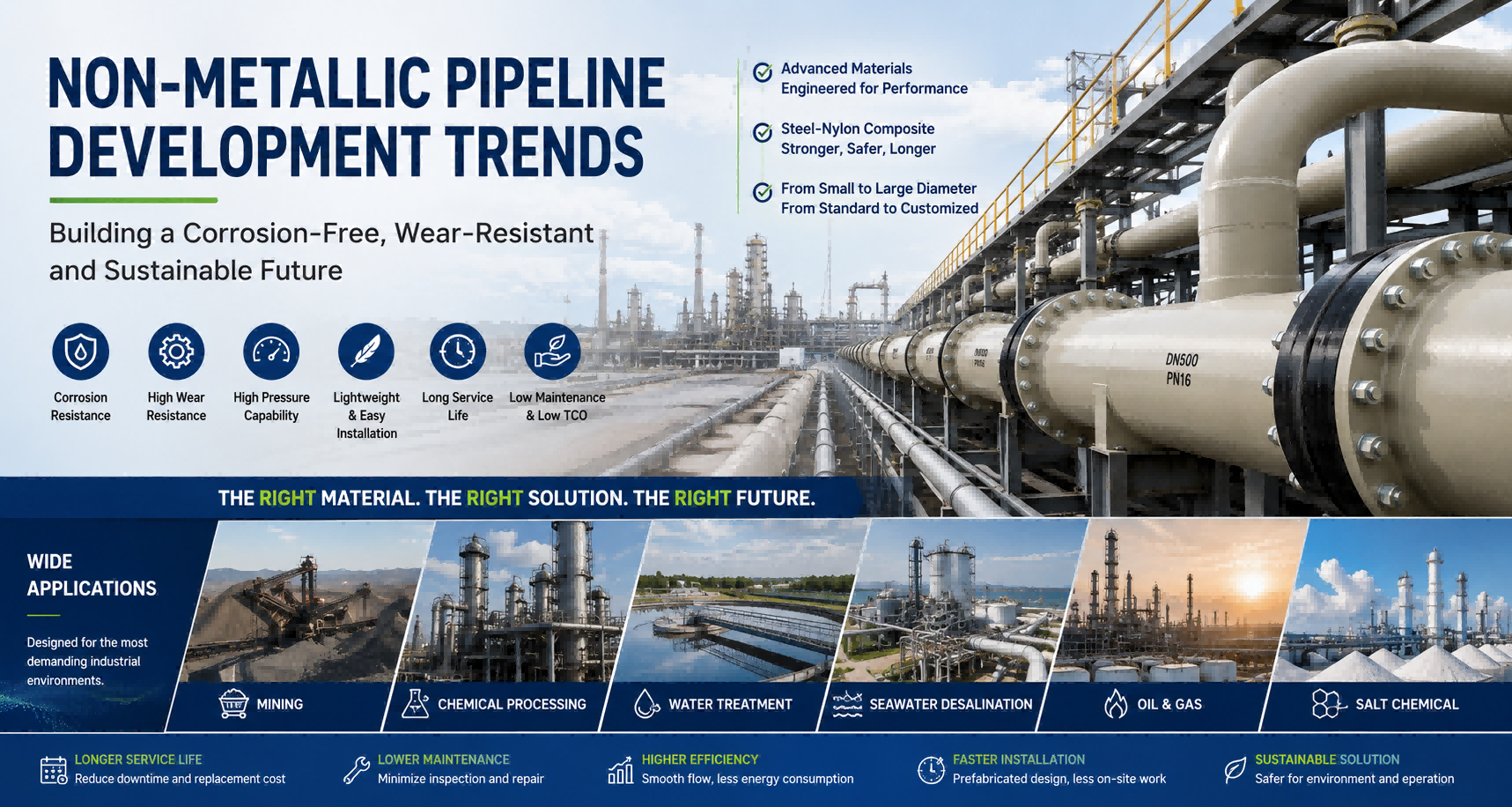
In industries such as petrochemicals, salt chemicals, mining, power generation, and seawater treatment, pipelines are constantly exposed to challenges including corrosion, abrasion, high pressure, temperature fluctuations, and rising maintenance costs.
Traditionally, duplex stainless steel pipe (DSS pipe) has been considered an advanced solution because of its excellent strength and corrosion resistance. However, as industrial operating conditions become more complex, relying only on metal materials is no longer sufficient for some high-corrosion and high-wear applications.
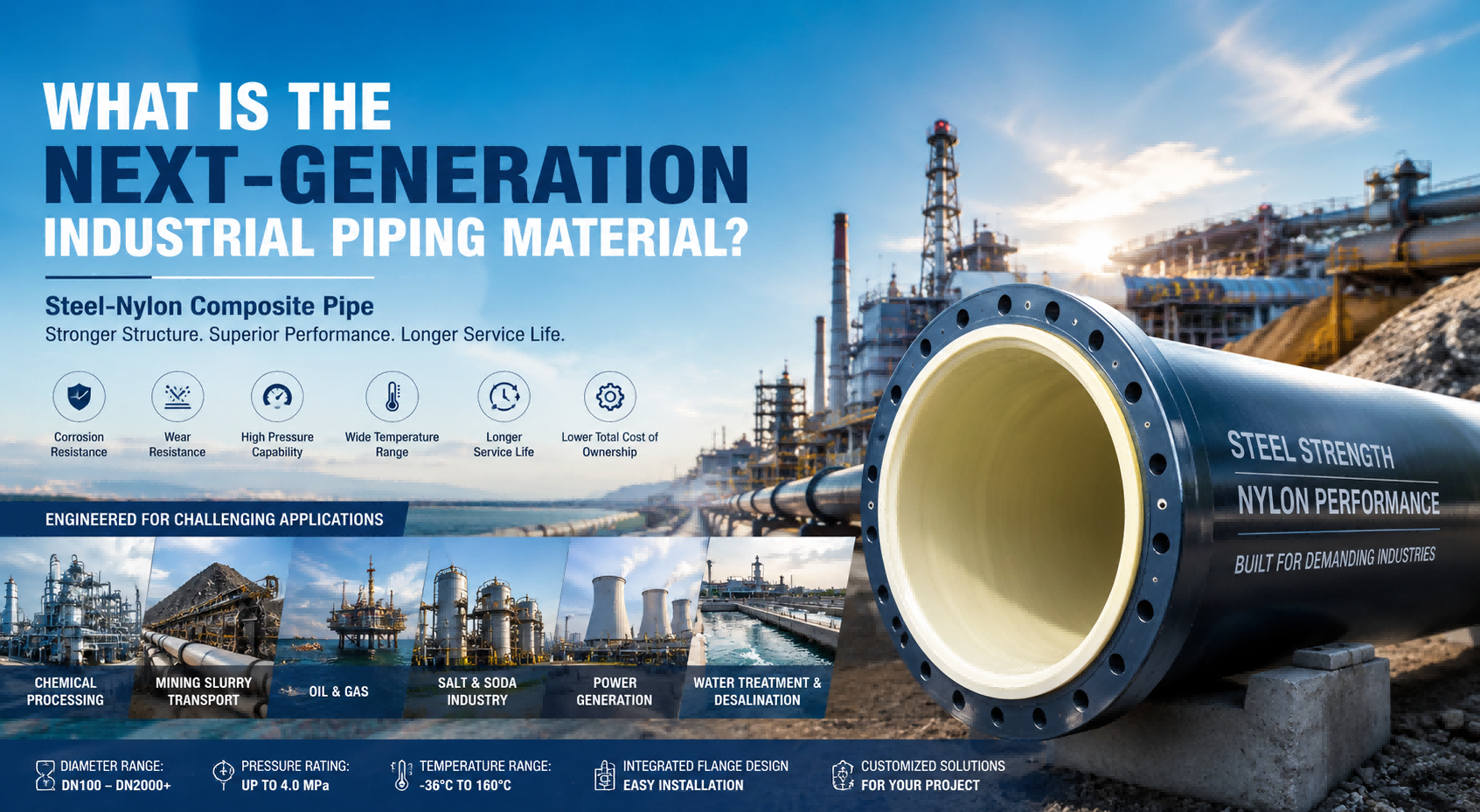
In recent years, steel-nylon composite pipe has become an increasingly attractive alternative due to its unique structure:
Steel provides mechanical strength and pressure resistance, while nylon provides corrosion resistance and wear protection.
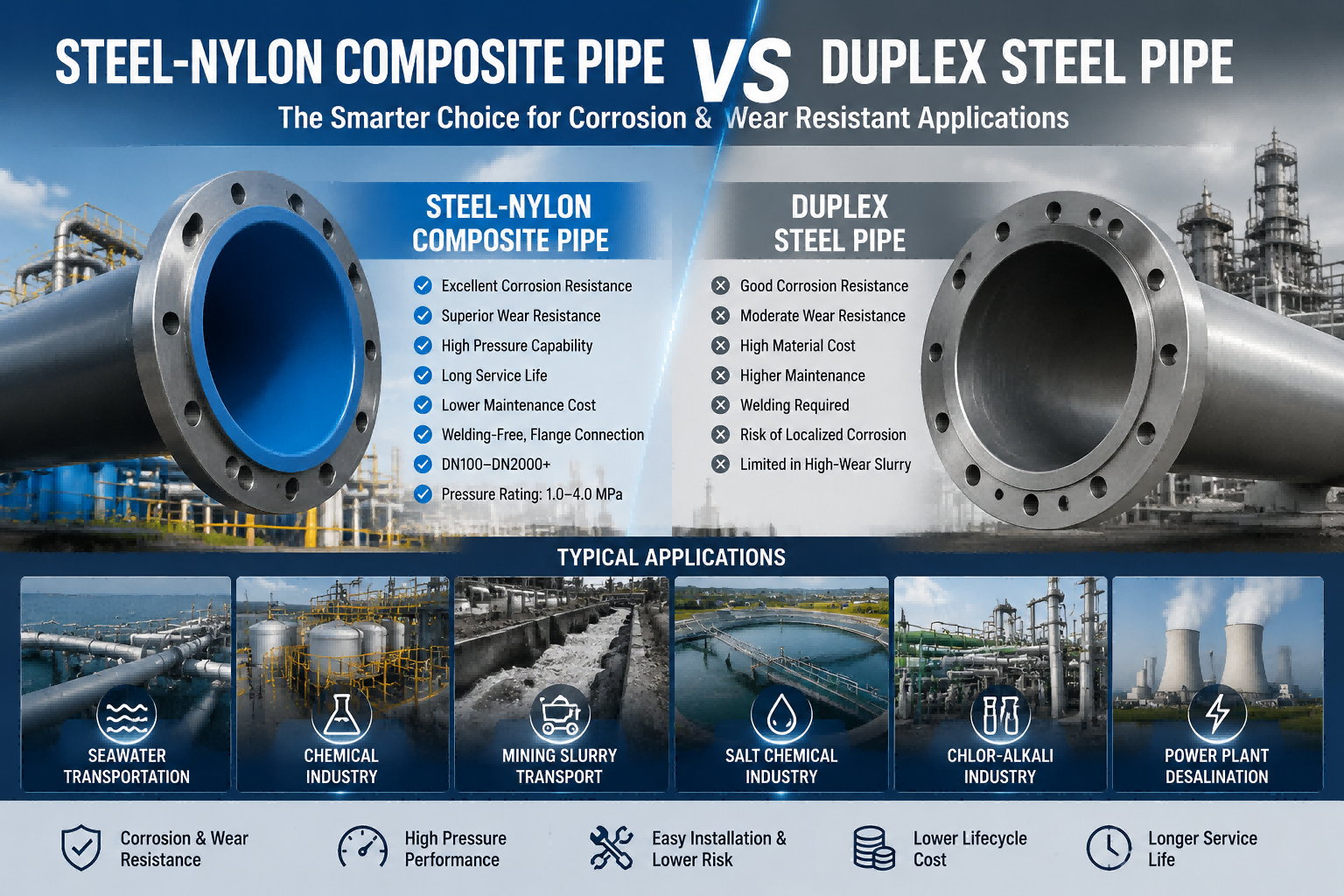
So, compared with duplex steel pipe:
Which pipeline material is more suitable for modern industrial applications?
This article provides an in-depth comparison from the perspectives of structure, corrosion resistance, wear resistance, pressure capability, installation efficiency, lifecycle cost, and application scenarios.
1. Structural Comparison: Steel-Nylon Composite Pipe vs Duplex Steel Pipe
1.1 Duplex Steel Pipe: Relying on Alloy Performance
Duplex stainless steel is a special stainless steel material consisting of both austenitic and ferritic phases.
Typical grades include:
-
Duplex 2205
-
Super Duplex 2507
Main advantages:
-
High mechanical strength
-
Excellent resistance to chloride corrosion
-
Better stress corrosion resistance than conventional 304/316L stainless steel
However, duplex steel remains essentially a metal material.
When transporting media containing:
-
Solid particles
-
Mineral sand
-
Crystal particles
-
High-concentration salts
-
Strong alkaline solutions
long-term erosion and corrosion can still occur.
Potential failure modes include:
-
Wall thickness reduction
-
Localized corrosion
-
Weld corrosion risks
1.2 Steel-Nylon Composite Pipe: Combining Metal Strength and Polymer Protection
Steel-nylon composite pipe adopts a unique composite structure:
Outer steel layer + high-performance nylon inner liner
Structure:
Transport Medium
        ↓
High Wear-Resistant Nylon Layer
        ↓
Steel Reinforced Pressure Layer
        ↓
External Environment
This design allows:
-
Nylon layer to provide corrosion resistance and wear protection
-
Steel layer to provide pressure resistance and structural stability
The result is:
A corrosion-resistant inner surface combined with a high-strength external structure.
2. Corrosion Resistance Comparison
Corrosion Performance of Duplex Steel Pipe
Compared with traditional stainless steel, duplex steel provides excellent corrosion resistance.
Performance:
| Medium | Duplex Steel Performance |
|---|---|
| Seawater | Excellent |
| Chloride environment | Excellent |
| Weak acid | Good |
| Strong alkali | Moderate |
| Particle-containing corrosive media | Affected by erosion |
Duplex steel performs particularly well in:
-
High-temperature chloride environments
-
Offshore applications
-
Seawater systems
However:
Metal corrosion is still a material degradation process.
Once the protective passive film is damaged, corrosion may continue to develop.
Corrosion Advantages of Steel-Nylon Composite Pipe
Nylon materials offer excellent chemical stability and resistance to:
-
Salt water
-
Chlorides
-
Carbonates
-
Weak acids
-
Strong alkalis
-
Chemical slurry
Because the transported medium only contacts the nylon inner surface:
the steel layer is completely isolated from the corrosive medium.
This effectively prevents:
-
Internal steel corrosion
-
Pitting corrosion
-
Electrochemical corrosion
-
Chloride penetration
Steel-nylon composite pipe is especially suitable for:
Salt Chemical Industry
Applications:
-
Brine transportation
-
Mother liquor systems
-
Salt slurry pipelines
Chlor-Alkali Industry
Applications:
-
Sodium chloride solutions
-
Alkaline solution transportation
3. Wear Resistance Comparison: Steel-Nylon Composite Pipe Has Clear Advantages
In industrial pipeline systems, abrasion is often more destructive than corrosion.
Typical high-wear media include:
-
Mining slurry
-
Coal slurry
-
Tailings slurry
-
Salt slurry
-
Chemical crystal slurry
Wear Performance of Duplex Steel Pipe
Duplex steel has higher hardness compared with ordinary stainless steel, but it still suffers from metal wear mechanisms:
Main forms:
-
Erosion wear
-
Fatigue wear
-
Localized damage expansion
Under continuous particle impact:
Possible issues include:
-
Wall thinning
-
Weld damage
-
Shortened replacement cycles
Wear Advantages of Steel-Nylon Composite Pipe
Nylon provides:
-
High toughness
-
Low friction coefficient
-
Excellent impact resistance
When particles hit the pipe wall:
For metal pipes:
Particle impact → Metal fatigue → Wall thickness reduction
For nylon-lined pipes:
Particle impact → Elastic deformation → Energy absorption
Therefore, steel-nylon composite pipes are especially suitable for:
-
Mine backfilling pipelines
-
Tailings transportation
-
Chemical slurry pipelines
Under severe wear conditions, they can significantly extend pipeline service intervals.
4. Pressure Capability Comparison
Many engineers believe:
“Plastic pipes resist corrosion but cannot handle high pressure.”
This is true for ordinary plastic pipes.
For example, HDPE pipes are limited by:
-
Temperature
-
Pressure rating
-
Long-term creep deformation
Pressure Performance of Duplex Steel Pipe
Advantages:
-
High strength
-
Excellent pressure capability
Suitable for:
-
High-pressure transportation
-
Offshore engineering
-
Chemical processing systems
Pressure Performance of Steel-Nylon Composite Pipe
Steel-nylon composite pipe solves the traditional weakness of plastic pipes by using steel as the structural reinforcement layer.
Current product range:
-
Diameter: DN100–DN2000+
-
Pressure rating: 1.0–4.0 MPa
While maintaining:
-
Corrosion resistance
-
Wear resistance
-
Structural strength
It provides the advantages of both:
Plastic corrosion resistance + steel pressure capability
5. Installation Comparison: Lower Construction Risk with Steel-Nylon Composite Pipe
Duplex Steel Pipe Installation
Common installation methods:
-
Welding
-
Flange connection
Welding requires:
-
Skilled technicians
-
Strict quality inspection
-
Longer construction periods
Especially in:
-
Chemical plants
-
Explosion-proof areas
welding increases construction complexity and cost.
Installation Advantages of Steel-Nylon Composite Pipe
Steel-nylon composite pipes use:
Integrated flange forming technology
Advantages:
✅ No on-site welding required
✅ Fewer leakage points
✅ Faster installation
✅ Lower maintenance risks
For large industrial projects, installation efficiency can be significantly improved.
6. Total Cost of Ownership (TCO) Comparison
Pipeline selection should not only consider:
“Cost per meter.”
The real cost includes:
-
Initial purchase cost
-
Installation cost
-
Downtime losses
-
Replacement expenses
-
Maintenance costs
Duplex Steel Pipe Cost Analysis
Advantages:
-
Long service life
-
Excellent corrosion resistance
However:
-
High material cost
-
Expensive fabrication
-
Higher welding costs
Lifecycle Cost Advantages of Steel-Nylon Composite Pipe
Although the initial purchase price may not always be the lowest:
it provides better long-term economic value through:
Reduced Maintenance Frequency
Due to:
-
Strong corrosion resistance
-
High wear resistance
it reduces:
-
Pipeline repairs
-
Production downtime
-
Replacement frequency
Lower Installation Cost
Integrated flange design:
reduces field fabrication requirements.
More Stable Long-Term Operation
The overall lifecycle cost can be significantly reduced.
7. Application Comparison
| Application | Duplex Steel Pipe | Steel-Nylon Composite Pipe |
|---|---|---|
| Seawater transportation | ★★★★★ | ★★★★★ |
| Chemical corrosive media | ★★★★ | ★★★★★ |
| Strong alkaline environment | ★★★ | ★★★★★ |
| Mining slurry | ★★★ | ★★★★★ |
| Salt chemical mother liquor | ★★★★ | ★★★★★ |
| High-wear slurry | ★★★ | ★★★★★ |
| Large diameter pipelines | ★★★★ | ★★★★★ |
8. Why Are More Industrial Projects Choosing Steel-Nylon Composite Pipe?
Modern pipeline engineering is shifting from:
“Choosing the most expensive metal material”
to:
“Choosing the most suitable material combination.”
Steel-nylon composite pipe solves three major problems of traditional pipeline materials:
Problem 1:
Carbon steel pipelines corrode easily
Solution:
Nylon liner isolates corrosive media from steel.
Problem 2:
Plastic pipes cannot withstand high pressure
Solution:
Steel reinforcement provides high-pressure capability.
Problem 3:
Metal pipes suffer from severe wear
Solution:
Nylon layer provides excellent abrasion resistance.
9. Conclusion: Steel-Nylon Composite Pipe as a New Generation Industrial Pipeline Solution
Duplex steel pipe remains an excellent material choice for many high-corrosion and high-strength applications.
However, for operating conditions involving:
-
Combined corrosion and abrasion
-
Particle-containing slurry transportation
-
Strong alkaline chemical environments
-
Large-diameter long-distance pipelines
-
Reduced maintenance requirements
steel-nylon composite pipe provides significant advantages.
With:
-
High-strength steel reinforcement
-
Corrosion-resistant nylon lining
-
Excellent wear resistance
-
DN2000+ large diameter capability
-
1.0–4.0 MPa pressure rating
-
Integrated flange, welding-free installation
steel-nylon composite pipe is becoming an important direction for industrial pipeline upgrades worldwide.
SEO Keywords
-
Steel Nylon Composite Pipe
-
Duplex Stainless Steel Pipe Alternative
-
Corrosion Resistant Industrial Pipe
-
Wear Resistant Pipeline
-
Chemical Industry Pipeline Solution
-
Slurry Transport Pipe
-
Nylon Lined Steel Pipe
-
High Pressure Composite Pipe
-
Industrial Pipeline Material Selection
-
Duplex Steel Pipe Replacement
Steel-Nylon Composite Pipe vs FRP Pipe: A Deep Comparison for Industrial Corrosion and Wear Applications
Steel-Nylon Composite Pipe vs 304 Stainless Steel Pipe: A New Choice for Industrial Pipeline Upgrading