Steel-Nylon Composite Pipe vs FRP Pipe: A Deep Comparison for Industrial Corrosion and Wear Applications

In industrial sectors such as chemical processing, mining, oil & gas, power generation, seawater desalination, and slurry transportation, pipeline systems are constantly exposed to challenges including:
-
Corrosion from aggressive chemicals;
-
Wear caused by solid particles;
-
High pressure operation;
-
Temperature fluctuations;
-
Complex installation environments.
For decades, FRP pipes (Fiberglass Reinforced Plastic / GRP pipes) have been widely used because of their lightweight structure and corrosion resistance. However, as industrial facilities become larger and operating conditions become more demanding, many engineering projects are beginning to reconsider whether FRP pipes can meet long-term reliability requirements.
Key concerns include:
-
Performance degradation after long-term operation;
-
Wear resistance in abrasive media;
-
Reliability under high pressure and large diameter applications;
-
Installation and maintenance costs;
-
Total Cost of Ownership (TCO).
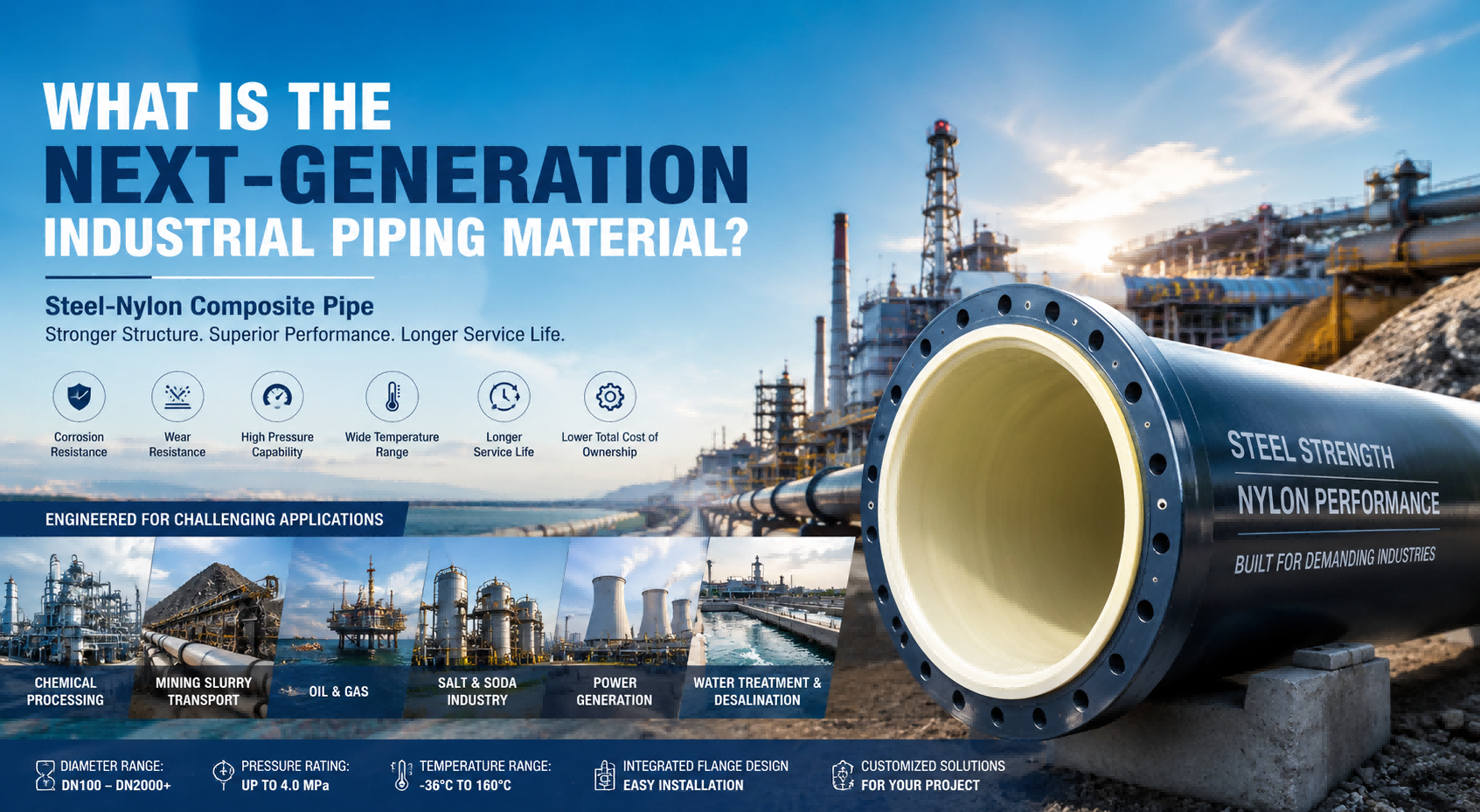
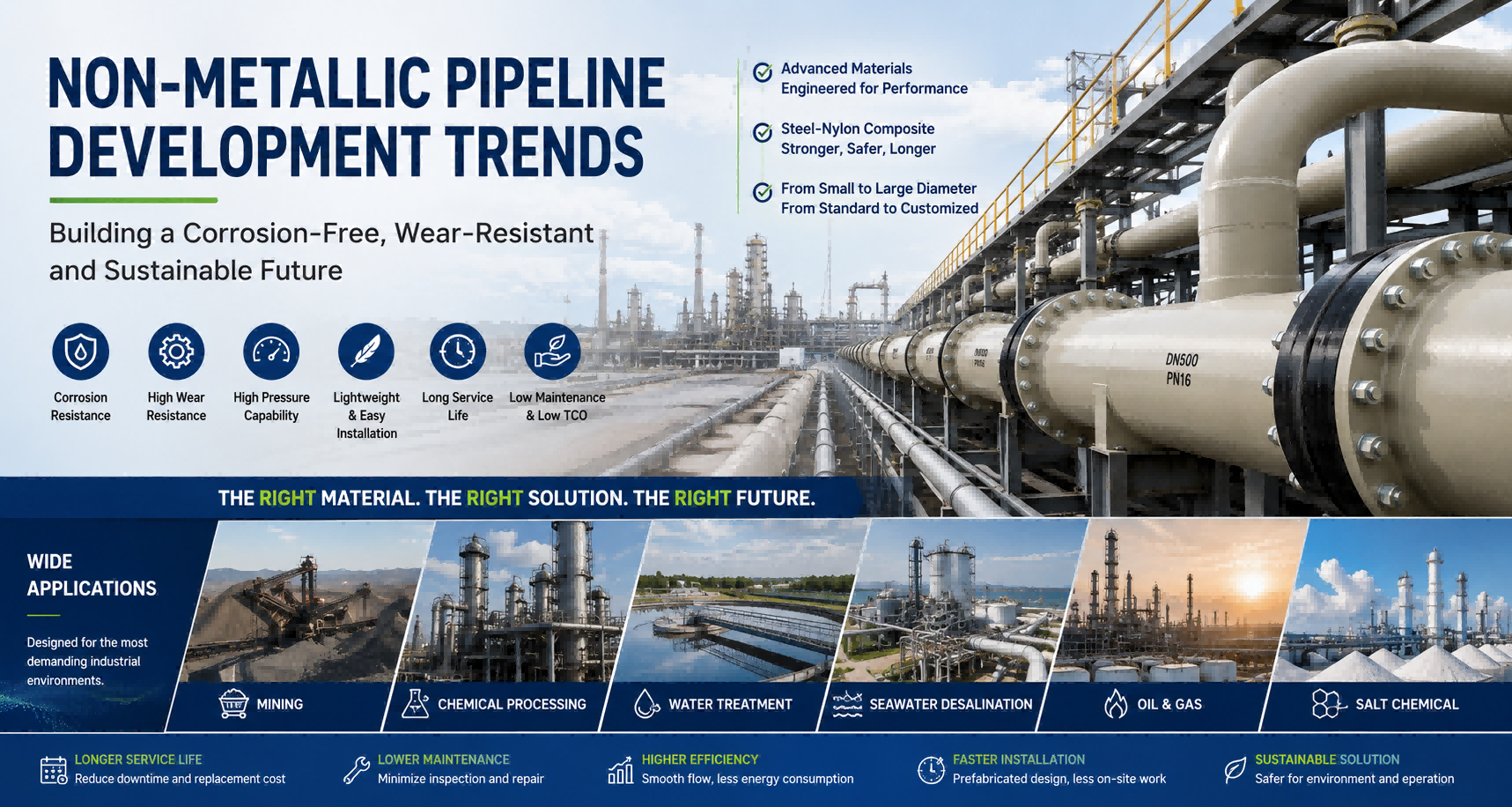
As an advanced composite pipeline solution, Steel-Nylon Composite Pipe combines the mechanical strength of steel with the corrosion and wear resistance of nylon. It is becoming an ideal alternative for demanding industrial applications where traditional FRP pipes may have limitations.
This article provides a comprehensive comparison between Steel-Nylon Composite Pipe and FRP Pipe from the perspectives of structure, performance, applications, and lifecycle cost.
1. Structural Difference: How Composite Design Creates Performance Advantages
1.1 Structure of FRP Pipe
FRP pipe is mainly composed of:
-
Resin matrix;
-
Glass fiber reinforcement;
-
Protective surface layer.
It is manufactured through processes such as filament winding and molding.
Advantages of FRP Pipe:
✔ Lightweight
✔ Good initial corrosion resistance
✔ Easy transportation and installation
However, FRP is essentially a fiber-reinforced polymer material, where mechanical strength depends heavily on the glass fiber structure.
During long-term industrial operation, FRP pipes may experience:
-
Resin aging;
-
Fiber fatigue;
-
Layer separation;
-
Reduced mechanical strength after surface damage.
1.2 Structure of Steel-Nylon Composite Pipe
Steel-Nylon Composite Pipe adopts a unique structure:
Outer steel layer + high-performance reinforced nylon inner lining
The two materials work together:
Outer Steel Layer Provides:
-
High mechanical strength;
-
Pressure resistance;
-
Impact resistance;
-
Structural stability.
Inner Nylon Layer Provides:
-
Excellent corrosion resistance;
-
Superior wear resistance;
-
Low friction characteristics;
-
Anti-scaling performance.
The result is:
"Steel provides strength, while nylon provides corrosion and wear protection."
This dual-protection structure makes Steel-Nylon Composite Pipe suitable for harsh industrial environments.
2. Corrosion Resistance Comparison
2.1 Corrosion Performance of FRP Pipe
FRP pipes show good resistance to many corrosive environments, including:
-
Salt solutions;
-
Mild acids;
-
Certain chemical fluids.
However, corrosion resistance depends greatly on:
-
Resin type;
-
Manufacturing quality;
-
Operating temperature;
-
Chemical concentration.
Long-term operation may lead to:
1. Resin Aging
Under high temperature or aggressive chemical conditions, resin gradually loses toughness and strength.
2. Chemical Permeation
Certain small molecules may penetrate the resin structure over time, causing:
-
Strength reduction;
-
Layer separation risks.
2.2 Corrosion Advantages of Steel-Nylon Composite Pipe
High-performance nylon materials provide:
-
Excellent chemical stability;
-
Resistance to salt corrosion;
-
Strong alkali resistance;
-
Protection against various industrial chemicals.
Steel-Nylon Composite Pipe is especially suitable for:
-
Chlor-alkali industries;
-
Soda ash production;
-
Salt chemical plants;
-
Phosphate chemical applications;
-
Mining slurry systems;
-
Wastewater treatment.
The continuous nylon inner layer isolates the transported medium from the steel body, preventing:
-
Internal corrosion;
-
Rust contamination;
-
Frequent pipeline replacement.
3. Wear Resistance Comparison: A Critical Factor for Slurry Transportation
In many industrial applications, pipeline failure is caused not by corrosion, but by mechanical wear.
Typical examples include:
-
Mining slurry;
-
Tailings transportation;
-
Coal slurry;
-
Phosphate slurry;
-
High-solid-content fluids.
3.1 Wear Limitations of FRP Pipe
Although FRP surfaces are relatively smooth, their wear resistance mainly depends on the resin layer.
During long-term transportation of abrasive materials:
Particle impact → Resin wear → Fiber exposure → Structural weakening
This can eventually cause:
-
Wall thinning;
-
Local damage;
-
Reduced service life.
Wear is especially serious in:
-
Elbows;
-
Tees;
-
Pump outlet sections;
-
High-flow areas.
3.2 Wear Advantages of Steel-Nylon Composite Pipe
Nylon materials feature:
-
Excellent impact resistance;
-
Self-lubricating properties;
-
High abrasion resistance.
When exposed to solid particles, the nylon lining absorbs impact energy and reduces direct damage to the pipe wall.
Therefore, Steel-Nylon Composite Pipe is ideal for:
-
Mining pipelines;
-
Long-distance slurry transportation;
-
Abrasion-prone elbows;
-
Pump outlet pipelines.
4. Pressure Performance Comparison
Industrial pipelines are becoming larger and more demanding.
Modern projects increasingly require:
-
DN500+ pipelines;
-
DN1000+ pipelines;
-
DN2000 large diameter systems;
-
Long-distance pressure transportation.
4.1 Pressure Limitations of FRP Pipe
FRP pressure performance is influenced by:
-
Fiber orientation;
-
Resin properties;
-
Wall thickness design;
-
Operating temperature.
Long-term pressure cycling may cause:
-
Fatigue damage;
-
Layer separation.
4.2 Pressure Advantages of Steel-Nylon Composite Pipe
Steel naturally provides:
-
High strength;
-
High toughness;
-
Excellent pressure impact resistance.
Steel-Nylon Composite Pipe can achieve:
-
Diameter range: DN100-DN2000;
-
Pressure ratings: 1.0-4.0 MPa.
For:
-
High-pressure transportation;
-
Large diameter pipelines;
-
Long-distance projects;
Steel-Nylon Composite Pipe provides higher safety margins and operational reliability.
5. Installation Comparison: Reducing Construction Risks
5.1 FRP Pipe Installation
FRP pipes commonly use:
-
Flange connections;
-
Adhesive joints;
-
Socket connections.
Installation quality depends heavily on:
-
Joint sealing;
-
Construction accuracy;
-
Protection against pipe damage.
5.2 Installation Advantages of Steel-Nylon Composite Pipe
Steel-Nylon Composite Pipe adopts:
Integrated Flange Forming Technology
Advantages:
✔ No welding required on site
✔ Fewer potential leakage points
✔ Faster installation
✔ Reduced construction difficulty
This is especially valuable for:
-
Chemical plant upgrades;
-
Mining sites;
-
Remote pipeline projects.
6. Total Cost of Ownership (TCO) Comparison
Many projects focus only on initial purchase costs. However, the real pipeline cost includes:
Purchase Cost + Installation Cost + Maintenance Cost + Replacement Cost
6.1 Initial Cost Advantage of FRP Pipe
FRP pipes offer:
-
Lower material cost;
-
Lightweight structure;
-
Lower initial investment.
However, long-term operation may involve:
-
Wear replacement;
-
Maintenance requirements;
-
Production downtime.
6.2 Lifecycle Cost Advantages of Steel-Nylon Composite Pipe
Although the initial investment may be higher than standard FRP pipes, Steel-Nylon Composite Pipe provides:
-
Longer service life;
-
Longer maintenance cycles;
-
Lower failure rates;
-
Fewer replacement requirements.
For industries where downtime is expensive, the lifecycle economic benefits are significant.
7. Comprehensive Comparison Table
| Performance | Steel-Nylon Composite Pipe | FRP Pipe |
|---|---|---|
| Structure | Steel + Nylon Composite | Glass Fiber + Resin |
| Pressure Resistance | ★★★★★ | ★★★★ |
| Wear Resistance | ★★★★★ | ★★★ |
| Corrosion Resistance | ★★★★★ | ★★★★ |
| Impact Resistance | ★★★★★ | ★★★ |
| Large Diameter Capability | DN2000+ | Depends on design |
| High Pressure Application | Excellent | Requires evaluation |
| Long-Term Stability | High | Resin dependent |
| Connection Reliability | Integrated flange | Installation dependent |
| Maintenance Cost | Low | Medium |
8. Industries Suitable for Steel-Nylon Composite Pipe
8.1 Chemical Industry
Applications:
-
Chlor-alkali transportation;
-
Soda ash mother liquor systems;
-
Salt chemical pipelines;
-
Corrosive chemical media transportation.
Advantages:
Excellent corrosion resistance + long service life
8.2 Mining Industry
Applications:
-
Tailings pipelines;
-
Backfill slurry transportation;
-
Ore slurry pipelines.
Advantages:
High abrasion resistance reduces replacement frequency
8.3 Oil & Gas Industry
Applications:
-
Gathering pipelines;
-
High-water-content crude oil transportation;
-
Sand-containing oilfield systems.
Advantages:
Corrosion protection + wear resistance
Conclusion: Steel-Nylon Composite Pipe — A Next-Generation Alternative to FRP Pipe
FRP pipes have successfully solved some corrosion problems of traditional metal pipelines. However, under extreme conditions involving:
-
High abrasion;
-
High pressure;
-
Large diameter;
-
Long-term continuous operation;
FRP pipes may face performance limitations.
Steel-Nylon Composite Pipe combines:
-
Steel structural strength;
-
Nylon corrosion resistance;
-
Superior abrasion resistance;
-
Integrated flange connection;
-
DN2000+ large diameter manufacturing capability;
-
Lower lifecycle cost.
For industrial pipeline systems requiring long-term reliability and minimal maintenance, Steel-Nylon Composite Pipe is becoming a high-performance alternative to FRP pipe.
Steel-Nylon Composite Pipe VS Steel Rubber Lined Pipe: How to Choose the Right Industrial Pipeline for Corrosion and Wear Resistance?
Steel-Nylon Composite Pipe VS Duplex Steel Pipe: A Deep Comparison for Industrial Pipeline Applications