Steel-Nylon Composite Pipe vs PE Pipe: A Comprehensive Comparison for Industrial Pipeline Upgrading
In industrial pipeline systems, PE (Polyethylene) pipes are widely used in water supply, gas transmission, and some chemical applications due to their lightweight structure, corrosion resistance, and convenient installation.
However, as industrial production develops toward higher pressure, larger diameter, higher temperature, and more aggressive operating conditions, traditional PE pipes are increasingly facing limitations:
-
Reduced mechanical strength under high-temperature conditions;
-
Long-term creep deformation under continuous pressure;
-
Limited performance in large-diameter, high-pressure applications;
-
Accelerated wear when transporting slurry or particle-containing media;
-
Difficulty meeting long service-life requirements under extreme conditions.
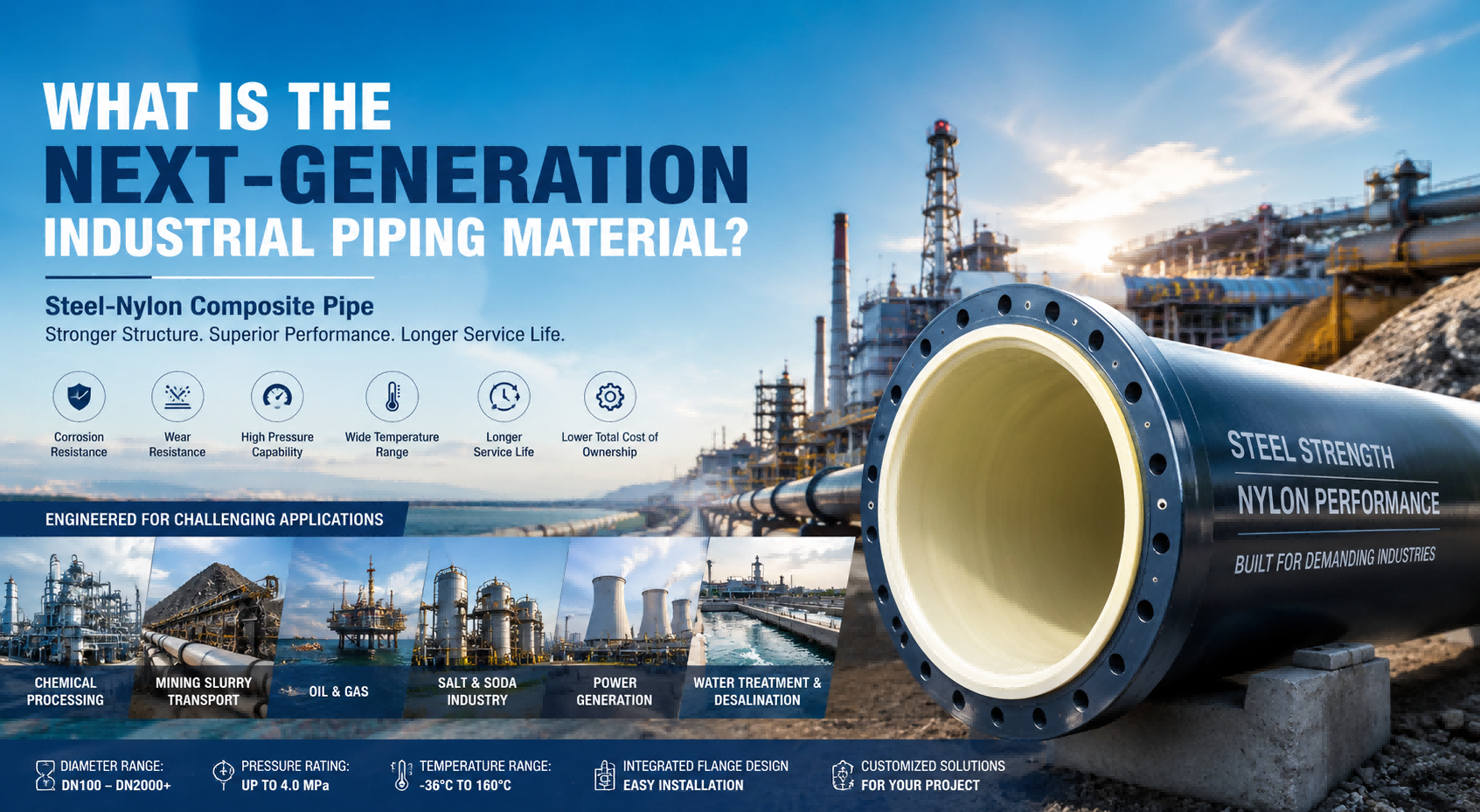
In comparison, Steel-Nylon Composite Pipe combines the structural strength of steel with the corrosion resistance and wear resistance of reinforced nylon, providing a more reliable pipeline solution for demanding industrial environments.
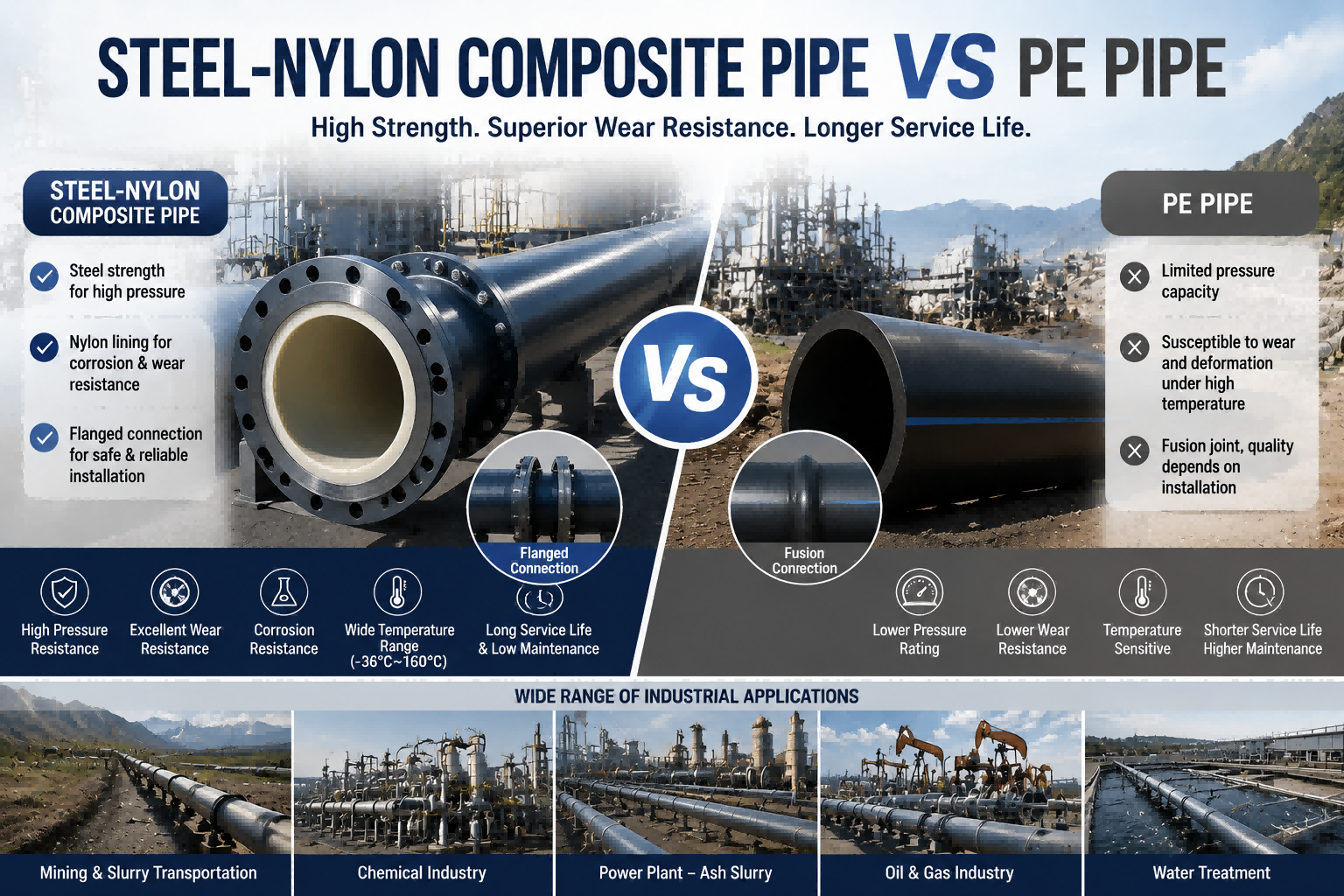
This article provides an in-depth comparison between Steel-Nylon Composite Pipe and PE Pipe from the perspectives of structure, pressure resistance, wear resistance, temperature performance, application scenarios, and total cost of ownership (TCO).
1. Structural Comparison: Single Material vs Composite Reinforced Structure
1.1 Characteristics of PE Pipe
PE pipe is manufactured through extrusion using a single polyethylene material.
Advantages include:
-
Stable molecular structure;
-
Good resistance to general acids and alkalis;
-
Smooth inner surface with low flow resistance;
-
Lightweight and easy installation.
However, PE is a flexible polymer material, and its pressure-bearing capacity mainly depends on wall thickness.
When pipe diameter and operating pressure increase:
-
Wall thickness must increase;
-
Pipe weight increases;
-
Effective flow area decreases.
Especially in large-diameter industrial pipelines above DN1000, PE pipes face limitations due to material strength.
1.2 Characteristics of Steel-Nylon Composite Pipe
Steel-Nylon Composite Pipe adopts an:
Outer steel layer + inner reinforced nylon lining integrated composite structure.
The structure provides:
-
Steel layer for mechanical strength and pressure resistance;
-
Nylon lining for corrosion protection and wear resistance.
This “rigid-flexible combination” gives the pipeline:
✅ The high strength of metal pipes
✅ The corrosion resistance of plastic pipes
✅ The wear resistance of engineering plastics
It is especially suitable for complex industrial operating conditions.
2. Pressure Performance: PE Limitations vs Steel-Nylon Advantages
Pressure capability is one of the most important factors in industrial pipeline selection.
2.1 Pressure Characteristics of PE Pipe
PE pipes are commonly used for:
-
Water supply systems;
-
Low-pressure transportation;
-
Municipal engineering applications.
Although higher-grade PE materials can improve pressure ratings, long-term performance is still affected by:
-
Operating temperature;
-
Environmental stress;
-
Pipe diameter.
At elevated temperatures, PE material strength decreases significantly, requiring reduced design pressure.
2.2 Pressure Advantages of Steel-Nylon Composite Pipe
Steel-Nylon Composite Pipe relies on the steel structure to bear the main pressure load.
It is suitable for:
-
Pressure ratings from 1.0 to 4.0 MPa;
-
Large diameters from DN100 to DN2000+;
-
Long-distance industrial transportation systems.
Typical applications include:
-
Mining slurry pipelines;
-
Chemical process pipelines;
-
Oilfield gathering pipelines;
-
Power plant ash slurry systems.
For projects requiring high safety margins and long-term reliability, Steel-Nylon Composite Pipe provides significant advantages.
3. Wear Resistance Comparison: A Critical Difference in Slurry Transportation
Pipeline wear is one of the largest causes of industrial maintenance costs.
Typical high-wear media include:
-
Mine tailings slurry;
-
Coal slurry;
-
Phosphate slurry;
-
Salt chemical mother liquor;
-
Sand-containing oilfield fluids.
3.1 Wear Performance of PE Pipe
PE has certain wear resistance, but under continuous exposure to:
-
High concentration solid particles;
-
High-speed fluid impact;
-
Frequent start-stop operations;
it may experience:
-
Inner wall abrasion;
-
Wall thickness reduction;
-
Localized failure.
Wear is especially severe at:
-
Elbows;
-
Tees;
-
Pump outlets;
-
Flow direction changes.
3.2 Wear Advantages of Steel-Nylon Composite Pipe
Reinforced nylon provides excellent:
-
Impact resistance;
-
Low friction coefficient;
-
Abrasion resistance.
The nylon inner layer protects the steel structure from direct contact with abrasive media.
Even under long-term transportation of particle-containing materials, Steel-Nylon Composite Pipe effectively reduces wear rates.
For mining, chemical, and oilfield applications, it significantly extends maintenance intervals.
4. Temperature Performance: The Application Boundary of PE Pipe
Temperature is a key factor affecting polymer pipeline life.
4.1 Temperature Limitations of PE Pipe
PE pipes are generally suitable for:
-
Normal temperature transportation;
-
Medium and low-temperature environments.
When temperature increases:
-
Material softening occurs;
-
Ring stiffness decreases;
-
Pressure capacity declines.
Therefore, PE is not ideal for long-term high-temperature industrial applications.
4.2 Temperature Advantages of Steel-Nylon Composite Pipe
Reinforced nylon provides a wider operating temperature range:
-36°C to 160°C
It can withstand:
-
High-temperature chemical fluids;
-
Cold winter conditions;
-
Outdoor industrial environments.
Compared with PE pipe, Steel-Nylon Composite Pipe offers a much wider application range.
5. Corrosion Resistance Comparison
5.1 Corrosion Resistance of PE Pipe
PE does not suffer from electrochemical corrosion like carbon steel.
It is suitable for:
-
Water systems;
-
General acid and alkali media;
-
Municipal pipelines.
5.2 Corrosion Resistance of Steel-Nylon Composite Pipe
The nylon inner layer isolates the transported medium from the steel substrate.
It effectively prevents:
-
Steel corrosion;
-
Pitting corrosion;
-
Chemical attack.
It is particularly suitable for:
-
Chlor-alkali industries;
-
Soda ash production;
-
Salt chemical plants;
-
Alkali transportation systems;
-
Weak acid applications.
Meanwhile, the external steel layer provides mechanical protection and improves overall reliability.
6. Connection Method Comparison: Installation Efficiency and Reliability
6.1 PE Pipe Connections
Common connection methods:
-
Heat fusion;
-
Electrofusion.
Potential challenges:
-
High requirements for construction conditions;
-
Connection quality depends heavily on workmanship;
-
Large-diameter installation becomes more difficult.
6.2 Steel-Nylon Composite Pipe Connections
Steel-Nylon Composite Pipe adopts:
Built-in flange and integrally formed connection design.
Advantages:
-
No on-site welding required;
-
Reduced leakage risks from welding joints;
-
Faster installation;
-
Easier maintenance.
It is especially suitable for:
-
Chemical plant upgrades;
-
Mining pipeline systems;
-
Long-distance transportation projects.
7. Large-Diameter Capability: The Choice for DN2000-Class Industrial Pipelines
With the expansion of industrial projects, demand for pipelines above DN1000 continues to grow.
Large-diameter PE pipes face challenges such as:
-
Increased wall thickness;
-
Limited rigidity;
-
Difficult transportation and installation.
Steel-Nylon Composite Pipe can achieve:
DN100 to DN2000+
Meeting the requirements of:
-
Large-scale slurry transportation;
-
Industrial circulating water systems;
-
Long-distance pipelines;
-
Chemical industrial parks.
8. Total Cost of Ownership (TCO) Comparison
Many projects focus only on initial pipe purchase costs. However, the real pipeline cost includes:
-
Initial investment;
-
Installation cost;
-
Downtime losses;
-
Maintenance expenses;
-
Replacement frequency.
| Comparison Item | PE Pipe | Steel-Nylon Composite Pipe |
|---|---|---|
| Initial Cost | Lower | Medium |
| High Pressure Capability | Limited | Excellent |
| Wear Resistance | Moderate | Excellent |
| Temperature Range | Limited | -36°C to 160°C |
| Large Diameter Capability | Limited | DN2000+ |
| Service Life | Highly affected by conditions | Long-term stable operation |
| Maintenance Frequency | Higher | Lower |
From a lifecycle perspective, Steel-Nylon Composite Pipe provides better economic value in high-wear, high-corrosion, and high-pressure industrial environments.
9. Industries Better Suited for Steel-Nylon Composite Pipe
9.1 Mining Industry
Applications:
-
Tailings transportation;
-
Mineral slurry pipelines;
-
Underground backfill pipelines.
Advantages:
-
Excellent wear resistance;
-
Impact resistance;
-
Reduced downtime.
9.2 Chemical Industry
Applications:
-
Chlor-alkali;
-
Soda ash;
-
Phosphate chemical;
-
Salt chemical industries.
Advantages:
-
Strong corrosion resistance;
-
Suitable for complex chemical media.
9.3 Oil & Gas Industry
Applications:
-
Gathering pipelines;
-
Sand-containing fluid transportation;
-
Valve group pipelines.
Advantages:
-
Wear resistance;
-
Corrosion protection;
-
Improved operating stability.
Conclusion: PE Pipe for Conventional Applications, Steel-Nylon Composite Pipe for Challenging Industrial Conditions
PE pipes remain an economical solution for conventional transportation systems due to their lightweight design and corrosion resistance.
However, for industrial applications involving:
-
High pressure;
-
High temperature;
-
Severe abrasion;
-
Strong corrosion;
-
Large diameter requirements;
PE pipes may not provide sufficient long-term reliability.
Steel-Nylon Composite Pipe combines the mechanical strength of steel with the corrosion resistance and wear resistance of reinforced nylon, delivering high strength, long service life, and stable operation in demanding industrial environments.
For industrial projects seeking lower maintenance costs and higher operational reliability, Steel-Nylon Composite Pipe is becoming an ideal alternative to traditional PE pipeline systems.
Steel-Nylon Composite Pipe vs HDPE Pipe: Choosing the Right Pipeline Solution for High-Strength, Wear-Resistant and Long-Life Industrial Applications
Steel-Nylon Composite Pipe VS Rubber Lined Steel Pipe: A Better Choice for Corrosive and Abrasive Industrial Applications