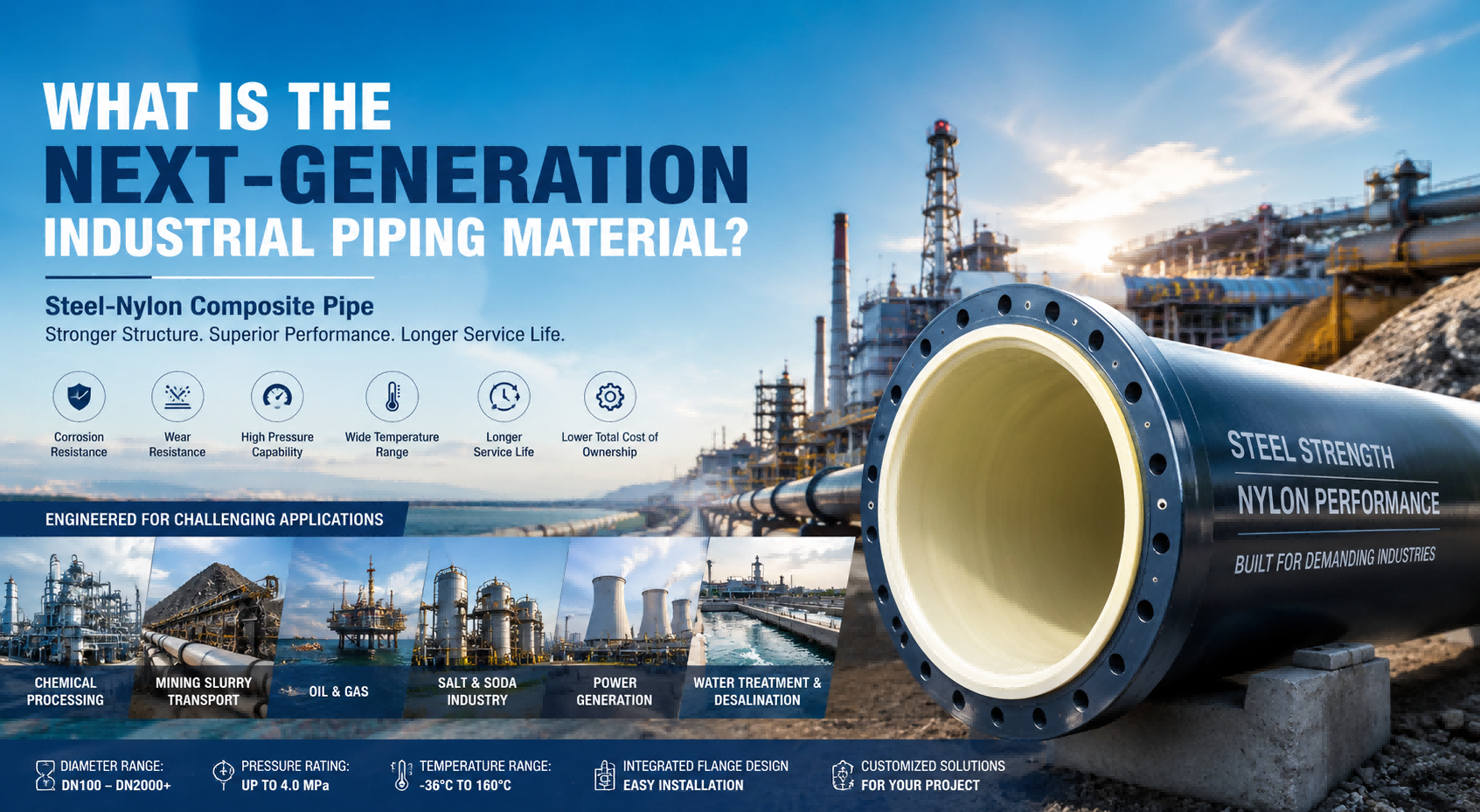
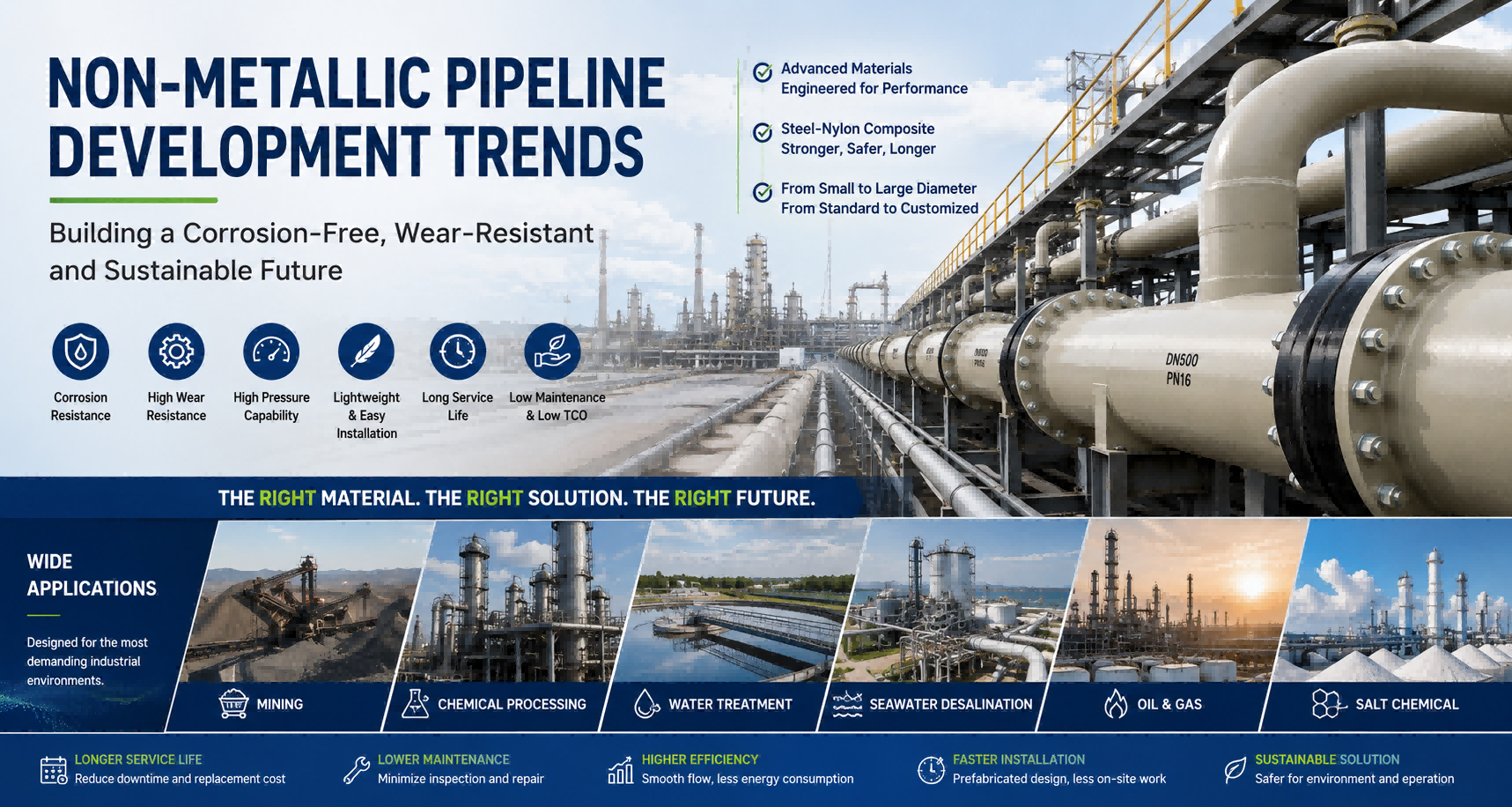
Steel-Nylon Composite Pipe vs Plastic Lined Steel Pipe: A Better Choice for Corrosive and Abrasive Industrial Applications
In industries such as chemical processing, mining, power generation, oil & gas, and water treatment, pipeline systems are continuously challenged by:
-
Corrosive chemicals
-
Abrasive particles
-
High pressure conditions
-
Temperature fluctuations
-
Long-term operation requirements
Plastic lined steel pipes have been widely used for decades because they combine the mechanical strength of steel with the corrosion resistance of plastic liners. However, as industrial facilities become larger and require longer maintenance cycles, many engineers are reevaluating whether traditional lined steel pipes can meet modern operating demands.
A new generation of pipeline technology — Steel-Nylon Composite Pipe — is gaining increasing attention.
By combining a high-strength steel structure with a high-performance reinforced nylon inner layer, steel-nylon composite pipes provide significant advantages in:
-
Corrosion resistance
-
Wear resistance
-
Pressure capability
-
Installation efficiency
-
Long-term reliability
This article provides an in-depth comparison between:
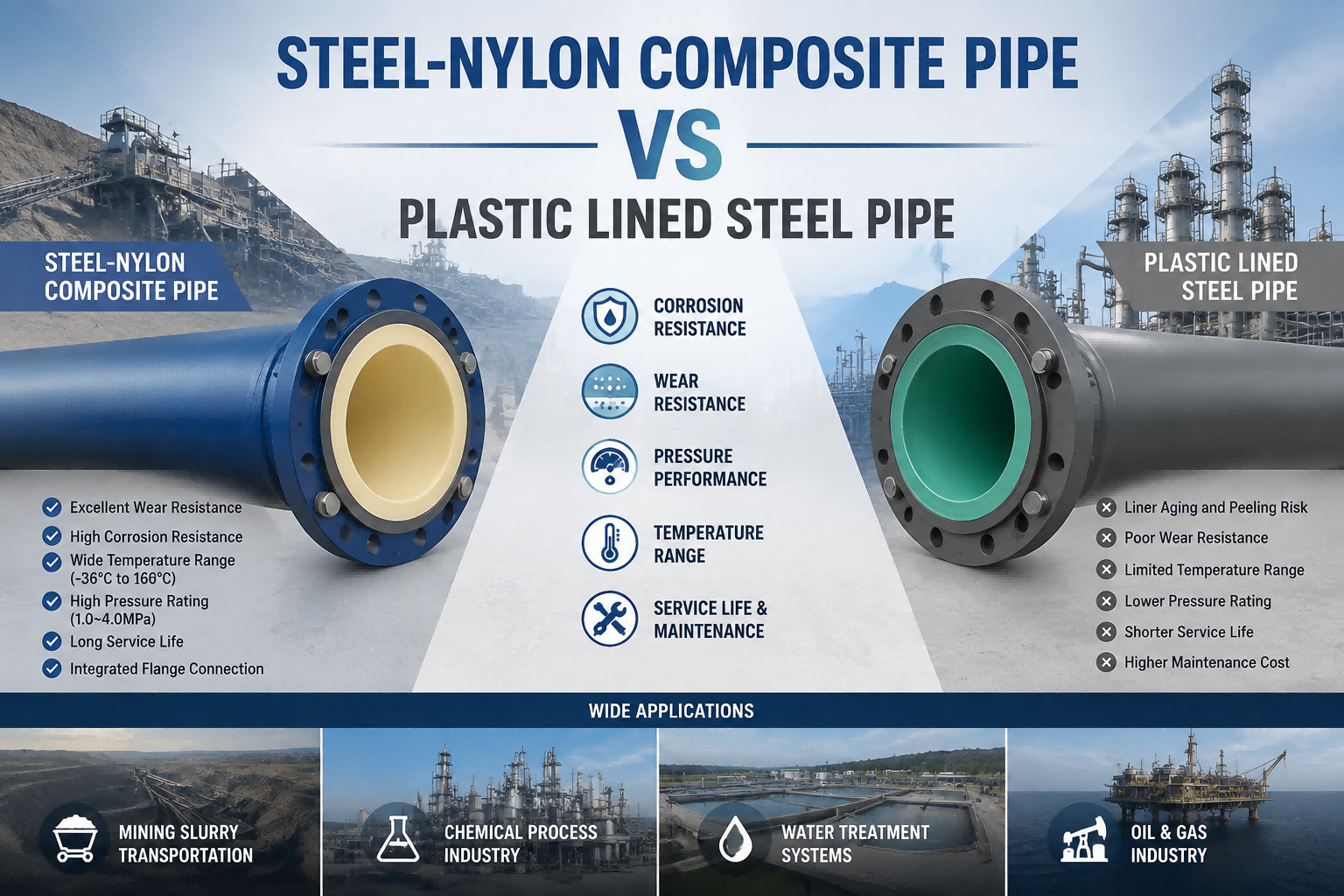
Steel-Nylon Composite Pipe vs Plastic Lined Steel Pipe
and explains why steel-nylon composite pipe is becoming a preferred solution for demanding industrial applications.
1. Structural Design Comparison: Simple Lining vs Integrated Composite Structure
1.1 Structure and Limitations of Plastic Lined Steel Pipe
Plastic lined steel pipe usually consists of:
Outer steel pipe + bonding layer + plastic liner
Common liner materials include:
-
PE
-
PP
-
PVC
-
PTFE
-
PO
The design concept is:
The steel pipe provides mechanical strength, while the plastic liner protects against corrosion.
However, steel and plastic have different:
-
Thermal expansion coefficients
-
Elastic properties
-
Mechanical behaviors
During long-term operation, these differences may cause:
-
Liner separation
-
Bulging
-
Cracking
-
Chemical penetration
-
Corrosion of the steel substrate
These problems become more significant under:
-
Frequent temperature changes
-
High-pressure operation
-
Abrasive slurry transportation
1.2 Structural Advantages of Steel-Nylon Composite Pipe
Steel-Nylon Composite Pipe adopts:
Steel reinforcement structure + high-performance reinforced nylon inner layer
The two materials work together as an integrated pipeline system.
Steel Layer Advantages:
Provides:
-
High mechanical strength
-
Excellent pressure resistance
-
Dimensional stability
Nylon Layer Advantages:
Provides:
-
Outstanding wear resistance
-
Excellent corrosion resistance
-
Low friction coefficient
-
High impact resistance
Through advanced composite manufacturing technology, steel and nylon form a stable structure rather than a simple liner system.
This means:
Steel-Nylon Composite Pipe is a true composite pipeline, not just a steel pipe with an attached plastic lining.
2. Corrosion Resistance Comparison
Industrial pipelines often transport complex media, including:
-
Sodium hydroxide
-
Sodium chloride
-
Carbonate solutions
-
Phosphate solutions
-
Seawater
-
Industrial wastewater
-
Chemical slurry
A pipeline must not only resist corrosion initially but also maintain performance over decades.
Corrosion Risks of Plastic Lined Steel Pipe
① Liner Damage Risk
During:
-
Transportation
-
Installation
-
Maintenance
-
Operation
the plastic liner may suffer:
-
Scratches
-
Impact damage
-
Local deformation
Once the steel substrate is exposed, corrosion can rapidly develop.
② Connection Point Weakness
Traditional plastic lined steel pipes usually require:
-
Flange connections
-
Welded steel sections
-
Additional sealing protection
Connection areas often become potential weak points for corrosion leakage.
Advantages of Steel-Nylon Composite Pipe
Steel-Nylon Composite Pipe uses high-performance nylon as the direct contact layer with the transported medium.
Excellent Chemical Stability
Suitable for:
-
Weak acids
-
Strong alkalis
-
Salt solutions
-
Various industrial chemicals
Strong Resistance to Penetration
The dense nylon structure reduces long-term chemical penetration risks.
No Dependence on Surface Coatings
Unlike traditional carbon steel pipes, corrosion protection does not rely mainly on external coatings.
3. Wear Resistance Comparison: The Key Factor in Slurry Transportation
In mining, power plants, and chemical industries, corrosion is not always the main cause of pipeline failure.
In many cases, the real problem is:
abrasive wear caused by solid particles.
Typical applications include:
-
Mining slurry pipelines
-
Tailings transportation
-
Fly ash pipelines
-
Salt mud transportation
Wear Problems of Plastic Lined Steel Pipe
Although plastic liners provide corrosion resistance, many conventional plastics have limited wear resistance.
Under:
-
High solid concentration
-
High flow velocity
-
Solid-liquid two-phase flow
plastic liners may experience:
-
Surface erosion
-
Wall thinning
-
Premature failure
Wear Resistance Advantages of Steel-Nylon Composite Pipe
Reinforced nylon offers:
-
High toughness
-
Excellent abrasion resistance
-
Strong impact resistance
Compared with ordinary plastic liners, nylon can better withstand continuous particle impact and erosion.
It is especially suitable for:
-
Mining filling pipelines
-
Tailings pipelines
-
Chemical slurry transportation systems
helping significantly extend maintenance intervals.
4. Temperature and Pressure Performance Comparison
Limitations of Plastic Lined Steel Pipe
Different plastic materials have different temperature limitations:
For example:
-
PE: Limited high-temperature performance
-
PVC: Poor high-temperature resistance
-
PP: Limited low-temperature impact resistance
Under:
-
Hot chemical media
-
Temperature cycling conditions
plastic liners may experience:
-
Softening
-
Shrinkage
-
Deformation
Performance Advantages of Steel-Nylon Composite Pipe
Through material modification technology, reinforced nylon provides:
Operating temperature range:
-36°C to 160°C
Pressure rating:
1.0–4.0 MPa
Diameter range:
DN100–DN2000+
This makes it suitable for large-scale industrial pipeline systems.
5. Installation Comparison: Improving Construction Efficiency and Reliability
Installation Characteristics of Plastic Lined Steel Pipe
Traditional installation usually requires:
-
Flange assembly
-
Multiple pipe connections
-
Additional sealing procedures
During installation, special attention must be paid to:
-
Protecting the liner
-
Maintaining flange sealing
-
Avoiding liner damage
Installation Advantages of Steel-Nylon Composite Pipe
Steel-Nylon Composite Pipe features:
Integrated forming and built-in flange design
Advantages include:
Reduced Welding Requirements
Avoids:
-
On-site welding risks
-
Heat damage to lining materials
-
Additional corrosion repair work
Fewer Leakage Points
Integrated flange structures improve system reliability.
Faster Installation
Especially beneficial for:
-
Large diameter pipelines
-
Pipeline renovation projects
-
Projects requiring rapid construction
6. Service Life and Total Cost of Ownership (TCO) Comparison
Many projects focus only on initial purchase costs.
However, the real pipeline cost includes:
-
Purchase cost
-
Installation cost
-
Maintenance cost
-
Downtime losses
-
Replacement expenses
Long-Term Cost of Plastic Lined Steel Pipe
Potential costs include:
-
Liner repair
-
Local replacement
-
Leakage maintenance
-
Production interruption
Long-Term Value of Steel-Nylon Composite Pipe
Due to:
-
Superior wear resistance
-
Excellent corrosion resistance
-
Longer service life
-
Lower maintenance requirements
Steel-Nylon Composite Pipe helps reduce:
-
Pipeline replacement frequency
-
Maintenance labor costs
-
Unexpected downtime risks
For continuous industrial operations, the lifecycle economic benefits are significant.
7. Application Comparison
Common Applications of Plastic Lined Steel Pipe
Suitable for:
-
General chemical transportation
-
Low-abrasion environments
-
Moderate operating conditions
Key Applications of Steel-Nylon Composite Pipe
More suitable for:
Chemical Industry
-
Chlor-alkali plants
-
Soda ash production
-
Phosphate chemical industry
Mining Industry
-
Slurry transportation
-
Tailings pipelines
-
Backfilling systems
Oil & Gas Industry
-
Produced water transportation
-
Sand-containing oil-water pipelines
-
Gathering systems
Water Treatment Industry
-
Seawater pipelines
-
Industrial circulation water systems
8. Engineering Selection Guide: When Should You Choose Steel-Nylon Composite Pipe?
Steel-Nylon Composite Pipe is especially recommended when your pipeline system involves:
✅ Corrosive media
✅ Abrasive particles
✅ Large diameter requirements
✅ Pressure requirements above 1.0 MPa
✅ Frequent maintenance problems
✅ High downtime costs
In these applications, steel-nylon composite pipe provides better long-term reliability compared with traditional plastic lined steel pipe.
Conclusion: Steel-Nylon Composite Pipe — The Next Generation Industrial Pipeline Solution
Plastic lined steel pipes solved many corrosion problems of traditional steel pipelines, but their liner-based structure still faces long-term reliability challenges.
Steel-Nylon Composite Pipe combines:
-
High-strength steel reinforcement
-
Wear-resistant reinforced nylon
-
Integrated composite structure
-
Built-in flange connection
-
Efficient installation
to achieve a balanced improvement in:
Strength + Corrosion Resistance + Wear Resistance + Service Life + Installation Efficiency
For modern industrial projects, Steel-Nylon Composite Pipe is not simply an alternative material — it is a complete pipeline solution designed to reduce lifecycle costs and improve operational reliability.
Reinforced Nylon Pipe vs FRP Pipe: A Comprehensive Comparison for Industrial Pipeline Selection
Steel-Nylon Composite Pipe VS PVC Pipe: How to Choose a More Reliable Pipeline Material for Industrial Applications?