Steel-Nylon Composite Pipe VS PVC Pipe: How to Choose a More Reliable Pipeline Material for Industrial Applications?

In industrial pipeline systems, PVC (Polyvinyl Chloride) pipes have been widely used in water supply, drainage, environmental protection, and general chemical applications due to their advantages such as low cost, lightweight structure, and good corrosion resistance.
However, as industrial operating conditions become more demanding, especially in applications involving high pressure, severe wear, high temperature, and complex corrosive media, traditional PVC pipes are gradually showing their limitations:
-
Reduced mechanical strength at elevated temperatures;
-
Limited impact resistance;
-
Creep deformation under long-term pressure;
-
Poor wear resistance when transporting solid-containing fluids;
-
Restrictions in large-diameter and high-pressure applications.
As a result, more industrial projects are looking for upgraded alternatives to traditional PVC piping systems.
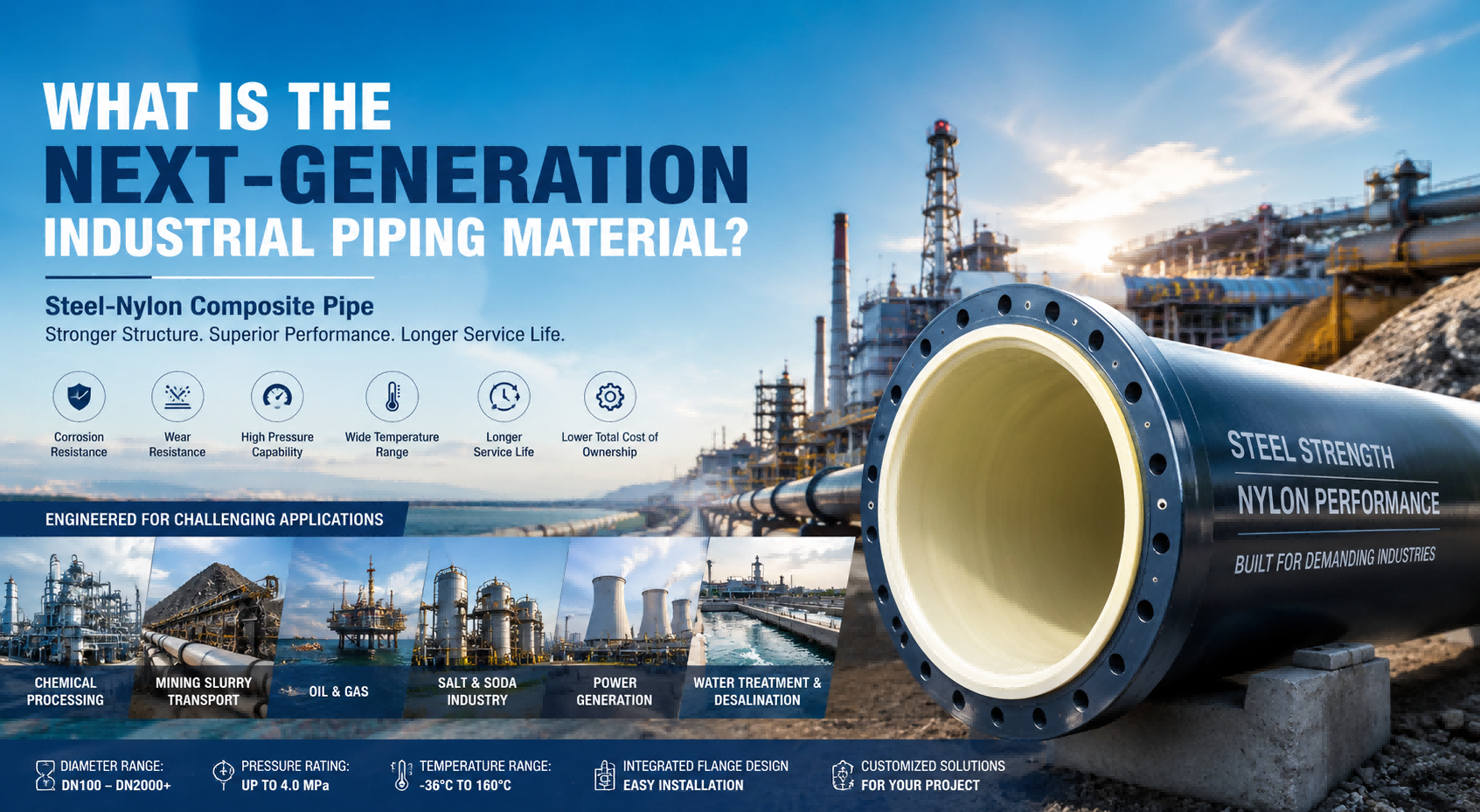
Steel-Nylon Composite Pipe has been developed to address these challenges. By combining the structural strength of steel with the corrosion resistance and wear resistance of reinforced nylon, it provides a high-performance pipeline solution that integrates the advantages of both metal and engineering plastics.
1. Fundamental Structural Differences Between PVC Pipe and Steel-Nylon Composite Pipe
1.1 PVC Pipe: Single-Layer Plastic Structure
PVC pipe is manufactured mainly through extrusion molding of polyvinyl chloride resin. Its performance depends entirely on the properties of PVC itself.
Typical structure:
Single-layer PVC wall
↓
The plastic material carries all pressure, corrosion resistance, and wear loads
This simple structure provides cost advantages but also creates limitations:
-
Limited mechanical strength;
-
Reduced pressure capability at higher temperatures;
-
Vulnerability to external impact;
-
Aging risks during long-term operation.
1.2 Steel-Nylon Composite Pipe: Metal Reinforcement + Functional Liner
Steel-Nylon Composite Pipe adopts advanced composite manufacturing technology:
Outer steel layer
↓
Provides structural strength and pressure resistance

Inner reinforced nylon layer
↓
Provides corrosion resistance, wear resistance, and anti-scaling performance
The design principle is:
Steel provides strength, while nylon provides protection.
This structure gives the pipeline:
-
High mechanical strength;
-
Excellent wear resistance;
-
Superior corrosion resistance;
-
Long service life.
It is especially suitable for industrial conditions where traditional PVC pipes cannot perform reliably.
2. Pressure Performance Comparison: Steel-Nylon Composite Pipe Handles More Demanding Systems
Pressure rating is one of the most important factors in industrial pipeline selection.
Limitations of PVC Pipe Under Pressure
PVC pipes are commonly used for:
-
Low-pressure water systems;
-
Normal-temperature transportation;
-
Non-critical industrial applications.
However, as:
-
Pipe diameter increases;
-
Temperature rises;
-
Service time extends;
PVC pressure performance gradually decreases.
In applications such as:
-
Pump outlet pipelines;
-
Slurry transportation systems;
-
Chemical circulation pipelines;
PVC pipes may experience:
-
Deformation;
-
Cracking;
-
Joint leakage.
Pressure Advantages of Steel-Nylon Composite Pipe
Steel-Nylon Composite Pipe uses steel as the pressure-bearing structure and can achieve:
Pressure ratings from 1.0 to 4.0 MPa
with large diameter capability:
DN100 to DN2000+
It is suitable for:
-
Long-distance transportation pipelines;
-
High-pressure pumping systems;
-
Mining slurry pipelines;
-
Chemical process networks.
Compared with PVC pipes, Steel-Nylon Composite Pipe provides significantly higher safety margins for pressure applications.
3. Corrosion Resistance Comparison: Nylon Lining Provides Protection in Complex Chemical Environments
PVC has certain corrosion resistance, but its performance can become limited under aggressive industrial conditions.
Typical challenging environments include:
-
Strong alkaline solutions;
-
High-salt environments;
-
Corrosive fluids containing particles;
-
Higher-temperature chemical media.
Long-term PVC operation may lead to:
-
Material degradation;
-
Embrittlement;
-
Micro-crack development.
Steel-Nylon Composite Pipe uses reinforced nylon as the fluid-contact layer, providing:
✓ Excellent acid and alkali resistance
✓ Strong chemical corrosion resistance
✓ Reduced scaling
✓ Smooth inner surface and lower flow resistance
It is widely used in:
-
Chlor-alkali industries;
-
Soda ash production;
-
Phosphate chemical plants;
-
Salt chemical industries;
-
Seawater transportation systems.
4. Wear Resistance Comparison: A Critical Difference in Solid-Containing Fluid Transportation
Many industrial pipelines fail not because of corrosion, but because of mechanical wear.
Typical applications include:
-
Mining slurry transportation;
-
Tailings pipelines;
-
Coal slurry systems;
-
Limestone slurry transportation;
-
Solid-liquid mixed media.
Due to its limited hardness and impact resistance, PVC pipe may suffer from:
-
Wall thinning;
-
Local perforation;
-
Shortened service life.
Steel-Nylon Composite Pipe features reinforced nylon with:
-
Excellent abrasion resistance;
-
High impact resistance;
-
Superior toughness.
In slurry transportation applications, it can significantly reduce:
-
Replacement frequency;
-
Maintenance downtime;
-
Operating costs.
5. High-Temperature Performance: The Major Limitation of PVC
PVC pipes are mainly suitable for normal-temperature applications.
When temperature increases:
-
Material strength decreases;
-
Deformation risk increases;
-
Service life becomes shorter.
Therefore, PVC is generally not recommended for:
-
High-temperature chemical fluids;
-
Thermal cycling systems;
-
Hot industrial wastewater transportation.
Steel-Nylon Composite Pipe operates within:
-36°C to 160°C
covering a much wider range of industrial applications.
Examples include:
-
Chemical process circulation pipelines;
-
Hot media transportation;
-
Metallurgical industrial water systems.
6. Installation Comparison: Steel-Nylon Composite Pipe Reduces Construction Risks
PVC pipes are commonly installed using:
-
Solvent bonding;
-
Threaded connections;
-
Conventional flange connections.
Over long-term operation, joints often become potential leakage points.
Steel-Nylon Composite Pipe adopts:
Integrally Formed Self-Flange Connection Design
Advantages:
-
No on-site welding required;
-
Reduced welding defects;
-
Easier installation;
-
Fewer leakage points.
It is especially suitable for:
-
Large-diameter industrial pipelines;
-
Chemical plant renovation projects;
-
High-safety industrial systems.
7. Lifecycle Cost Comparison (TCO): Low Initial Cost Does Not Always Mean Low Operating Cost
Many projects select PVC pipes because of their lower purchase price.
However, industrial users focus more on:
Total Cost of Ownership (TCO)
including:
-
Initial investment;
-
Installation cost;
-
Maintenance expenses;
-
Production losses caused by downtime;
-
Replacement costs.
Although PVC pipes have lower initial costs, frequent replacement may occur under:
-
High-wear conditions;
-
High-pressure systems;
-
High-temperature environments;
-
Long-distance transportation applications.
Although Steel-Nylon Composite Pipe requires a higher initial investment, it reduces long-term costs through:
-
Longer service life;
-
Less maintenance;
-
Higher operational reliability.
8. Comprehensive Comparison: Steel-Nylon Composite Pipe VS PVC Pipe
| Performance | PVC Pipe | Steel-Nylon Composite Pipe |
|---|---|---|
| Pressure capability | Limited | High (1.0-4.0 MPa) |
| Large diameter application | Restricted | DN2000+ |
| Wear resistance | Moderate | Excellent |
| Corrosion resistance | Good | Excellent |
| Temperature range | Limited | -36°C to 160°C |
| Impact resistance | Lower | High |
| Long-distance transportation | Limited | Suitable |
| Slurry transportation | Limited applications | Widely used |
| Flange connection | Conventional | Integrated flange design |
| Service life | Depends on conditions | Long-term operation |
9. Industries Where Steel-Nylon Composite Pipe Is More Suitable
9.1 Chemical Industry
Applications:
-
Chlor-alkali transportation systems;
-
Soda ash mother liquor pipelines;
-
Phosphate chemical pipelines.
Advantages:
Corrosion resistance + wear resistance.
9.2 Mining Industry
Applications:
-
Tailings transportation;
-
Mine backfilling pipelines;
-
Slurry pipelines.
Advantages:
Reduced wear and improved continuous operation time.
9.3 Oil & Gas Industry
Applications:
-
Gathering pipelines;
-
Sand-containing fluid transportation;
-
Process pipelines.
Advantages:
Excellent corrosion protection and abrasion resistance.
10. Conclusion: PVC for General Applications, Steel-Nylon Composite Pipe for Industrial Upgrading
PVC pipe remains an economical choice for:
-
General water supply;
-
Low-pressure systems;
-
Normal-temperature applications.
However, for modern industrial requirements involving:
-
High pressure;
-
High wear;
-
Strong corrosion;
-
Large diameter;
-
Long service life;
PVC pipes often cannot provide sufficient reliability.
Steel-Nylon Composite Pipe combines:
Steel pressure-bearing structure + Reinforced nylon corrosion-resistant liner + Integrated flange connection technology
to provide a more reliable industrial pipeline solution.
For industrial projects seeking:
-
Lower maintenance costs;
-
Longer service intervals;
-
Higher operational safety;
Steel-Nylon Composite Pipe is becoming an advanced alternative to traditional PVC piping systems.
Steel-Nylon Composite Pipe vs Plastic Lined Steel Pipe: A Better Choice for Corrosive and Abrasive Industrial Applications
Steel-Nylon Composite Pipe vs HDPE Pipe: Choosing the Right Pipeline Solution for High-Strength, Wear-Resistant and Long-Life Industrial Applications