Steel-Nylon Composite Pipe VS Rubber Lined Steel Pipe: A Better Choice for Corrosive and Abrasive Industrial Applications

In industries such as chemical processing, mining, power generation, oil & gas, and salt chemical production, pipelines are continuously exposed to challenging operating conditions, including:
-
Corrosive chemicals;
-
Abrasive slurry;
-
High flow velocity;
-
Temperature fluctuations;
-
Long-term pressure loading.
For decades, rubber lined steel pipes have been widely used as an anti-corrosion solution for transporting acidic, alkaline, and slurry media. However, as modern industries demand longer service life, lower maintenance costs, and higher operational reliability, the limitations of traditional rubber lined steel pipes have become increasingly apparent.
Common problems include:
-
Rubber lining aging and peeling;
-
Reduced performance under high temperatures;
-
Difficult inspection after internal damage;
-
Failure under vacuum conditions;
-
Leakage risks at connection points.
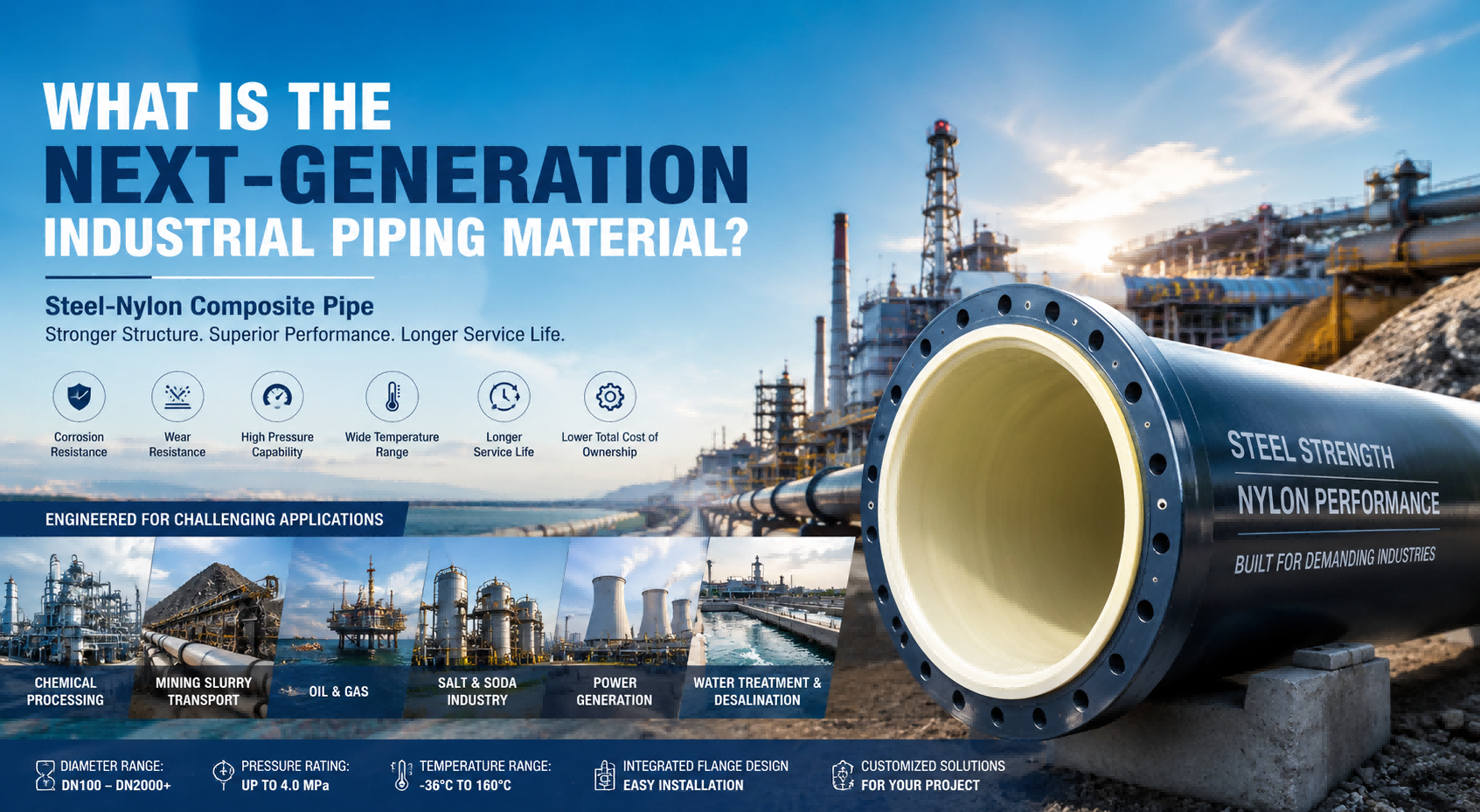
Compared with rubber lined steel pipes, steel-nylon composite pipes combine the mechanical strength of steel with the corrosion resistance and wear resistance of reinforced nylon, providing a more reliable solution for demanding industrial pipeline systems.
This article provides an in-depth comparison of Steel-Nylon Composite Pipe vs Rubber Lined Steel Pipe from the perspectives of structure, corrosion resistance, wear resistance, temperature capability, installation efficiency, and total lifecycle cost.
1. Structural Comparison: The Structure Determines Long-Term Performance
1.1 Structure of Rubber Lined Steel Pipe
Rubber lined steel pipe generally consists of:
Carbon steel outer pipe + rubber inner lining
The rubber layer isolates the transported medium from the steel substrate to achieve corrosion protection.
Typical structure:
Transport Medium
        ↓
Rubber Lining
        ↓
Steel Pipe Body
The main limitation of this structure is:
The rubber lining depends on bonding adhesion. Once the bonding interface fails, the entire protection system can be compromised.
Common failure modes include:
-
Rubber blistering;
-
Lining separation;
-
Rubber aging and cracking;
-
Steel corrosion after lining damage.
1.2 Structure of Steel-Nylon Composite Pipe
Steel-nylon composite pipe adopts:
High-strength steel reinforcement layer + reinforced nylon inner layer
This design combines mechanical strength and chemical resistance.
Structure:
Transport Medium
        ↓
Reinforced Nylon Wear & Corrosion Resistant Layer
        ↓
Steel Reinforcement Layer
The steel layer provides:
-
High pressure resistance;
-
Structural stability;
-
External impact resistance.
The nylon layer provides:
-
Excellent corrosion resistance;
-
Superior wear resistance;
-
Low friction coefficient;
-
Impact resistance.
The combination of both materials creates a pipeline solution with outstanding durability and reliability.
2. Corrosion Resistance Comparison
Industrial pipelines often transport complex media containing:
-
Acids;
-
Alkalis;
-
Chloride ions;
-
Brine;
-
Chemical mother liquor;
-
Solid particles.
Rubber Lined Steel Pipe
Rubber has good corrosion resistance in many applications, but long-term operation may lead to:
1. Rubber Aging Problems
Due to:
-
Temperature changes;
-
Chemical exposure;
-
Oxidation;
rubber gradually loses elasticity and may experience:
-
Hardening;
-
Cracking;
-
Delamination.
2. Hidden Damage Inside the Pipeline
The external steel pipe may appear intact while internal rubber lining has already developed:
-
Micro cracks;
-
Local separation;
-
Internal damage.
This makes inspection and maintenance more difficult.
Steel-Nylon Composite Pipe
Reinforced nylon provides excellent chemical stability and is suitable for:
-
Weak acid environments;
-
Strong alkaline environments;
-
Saltwater systems;
-
Chemical circulation pipelines.
Unlike rubber lining, reinforced nylon does not suffer from vulcanized rubber aging issues.
For example:
Chlor-Alkali Industry Applications
Media such as:
-
Brine;
-
Alkali solutions;
-
Chloride-containing liquids;
can be transported reliably with steel-nylon composite pipes for long-term operation.
3. Wear Resistance Comparison: The Key Difference in Slurry Transport
For mining, mineral processing, phosphate chemical, and coal chemical industries, pipeline failure is often caused not by corrosion, but by:
High-speed erosion from solid particles.
Wear Problems of Rubber Lined Steel Pipes
Rubber provides elasticity and absorbs some impact energy.
However, during long-term operation:
Particle impact
↓
Rubber surface wear
↓
Reduced lining thickness
↓
Steel substrate exposure
↓
Accelerated corrosion
Wear is especially serious in:
-
Elbows;
-
Tees;
-
Pump outlets;
-
High-velocity sections.
Wear Advantages of Steel-Nylon Composite Pipe
Reinforced nylon offers:
-
High molecular wear resistance;
-
Low friction characteristics;
-
Strong impact resistance.
During slurry transportation, nylon lining effectively reduces damage caused by particle impact.
It is particularly suitable for:
-
Mining slurry pipelines;
-
Tailings pipelines;
-
Fly ash transportation;
-
Chemical slurry systems.
4. Temperature and Pressure Performance Comparison
Limitations of Rubber Lined Steel Pipe
Rubber performance is highly affected by temperature.
Under high-temperature conditions:
-
Elasticity decreases;
-
Bonding strength declines;
-
Aging accelerates.
Therefore, many conventional rubber lined pipes have limitations in continuous high-temperature operation.
Advantages of Steel-Nylon Composite Pipe
Through advanced reinforced nylon modification technology, steel-nylon composite pipes can operate within:
-36°C to 160°C
The steel reinforcement layer ensures:
-
High pressure capability;
-
Long-distance transportation stability.
Pressure ratings can reach:
1.0–4.0 MPa
Suitable for:
-
Chemical transportation;
-
Industrial circulation systems;
-
Mining slurry pipelines;
-
Oilfield gathering pipelines.
5. Connection Design Comparison: Reducing Leakage Risks
Installation of Rubber Lined Steel Pipes
Traditional installation usually requires:
-
Steel pipe welding;
-
Flange connection;
-
Rubber lining protection.
Potential issues:
-
Longer installation time;
-
Welding requirements;
-
Possible damage to rubber lining near flanges;
-
Increased leakage risks.
Steel-Nylon Composite Pipe Connection Advantages
Steel-nylon composite pipes feature:
Integrated flange forming technology
Advantages:
1. Reduced Field Welding
No complicated welding process is required.
Benefits:
-
Faster installation;
-
Lower construction risk;
-
Reduced labor requirements.
2. Fewer Leakage Points
The integrated structure reduces:
-
Welding seams;
-
Lining joints;
-
Secondary processing areas.
This makes it especially suitable for:
-
Large chemical plants;
-
Long-distance pipelines;
-
Complex construction environments.
6. Total Lifecycle Cost (TCO) Comparison
Many projects focus only on initial purchase price, but the real pipeline cost includes:
Purchase cost + Installation cost + Maintenance cost + Replacement cost
| Item | Rubber Lined Steel Pipe | Steel-Nylon Composite Pipe |
|---|---|---|
| Initial investment | Lower | Medium |
| Installation efficiency | Average | High |
| Corrosion resistance | Good | Excellent |
| Wear resistance | Average | Excellent |
| High-temperature capability | Limited | Better |
| Maintenance frequency | Higher | Lower |
| Service life | Depends on rubber lining | Long-term stable operation |
For continuous production facilities:
The cost of unexpected shutdowns is often much higher than the pipeline purchase cost.
Therefore, selecting a longer-life pipeline solution can significantly reduce lifecycle expenses.
7. Typical Application Industries
1. Chemical Industry
Applications:
-
Soda ash production;
-
Chlor-alkali industry;
-
Phosphate chemical industry;
-
Salt chemical systems.
Advantages:
-
Excellent corrosion resistance;
-
Reduced maintenance downtime.
2. Mining Industry
Applications:
-
Ore slurry transportation;
-
Tailings pipelines;
-
Backfill pipelines.
Advantages:
-
Strong resistance to particle erosion;
-
Extended replacement cycles.
3. Oil & Gas Industry
Applications:
-
Gathering pipelines;
-
Wellhead systems;
-
Sand-containing fluid transportation.
Advantages:
-
Wear resistance;
-
Corrosion protection;
-
Improved operational reliability.
8. Why Is Steel-Nylon Composite Pipe Becoming an Upgrade Alternative to Rubber Lined Steel Pipe?
Overall:
Rubber lined steel pipe mainly solves:
“Short-term corrosion protection”
Steel-nylon composite pipe focuses on:
“Long-term reliable operation”
Key advantages of steel-nylon composite pipe:
✅ Steel reinforcement provides high strength and pressure resistance
✅ Reinforced nylon provides excellent corrosion and wear resistance
✅ Wide operating temperature range (-36°C to 160°C)
✅ Pressure rating up to 4.0 MPa
✅ Integrated flange structure reduces welding requirements
✅ Lower maintenance frequency and better lifecycle economics
For industrial projects requiring:
-
Long service life;
-
Low maintenance;
-
High reliability;
steel-nylon composite pipe is becoming an advanced alternative to traditional rubber lined steel pipe.
Conclusion
In modern industrial environments, pipeline selection should not only consider initial purchase price but also long-term operational performance.
Rubber lined steel pipe has played an important role in industrial corrosion protection for decades. However, with increasing requirements for:
-
Wear resistance;
-
High temperature performance;
-
High pressure operation;
-
Long service life;
-
Reduced maintenance;
its limitations are becoming more visible.
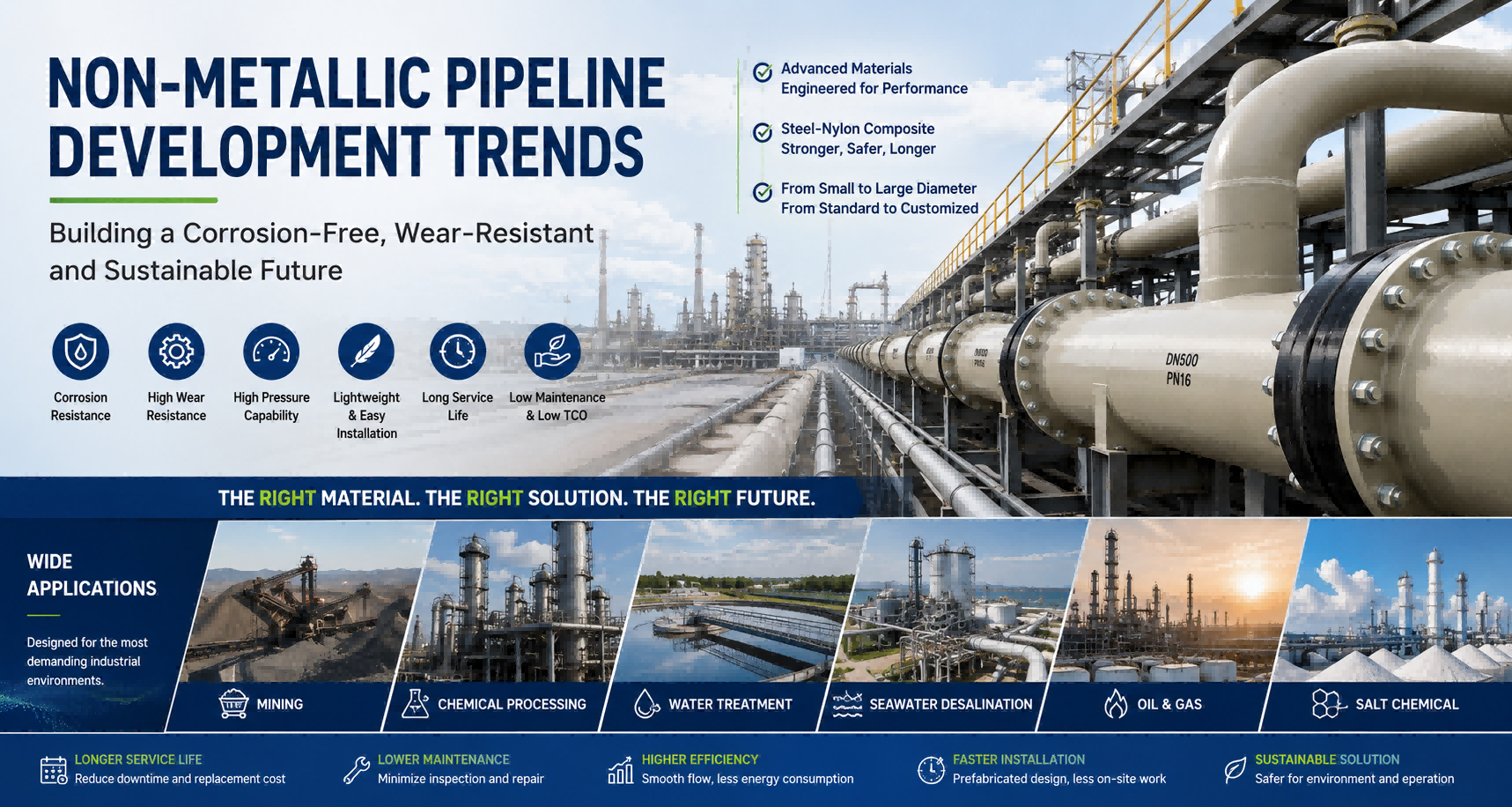
Steel-nylon composite pipe combines the strength of steel with the advanced performance of reinforced nylon, providing a more reliable pipeline solution for chemical, mining, oil & gas, and power industries.
Choosing the right pipeline material today reduces operational risks for decades.
Steel-Nylon Composite Pipe vs PE Pipe: A Comprehensive Comparison for Industrial Pipeline Upgrading
Steel-Nylon Composite Pipe VS Steel Rubber Lined Pipe: How to Choose the Right Industrial Pipeline for Corrosion and Wear Resistance?