Steel-Nylon Composite Pipe VS Steel Rubber Lined Pipe: How to Choose the Right Industrial Pipeline for Corrosion and Wear Resistance?

In industrial sectors such as chemical processing, mining, power generation, oil & gas, and salt chemical industries, pipelines are often required to handle highly corrosive media, severe abrasion, temperature fluctuations, and long-term continuous operation.
Traditional carbon steel pipes are vulnerable to corrosion, while pure plastic pipes often lack sufficient mechanical strength and pressure resistance.
To combine the advantages of metal strength and non-metal corrosion resistance, various composite pipeline technologies have been developed, among which the most widely used include:
-
Steel Rubber Lined Pipe
-
Steel-Nylon Composite Pipe
Both technologies adopt the concept of a metal structural layer + corrosion-resistant lining layer, but due to the different properties of rubber and nylon, their long-term performance in harsh industrial environments varies significantly.
So, can Steel-Nylon Composite Pipe replace traditional Steel Rubber Lined Pipe in high-wear, high-corrosion, and high-pressure applications?
This article provides an in-depth comparison from the perspectives of structure, wear resistance, corrosion resistance, service life, installation efficiency, and total cost of ownership (TCO).
1. Structural Comparison: Bonded Rubber Lining vs Integrated Nylon Composite Structure
1.1 Characteristics of Steel Rubber Lined Pipe
Steel Rubber Lined Pipe usually consists of:
-
An outer carbon steel pipe providing mechanical strength
-
An inner rubber lining providing corrosion and wear protection
The rubber lining is bonded to the steel pipe through processes such as adhesive bonding or vulcanization.
Advantages:
✅ Relatively low initial investment
✅ Good resistance to certain corrosive media
✅ Flexible structure with impact absorption capability
However, during long-term operation, several issues may occur.
(1) Rubber Aging Problems
Rubber is an elastic polymer material. Long-term exposure to:
-
High temperature
-
Oxidation
-
Chemical media
-
Pressure fluctuations
may cause:
-
Hardening
-
Cracking
-
Delamination
-
Blistering
Especially under frequent temperature cycling conditions, stress may develop between the rubber lining and steel substrate, reducing reliability.
1.2 Characteristics of Steel-Nylon Composite Pipe
Steel-Nylon Composite Pipe consists of:
High-strength steel pipe as the pressure-bearing layer + reinforced nylon as the corrosion and wear-resistant inner layer
Through advanced composite manufacturing technology, the nylon lining forms a stable bond with the steel structure.
Structural advantages:
-
The steel layer provides pressure resistance and mechanical strength
-
The nylon layer provides corrosion resistance and wear protection
-
The smooth inner surface reduces flow resistance
Compared with traditional Steel Rubber Lined Pipe, Steel-Nylon Composite Pipe reduces the risk of failure caused by conventional bonding interfaces.
2. Wear Resistance Comparison: Nylon Provides Superior Performance in Slurry Transportation
Pipeline wear is one of the most common causes of industrial pipeline failure.
Typical high-wear media include:
-
Mineral slurry
-
Tailings slurry
-
Coal slurry
-
Salt slurry
-
Phosphate slurry
-
Sand-containing crude oil
Wear Characteristics of Steel Rubber Lined Pipe
Rubber has elasticity and can absorb impact from solid particles.
However, under continuous erosion from high-speed particles:
-
Rubber surface gradually wears down
-
The lining becomes thinner
-
The steel substrate becomes exposed
-
Rapid corrosion-wear failure occurs
This problem becomes more serious under:
-
High flow velocity
-
High solid concentration
-
Large particle size slurry conditions
Wear Advantages of Steel-Nylon Composite Pipe
Reinforced nylon features:
-
Stable polymer molecular structure
-
High impact resistance
-
Low friction coefficient
-
Excellent abrasion resistance
Steel-Nylon Composite Pipe is particularly suitable for:
-
Mining backfilling pipelines
-
Tailings transportation pipelines
-
Chemical slurry pipelines
Key advantages:
① Strong Resistance to Particle Impact
When solid particles strike the pipe wall, nylon absorbs impact energy and reduces surface damage.
② Lower Friction and Energy Consumption
The smooth inner surface reduces:
-
Pressure loss
-
Pumping energy consumption
-
Material deposition
③ Stable Long-Term Wear Performance
Unlike rubber, nylon does not easily suffer from:
-
Hardening
-
Cracking
-
Aging-related degradation
3. Corrosion Resistance Comparison: Steel-Nylon Composite Pipe Handles More Complex Chemical Environments
Industrial pipelines often transport media containing:
-
Chloride ions
-
Alkali solutions
-
Brine
-
Weak acids
-
Chemical solutions
Corrosion Risks of Steel Rubber Lined Pipe
Although rubber provides corrosion resistance, different rubber materials have different limitations:
-
Natural rubber
-
Butyl rubber
-
EPDM rubber
-
Chloroprene rubber
Long-term operation may cause:
Chemical Swelling
Rubber absorbs chemical media, resulting in:
-
Volume expansion
-
Strength reduction
Lining Separation
Once the rubber lining separates from the steel substrate, the exposed steel can corrode rapidly.
Corrosion Advantages of Steel-Nylon Composite Pipe
Reinforced nylon provides excellent chemical stability and is suitable for:
-
Chlor-alkali industries
-
Salt chemical production
-
Alkali solution transportation
-
Seawater environments
-
Chemical circulation systems
Advantages:
✅ No rust
✅ Resistance to weak acids
✅ Resistance to strong alkalis
✅ Resistance to saltwater corrosion
Especially in strong alkaline environments, Steel-Nylon Composite Pipe provides significant advantages over traditional metal pipelines.
4. Temperature and Pressure Performance Comparison
| Performance | Steel Rubber Lined Pipe | Steel-Nylon Composite Pipe |
|---|---|---|
| Pressure resistance | High | High |
| Temperature range | Limited by rubber | -36°C to 160°C |
| Temperature fluctuation resistance | Moderate | Excellent |
| Long-term dimensional stability | Average | Excellent |
| Large diameter capability | Good | DN100-DN2000+ |
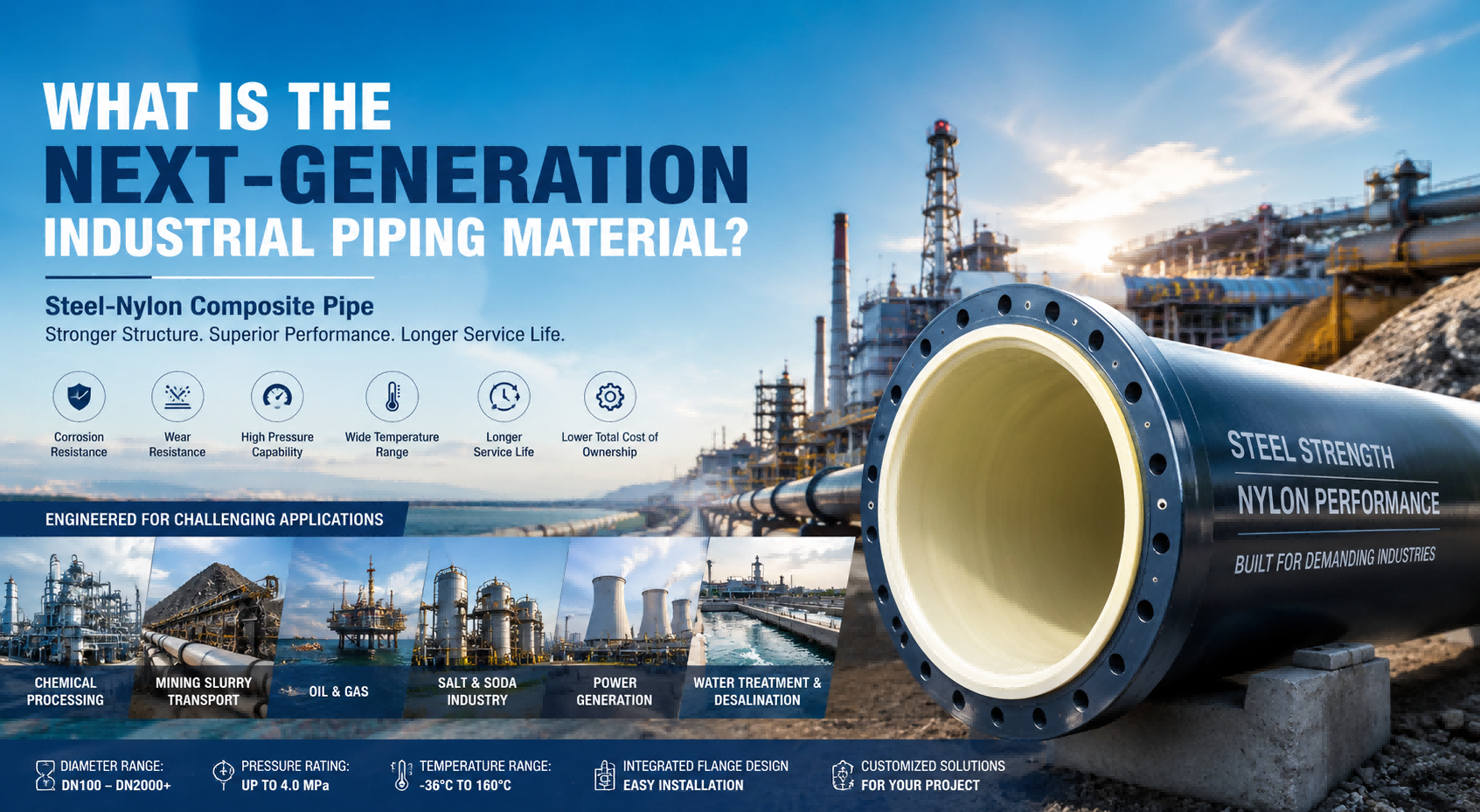
By combining steel strength with nylon performance, Steel-Nylon Composite Pipe can meet:
-
Pressure ratings from 1.0 to 4.0 MPa
-
Large diameter industrial transportation requirements
5. Installation Comparison: Steel-Nylon Composite Pipe Reduces Construction Risks
Installation of Steel Rubber Lined Pipe
Usually requires:
-
Flange connections
-
Precise sealing adjustment
-
Careful installation protection
Construction quality has a significant impact on service reliability.
Installation Advantages of Steel-Nylon Composite Pipe
Steel-Nylon Composite Pipe adopts:
Integrated flange forming technology
Advantages:
① Reduced Welding Requirements
No field welding is required:
-
Lower installation risks
-
Avoids damage to corrosion-resistant layers caused by welding
② Fewer Leakage Points
For traditional welded pipelines:
Weld joints = potential failure points
Steel-Nylon Composite Pipe:
Reduces connection risks.
③ Faster Installation
Especially suitable for:
-
Long-distance pipelines
-
Large industrial projects
-
Pipeline renovation projects
6. Total Cost of Ownership (TCO) Comparison
Many projects focus only on initial purchase costs, but the real pipeline cost includes:
-
Purchase cost
-
Installation cost
-
Downtime losses
-
Maintenance expenses
-
Replacement costs
Long-Term Cost of Steel Rubber Lined Pipe
Potential additional costs include:
-
Rubber lining repair
-
Pipe section replacement
-
Production shutdown maintenance
Long-Term Value of Steel-Nylon Composite Pipe
Although the initial investment may be higher than ordinary steel pipes, it provides:
-
Longer service life
-
Less maintenance
-
Lower downtime risks
For continuous production industries, upgrading to Steel-Nylon Composite Pipe can significantly reduce long-term operational pressure.
7. Application Comparison
Suitable Applications for Steel Rubber Lined Pipe:
-
General corrosive media transportation
-
Low-abrasion applications
-
Stable temperature environments
Key Applications of Steel-Nylon Composite Pipe:
Chemical Industry
-
Caustic soda transportation
-
Brine systems
-
Soda ash production
Mining Industry
-
Mineral slurry transportation
-
Tailings pipelines
-
Backfilling systems
Oil & Gas Industry
-
Oil gathering systems
-
Sand-containing crude oil transportation
Power Industry
-
Desulfurization slurry systems
-
Cooling water systems
8. Why Is Steel-Nylon Composite Pipe Becoming a New Generation Industrial Pipeline Solution?
| Performance | Steel Rubber Lined Pipe | Steel-Nylon Composite Pipe |
|---|---|---|
| Corrosion resistance | ★★★★ | ★★★★★ |
| Wear resistance | ★★★ | ★★★★★ |
| Aging resistance | ★★★ | ★★★★★ |
| Temperature adaptability | ★★★ | ★★★★★ |
| Large diameter capability | ★★★★ | ★★★★★ |
| Maintenance cost | Higher | Lower |
| Service life | Medium | Long |
Conclusion: Steel-Nylon Composite Pipe Is Replacing Traditional Steel Rubber Lined Pipe in More Applications
Steel Rubber Lined Pipe once solved many industrial corrosion problems. However, as modern industries demand:
-
Higher pressure
-
Higher temperature
-
Higher wear resistance
-
Longer service life
traditional rubber lining technology faces challenges such as aging, delamination, and frequent maintenance.
Steel-Nylon Composite Pipe combines:
-
High-strength steel structure
-
Reinforced nylon corrosion-resistant layer
-
Integrated composite technology
-
Built-in flange connection design
to achieve:
Superior corrosion resistance, excellent wear resistance, high reliability, and lower maintenance requirements.
For continuous-operation industries such as chemical processing, mining, oil & gas, and power generation, Steel-Nylon Composite Pipe is becoming an advanced alternative solution to traditional Steel Rubber Lined Pipe.
Steel-Nylon Composite Pipe VS Rubber Lined Steel Pipe: A Better Choice for Corrosive and Abrasive Industrial Applications
Steel-Nylon Composite Pipe vs FRP Pipe: A Deep Comparison for Industrial Corrosion and Wear Applications