
The Ultimate Abrasion Resistance Test for Mine Backfill Pipes: Why Steel-Nylon Pipes Completely Outperform Traditional Steel-Rubber Pipes
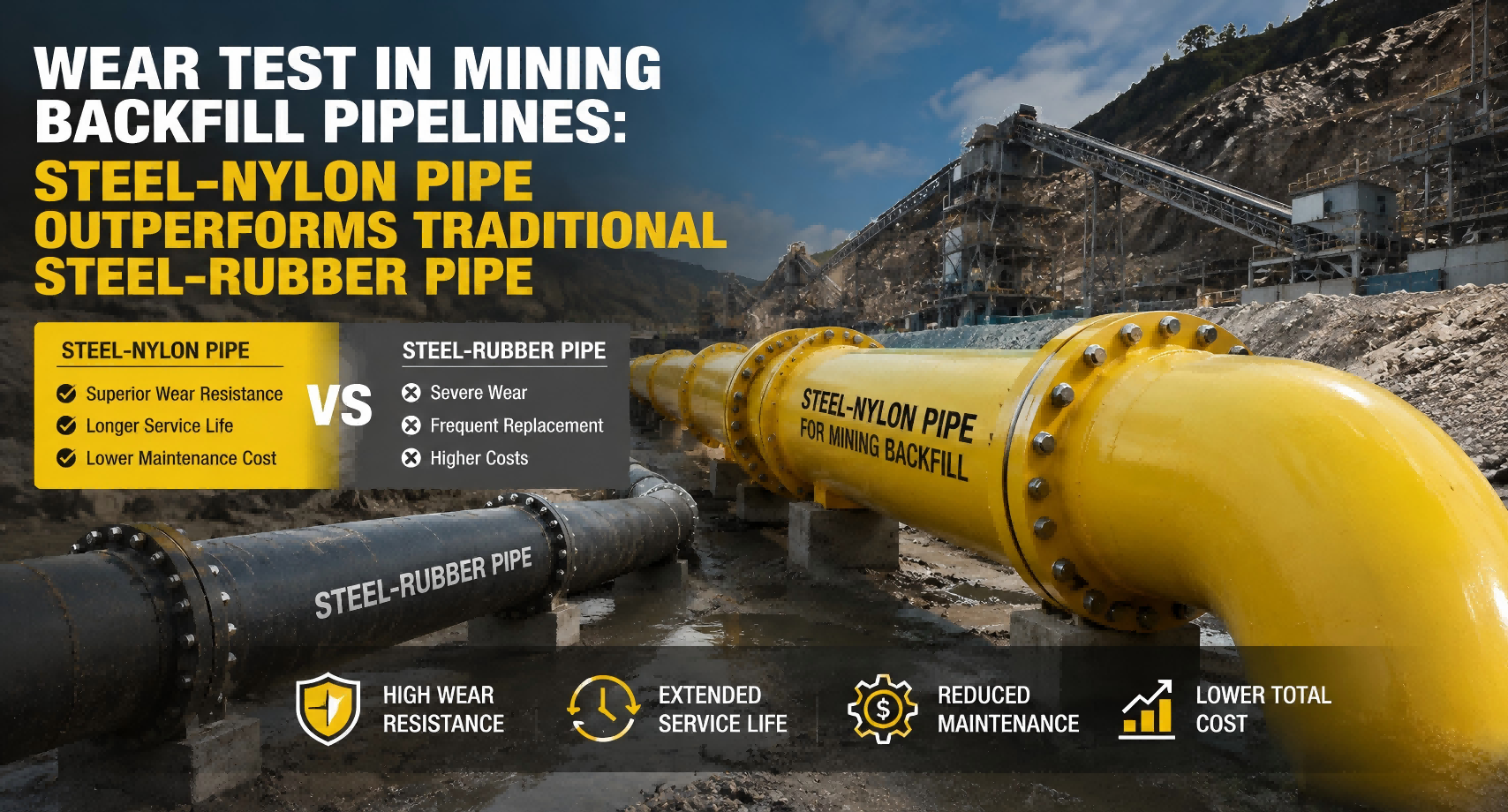
In the backfill mining process, the pipeline is hailed as the "lifeline" of the system. It transports high-concentration, highly abrasive paste tailings or slurries over long distances and under high pressure to mined-out stopes. Once this lifeline is perforated or ruptured due to wear, it not only causes severe environmental pollution and production downtime but also threatens underground operational safety.
Therefore, the abrasion resistance of backfill pipes is the ultimate test that determines both efficiency and cost. Traditionally, **Steel-Rubber Composite Pipes** (Steel-Rubber Lined Pipe), with their elastic inner lining, were once regarded as the standard solution. However, as mines face increasingly demanding requirements for long-distance, high-pressure, and coarse-particle backfill, a groundbreaking new technology—the **Steel-Nylon Composite Pipe**—is emerging as the overwhelming victor. This article will analyze in depth exactly why Steel-Nylon pipes outperform traditional Steel-Rubber pipes in this abrasion resistance test.
Traditional Steel-Rubber Pipes: Four "Fatal" Flaws Beneath the Sheen
The inner lining of Steel-Rubber pipes is typically made of natural or synthetic rubber, relying on rubber's elasticity to resist wear. However, under the real working conditions of mine backfill, this elastic protection often falls short.
**1. Poor Resistance to Cutting Wear**
Backfill slurries often contain sharp-edged gangue or hard rock tailings. Under high-pressure and high-velocity scouring, these particles act like countless microscopic daggers. Although rubber can rebound, its tear strength is low. Sharp particles easily cut the rubber surface, forming deep grooves or even penetrating incisions. Once the surface is damaged, the fluid undercuts the lining, causing rapid failure.
Backfill slurries often contain sharp-edged gangue or hard rock tailings. Under high-pressure and high-velocity scouring, these particles act like countless microscopic daggers. Although rubber can rebound, its tear strength is low. Sharp particles easily cut the rubber surface, forming deep grooves or even penetrating incisions. Once the surface is damaged, the fluid undercuts the lining, causing rapid failure.
**2. Fatal "Delamination" and "Blistering"**
Steel-Rubber pipes rely on adhesives to vulcanize the rubber onto the inner wall of the steel pipe. Under the long-term effects of vacuum negative pressure, temperature fluctuations, or media permeation, the adhesive layer is highly prone to aging and failure. The result is partial detachment of the lining from the steel pipe, forming "blisters." This leads to a sudden reduction in the effective inner diameter, causing pipeline blockages, and in severe cases, the detached rubber can even completely clog the entire transport system.
Steel-Rubber pipes rely on adhesives to vulcanize the rubber onto the inner wall of the steel pipe. Under the long-term effects of vacuum negative pressure, temperature fluctuations, or media permeation, the adhesive layer is highly prone to aging and failure. The result is partial detachment of the lining from the steel pipe, forming "blisters." This leads to a sudden reduction in the effective inner diameter, causing pipeline blockages, and in severe cases, the detached rubber can even completely clog the entire transport system.
**3. Chemical Aging and Thermal Failure**
The underground backfill environment is complex, often containing acidic water or oily flotation reagents. In such media, rubber can swell, harden, or soften and degrade. Furthermore, ordinary rubber typically cannot withstand temperatures above 70°C. The combined effect of frictional heat from high-concentration backfill slurry and hydration heat easily accelerates thermo-oxidative aging of the rubber, causing it to lose elasticity and crack.
The underground backfill environment is complex, often containing acidic water or oily flotation reagents. In such media, rubber can swell, harden, or soften and degrade. Furthermore, ordinary rubber typically cannot withstand temperatures above 70°C. The combined effect of frictional heat from high-concentration backfill slurry and hydration heat easily accelerates thermo-oxidative aging of the rubber, causing it to lose elasticity and crack.
**4. High Frictional Resistance, Massive Energy Consumption**
Rubber surfaces may appear smooth, but when conveying slurry in wet conditions, the friction coefficient is usually as high as 0.3-0.5. To overcome this enormous frictional resistance along the pipeline, mines must invest in much higher pumping pressure, directly leading to surging electricity consumption.
Rubber surfaces may appear smooth, but when conveying slurry in wet conditions, the friction coefficient is usually as high as 0.3-0.5. To overcome this enormous frictional resistance along the pipeline, mines must invest in much higher pumping pressure, directly leading to surging electricity consumption.
Technological Breakthrough: How Steel-Nylon Composite Pipes "Fight Hardness with Toughness"
Steel-Nylon pipe, specifically refers to a seamless steel pipe whose inner wall is formed with a dense layer of high-performance **Modified Cast Nylon (MC Nylon/PA6)** through centrifugal casting or co-extrusion composite processes. It does not simply "fight hardness with hardness" but achieves superior wear resistance through a physical principle of "combining rigidity and flexibility."
**Mechanical Interlocking Structure**: The advanced centrifugal casting process allows the molten nylon material to penetrate the micropores and anchor grooves on the inner wall of the steel pipe. Upon cooling, it forms a mechanical interlock similar to a "dovetail" joint. This not only eliminates delamination issues but also achieves an interlayer bonding shear strength far exceeding that of rubber adhesion processes.
**Self-Lubrication and Low Friction**: Nylon material inherently possesses self-lubricating properties, with a wet sliding friction coefficient as low as 0.15-0.2. This means that under the same pumping pressure, Steel-Nylon pipes can transport material over longer distances, and energy consumption can be reduced by 15%-25%.
**Excellent Anti-Cutting Toughness**: Although modified nylon has higher hardness than rubber, its elongation at break and impact strength are extremely high. Facing sharp particles, the nylon surface can absorb impact energy through micro-plastic deformation without tearing, demonstrating exceptionally strong resistance to "gouging wear."
**Self-Lubrication and Low Friction**: Nylon material inherently possesses self-lubricating properties, with a wet sliding friction coefficient as low as 0.15-0.2. This means that under the same pumping pressure, Steel-Nylon pipes can transport material over longer distances, and energy consumption can be reduced by 15%-25%.
**Excellent Anti-Cutting Toughness**: Although modified nylon has higher hardness than rubber, its elongation at break and impact strength are extremely high. Facing sharp particles, the nylon surface can absorb impact energy through micro-plastic deformation without tearing, demonstrating exceptionally strong resistance to "gouging wear."
The Abrasion Resistance Test: A Dominant Victory Backed by Real Data
In comparative abrasion resistance tests under identical working conditions, Steel-Nylon pipes delivered a stunning performance:
| Comparative Test Item | Traditional Steel-Rubber Composite Pipe | Steel-Nylon Composite Pipe | Conclusion Analysis |
|---|---|---|---|
| Slurry Abrasion Rate (per ISO 4649) | Approx. 120-180 mm³ | Approx. 20-40 mm³ | The volumetric wear of Steel-Nylon pipe is only 1/5 to 1/4 that of rubber, ensuring much longer service life. |
| Resistance to Sharp Particle Cutting | Very poor, prone to deep tearing | Extremely strong, only surface scratches | With a Barcol hardness of 18-25, Nylon effectively resists the "blade effect." |
| Lining-to-Steel Bonding | Chemical adhesion, prone to delamination | Molecular-level interlock, never delaminates | Completely eliminates the risk of pipeline blockage caused by collapsed rubber linings. |
| Applicable Temperature Range | -20°C to +70°C | -40°C to +150°C | Steel-Nylon pipes remain stable in severe cold or with high-temperature backfill. |
| Friction Coefficient (Slurry) | 0.30 ~ 0.50 | 0.15 ~ 0.20 | Saves hundreds of thousands in pumping electricity costs annually for the enterprise. |
| Chemical Corrosion Resistance | Very poor, swells in oil | Excellent, resistant to acid, alkali & oil | Handles backfill containing flotation reagents with ease. |
**Real-World Case Study**: A large lead-zinc mine in China utilized cemented tailings backfill containing a large amount of angular, high-hardness waste rock. The originally installed DN200 Steel-Rubber bends, operating under a delivery pressure of 6MPa, had an average service life of only 3 to 4 months before requiring shutdown for replacement, with frequent occurrences of blistering and pipe blockages. After switching to our **Steel-Nylon composite wear-resistant pipes**, they have operated continuously for 18 months with no noticeable wear and are still in use today, completely solving the persistent pipe bursting problem that plagued the mine for years.
Total Lifecycle Cost Calculation: Who Is the Real Winner?
Many purchasers are initially misled by the per-meter price of Steel-Nylon pipes, deeming them "relatively expensive." However, the mining industry is all about the total cost calculation, and the lifecycle cost is king.
1. **Zero Maintenance Cost**: The service life of Steel-Nylon pipes is 3-5 times that of Steel-Rubber pipes, essentially matching the lifespan of the mine stope, eliminating the labor costs and production losses associated with frequent replacements.
2. **Energy Savings**: Thanks to the extremely low friction coefficient, the annual electricity cost savings for the transport system often cover the initial procurement price difference of the pipes themselves.
3. **Zero Risk in Safety and Environmental Protection**: No more worries about total system shutdowns caused by lining detachment and blockages, nor the huge environmental fines resulting from slurry leakage.
2. **Energy Savings**: Thanks to the extremely low friction coefficient, the annual electricity cost savings for the transport system often cover the initial procurement price difference of the pipes themselves.
3. **Zero Risk in Safety and Environmental Protection**: No more worries about total system shutdowns caused by lining detachment and blockages, nor the huge environmental fines resulting from slurry leakage.
A comprehensive calculation shows that the integrated operating cost of using Steel-Nylon pipes over three years can be reduced by over 60% compared to Steel-Rubber pipes.
Tailoring Mine Wear-Resistant Pipeline Solutions for You
We specialize in providing top-tier Steel-Nylon composite pipeline systems to mining clients worldwide. Our advantages go further:
**Full-Spec Customization**: Available from DN50 to DN1200, supporting the custom production of elbows at any angle, tees, and reducer pipes, with quick and reliable flange connections.
**Stringent Quality Control**: We use imported high-viscosity MC Nylon raw materials, and every single pipe undergoes ultrasonic thickness measurement and spark testing to ensure zero-defect delivery.
**Global Mining Service Experience**: Our products have been exported to major mining regions including Australia, South America, Africa, and Southeast Asia. We have over 15 years of experience handling extreme wear conditions and are proficient in international shipping packaging and delivery.
**Stringent Quality Control**: We use imported high-viscosity MC Nylon raw materials, and every single pipe undergoes ultrasonic thickness measurement and spark testing to ensure zero-defect delivery.
**Global Mining Service Experience**: Our products have been exported to major mining regions including Australia, South America, Africa, and Southeast Asia. We have over 15 years of experience handling extreme wear conditions and are proficient in international shipping packaging and delivery.
Conclusion
The choice of wear-resistant backfill pipeline directly determines a mine's continuous production capacity and profit margin. While traditional Steel-Rubber pipes struggle with delamination, cutting, and high energy consumption, **Steel-Nylon Composite Pipe** has emerged as the ultimate answer for next-generation mine backfill pipelines, backed by its overwhelming wear resistance data, high reliability of never delaminating, and lower total lifecycle cost.
**In the ultimate abrasion resistance test, choosing Steel-Nylon Pipe means choosing peace of mind and profitability.**
**Ready to Upgrade Your Mine Backfill Pipeline?**
FRP Pipes Delaminate and Leak Under Long-Term Pressure? Steel-Nylon Composite Pipes Maintain Structural Stability Without "Peeling Off"
For Caustic Soda Transport in the Chlor-Alkali Industry: Which Pipe Combines Corrosion Resistance and Real Cost Savings?
Related blog


SEND MESSAGE