How to Reduce Maintenance Costs for Water Injection Pipelines: A Systematic Analysis from Corrosion and Scaling to Total Cost of Ownership

For oilfields entering the middle and late stages of production, water injection is commonly used to maintain reservoir pressure and improve oil recovery. However, injection water is not simply “ordinary water.” Depending on the water source, treatment process, and operating conditions, the injected fluid may contain dissolved salts, chlorides, suspended solids, microorganisms, corrosive gases, and varying levels of mineral content.
Over time, these factors may cause conventional pipelines to suffer from:
-
Internal corrosion
-
Pitting and localized perforation
-
Scaling that reduces effective flow area
-
Erosion caused by solid particles
-
Frequent failures near welds, elbows, and valves
-
Repeated emergency repairs after leakage
-
Partial or complete pipeline replacement
Therefore, the real economic performance of a water injection pipeline is not determined by how much the pipe costs per meter at the time of purchase.
The more important question is:
How much does it cost to keep the pipeline operating reliably throughout its entire service life?
This is why more industrial projects are moving away from a “lowest purchase price” approach toward a lowest Total Cost of Ownership (TCO) approach when selecting pipeline materials.
For high-corrosion, high-salinity, and long-term continuous water injection systems, steel-nylon composite pipe offers an alternative worth serious evaluation.
1. Why Do Water Injection Pipeline Maintenance Costs Tend to Increase Over Time?
Many water injection systems perform well when first commissioned, but maintenance workload gradually increases as the system ages.
The fundamental reason is that:
Pipeline failure is usually not caused by a single mechanism, but by several damage mechanisms acting together.
1.1 Internal Corrosion Is a Major Source of Long-Term Maintenance Cost
Conventional carbon steel relies on steel itself to provide pressure resistance. When steel is directly exposed to injection water, electrochemical corrosion can occur.
Corrosion may accelerate when the medium contains:
-
Dissolved oxygen
-
CO₂
-
H₂S
-
Chloride ions
-
High-salinity water
-
Microorganisms
-
Unstable water chemistry
The most dangerous problem is not always uniform corrosion, but rather localized corrosion and pitting.
Most of the pipeline may still appear to be in acceptable condition, while a small local area may already have suffered serious wall thinning and eventually develops perforation.
This creates a common maintenance cycle:
Leak detected → system shutdown → excavation or dismantling → repair or pipe replacement → restart → another leak occurs elsewhere
A single repair may not seem expensive.
But when similar repairs are repeated year after year, the accumulated cost can far exceed the original pipeline investment.
2. Why Does Scaling Also Increase Water Injection System Costs?
Scaling is another common problem in water injection pipelines.
When water from different sources is mixed, or when temperature, pressure, and pH change, dissolved minerals may precipitate and gradually deposit on the inner pipe wall.
Typical deposits may include:
-
Carbonate scale
-
Sulfate scale
-
Iron corrosion products
-
Sand and other suspended solids
Scaling does not only mean that the pipe needs cleaning.
It also changes the hydraulic performance of the entire pipeline.
For example, a pipeline may originally have 100% of its designed internal diameter available for flow. After years of scaling, the effective flow area gradually decreases.
To maintain the same injection rate, the operator may need to:
-
Increase pumping pressure
-
Consume more energy
-
Increase cleaning frequency
-
Use chemical descaling agents
-
Perform mechanical pigging or cleaning
-
Replace severely affected pipe sections
Therefore, when evaluating a water injection pipeline, the question should not simply be:
“Will this material corrode?”
It should also be:
“Can the pipeline maintain stable internal flow capacity after years of operation?”
3. Six Major Cost Categories That Must Be Controlled in Water Injection Pipelines
From a lifecycle perspective, the total cost of a water injection pipeline includes much more than the pipe purchase price.
① Initial Material Cost
This is the easiest cost to see and often receives too much attention during procurement.
However, it is only one part of the total cost structure.
② Installation Cost
Installation cost may include:
-
Welding
-
Flange installation
-
Lifting
-
Anti-corrosion work
-
Hot work on site
-
Inspection
-
Labor
-
Construction time
For retrofit projects, longer construction periods can have a greater impact on production.
③ Corrosion Repair Cost
This may include:
-
Repair welding
-
Pipe section replacement
-
Coating repair
-
Leak detection
-
Maintenance labor
-
Construction equipment
-
Excavation and restoration
④ Cleaning and Descaling Cost
When scaling or deposits continue to accumulate inside the pipe, operators may need:
-
Chemical cleaning
-
Mechanical pigging
-
Descaling
-
Flushing
-
Deposit removal and disposal
These costs often increase as the pipeline ages.
⑤ Pumping Energy Cost
This is frequently overlooked.
As the pipe wall becomes rougher and scaling becomes more severe, hydraulic resistance increases.
This means:
More pumping pressure and more energy are required to transport the same amount of injection water.
For large water injection systems operating 24 hours a day, even a small increase in energy consumption can create substantial costs over many years.
⑥ Shutdown and Production Interruption Cost
This is often the most expensive and underestimated cost.
The true loss caused by a pipeline leak may not be the cost of several meters of pipe.
It may include:
-
Water injection system shutdown
-
Related equipment shutdown
-
Disruption of production schedules
-
Emergency mobilization of repair teams and equipment
-
Environmental cleanup
-
Secondary construction work
From a business perspective:
Reducing the frequency of pipeline failures can be more valuable than reducing the purchase price of the pipe itself.
4. Why Can Carbon Steel Water Injection Pipelines Fall into the Trap of “Low Purchase Cost, High Maintenance Cost”?
Carbon steel has several obvious advantages:
-
High mechanical strength
-
Mature supply chain
-
Established construction methods
-
Competitive initial purchase cost
However, it also has a fundamental weakness:
The steel is directly exposed to corrosive fluids.
As a result, the service life of the pipeline increasingly depends on:
-
Corrosion allowance
-
Internal and external coatings
-
Corrosion inhibitors
-
Cathodic protection
-
Water treatment
-
Periodic inspection
-
Periodic maintenance
In other words, carbon steel does not eliminate corrosion.
Instead, it relies on multiple supporting measures to manage corrosion.
If any part of this protection system becomes ineffective, such as changes in water quality, coating damage, inadequate inhibitor dosage, or local deposits, new corrosion risks may develop.
This is why some projects discover that:
The pipe itself is inexpensive, but the long-term maintenance budget continues to increase.
5. Why Does Simply Upgrading the Metal Grade Not Always Solve the Problem?
When corrosion becomes serious, one obvious solution is:
Use a higher-grade stainless steel.
For example, 304, 316L, or other alloy materials may provide improved corrosion resistance under specific service conditions.
However, higher alloy grades usually mean significantly higher material costs, while other risks may still need to be considered, including:
-
Chloride-induced pitting
-
Crevice corrosion
-
Weld heat-affected zones
-
Stress corrosion cracking
-
Welding quality control
-
High cost in large-diameter pipelines
For long-distance or large-diameter water injection projects, constructing the entire system from high-alloy metal can result in very high capital expenditure.
A more useful question is:
Can the pressure-bearing function and the corrosion-resistance function be handled by different materials?
This is the core logic behind composite pipe design.
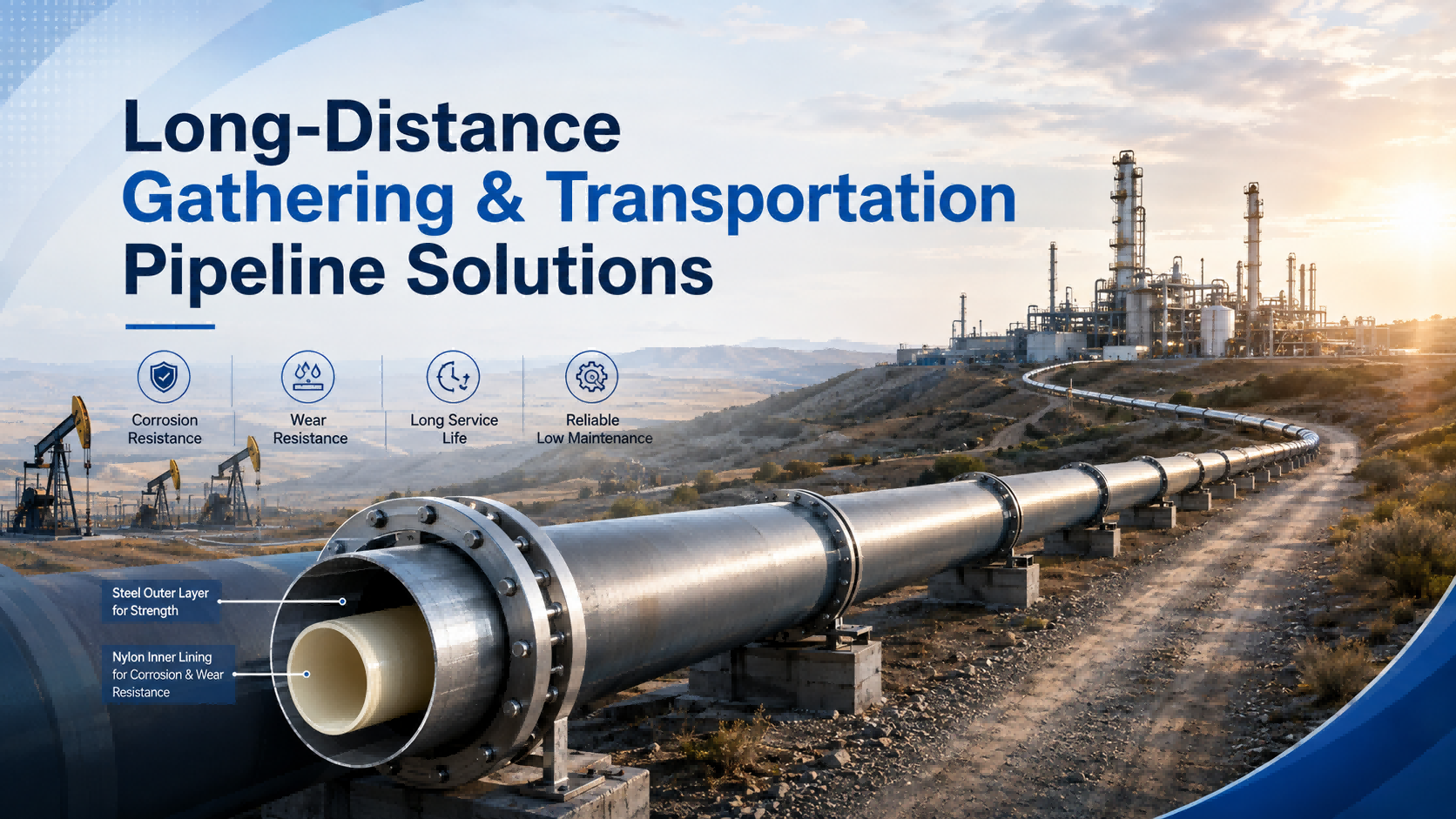
6. Steel-Nylon Composite Pipe: Separating Pressure Resistance from Corrosion Resistance
Steel-nylon composite pipe does not attempt to solve every problem with a single material.
Instead, it combines the advantages of different materials within one structure.
In simple terms:
The steel structure provides mechanical strength and pressure resistance, while the nylon layer is responsible for contact with the transported medium.
This design changes the corrosion pathway found in conventional steel pipe.
Conventional Steel Pipe:
Injection water
↓
Direct contact with steel
↓
Electrochemical corrosion
↓
Wall thinning
↓
Localized perforation
↓
Repair or replacement
Steel-Nylon Composite Pipe:
Injection water
↓
Contact with nylon inner layer
↓
Steel pressure-bearing layer isolated from the medium
↓
Reduced risk of direct internal corrosion of steel
↓
Longer stable operating period
This is not simply an attempt to make steel more corrosion resistant.
It is a structural approach that changes the relationship between the corrosive medium and the pressure-bearing steel layer.
7. How Can Steel-Nylon Composite Pipe Reduce Water Injection Pipeline Maintenance Costs?
7.1 Reduced Internal Corrosion Risk
One of the most direct advantages of steel-nylon composite pipe is that the nylon inner layer helps isolate the process medium from the pressure-bearing steel layer.
For high-salinity water, salt-containing fluids, weak acids, and certain strong alkaline conditions, this structure can improve resistance to the internal corrosion problems commonly encountered by conventional steel pipelines.
When corrosion is reduced:
-
Perforation risk decreases
-
Leak frequency decreases
-
Repair welding is reduced
-
Partial pipe replacement is reduced
-
Maintenance intervals become longer
The biggest saving is not only the repair material.
It is the reduction in unplanned maintenance events.
7.2 Smooth Inner Wall Helps Reduce Scaling and Deposits
As steel pipe corrodes, its internal surface gradually develops:
-
Corrosion pits
-
Rust
-
Oxide deposits
-
Rough surfaces
These areas can trap more suspended solids and crystalline deposits, creating a damaging cycle:
Corrosion → surface roughness → deposition → under-deposit corrosion → more severe corrosion
A nylon inner surface is relatively smooth and does not develop the same type of rusted surface associated with carbon steel corrosion.
For long-term water injection systems, this helps maintain more stable flow conditions and may reduce the frequency of cleaning and descaling.
8. Wear Resistance Also Matters in Water Containing Sand and Solids
Many water injection systems do not transport perfectly clean water.
The fluid may contain:
-
Sand
-
Corrosion products
-
Suspended solids
-
Other mechanical impurities
At high flow velocity, these particles can cause erosion and abrasion.
Wear is often more severe at:
-
Elbows
-
Tees
-
Reducers
-
Upstream and downstream of valves
-
Pump discharge sections
-
Local high-velocity areas
By taking advantage of the wear resistance of nylon materials, steel-nylon composite pipe can address both:
Corrosion + abrasion
For injection systems affected by both corrosion and particle erosion, this is particularly important.
Simply upgrading the corrosion resistance of the metal may not solve the wear problem at the same time.
9. Why Can Flange Connections Further Reduce Maintenance Costs?
Pipeline material performance is only part of the maintenance equation.
Connection method is equally important.
Traditional welded steel pipelines often require:
-
Cutting
-
Bevel preparation
-
Welding
-
Weld inspection
-
Coating restoration
-
Hot-work management
In oilfield environments where on-site safety requirements are strict, hot work can also create additional approval and safety management requirements.
Steel-nylon composite pipes can be connected using flanges.
This allows many pipe sections and fittings to be maintained through a simpler process:
Disconnect → Replace → Reconnect
This is particularly useful for:
-
Elbows
-
Tees
-
Reducers
-
Valve upstream and downstream sections
-
Pump outlet sections
-
High-wear pipe sections
For sites with limited maintenance access or strict requirements for minimizing shutdown time, this modular maintenance method can provide clear advantages.
10. Do Not Compare Only the “Price per Meter” — Compare the Total Cost Over 10 Years
Consider two pipeline options.
Option A
Lower initial investment, but during operation it requires:
-
Frequent corrosion repairs
-
Corrosion inhibitors
-
Regular repair welding
-
Periodic pipe section replacement
-
Multiple production shutdowns
-
Regular descaling
Option B
Higher initial purchase cost, but provides:
-
Lower corrosion risk
-
Lower maintenance frequency
-
Less scaling
-
Longer service intervals
-
Fewer shutdown events
If only first-year CAPEX is considered:
Option A may look cheaper.
But over 5, 10, or more years:
Option B may have the lower total cost.
Therefore, water injection pipeline selection should move from:
Price per meter
to:
Cost per year of reliable operation
In other words:
How much does each year of stable operation actually cost?
11. A More Practical TCO Model for Water Injection Pipelines
When selecting pipeline materials, companies can use the following model:
Pipeline Lifecycle Cost =
Initial procurement cost
-
Installation cost
-
Corrosion protection cost
-
Chemical treatment cost
-
Inspection cost
-
Maintenance cost
-
Cleaning and descaling cost
-
Energy cost
-
Replacement cost
-
Production shutdown losses
This model often leads to very different conclusions than simply comparing material prices.
For example, if one pipeline material can reduce frequent emergency repairs and extend the replacement cycle to many years, a higher initial investment may still result in lower overall cost.
12. Why Is Steel-Nylon Composite Pipe Particularly Suitable for Water Injection Pipeline Retrofit Projects?
For mature oilfields, there is one important practical reality:
It is not always necessary to replace the entire pipeline system at once.
In many systems, failures are concentrated in specific locations.
Typical high-risk areas include:
-
Elbows
-
Valve groups
-
Tees
-
Reducers
-
Pump outlets
-
High-frequency perforation sections
-
High-velocity zones
A more practical upgrade strategy can be used.
Stage 1: Identify High-Failure Areas
Review maintenance records from the previous three to five years and identify:
-
Locations with the most leaks
-
Pipe sections replaced most frequently
-
Elbows with the highest wear rate
-
Areas with the highest maintenance cost
Stage 2: Install a 100–500 Meter Trial Section
Large-scale replacement is not always necessary at the beginning.
A steel-nylon composite pipe trial section can be installed in a highly corrosive or high-maintenance area.
Key performance indicators may include:
-
Internal surface condition
-
Leak frequency
-
Pressure stability
-
Flow stability
-
Scaling condition
-
Number of maintenance interventions
Stage 3: Compare Total Lifecycle Cost
After a period of operation, the comparison should not focus only on pipe price.
Instead, compare:
Original pipeline maintenance cost vs. steel-nylon composite pipeline operating cost
If the trial section performs reliably, the application can then be expanded step by step.
This approach significantly reduces the technical and financial risk of material upgrades.
13. Which Water Injection Conditions Are Particularly Suitable for Evaluating Steel-Nylon Composite Pipe?
Steel-nylon composite pipe is especially worth evaluating in the following operating conditions.
High-Salinity Injection Water
High concentrations of salts and ions can increase internal corrosion risks in conventional carbon steel pipelines.
Mature Oilfield Water Injection Systems
Older pipeline networks often suffer from repeated welding repairs, perforation, and frequent partial replacement.
Water Containing Sand or Solid Particles
The system may face both corrosion and erosion at the same time.
High-Maintenance Locations
Elbows, tees, and valve upstream or downstream sections may require frequent replacement.
Systems Highly Sensitive to Shutdowns
The economic loss caused by one maintenance shutdown may be much greater than the value of the pipeline itself.
Large-Diameter or Higher-Pressure Pipelines
These applications require both mechanical strength and corrosion-resistant internal surfaces.
14. The Value of Steel-Nylon Composite Pipe Goes Beyond Corrosion Resistance
If steel-nylon composite pipe is viewed only as a corrosion-resistant pipeline, its broader value may be underestimated.
For industrial water injection systems, its advantages come from several performance characteristics working together:
| Water Injection System Problem | Steel-Nylon Composite Pipe Solution |
|---|---|
| Internal corrosion of steel pipe | Nylon inner layer isolates the medium from the pressure-bearing steel |
| Frequent perforation | Reduced internal corrosion lowers localized failure risk |
| Particle erosion | Nylon provides wear-resistant performance |
| Internal scaling | Smooth inner surface helps reduce deposit accumulation |
| High-pressure requirements | Steel structure provides mechanical strength |
| Large-diameter requirements | Steel-nylon composite structure can support larger diameters |
| Complex field maintenance | Flanged connection simplifies disassembly |
| Long welding construction time | Reduced on-site welding work |
| Short pipeline service life | Longer stable operating intervals |
| High maintenance expenses | Lower lifecycle maintenance frequency |
This is one of the biggest differences between composite pipeline systems and single-material pipelines:
Instead of forcing one material to solve every problem, different materials are used for the functions they perform best.
15. Our Steel-Nylon Composite Pipe Solution
We specialize in the development and production of reinforced nylon pipes and steel-nylon composite pipes, providing corrosion-resistant and wear-resistant industrial pipeline solutions for oil and gas fields, chemical plants, mining, power generation, seawater desalination, and municipal engineering.
Steel-nylon composite pipe combines:
The strength and pressure resistance of steel + the corrosion and wear resistance of nylon
Products can be engineered according to specific project requirements, including:
-
Pipe diameter
-
Wall thickness
-
Pressure rating
-
Flange structure
-
Fitting configuration
-
Operating conditions
Our product portfolio covers a wide range of industrial diameters and pressure classes, including large- and ultra-large-diameter composite pipeline manufacturing capabilities.
For water injection systems, we can provide not only straight pipe, but also solutions for high-failure areas, including:
-
Wear-resistant elbows
-
Tees
-
Reducers
-
Valve connection sections
-
Pump discharge sections
-
High-frequency failure sections
-
100–500 m field trial sections
-
Partial replacement solutions for aging pipelines
This approach is particularly suitable for projects that prefer to verify material performance before expanding to large-scale application.
16. The Key to Reducing Water Injection Pipeline Costs Is Not Simply “Paying Less for Pipe” — It Is “Repairing Less Often”
When industrial companies discuss reducing pipeline costs, the first idea is often:
Reduce the purchase price by another 5%.
But for a water injection pipeline expected to operate continuously for 10 years or longer, more important questions may be:
-
Can we eliminate one maintenance event?
-
Can we avoid one shutdown?
-
Can we prevent one leak?
-
Can we reduce one major pipeline replacement?
-
Can we extend a three-year replacement cycle to a significantly longer period?
Improving even one of these factors may create more value than the original savings in pipe procurement.
Therefore, modern water injection pipeline selection is gradually shifting from:
“Which pipe is the cheapest?”
to:
“Which pipeline can operate reliably for the longest period at the lowest total cost?”
Conclusion: The Most Economical Water Injection Pipeline Is the One That Requires Less Maintenance Over Its Lifecycle
Reducing water injection pipeline maintenance costs cannot rely only on improving repair efficiency.
A more fundamental approach is to reduce the root causes of maintenance through better pipeline material selection and structural design.
For water injection systems that repeatedly suffer from:
Corrosion, abrasion, scaling, leakage, and frequent replacement
steel-nylon composite pipe combines:
-
Steel pressure-bearing structure
-
Corrosion-resistant nylon inner layer
-
Excellent wear resistance
-
Smooth internal surface
-
Flanged connections
-
Modular fitting design
This helps operators move from:
“Repairing problems after they happen”
toward:
“Reducing the occurrence of problems through material upgrades.”
For oilfield projects that focus on long-term operating economics, pipeline evaluation should not be based only on purchase price.
The more important question is:
Over the next 5, 10, or more years, how much maintenance, shutdown, and replacement cost can the pipeline help eliminate?
That is the real key to reducing the maintenance cost of water injection pipelines.
Pipeline Selection for High-H₂S Oilfields
How to Extend the Service Life of Oil & Gas Gathering Pipelines: A Systematic Approach from Corrosion and Erosion Control to Material Upgrading