Which Industrial Pipe Has the Lowest Total Cost? A Deep Analysis of Lifecycle Cost

For industries such as oil & gas, chemical processing, mining, power generation, soda ash, chlor-alkali, salt chemicals, and water treatment, the purchase price of a pipeline is only one part of the total project cost. What truly determines the economic performance of a pipeline is its life cycle cost (LCC), including procurement, transportation, installation, operation, maintenance, downtime, and eventual replacement.
A pipe with a low initial purchase price may become much more expensive if corrosion, wear, leakage, or deformation leads to frequent repairs and replacement.
Therefore, industrial pipe selection should be based on Total Cost of Ownership (TCO) rather than purchase price alone.
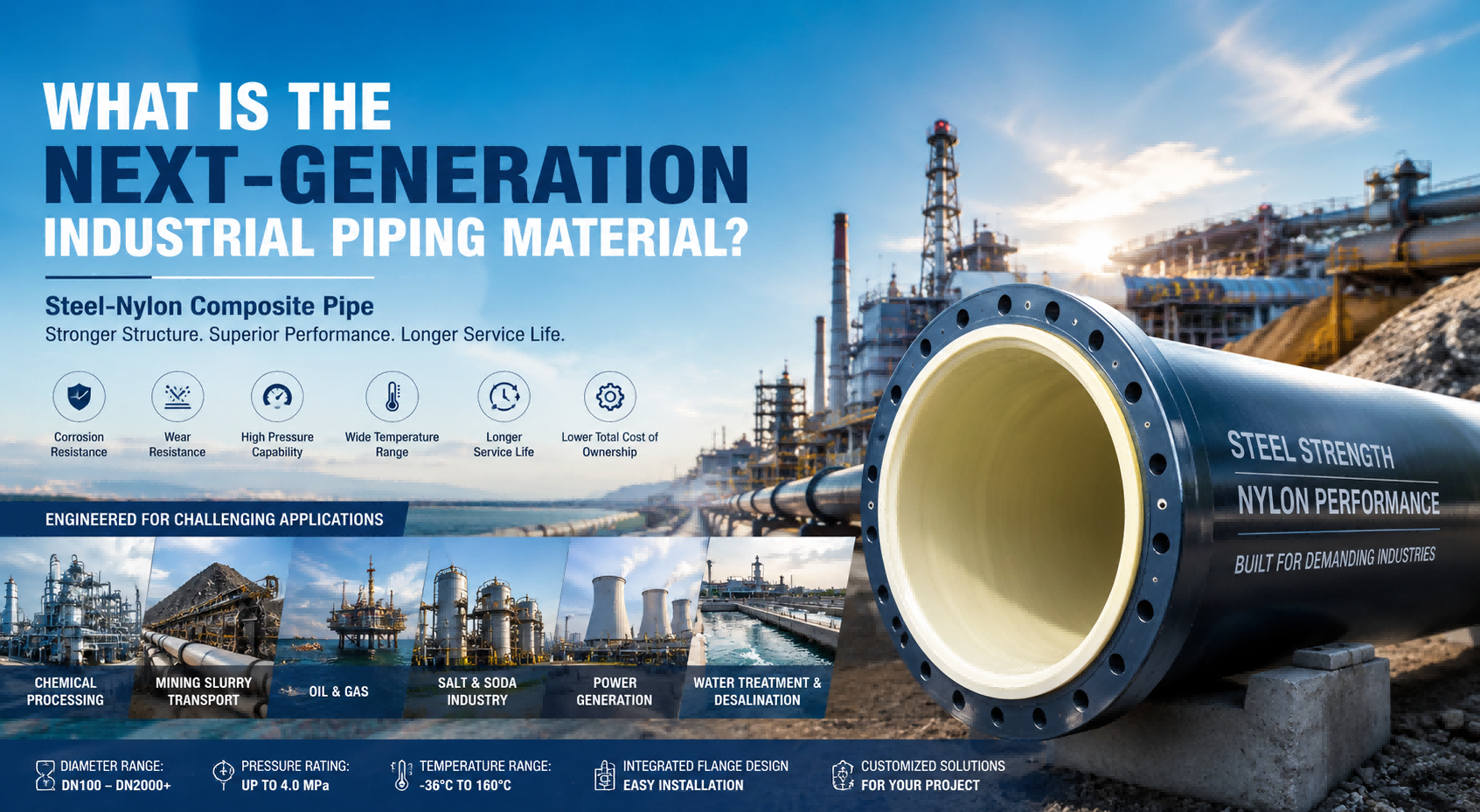
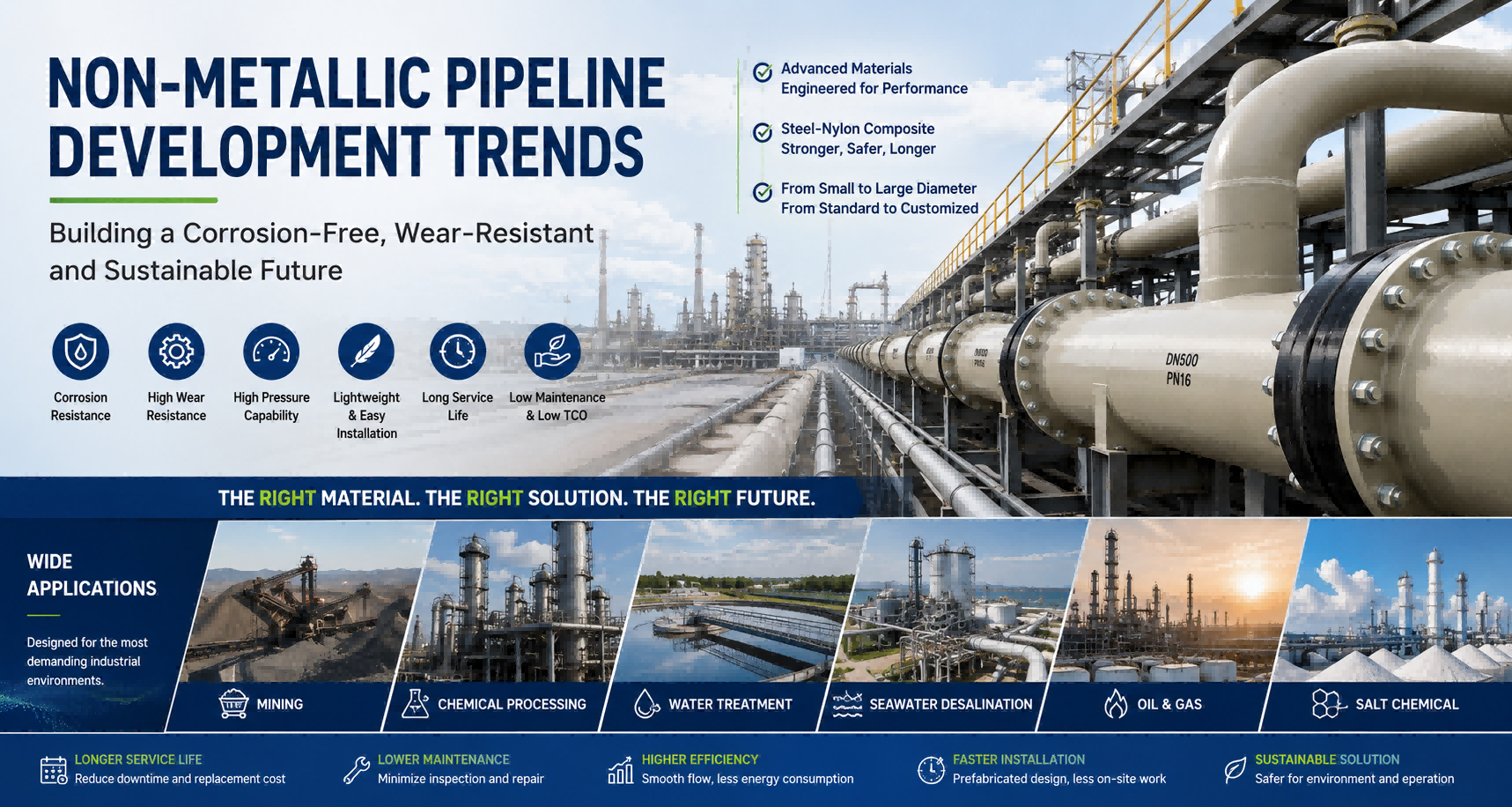
For demanding applications where corrosion, abrasion, pressure, and temperature occur simultaneously, Steel-Nylon Composite Pipe can be a highly competitive low-lifecycle-cost solution.
1. The Real Cost of an Industrial Pipeline Is More Than the Purchase Price
The total cost of an industrial pipeline can be simplified as:
Total Cost = Purchase Cost + Transportation + Installation + Maintenance + Downtime + Replacement
A more complete engineering calculation should also consider:
-
Pipe fittings and valve connection costs
-
Welding and corrosion-protection costs
-
Inspection and pressure testing
-
Spare parts inventory
-
Product losses caused by leakage
-
Unplanned shutdown losses
-
Maintenance labor
-
Pipe removal and reinstallation costs
Therefore, simply comparing the price per meter can lead to the wrong material selection.
| Pipeline Solution | Initial Cost | Installation Cost | Corrosion/Wear Risk | Maintenance Frequency | Overall Cost |
|---|---|---|---|---|---|
| Carbon Steel Pipe | Low | Medium | High | High | Potentially High |
| HDPE / PE Pipe | Low | Low | Low | Medium | Application Dependent |
| FRP Pipe | Medium | Medium | Low | Medium | Application Dependent |
| Stainless Steel Pipe | High | High | Application Dependent | Medium | Relatively High |
| Rubber-Lined Steel Pipe | Medium | Medium | Lining Life Dependent | Medium-High | Application Dependent |
| Steel-Nylon Composite Pipe | Medium | Relatively Low | Low | Relatively Low | Highly Competitive |
It is important to emphasize that no single pipe material has the lowest cost in every application.
The correct choice must be based on the actual service conditions, including the medium, temperature, pressure, solids content, flow velocity, corrosiveness, and required design life.
2. Why Can a “Cheap Pipe” Become More Expensive?
One of the most common cost traps in industrial pipeline projects is focusing only on the initial purchase price.
Consider two solutions:
-
Solution A: Low purchase price but short service life and frequent maintenance.
-
Solution B: Slightly higher initial cost but longer service life and lower maintenance requirements.
If the project is designed for 15 or even 20 years, Solution A may require multiple repairs and replacements.
For example:
Solution A
Initial Purchase → Installation → Operation → Corrosion/Wear → Repair → Replacement → Reinstallation → Further Maintenance
Solution B
Initial Purchase → Installation → Long-Term Operation → Periodic Inspection → Extended Service
Once labor, downtime, replacement, and maintenance costs are included, the final cost difference can become substantial.
This is why modern industrial procurement is increasingly moving from a pure CAPEX approach toward a combination of CAPEX + OPEX + Downtime Cost.
3. Corrosion Is a Major Source of Pipeline Lifecycle Cost
For chemical processing, salt chemical, chlor-alkali, soda ash, phosphate chemical, and certain water-treatment applications, corrosion is a major factor affecting pipe service life.
Carbon steel offers:
-
High mechanical strength
-
Low material cost
-
Easy fabrication
-
Wide availability
However, its corrosion resistance is limited.
When corrosive media are transported, additional measures may be required, such as:
-
Internal lining
-
Protective coatings
-
Cathodic protection
-
Corrosion maintenance
-
Regular wall-thickness inspection
All of these increase lifecycle costs.
A Steel-Nylon Composite Pipe uses a steel substrate combined with a nylon inner layer.
The steel substrate provides the required mechanical strength, while the nylon layer directly contacts the transported medium.
This structure combines the advantages of two materials:
Steel provides strength, while nylon provides corrosion and wear resistance.
Therefore, in applications requiring both mechanical strength and corrosion resistance, the composite structure can reduce dependence on thick-wall metal pipes or expensive corrosion-resistant alloys.
4. Wear Costs Are Often Underestimated
In mining, mineral processing, coal handling, power generation, desulfurization, slurry transportation, and pipelines carrying solids-containing media, pipes face not only corrosion but also severe abrasive wear.
Typical examples include:
-
Mineral slurry
-
Tailings
-
Sand-containing water
-
Solid-liquid two-phase flow
-
High-concentration slurry
-
Chemical media containing solid particles
These particles continuously impact and abrade the inner pipe wall.
Excessive wear can eventually cause:
Wall Thickness Reduction → Local Perforation → Leakage → Shutdown → Pipe Replacement
Therefore, in these applications, comparing pipe prices alone is not meaningful.
A more important indicator is:
Wear Cost per Unit of Operating Time
One major advantage of Steel-Nylon Composite Pipe is the wear resistance of its nylon inner layer, which can reduce abrasion of the pipe wall and potentially extend the service interval of vulnerable pipeline sections.
This can be particularly valuable for:
-
Elbows
-
Tees
-
Reducers
-
Pump outlet sections
-
Other high-wear components
5. Installation Cost Is Also an Important Part of TCO
Many projects focus heavily on material prices during procurement while overlooking installation costs.
In reality, pipeline installation can involve:
-
Pipe welding
-
Weld inspection
-
Corrosion protection
-
Scaffolding
-
Lifting
-
Skilled labor
-
Hot work
-
Rework
-
Pressure testing
If a pipeline requires extensive field welding, both construction time and labor costs can increase.
One important feature of Steel-Nylon Composite Pipe is that it can be manufactured with integrally formed, built-in flange connections, reducing certain welding operations during installation.
Under suitable engineering conditions, this can help reduce:
-
Field welding
-
Hot work
-
Number of weld joints
-
Weld inspection requirements
-
Some corrosion-protection work
-
Installation labor
Therefore, installation efficiency should be included when evaluating total pipeline cost.
6. Why Can Steel-Nylon Composite Pipe Be Highly Competitive in Total Cost?
The main value of Steel-Nylon Composite Pipe is not simply achieving the lowest purchase price.
Its core concept is:
A composite structure that addresses strength, corrosion resistance, abrasion resistance, and long-term operation at the same time.
Compared with single-material pipes, it can offer significant advantages in many demanding industrial applications.
① Steel Substrate Provides Mechanical Strength
Compared with conventional plastic pipes, the steel substrate provides stronger mechanical support and load-bearing capability.
This is particularly important for:
-
Large-diameter industrial pipelines
-
Above-ground pipe racks
-
Long-span pipeline systems
-
Complex support conditions
Depending on engineering requirements, Steel-Nylon Composite Pipe can be manufactured in large diameters and different pressure classes.
② Nylon Inner Layer Provides Corrosion Resistance
The nylon inner layer directly contacts the transported medium, reducing direct exposure of the steel substrate to corrosive substances.
For weak acids, strong alkalis, salt solutions, and selected chemical media, properly selected nylon materials can provide excellent chemical resistance.
However, actual application suitability should always be evaluated based on:
Medium Concentration + Temperature + Pressure + Flow Velocity + Required Service Life
③ Excellent Wear Resistance
For media containing solid particles, the nylon inner layer can reduce direct abrasion of the pipe wall.
This is particularly useful for:
-
Mineral slurry
-
Sand-containing fluids
-
Slurry transportation
-
Solid-liquid two-phase flow
-
High-wear applications
If the service interval of elbows, tees, reducers, pump outlets, and other vulnerable sections can be significantly extended, overall pipeline maintenance costs can be reduced.
④ Large-Diameter Capability Can Simplify Pipeline Systems
Industrial projects increasingly require larger pipeline diameters.
Large-diameter pipes must provide:
-
Adequate mechanical strength
-
Reliable connections
-
Convenient installation
-
Long-term operational stability
-
Easy maintenance
Steel-Nylon Composite Pipe can be applied to large-diameter industrial transportation systems, with manufacturing capabilities reaching DN2000 and above, and pressure ratings covering approximately 1.0–4.0 MPa, depending on the specific product and design.
For large-scale transportation systems, this can provide greater flexibility in pipeline design.
7. Why Can Steel-Nylon Composite Pipe Be More Economical Than Stainless Steel?
Stainless steel is widely used because of its combination of corrosion resistance and mechanical properties.
However, simply specifying “stainless steel” does not automatically guarantee long-term maintenance-free operation in every corrosive or abrasive environment.
For example:
-
Chloride-containing environments
-
High-concentration alkaline media
-
Particle-containing fluids
-
High-velocity flow
all require careful consideration of the appropriate stainless steel grade and design conditions.
At the same time, stainless steel has a relatively high material cost.
Steel-Nylon Composite Pipe takes a different approach:
Steel Strength + Nylon Corrosion/Wear Resistance
For many industrial transportation systems, this composite structure can provide a more economical alternative to high-cost metallic materials.
8. How Does Steel-Nylon Composite Pipe Compare with Conventional Plastic Pipes?
HDPE, PE, and PVC pipes offer important advantages, including low cost and corrosion resistance. They can therefore be highly competitive in many low-pressure and relatively moderate-temperature applications.
However, industrial pipelines must also consider:
-
Operating pressure
-
Temperature
-
Large diameter
-
External loads
-
Support spans
-
Pipe stiffness
-
Mechanical impact
As service conditions become more demanding, the applicability of conventional plastic pipes may become more limited.
Steel-Nylon Composite Pipe adds a steel substrate to the corrosion-resistant nylon inner layer, providing greater structural strength.
As a result, it can be particularly attractive for applications requiring a combination of:
Corrosion Resistance + Wear Resistance + Mechanical Strength + Large-Diameter Capability
9. How Should the True Total Cost of an Industrial Pipeline Be Calculated?
Engineering and procurement teams can use a simplified model:
TCO = Cₚ + Cᵢ + Cₘ + Cᵣ + C𝒹
Where:
Cₚ = Purchase Cost
Cost of pipes, fittings, flanges, and related components.
Cᵢ = Installation Cost
Transportation, lifting, welding, installation, inspection, and pressure testing.
Cₘ = Maintenance Cost
Periodic inspection, repairs, local replacement, and maintenance labor.
Cᵣ = Replacement Cost
Future procurement, removal, replacement, and reinstallation after the pipe reaches the end of its service life.
C𝒹 = Downtime Cost
Production losses caused by pipeline failure or unplanned shutdowns.
The last item is frequently underestimated.
For continuous-production facilities:
The cost of a single unexpected shutdown can sometimes exceed the purchase price of the entire pipeline.
Therefore, instead of asking only:
“How much does the pipe cost per meter?”
A better question is:
“How much will this pipeline cost per year of operation?”
10. A Better Procurement Indicator: Cost per Service Year
For industrial projects, another useful metric is:
Annualized Pipeline Cost = Total Lifecycle Cost ÷ Expected Service Life
For example, one pipeline solution may require a higher initial investment but provide many years of stable operation.
Another solution may have a lower initial price but require frequent replacement.
Even if the first solution costs more initially, its cost per service year may ultimately be lower.
This is why mature industrial procurement systems increasingly focus on:
-
Life Cycle Cost
-
Total Cost of Ownership
-
Cost per Service Year
-
Maintenance Cost
-
Downtime Risk
rather than purchase price alone.
11. Which Applications Are Particularly Suitable for Steel-Nylon Composite Pipe?
Steel-Nylon Composite Pipe is particularly suitable for industrial systems that need to address several challenges simultaneously.
Chemical Industry
-
Chlor-alkali
-
Salt chemical processing
-
Soda ash
-
Phosphate chemicals
-
Chemical mother liquor
-
Corrosive liquid transportation
Mining
-
Mineral slurry
-
Tailings
-
Backfill slurry
-
Sand-containing water
-
Solid-liquid two-phase flow
Oil & Gas
-
High-water-cut crude oil
-
Sand-containing crude oil
-
Water injection systems
-
Gathering systems
Power Generation and Environmental Protection
-
Desulfurization slurry
-
Ash and residue transportation
-
Industrial wastewater
-
Corrosive water media
Water Treatment
-
Industrial water supply and drainage
-
Brine transportation
-
Seawater-related systems
-
Corrosive wastewater
The common characteristic of these applications is that the pipeline must provide more than corrosion resistance.
It may also need:
Wear Resistance + Pressure Resistance + Mechanical Strength + Long-Term Reliability
12. Why Should You Not Simply Choose the Lowest Purchase Price?
One of the most dangerous approaches to industrial pipeline procurement is:
“Choose the supplier with the lowest quotation.”
A professional procurement strategy should consider:
Initial Cost → Installation → Operation → Maintenance → Replacement → Downtime
In other words:
Move from “buying a pipe” to “buying lifecycle performance.”
For ordinary building water-supply systems, the difference may not always be significant.
But for:
-
Continuous chemical production
-
Large-scale mining
-
Oil production systems
-
Large water-treatment facilities
-
Long-distance transportation pipelines
a pipeline failure can affect much more than the pipe itself.
It can disrupt the entire production system.
13. The Core Value of Steel-Nylon Composite Pipe: Reducing Long-Term Operating Risk
Steel-Nylon Composite Pipe does not necessarily have the lowest initial purchase price in every project.
Its value lies in its ability to address multiple challenges through a composite structure:
Reduced Corrosion Risk
Lower Wear Rate
High Mechanical Strength
Reduced Field Welding in Suitable Designs
Lower Maintenance Frequency
Extended Service Intervals for Wear-Prone Sections
=
Lower Lifecycle Cost
This is the real economic value of Steel-Nylon Composite Pipe.
14. Conclusion: The Lowest Total-Cost Pipe Is Not Necessarily the Cheapest Pipe to Buy
So, which industrial pipe has the lowest total cost?
The answer is not simply one particular material.
The real answer is:
The pipe with the lowest total cost under the specific service conditions—while meeting the required safety, service life, corrosion resistance, wear resistance, and maintenance requirements—is the pipe with the lowest overall cost.
For industrial transportation systems involving corrosive media, solid particles, pressure requirements, and large diameters, Steel-Nylon Composite Pipe combines a steel structural substrate with a nylon inner layer to balance mechanical strength, corrosion resistance, wear resistance, and installation efficiency.
Especially when the project design life is 10, 15, or even 20 years, comparing only the initial purchase price cannot accurately reflect the true economic value of a pipeline.
The more meaningful question is not:
“How much does the pipe cost per meter?”
but:
“How much will the pipeline cost per year of reliable operation?”
If your project is comparing carbon steel, HDPE, FRP, stainless steel, rubber-lined steel, plastic-lined steel, and Steel-Nylon Composite Pipe, the best approach is to build a TCO model based on the actual medium, temperature, pressure, flow velocity, solids content, pipe diameter, maintenance requirements, and design life.
This is the key step in moving industrial pipeline procurement from price-driven purchasing to lifecycle-value-driven engineering.
For long-term industrial service, the lowest purchase price is not always the lowest total cost. The right pipe is the one that delivers the lowest cost over its entire service life.
10-Year Lifecycle Cost Comparison: Which Industrial Pipeline Is Truly the Most Cost-Effective?
Common Failure Modes of Rubber-Lined Steel Pipes: Why Do Their Corrosion and Wear Resistance Decline Over Time?