
Why Low Initial Pipe Prices Can Lead to Higher Total Costs
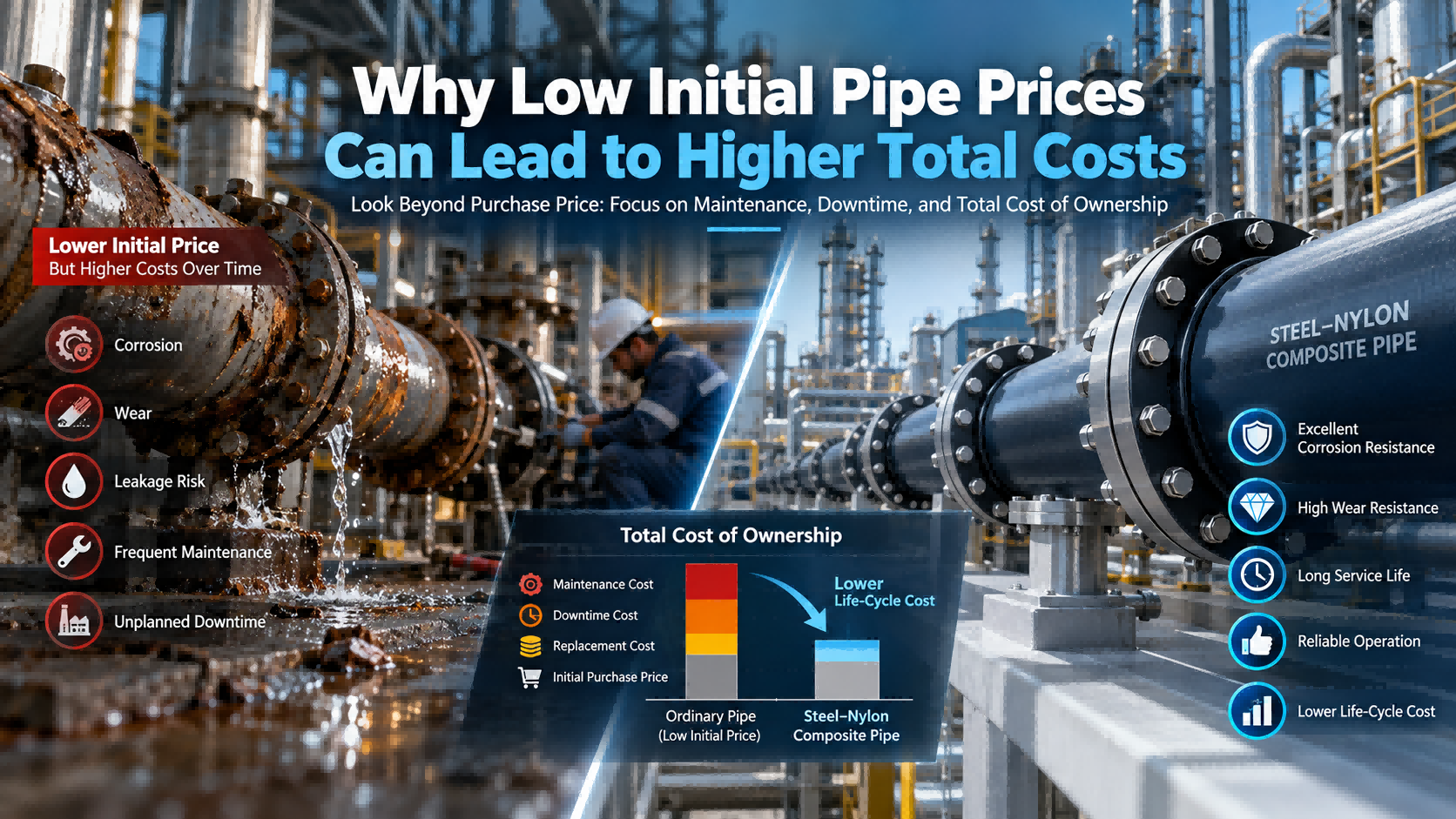
Introduction: Is the Cheapest Pipe Really the Most Cost-Effective Choice?
In industrial pipeline projects, the initial purchase price is often one of the most important factors influencing material selection.
When two piping solutions appear to meet the basic design requirements, procurement managers naturally tend to favor the option with the lower quotation.
This is especially true for large-scale chemical plants, oil and gas facilities, mining operations, power plants, and water infrastructure projects, where hundreds or even thousands of meters of piping can represent a significant capital investment.
However, one critical question is frequently overlooked:
Does choosing the cheapest pipe today really mean achieving the lowest total cost over the next 10 or 20 years?
Not necessarily.
For industrial piping systems designed for long-term operation, the initial purchase price represents only a fraction of the total financial commitment.
Corrosion, abrasion, leakage, maintenance, premature replacement, production downtime, and energy consumption can all create substantial expenses throughout a pipeline's operating life.
A pipe that appears inexpensive during procurement may require frequent repairs or even complete replacement after only a few years.
By contrast, a piping solution with a higher initial investment but better corrosion resistance, wear resistance, and structural reliability may provide significant long-term financial benefits.
This is why more industrial companies are shifting their focus from initial purchase price to Total Cost of Ownership (TCO) and Life Cycle Cost (LCC) when evaluating pipeline materials.
For demanding applications involving corrosive fluids, abrasive slurries, and continuous industrial operations, steel–nylon composite pipes represent an alternative worth evaluating.
1. Why the Initial Purchase Price Does Not Reflect the True Cost of Industrial Pipes
1.1 Initial Investment Is Only the Beginning
The actual cost of an industrial pipeline extends far beyond the price of the pipe itself.
A complete industrial piping system involves multiple cost categories:
-
Procurement costs: Pipes, flanges, elbows, tees, fittings, and transportation.
-
Installation costs: Lifting, joining, labor, pressure testing, and commissioning.
-
Operating costs: Pumping energy, routine inspections, and system operation.
-
Maintenance costs: Corrosion protection, cleaning, repairs, gasket replacement, and localized pipe rehabilitation.
-
Failure costs: Leakage control, emergency repairs, environmental remediation, and production losses.
-
Replacement costs: Removal of damaged pipes, purchasing new materials, reinstallation, and system restart.
-
End-of-life costs: Dismantling, disposal, and applicable compliance requirements.
For industrial pipelines operating over extended periods, these additional expenses can eventually exceed the original procurement investment.
Consider a pipeline designed to transport highly saline industrial wastewater.
A company may initially select conventional carbon steel pipes because of their relatively low purchase price.
However, if the transported fluid causes continuous internal corrosion, the pipeline may eventually experience wall thinning, localized perforation, and leakage at vulnerable sections.
Over time, the operator may need to spend increasing amounts on inspections, corrosion protection, emergency repairs, and pipe replacement.
The money saved during the initial purchase may gradually disappear.
In severe cases, the total cost can become significantly higher than that of a more corrosion-resistant solution.
1.2 Total Cost of Ownership Is a Better Decision-Making Metric
A simplified TCO calculation for industrial pipelines can be expressed as:
TCO = Initial Procurement Cost + Installation Cost + Operating Cost + Maintenance Cost + Failure and Downtime Cost + Replacement and End-of-Life Cost
For more rigorous financial evaluations, the model should also account for the time value of money, inflation assumptions, and uncertainty in future expenditures.
The difference is straightforward:
Initial purchase price measures how much a pipeline costs to buy. Total Cost of Ownership measures how much it costs to own and operate over its entire evaluation period.
This distinction is particularly important in the chemical processing, mining, oil and gas, and power generation industries, where pipeline failures can disrupt continuous production.
2. Five Hidden Costs Behind Low-Cost Industrial Pipes
2.1 Corrosion Can Create Continuous Maintenance Expenses
Corrosion is one of the major causes of industrial pipeline deterioration.
In chemical processing plants, salt chemical facilities, oilfield produced-water systems, and industrial wastewater networks, pipes may be exposed to aggressive operating environments containing:
-
Chloride ions
-
Acidic or alkaline chemicals
-
Highly saline solutions
-
Dissolved corrosive gases
-
Other chemically aggressive compounds
When a pipe material is not properly matched to the transported medium, several failure mechanisms may develop, including localized corrosion, pitting, wall thinning, perforation, and leakage.
Some conventional metallic piping systems depend on protective coatings, linings, or other corrosion-control measures.
If these protective barriers become damaged, detached, or degraded, corrosive fluids may reach the underlying metal.
This can increase maintenance requirements and shorten the effective service life of the pipeline.
How Steel–Nylon Composite Pipes Can Help
Steel–nylon composite pipes combine a metallic load-bearing structure with a nylon protective layer.
When properly designed for the operating conditions, this structure can help reduce direct contact between the transported medium and the steel component, thereby reducing corrosion-related risks.
For selected brines, industrial wastewater streams, and compatible chemical solutions, the nylon protective layer can provide useful corrosion resistance.
However, material compatibility must always be verified against the specific chemical composition, concentration, operating temperature, pressure, and expected exposure duration.
2.2 Abrasion May Cause Premature Pipe Replacement
In mining operations, mineral processing plants, and certain chemical facilities, pipelines are exposed not only to internal pressure but also to abrasive solid particles.
Typical applications include:
-
Iron ore slurry transportation
-
Copper ore slurry pipelines
-
Tailings transportation
-
Mine backfilling systems
-
Solid-containing industrial wastewater
-
Abrasive process slurries
During operation, solid particles repeatedly contact and impact the internal pipe surface.
Abrasion may be particularly severe at elbows, tees, reducers, pump outlets, and other locations where flow direction or velocity changes.
When a pipe is selected mainly for its low purchase price without considering abrasion resistance, premature wall loss and frequent replacement may occur.
The cost of replacement includes much more than the pipe itself.
Additional expenses may involve labor, lifting equipment, system isolation, reinstallation, and production interruption.
How Steel–Nylon Composite Pipes Can Help
Properly formulated and engineered nylon layers can offer wear-resistant protection in selected slurry transportation applications, subject to relevant testing and operating conditions.
The steel structure provides mechanical support while the nylon layer serves as a functional barrier against direct contact with the transported medium.
For applications involving both corrosion and abrasion, this combination can be evaluated against conventional carbon steel, rubber-lined steel, and other wear-resistant piping materials.
Actual wear life depends on particle hardness, particle size, solids concentration, flow velocity, impact angle, and pipeline geometry.
Therefore, material selection should be based on application-specific engineering evaluation rather than generic wear-resistance claims.
2.3 Unplanned Downtime Can Cost More Than the Pipe Itself
In many industrial operations, repair expenses are not the largest financial consequence of pipeline failure.
The greater cost may come from interrupted production.
Consider a slurry transportation pipeline in a mining facility.
If a major leak occurs, the operator may need to:
-
Stop the transportation system.
-
Isolate the damaged pipeline section.
-
Drain or remove the remaining slurry.
-
Remove the defective pipe.
-
Install a replacement section.
-
Perform inspections and pressure testing.
-
Restart the transportation process.
Depending on the system configuration, this event may disrupt upstream material handling and downstream processing operations.
A similar situation can occur in chemical plants, where failure of a critical pipeline may affect an entire production unit.
For this reason, procurement managers should not ask only:
"How much does this pipe cost?"
They should also ask:
"How much would a pipeline failure cost our entire operation?"
For facilities operating continuously, avoiding a single major unplanned shutdown may create substantial economic value.
2.4 Internal Surface Deterioration Can Increase Pumping Costs
In fluid transportation systems, hydraulic performance directly affects energy consumption.
At a given flow rate, pressure losses depend on factors such as:
-
Internal pipe diameter
-
Pipe length
-
Surface roughness
-
Flow velocity
-
Fittings and local resistance
-
Deposits and scaling
-
Changes in the internal pipe condition
In certain metallic piping systems, corrosion products, deposits, or internal surface deterioration may increase flow resistance over time.
If the pumping system must maintain a specified flow rate, the resulting hydraulic losses can increase energy requirements.
A common method for calculating frictional head loss is the Darcy–Weisbach equation:
h_f = f × (L/D) × (v²/2g)
Where:
-
h_f = Frictional head loss
-
f = Darcy friction factor
-
L = Pipe length
-
D = Internal pipe diameter
-
v = Average fluid velocity
-
g = Gravitational acceleration
This relationship demonstrates why long-term hydraulic performance should be considered in pipeline cost evaluations.
Potential Advantages of Steel–Nylon Composite Pipes
A properly manufactured nylon internal layer can provide a relatively smooth fluid-contact surface.
By reducing direct exposure of the steel structure to corrosive media, the protective layer may also help limit certain forms of corrosion-related internal surface deterioration.
However, actual energy savings must be demonstrated through hydraulic calculations or operational data under comparable conditions, including equivalent internal diameters and flow rates.
A composite pipe should not automatically be assumed to consume less pumping energy than every alternative material.
2.5 Pipe Replacement Means Paying Installation Costs Again
When a pipeline reaches the end of its useful life earlier than expected, the operator must pay for more than replacement materials.
Industrial pipe replacement may involve complicated construction activities, especially in:
-
Elevated pipe racks
-
Underground utility networks
-
Congested chemical plants
-
Restricted-access industrial facilities
-
Hazardous processing areas
Replacement may require removing existing piping, mobilizing equipment, conducting safety inspections, and temporarily shutting down production.
In facilities handling flammable, toxic, or otherwise hazardous substances, additional isolation and safety procedures may be necessary.
Even when replacement pipes are relatively inexpensive, repeated construction work can significantly increase the long-term cost of the system.
Reducing replacement frequency can therefore become a major source of economic value.
3. A 10-Year Cost Comparison: How Much Can a Cheap Pipe Really Cost?
To illustrate how the choice of piping material may influence long-term expenditure, consider a hypothetical industrial fluid transportation project.
The operator is comparing two technically feasible options.
Option A: Conventional piping with a lower initial purchase price
Option B: Steel–nylon composite piping with a higher initial investment
Both options are assumed to satisfy the basic engineering requirements.
However, the analysis models different maintenance, energy, repair, and downtime costs under a particular corrosive operating scenario.
3.1 Hypothetical 10-Year Total Cost Comparison
All values are expressed in USD for illustration.
| Cost Category | Option A: Conventional Pipe | Option B: Steel–Nylon Composite Pipe |
|---|---|---|
| Initial pipe and installation investment | $600,000 | $820,000 |
| Routine maintenance over 10 years | $600,000 | $200,000 |
| Pumping energy over 10 years | $700,000 | $650,000 |
| Major repairs or partial replacement | $350,000 | $0 |
| Unplanned downtime losses | $180,000 | $0 |
| Total 10-Year Cost | $2,430,000 | $1,670,000 |
Important Note: These figures are hypothetical and are intended only to demonstrate the TCO calculation method. They are not actual customer project results, verified material performance data, or guarantees that steel–nylon composite pipes will eliminate major repairs or downtime. The model uses a simplified undiscounted cost approach and excludes taxes, residual value, and unlisted expenses.
3.2 What Does the Comparison Show?
Initial investment:
The steel–nylon composite piping solution requires an additional $220,000 upfront, representing approximately 36.7% more initial investment.
Total 10-year cost:
-
Conventional piping: $2,430,000
-
Steel–nylon composite piping: $1,670,000
Potential 10-year cost savings:
$2,430,000 − $1,670,000 = $760,000
Potential TCO reduction:
$760,000 ÷ $2,430,000 × 100% = 31.3%
Under these hypothetical conditions, the steel–nylon composite piping solution reduces total costs by approximately 31.3% despite requiring higher initial investment.
This illustrates how improved maintenance performance, fewer major repairs, and reduced operational disruption may offset a higher purchase price.
However, the outcome depends strongly on the underlying assumptions.
If conventional piping can operate reliably under the actual process conditions with minimal maintenance, the economic advantage of upgrading to a composite material may be much smaller or may disappear entirely.
Consequently, the objective of a proper TCO analysis is not to prove that one material is always cheaper.
The objective is to identify the piping solution that delivers the lowest realistic long-term cost while meeting the required safety, performance, and reliability standards.
4. Why Steel–Nylon Composite Pipes Deserve Consideration in Long-Term Cost Evaluations
4.1 Combining Steel Strength With Nylon Protection
Traditional piping materials have different performance characteristics and engineering limitations.
Carbon steel pipes offer mechanical strength, widespread availability, and well-established installation methods. However, additional corrosion protection may be required in aggressive environments.
Certain thermoplastic pipes provide excellent chemical resistance in compatible applications, but temperature limitations, pressure ratings, thermal expansion, and long-term mechanical behavior must be evaluated carefully.
Fiberglass-reinforced plastic (FRP) pipes provide corrosion resistance and relatively low weight, but impact conditions, installation quality, connection design, and abrasive service must be assessed for each application.
Steel–nylon composite pipes combine different materials to provide complementary functions within a single piping structure.
The basic design concept is to:
Use the steel component for structural support and pressure-bearing capacity while utilizing the nylon layer to protect the fluid-contact surface against selected corrosive and abrasive environments.
This integrated approach makes steel–nylon composite pipes an attractive candidate for applications where pressure, chemical exposure, and mechanical wear must be considered together.
4.2 Addressing Corrosion and Abrasion in the Same Pipeline
In many industrial applications, corrosion and abrasion occur simultaneously.
For example:
Highly saline industrial wastewater may also contain suspended solids.
Oilfield produced water may contain dissolved salts, corrosive gases, and sand particles.
Mining slurries may combine chemical exposure with continuous particle impact.
These operating conditions create complex material-selection challenges.
A pipe that performs well against corrosion may not necessarily provide adequate abrasion resistance.
Likewise, a highly wear-resistant pipe may not be suitable for every corrosive fluid.
Steel–nylon composite piping offers a material-design approach that considers corrosion protection, abrasion resistance, and mechanical support as part of one engineered system.
Its potential value comes from managing multiple deterioration mechanisms rather than optimizing a single material property.
4.3 Integrated Flange Design Can Improve Connection Reliability
Pipeline connections are critical components of industrial piping systems.
Improperly designed or installed flange connections can develop leakage because of gasket selection, damaged sealing surfaces, uneven bolt loading, deformation, or structural inconsistencies.
Steel–nylon composite pipes with appropriately engineered integrally molded flange structures can help improve structural continuity and protective-layer design around connection areas.
This may reduce some vulnerabilities associated with discontinuous protective linings or poorly configured transitions.
Nevertheless, flange performance must still be confirmed through appropriate engineering design, gasket selection, bolt-tightening procedures, installation practices, and pressure testing.
4.4 Potentially Lower Maintenance Requirements
For continuous industrial operations, reduced maintenance can provide several advantages:
-
Fewer corrosion-related interventions
-
Less frequent replacement of damaged sections
-
Lower exposure to emergency repair activities
-
More predictable maintenance schedules
-
Reduced disruption to production planning
When steel–nylon composite pipes demonstrate reliable performance under validated conditions, these operational improvements may translate into measurable financial benefits.
This can be particularly valuable in facilities where maintenance access is difficult or shutdowns are expensive.
4.5 Supporting Large-Diameter and Customized Industrial Projects
Large industrial pipeline projects often require more than standard material specifications.
Engineers must consider pipe diameter, pressure rating, wall thickness, flange dimensions, fittings, installation requirements, and project-specific operating conditions.
Steel–nylon composite piping solutions can be engineered for different industrial configurations, including selected large-diameter applications and customized piping components.
For every project, actual manufacturing capability, dimensional tolerances, pressure classifications, and quality-control documentation should be verified.
Performance data for one pipe size or pressure class should not automatically be applied to all other specifications.
5. Steel–Nylon Composite Pipes vs. Other Industrial Piping Materials
Different piping materials offer advantages under different operating conditions.
A reliable material-selection process should compare their performance, limitations, and long-term economic implications rather than focusing exclusively on price.
| Pipe Material | Main Advantages | Key Cost and Engineering Considerations |
|---|---|---|
| Carbon Steel | High structural strength, established manufacturing and installation methods | Internal corrosion, protective coatings, inspections, and maintenance |
| HDPE | Good resistance to many chemicals, relatively lightweight, established joining methods | Pressure and temperature derating, thermal expansion, external loads, and joining requirements |
| FRP/GRP | Good corrosion resistance for compatible media, relatively lightweight | Impact damage, joint design, installation quality, and abrasive conditions |
| Stainless Steel | Mechanical strength, broad industrial experience, multiple alloy options | Material costs, chloride-induced corrosion, and appropriate alloy selection |
| Rubber-Lined Steel | Steel support combined with an elastomeric lining for selected abrasive services | Lining degradation, debonding, joint protection, and maintenance |
| Steel–Nylon Composite | Steel structural support combined with nylon protection for selected corrosive and abrasive applications | Chemical compatibility, temperature limits, composite-interface integrity, and connection quality |
No single pipe material is ideal for every application.
For example, HDPE may provide excellent economic value in low-pressure, moderate-temperature water transportation systems where its design limitations are acceptable.
In certain high-temperature or high-pressure applications, properly selected metallic piping systems may be more appropriate.
However, in applications combining corrosion, abrasive particles, pressure requirements, and high maintenance costs, steel–nylon composite pipes may offer meaningful advantages in an overall engineering and economic assessment.
6. Which Industries Can Benefit From Steel–Nylon Composite Piping Solutions?
6.1 Oilfield Produced Water and Injection Water Systems
Oilfield pipelines frequently operate in complex chemical environments.
High salinity, dissolved gases, sand particles, and operating pressure can all influence pipeline reliability.
In certain produced-water, injection-water, and auxiliary gathering applications, corrosion resistance and mechanical strength must be evaluated together.
Steel–nylon composite pipes can be considered as an alternative for projects seeking to reduce internal corrosion risks and maintenance requirements.
Where CO₂, H₂S, or other aggressive substances are present, additional testing and validation may be required to assess chemical compatibility, permeability, and long-term material performance.
6.2 Chemical Processing and Salt Chemical Industries
Chemical plants and salt-processing facilities often transport brine, process liquors, alkaline solutions, and industrial wastewater.
These services can create demanding operating conditions for piping materials.
When existing pipelines require frequent corrosion-related maintenance or replacement, material upgrades may help improve reliability and reduce long-term expenditure.
For media compatible with the selected nylon material, steel–nylon composite pipes can offer a combination of structural performance and protective functionality.
However, chemical compatibility must be confirmed for the actual concentration, temperature, pressure, and exposure duration.
Compatibility with one concentration of a chemical does not necessarily establish suitability for all concentrations.
6.3 Mining Slurry and Tailings Transportation
Mining pipeline systems must withstand a combination of operational stresses, including particle abrasion, pressure fluctuations, changes in slurry concentration, and challenging maintenance conditions.
Elbows, pump discharge sections, and high-velocity regions often require particular attention.
For applications requiring both structural support and abrasion resistance, steel–nylon composite piping can be evaluated alongside other engineered wear-resistant materials.
Where production continuity is critical, reduced replacement frequency and downtime risk may provide significant economic value.
6.4 Power Plant Circulating Water and Auxiliary Systems
Power plant pipelines can be exposed to corrosion, scaling, sediment accumulation, and particle erosion.
These issues may affect system efficiency, maintenance requirements, and operational availability.
For circulating water, industrial wastewater, and selected auxiliary transportation systems, steel–nylon composite pipes may be considered when chemical compatibility, operating temperature, and pressure requirements are satisfied.
High-temperature systems, strongly oxidizing environments, and specialized flue-gas desulfurization services require additional engineering verification.
6.5 Seawater and Coastal Industrial Water Systems
Chloride-rich environments present corrosion challenges for many metallic piping systems.
Coastal industrial facilities and seawater transportation networks must consider both internal corrosion and external environmental exposure.
For appropriately designed and verified applications, steel–nylon composite piping may provide a potential corrosion-resistant alternative.
Selection should account for fluid chemistry, structural requirements, joining methods, inspection access, and the expected operating period.
7. How Procurement Managers Can Calculate the True Return on Investment of Industrial Pipes
A meaningful investment comparison should use a consistent evaluation period, such as 10, 15, or 20 years.
The following five-step approach can help industrial procurement teams compare alternative piping materials.
Step 1: Define the Actual Operating Conditions
Collect accurate information about:
-
Transported fluid and chemical composition
-
Chemical concentration
-
Operating and design pressure
-
Operating and design temperature
-
Flow rate and velocity
-
Solid particle concentration and characteristics
-
Annual operating hours
-
Installation environment
-
Expected service period
Without reliable operating data, even a technically advanced material may fail to achieve its expected performance.
Step 2: Compare Complete Initial Investment
Do not compare pipe prices alone.
Include transportation, fittings, flange connections, installation labor, pressure testing, and commissioning.
All alternatives must meet the same applicable design and performance requirements.
Step 3: Estimate Maintenance and Replacement Costs
Use available operational records, comparable application data, material test results, and engineering experience to estimate future maintenance requirements.
Potential expenses include inspections, protective-layer maintenance, cleaning, localized repairs, and replacement.
Avoid assuming that any pipe material will operate without maintenance unless such an assumption is supported by relevant evidence.
Step 4: Quantify Failure and Downtime Risks
A simplified expected-cost approach can be expressed as:
Expected Failure Cost = Probability of Failure × Financial Consequence of Failure
For continuous production facilities, consequences may include lost production, emergency labor, environmental response, and restoration expenses.
Care should be taken to avoid double-counting the same loss under multiple cost categories.
Step 5: Calculate Life Cycle Cost and Return on Investment
For a more accurate financial evaluation, future costs can be discounted to present value.
A simplified life-cycle cost model is:
LCC = C₀ + Σ [Cₜ / (1 + r)ᵗ], for t = 1 to n
Where:
-
C₀ = Initial investment
-
Cₜ = Net cost cash flow in year t
-
r = Discount rate
-
n = Evaluation period
Replacement costs, disposal costs, and residual value can be incorporated into the relevant annual cash flows.
If steel–nylon composite piping requires a higher initial investment, procurement managers can compare its incremental capital cost against the expected savings in maintenance, energy, replacement, and downtime expenses.
This allows the project team to evaluate net savings, payback period, and return on investment.
Sensitivity analysis is also recommended.
For example, engineers may calculate TCO under low, medium, and high assumptions for corrosion rates, maintenance frequency, or expected replacement intervals.
This helps determine whether the preferred solution remains economically attractive under less favorable conditions.
8. Why More Industrial Companies Are Moving From Lowest Purchase Price to Lowest Long-Term Cost
Industrial pipeline procurement is increasingly being viewed as a long-term engineering and asset-management decision rather than simply a materials purchasing exercise.
For short-term, easily accessible, and relatively mild applications, the initial purchase price may remain a major deciding factor.
However, in demanding environments involving corrosion, abrasion, difficult maintenance access, or expensive downtime, long-term performance can have a much greater financial impact.
From an asset-management perspective, selecting a suitable piping material may create value in three important areas.
8.1 Lower Predictable Maintenance Expenditure
Reducing corrosion repairs, wear-related replacement, and unexpected maintenance can help operators control long-term operating budgets.
8.2 Improved Production Continuity
Reliable pipeline systems can reduce unplanned interruptions and make production schedules more predictable.
This is particularly valuable in continuous-process industries where pipeline failures may affect multiple connected production units.
8.3 Better Long-Term Value From Capital Investment
A piping solution that maintains the required performance while controlling operating expenses can deliver greater economic value over its evaluation period.
This is why procurement decisions should compare more than supplier quotations.
The true comparison should be between the total economic consequences of each technically acceptable piping solution.
9. How Our Steel–Nylon Composite Pipes Help Optimize Long-Term Pipeline Costs
As a manufacturer of steel–nylon composite pipes and reinforced nylon industrial piping products, we focus on more than supplying pipes at a competitive purchase price.
Our objective is to help industrial customers select reliable piping solutions based on their actual operating conditions and long-term project requirements.
We emphasize several key engineering considerations.
Corrosion-Resistant Design
We evaluate the transported medium, chemical concentration, temperature, and exposure conditions to help determine whether the nylon protective layer is suitable for the intended application.
Wear-Resistant Design
For slurry transportation, solid-containing wastewater, and other abrasive services, we consider flow conditions, particle characteristics, and pipeline configuration when assessing appropriate wear-resistant solutions.
Pressure-Bearing and Structural Design
We evaluate pressure requirements, steel structural components, composite construction, wall thickness, and relevant piping components to support appropriate engineering selection.
Integrated Flange Connections
Our piping solutions can incorporate integrally molded flange designs, with attention to structural continuity, sealing performance, and installation requirements.
Customized Industrial Pipeline Solutions
Different projects require different specifications.
We support engineering discussions involving pipe diameter, pressure rating, flange standards, fittings, and application-specific configurations.
Long-Term Cost Evaluation
We help customers consider the economic implications of material selection, including procurement, installation, maintenance, replacement, and operational risks.
Our goal is not to encourage customers to purchase the most expensive piping material.
Our goal is to help customers identify the most appropriate piping solution for their operating conditions and long-term economic objectives.
For projects experiencing frequent corrosion, abrasion, leakage, or repeated pipe replacement, properly designed and validated steel–nylon composite pipes may offer a valuable opportunity to reduce overall operating costs.
10. Frequently Asked Questions (FAQ)
Q1: Why can cheaper industrial pipes become more expensive over time?
Because the initial purchase price represents only one component of total cost.
If a pipeline experiences frequent corrosion, abrasion, leakage, or premature replacement, the resulting maintenance, downtime, and reinstallation expenses may eventually exceed the original procurement savings.
Q2: Are steel–nylon composite pipes always more economical than carbon steel pipes?
No.
Steel–nylon composite pipes may offer better long-term economic performance in certain corrosive or abrasive environments where maintenance and replacement costs are significant.
However, in mild operating conditions where conventional carbon steel performs reliably with minimal maintenance, the traditional solution may remain more economical.
A project-specific TCO analysis is necessary.
Q3: Should industrial pipeline costs be evaluated over 10 or 20 years?
The evaluation period should reflect the project's design life, expected operating period, and asset-management requirements.
A 10-year period is often useful for medium-term comparisons.
For long-life industrial infrastructure, a 20-year or longer assessment may provide a more complete economic perspective.
Discounting, replacement expenses, and uncertainty should be included where appropriate.
Q4: Are steel–nylon composite pipes suitable for transporting corrosive chemicals?
They may be suitable for selected brines, industrial wastewater streams, and specific chemical media.
However, chemical resistance varies with nylon formulation, concentration, temperature, pressure, and exposure conditions.
Compatibility must be verified before selecting the material for a particular application.
Q5: How can a company determine whether upgrading to steel–nylon composite pipes is worthwhile?
The first step is to evaluate the existing pipeline's performance.
If frequent leakage, corrosion, abrasion, expensive repairs, or repeated replacement are occurring, a technical and economic evaluation may be justified.
For uncertain operating conditions, a pilot installation or trial section can help establish actual performance before wider deployment.
Conclusion: The True Value of an Industrial Pipe Is Determined Over Years of Operation, Not on the Day of Purchase
For industrial companies, choosing a piping material is more than a procurement decision.
It is an investment that can influence maintenance expenditure, energy consumption, production continuity, and operational reliability for many years.
A low initial purchase price may reduce today's project budget.
However, if the selected material cannot withstand actual operating conditions, future corrosion, abrasion, repairs, downtime, and replacement costs may make the solution considerably more expensive over time.
Conversely, a piping system with a higher initial investment but better suitability for the intended application may generate substantial long-term value through reduced maintenance requirements, lower failure risks, and extended operating periods.
For industrial applications involving a combination of corrosion, abrasion, and pressure requirements, steel–nylon composite pipes offer an engineered approach that combines steel structural support with the protective characteristics of nylon materials.
When properly selected, designed, tested, and installed, this composite structure may help industrial operators improve pipeline reliability and optimize their total cost of ownership.
Ultimately, industrial pipe procurement should move beyond one simple question:
"Which pipe has the lowest purchase price?"
The better question is:
"Which piping solution will deliver the greatest long-term value at an acceptable level of operational risk?"
The most economical industrial pipe is not necessarily the cheapest one to purchase.
It is the pipe that can consistently meet the project's safety, performance, and operational requirements at a reasonable total cost throughout its intended service period.
Contact Us: Evaluate the Long-Term Cost of Your Industrial Pipeline Project
Are you dealing with frequent pipe corrosion, abrasion, leakage, unexpected repairs, or high pipeline maintenance expenses?
Our technical team can help you evaluate whether steel–nylon composite pipes are suitable for your project.
By reviewing your transported medium, operating pressure, temperature, pipe diameter, installation requirements, and expected service conditions, we can support the technical selection process and help you assess alternative piping solutions from a long-term cost perspective.
Contact Us for a Customized Steel–Nylon Composite Pipe Solution
Reduce Maintenance Costs. Improve Pipeline Reliability. Optimize Long-Term Value.
Send us your project specifications and inquiry requirements to discuss an industrial piping solution tailored to your application.
What Do EPC Companies Look for When Selecting New Piping Materials?
Why More Industrial Buyers Are Calculating the 10-Year Total Cost of Pipeline Ownership


