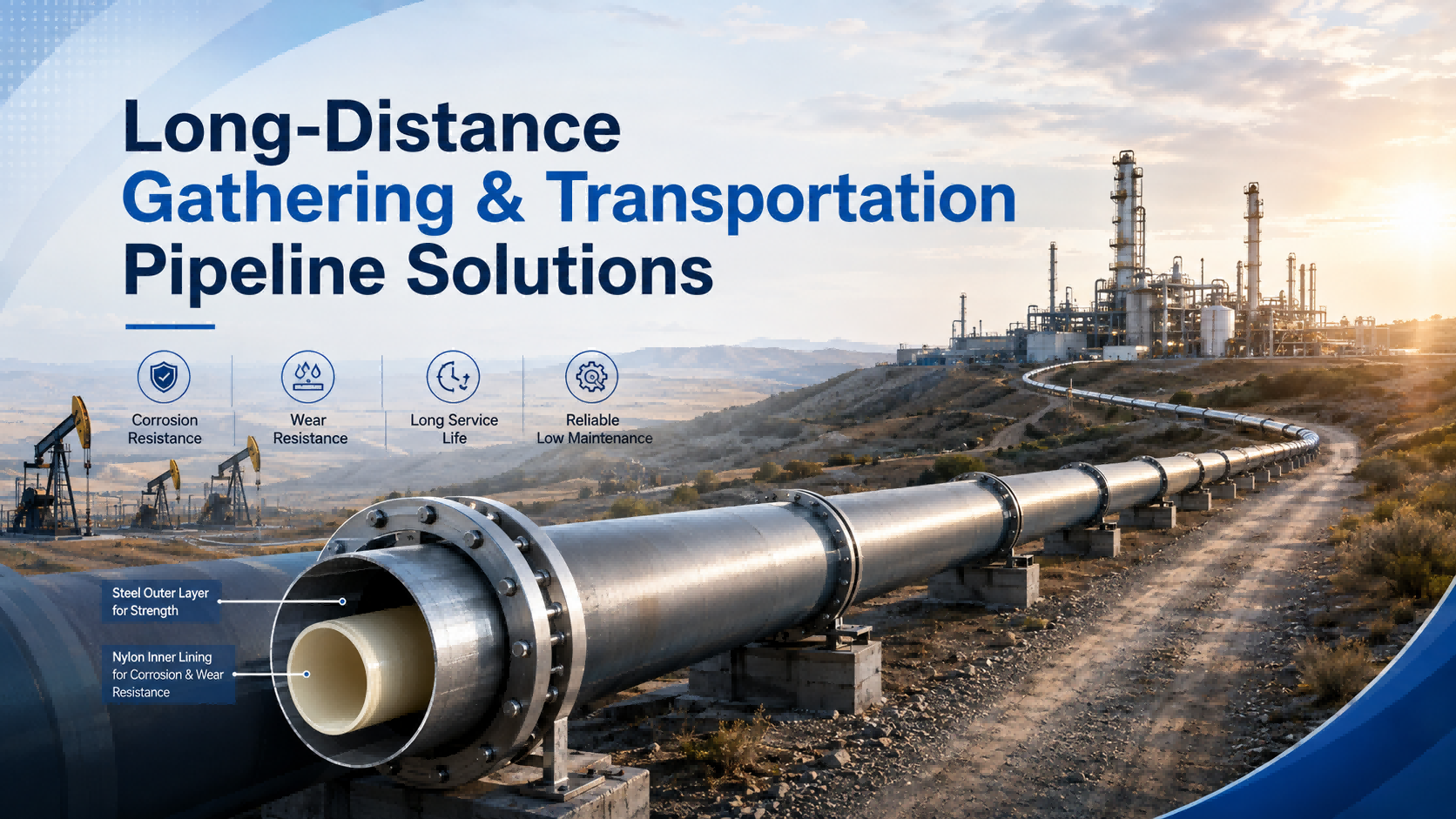
Why Are Oilfields Starting to Adopt Steel–Nylon Composite Pipes?

In oil and gas production systems, pipelines have never been merely containers for transporting fluids.
As oilfields enter the middle and late stages of production, water cut continues to rise, produced water becomes increasingly mineralized, and the transported fluids may contain CO₂, H₂S, chloride ions, sand, corrosion products, and other aggressive components. At the same time, pipelines must operate under changing temperature and pressure conditions.
As a result, oilfield gathering and transportation pipelines are facing increasingly complex service environments.
In the past, pipeline selection in oilfields often focused primarily on initial purchase price and pressure capability. Today, more operators are asking a different question:
Over the next 10 years or longer, how many times will this pipeline corrode, leak, require maintenance, or need replacement?
This shift in thinking is one of the key reasons why steel–nylon composite pipes are increasingly being considered for oilfield gathering systems, produced-water pipelines, wastewater transportation, water-injection systems, and other corrosive services.
Steel–nylon composite pipe is not simply about “replacing steel with plastic.”
Instead, it follows a more rational material-engineering principle:
Let steel provide pressure resistance and structural strength, while nylon provides corrosion resistance, wear resistance, and isolation from the transported medium.
This combination of a structural material + functional material is changing the way pipelines are selected for demanding oilfield applications.
1. Why Are Traditional Oilfield Pipelines Facing Increasing Challenges?
The most vulnerable section of an oilfield pipeline is not necessarily the point with the highest pressure.
In many cases, failures occur where corrosion, erosion, scaling, and operating fluctuations occur simultaneously.
Industry standards and research concerning internal corrosion of oil and gas pipelines identify factors such as water, CO₂, H₂S, solid particles, microorganisms, and fluid corrosivity as important parameters affecting pipeline integrity.
In other words, oilfield pipeline corrosion is rarely caused by a single factor.
It is usually the result of multiple mechanisms acting together.
This problem becomes particularly serious in mature, high-water-cut oilfields.
High Water Cut Fundamentally Changes the Corrosion Environment
When crude oil contains relatively little water, the internal surface of a carbon steel pipeline may not remain continuously exposed to an aqueous phase.
However, as an oilfield enters a high-water-cut or ultra-high-water-cut stage, large volumes of produced water remain in continuous contact with the steel surface.
This creates more favorable conditions for electrochemical corrosion.
If the produced water also contains:
-
CO₂
-
H₂S
-
Cl⁻
-
dissolved salts
-
dissolved oxygen
-
bacteria
-
other corrosive components
conventional carbon steel pipelines may gradually experience:
-
general corrosion
-
localized corrosion
-
pitting
-
wall thinning
-
perforation
-
leakage
When H₂S and CO₂ coexist, the corrosion behavior of carbon steel can become even more complex.
For mature oilfields, therefore, simply increasing the corrosion allowance or increasing steel wall thickness may not fundamentally solve the problem.
2. Erosion and Corrosion Are Often Not Separate Problems
Oilfield gathering fluids are rarely clean liquids.
Well fluids may contain:
-
fine sand
-
formation particles
-
corrosion products
-
scale particles
-
other suspended solids
When these particles flow at high velocity through elbows, tees, reducers, pump discharge sections, manifolds, and upstream or downstream sections of valves, continuous erosion can occur.
If the pipeline is already exposed to a corrosive environment, a damaging cycle may develop:
Corrosion causes wall thinning → the surface becomes vulnerable → particles continue to erode the material → fresh metal is exposed → corrosion accelerates further.
Therefore, many oilfield pipelines are actually dealing with:
Corrosion + Erosion
rather than corrosion alone.
This is one reason why elbows, tees, reducers, and other areas with sudden changes in flow direction often fail earlier than straight pipeline sections.
Solving this problem requires more than corrosion resistance.
The pipeline material must also provide effective abrasion and erosion resistance.
3. What Problem Does Steel–Nylon Composite Pipe Actually Solve?
The fundamental value of steel–nylon composite pipe is not simply that it introduces another pipeline material.
Its real advantage is that it assigns different engineering functions to different materials.
A conventional carbon steel pipe is expected to perform many functions simultaneously:
-
withstand internal pressure
-
provide structural support
-
resist mechanical loads
-
resist corrosion
-
resist erosion
-
maintain long-term transportation reliability
This creates an inherent material conflict.
Steel–nylon composite pipe takes a different approach.
| Function | Steel Structural Layer | Nylon Functional Layer |
|---|---|---|
| Pressure resistance | Primary function | Supporting role |
| Structural rigidity | Primary function | — |
| External mechanical loads | Primary function | — |
| Direct contact with fluid | Minimized | Primary function |
| Corrosion resistance | Not the primary barrier | Core function |
| Wear resistance | Moderate | Strong |
| Resistance to deposit buildup | Moderate | Advantage of smooth inner surface |
| Large-diameter structural stability | Strong advantage | Combined with steel structure |
It is therefore not simply a combination of “steel pipe + plastic.”
The engineering principle is:
Steel for Strength + Nylon for Protection
Each material performs the function it is best suited for.
This principle is particularly valuable in oilfield applications where pressure, corrosion, wear, and structural reliability must all be considered simultaneously.
4. Advantage One: Moving from “Protecting Steel” to Isolating Steel from the Medium
Traditional corrosion-control strategies for steel pipelines usually focus on protecting the steel itself.
Typical measures include:
-
increased corrosion allowance
-
corrosion inhibitors
-
internal coatings
-
protective linings
-
cathodic protection
-
regular inspection
-
replacement of severely corroded sections
These technologies remain important and are indispensable in many applications.
However, they all face one fundamental reality:
The steel is still the material being exposed to corrosion risk.
Steel–nylon composite pipe follows a different principle.
Where chemical compatibility has been verified, the nylon layer is placed in direct contact with the transported fluid, minimizing direct contact between the corrosive medium and the steel pressure-bearing structure.
The engineering question therefore changes from:
“How can we make steel corrode more slowly?”
to:
“How can we prevent the corrosive medium from reaching the pressure-bearing steel layer?”
These are two fundamentally different approaches to pipeline life-cycle design.
For produced water, oilfield wastewater, water injection, and certain corrosive gathering applications, this approach can provide significant engineering value.
5. Advantage Two: Oilfield Pipelines Need Wear Resistance as Well as Corrosion Resistance
One issue is frequently underestimated in oilfield pipeline design:
A reliable straight section does not necessarily mean the entire pipeline system is reliable.
High-frequency failure points often include:
-
elbows
-
tees
-
reducers
-
upstream and downstream sections of valves
-
pump discharge sections
-
manifolds
-
areas with sudden changes in flow direction
At these locations, particle trajectories, velocity, turbulence, and impact angles can change significantly.
Even if the overall corrosion rate is not extremely high, long-term particle erosion can gradually reduce wall thickness.
Steel–nylon composite pipes utilize the good wear resistance of nylon to address environments where both:
corrosion + erosion
are present.
This makes the material particularly attractive for certain produced-fluid systems, wastewater pipelines, sand-containing fluids, slurry-type media, and other services where conventional anti-corrosion measures alone may not provide sufficient protection.
6. Advantage Three: A Smooth Inner Surface Helps Reduce Scaling Tendency and Flow Resistance
Scaling is another common problem in oilfield pipeline systems.
As fluid chemistry, temperature, and pressure change, minerals such as:
-
CaCO₃
-
BaSO₄
-
SrSO₄
-
other inorganic salts
may precipitate and accumulate on the internal pipeline surface.
Once a rough deposit layer begins to develop, it may:
-
reduce the effective flow diameter
-
increase pressure loss
-
decrease transportation capacity
-
increase cleaning frequency
-
increase maintenance requirements
Carbon steel surfaces can also become increasingly rough after long-term corrosion, further promoting deposit accumulation.
The relatively smooth nylon inner surface of a steel–nylon composite pipe can help reduce hydraulic resistance while creating less favorable surface conditions for the attachment of deposits and solid particles.
It is important, however, to distinguish between:
“reduced scaling tendency”
and
“absolute prevention of scaling.”
No pipeline material can guarantee that scaling will never occur under every operating condition.
Actual scale formation depends on:
-
water chemistry
-
temperature
-
pressure
-
ion concentration
-
flow conditions
-
residence time
Nevertheless, maintaining a smoother inner surface over long-term operation can provide meaningful benefits in reducing deposition tendency and maintaining transportation efficiency.
This is a more technically credible approach than simply claiming that a pipeline will “never scale.”
7. Advantage Four: Combining the Corrosion Resistance of Non-Metallic Materials with the Strength of Steel
Why not simply replace all oilfield pipelines with conventional non-metallic pipes?
Because corrosion is not the only engineering requirement in an oilfield.
Oilfield pipelines must also consider:
-
operating pressure
-
structural rigidity
-
temperature
-
span between supports
-
mechanical loading
-
installation conditions
-
external impact
-
large-diameter stability
PE, HDPE, FRP, and other non-metallic piping systems all have important advantages and are widely used in oilfield applications.
However, for certain high-pressure, large-diameter, elevated-temperature, long-span, or mechanically demanding installations, fully non-metallic pipes may require more complex structural design.
Steel–nylon composite pipe retains the structural advantages of steel.
Our steel–nylon composite pipe systems can be engineered for pressure classes of approximately:
1.0–4.0 MPa
depending on pipe diameter, temperature, service conditions, and project requirements.
The product system can also cover conventional industrial diameters as well as large-diameter pipeline applications.
This makes steel–nylon composite pipe particularly suitable for projects that:
require the structural capability of steel but do not want corrosive media to directly contact the steel pressure-bearing layer.
8. Advantage Five: Broad Temperature Adaptability for Complex Oilfield Environments
Oilfields do not always operate in moderate climates.
Some projects must deal with:
-
extremely cold winters
-
large day-night temperature variations
-
wide seasonal temperature ranges
-
elevated-temperature produced fluids
-
high-temperature process media
The pressure capability of many thermoplastic pipelines decreases as operating temperature increases.
Conventional steel pipelines, on the other hand, offer excellent high-temperature structural performance but remain vulnerable to internal corrosion.
Depending on the specific product configuration and operating conditions, our steel–nylon composite pipe systems can be designed for applications within an approximate temperature range of:
-36°C to 160°C
This enables the system to combine the structural strength of steel with corrosion-resistant internal protection in certain applications where temperature, pressure, and corrosive conditions occur simultaneously.
However, actual project selection must always consider:
-
fluid composition
-
continuous operating temperature
-
maximum temperature
-
design pressure
-
operating cycle
-
pipe diameter
Pipeline selection should never be based solely on a single maximum temperature figure.
9. Advantage Six: Integral Flange Connections Can Reduce On-Site Welding
One very practical issue in oilfield pipeline maintenance is:
hot work.
In operating gathering stations, metering stations, combined stations, and oil and gas treatment facilities, welding often requires more complicated safety procedures, shutdown arrangements, permits, gas testing, and construction management.
Our steel–nylon composite pipe system can utilize an integrally formed flange connection structure.
Straight pipe sections, elbows, tees, reducers, and other fittings can form a complete flanged piping system, reducing the amount of welding required on site.
This can be particularly valuable for rehabilitation and partial replacement of aging oilfield pipelines.
For example, if only the following sections of an existing pipeline repeatedly fail:
-
5 meters upstream or downstream of a valve
-
one elbow
-
one tee
-
one reducer
-
one pump discharge section
it may not be necessary to replace the entire pipeline immediately.
These high-failure locations can first be replaced with steel–nylon composite pipe sections.
This approach allows operators to introduce new materials gradually while controlling project risk.
10. Why Is Steel–Nylon Composite Pipe Particularly Suitable for Aging Oilfield Pipeline Rehabilitation?
This may become one of its most important future applications.
Many oilfields have already been operating for several decades.
For these projects, completely rebuilding the entire gathering and transportation system is usually neither practical nor economical.
A more realistic strategy is to identify the 20% of pipeline sections responsible for the highest failure frequency, maintenance cost, and leakage risk.
These sections can then be upgraded first.
Typical locations include:
-
well drainage valve groups
-
gathering branches
-
elbows
-
tees
-
reducers
-
pump discharge pipelines
-
produced-water pipelines
-
wastewater pipelines
-
water-injection pipelines
-
high-water-cut gathering sections
Operators can first install:
100–500 m trial sections
or replace vulnerable fittings and high-risk pipeline sections.
Performance can then be evaluated under actual operating conditions before expanding the application.
For oilfield operators, this is often a much easier decision than immediately replacing several kilometers of existing pipeline.
11. A Typical Application: Ultra-High-Water-Cut Oilfield Gathering Systems
One example comes from our application experience in the Shengli Oilfield.
According to project operating data, some production areas had entered an ultra-high-water-cut stage, with an overall water cut of approximately 97.2%, while certain blocks exceeded 98%.
Under such conditions, what is traditionally called an “oil pipeline” is in reality transporting a complex multiphase mixture consisting largely of:
produced water + crude oil + natural gas + sand + corrosive components
Beginning in 2015, PAMC steel–nylon composite pipes were introduced in stages for:
-
well drainage valve groups
-
reducers
-
elbows
-
manifolds
-
major process pipelines within stations
The cumulative installed length reached approximately 2.6 km.
The real value of this type of project is not to prove that one material can solve every oilfield pipeline problem.
Instead, it demonstrates a more important principle:
As an oilfield transitions from a lower-water-cut stage to a high-water-cut, high-corrosion, and high-maintenance stage, pipeline material selection must evolve together with the operating conditions.
A material that was suitable during one production stage may no longer provide the lowest total cost during the next stage.
12. Oilfields Should Compare More Than the Price per Meter
Consider two pipeline options.
Pipeline A costs 20% less to purchase.
Pipeline B has a higher initial purchase price.
If the decision is based only on procurement cost, Pipeline A clearly appears more attractive.
But what happens if, during the next 10 years:
Pipeline A must be replaced three times,
while Pipeline B requires only one installation?
The economics change completely.
The true life-cycle cost of an oilfield pipeline should include:
TCO = Pipe Procurement + Installation + Corrosion Protection + Chemicals + Inspection + Cleaning + Maintenance + Leakage Treatment + Production Loss + Replacement Cost
One of the most underestimated costs is often:
production shutdown.
For continuously operating oilfields, the cost associated with a single pipeline leak may include:
-
production interruption
-
emergency repair
-
environmental cleanup
-
equipment mobilization
-
labor
-
restart procedures
-
secondary damage
-
lost production
These costs can be many times higher than the purchase price of the failed pipeline section itself.
Therefore, the true competitor of steel–nylon composite pipe is not simply:
“How much does carbon steel cost per meter?”
The more important question is:
Over the same 10-year operating period, which pipeline system requires less total expenditure, fewer shutdowns, and lower operational risk?
This is the question that future oilfield pipeline procurement should increasingly focus on.
13. How Should Steel–Nylon Composite Pipe Be Compared with Other Oilfield Pipeline Materials?
Steel–nylon composite pipe is not intended to replace every other pipeline material.
Every material has its own optimum application range.
| Pipeline Material | Main Advantages | Key Considerations |
|---|---|---|
| Carbon Steel | High strength, mature supply chain, established engineering standards | Internal corrosion, scaling, corrosion allowance, maintenance |
| Stainless Steel | Good strength and corrosion resistance | Higher investment; specific Cl⁻ and H₂S environments still require careful material evaluation |
| PE / HDPE | Corrosion resistant, lightweight, convenient installation | Temperature, pressure, rigidity, and large-diameter structural design |
| FRP | Corrosion resistant and lightweight | Impact resistance, joints, and long-term structural reliability must be evaluated |
| Steel–Nylon Composite Pipe | Steel structure + corrosion- and wear-resistant inner layer; balances pressure and corrosion resistance | Chemical compatibility, temperature, pressure, and connection design must be confirmed |
A professional pipeline manufacturer should not tell customers:
“Our pipe is suitable for every oilfield.”
A more technically responsible conclusion is:
Where corrosion, erosion, pressure, temperature, and maintenance costs become major challenges at the same time, steel–nylon composite construction can offer significant engineering value.
14. Which Oilfield Pipelines Should Consider Steel–Nylon Composite Pipe First?
If an oilfield is repeatedly experiencing the following problems, steel–nylon composite pipe should be considered as part of the material evaluation process:
-
high-water-cut oil and gas gathering systems
-
produced-water transportation
-
oilfield wastewater pipelines
-
water-injection systems
-
sand-containing fluids
-
pipelines exposed to simultaneous corrosion and erosion
-
aging steel pipelines with frequent perforation
-
high-failure elbows and tees
-
pump discharge sections
-
pipeline rehabilitation projects requiring reduced on-site welding
Special attention should be paid to pipeline sections that require repair:
every one or two years—or even every few months.
These are often the best locations for calculating the potential return on investment of a longer-life pipeline material.
15. Steel–Nylon Composite Pipe Still Requires Proper Engineering Selection
Composite pipe is still an engineered industrial product.
Before a steel–nylon composite pipeline is selected for an oilfield project, the following parameters should normally be evaluated:
-
fluid composition
-
chemical concentration
-
CO₂ conditions
-
H₂S conditions
-
oil-water ratio
-
aromatic hydrocarbons and other organic components
-
chloride concentration
-
total salinity
-
solid particle concentration
-
design pressure
-
operating pressure
-
continuous operating temperature
-
maximum temperature
-
flow velocity
-
possible vacuum or negative-pressure conditions
-
pipe diameter
-
support spacing
-
indoor or outdoor installation
-
expected service life
Particular attention should be paid to applications involving complex hydrocarbons, elevated-temperature organic media, or unusual chemical compositions.
Material compatibility should be confirmed before final selection.
Good pipeline engineering is not about matching a few advertised parameters. It is about matching the material to the complete operating environment.
This represents an important shift in oilfield pipeline procurement—from buying a product to selecting an engineered transportation solution.
Conclusion: Oilfields Are Moving from “Corrosion-Protected Steel Pipe” Toward Long-Life Pipeline Systems
For decades, the conventional oilfield pipeline strategy was essentially:
Use steel pipe, and then find ways to control steel corrosion.
An increasing number of projects are now considering a different approach:
Design the pipeline system so that corrosive media have less opportunity to directly contact the pressure-bearing steel structure in the first place.
Steel–nylon composite pipe represents this engineering philosophy.
It uses steel to provide:
strength, pressure resistance, and structural stability;
while nylon provides:
corrosion resistance, wear resistance, a smooth internal surface, and isolation of the steel from aggressive media.
Integral flange connections can further reduce on-site welding requirements and make the system suitable for both new oilfield projects and rehabilitation of aging pipeline networks.
Oilfields are therefore beginning to pay more attention to steel–nylon composite pipes not because conventional steel pipe has suddenly lost its value.
The oilfield operating environment itself has changed.
As mature fields move into stages characterized by high water cut, severe corrosion, and increasing maintenance costs, purchasing the lowest-cost pipe is no longer the most important objective.
The real questions become:
How many times will this pipeline require maintenance over the next 10 years?
How many production shutdowns could it cause?
Can leakage risk be reduced?
What will the pipeline actually cost over its entire service life?
When procurement decisions shift from Purchase Price to Lifecycle Cost, the value of steel–nylon composite pipe becomes much clearer.
The competition in next-generation oilfield pipeline systems will no longer be about which pipe has the lowest initial price. It will be about which pipeline can operate longer, require less maintenance, and cause fewer production interruptions.
Maintenance-Free Pipeline Case Study for Oil & Gas Fields: How Steel-Nylon Composite Pipes Reduce Corrosion, Leakage, and Lifecycle Maintenance Costs
Winter Oilfield Low-Temperature Pipeline Solutions: How to Balance Low-Temperature Resistance, Corrosion Resistance, and Long-Term Reliability