Why Are PE Pipes Not Suitable for High-Temperature Applications?
In modern industrial production, pipeline systems are facing increasingly complex operating challenges. Especially in industries such as chemical processing, salt chemical production, oil & gas, metallurgy, power generation, and mining, high-temperature fluid transportation has become a common requirement.
Many engineering projects initially choose PE pipes (Polyethylene Pipes) because they offer advantages such as corrosion resistance, lightweight structure, and easy installation. However, when operating temperatures continue to rise, the performance of PE materials decreases significantly, resulting in reduced pressure resistance, increased deformation, and even pipeline failure.
So, why are PE pipes not suitable for high-temperature applications?
This article provides an in-depth analysis from the perspectives of material performance, structural stability, and lifecycle operating costs, and explains why steel-nylon composite pipes have become a more reliable solution for high-temperature, corrosive, and abrasive industrial applications.
1. Material Properties of PE Pipes Determine Their High-Temperature Limitations
PE pipes are mainly manufactured from polyethylene, a thermoplastic polymer material.
Under normal temperature conditions, PE pipes provide excellent:
-
Chemical corrosion resistance
-
Impact resistance
-
Flexibility
-
Cost-effectiveness
Therefore, PE pipes are widely used in:
-
Municipal water supply and drainage
-
Normal-temperature water transportation
-
Gas distribution systems
-
General chemical auxiliary pipelines
However, as temperature increases, the properties of PE materials change significantly.
1.1 High Temperature Causes PE Material Softening
The molecular structure of PE allows polymer chains to move more actively when exposed to heat.
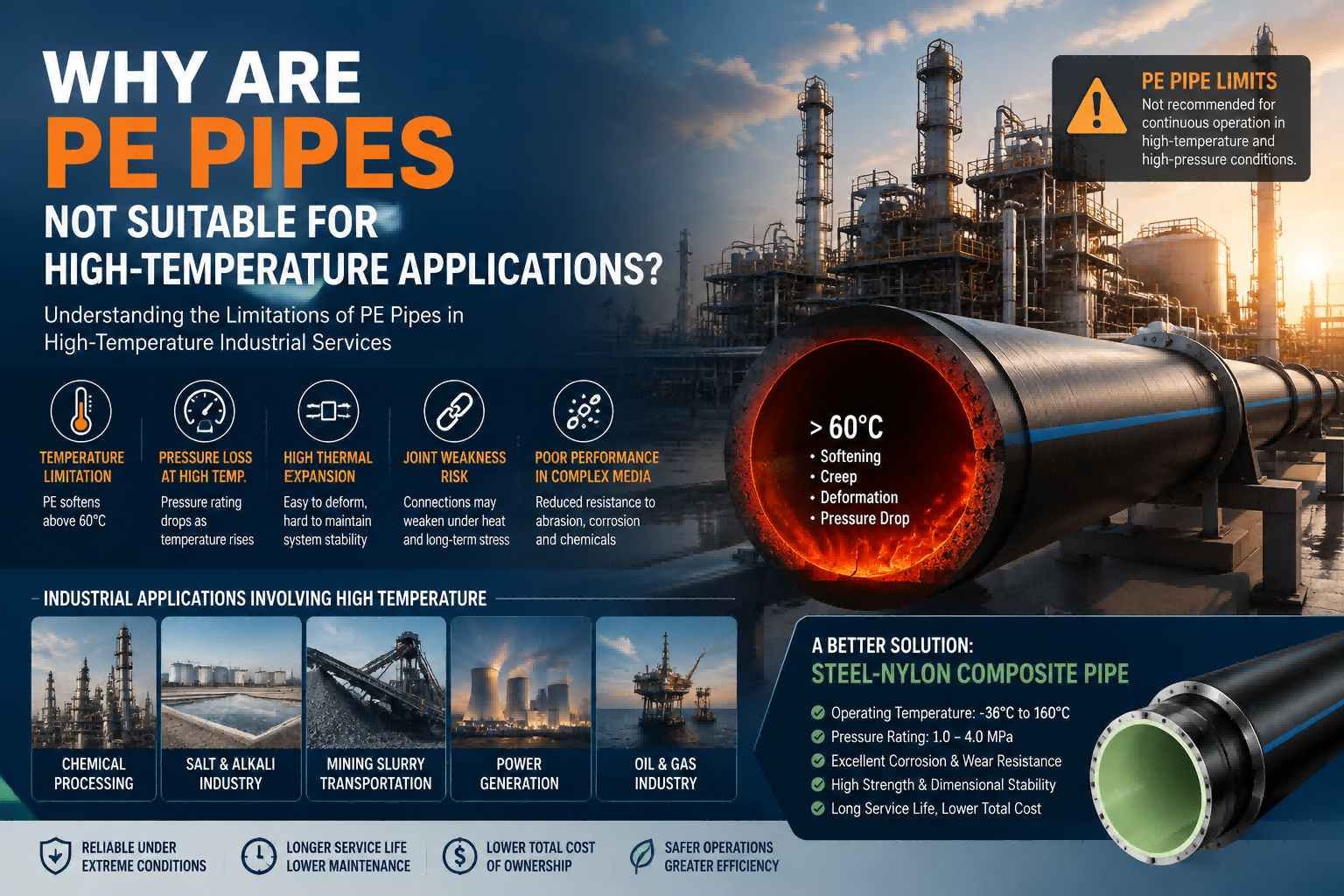
When temperatures exceed approximately 60°C:
-
Molecular movement increases
-
Material stiffness decreases
-
Hoop strength reduces
-
Pressure resistance declines
Especially under long-term high-temperature operation, PE pipes may experience creep deformation.
Creep refers to the gradual permanent deformation of a material under continuous stress over time.
For pressure pipelines, this can result in:
-
Gradual expansion of pipe diameter
-
Reduced load-bearing capability
-
Shortened service life
2. High Temperature Significantly Reduces the Pressure Capacity of PE Pipes
A key issue often overlooked during pipeline selection is:
The pressure rating of PE pipes is normally tested under standard temperature conditions and does not represent the same pressure capability at elevated temperatures.
For example:
A PE100 pipe may meet design pressure requirements at 20°C.
However, when temperature increases:
| Operating Temperature | Pressure Performance of PE Pipe |
|---|---|
| 20°C | Maintains rated pressure |
| 40°C | Pressure capacity begins to decrease |
| Above 60°C | Significant reduction |
| Higher temperatures | Not suitable for long-term pressure operation |
Therefore, in high-temperature applications, PE pipes often require:
-
Increased wall thickness
-
Reduced operating pressure
-
More frequent maintenance
Ultimately, this reduces the overall economic efficiency of the pipeline system.
3. High Temperature Can Cause PE Pipe Deformation and Connection Failures
Industrial pipeline systems require not only material durability but also overall structural stability.
3.1 Significant Thermal Expansion
The thermal expansion coefficient of PE is much higher than that of metal materials.
With temperature fluctuations:
-
Pipeline length changes significantly
-
Support systems experience additional loads
-
Pipeline movement increases
For long-distance transportation pipelines, this may lead to:
-
Pipe bending
-
Increased stress on joints
-
Damage to supports
3.2 Connection Points Become Weak Areas
PE pipes are commonly connected by:
-
Heat fusion
-
Electrofusion
Under high temperature, high pressure, and long-term operation:
Connection areas may be affected by:
-
Thermal cycling
-
Stress concentration
-
Material aging
Potential problems include:
-
Reduced joint strength
-
Leakage risks
For continuous industrial production systems, pipeline leakage can cause:
-
Production shutdowns
-
Safety hazards
-
Environmental pollution
4. PE Pipes Face Greater Challenges Under Combined Conditions of High Temperature, Corrosion, and Wear
Many industrial applications involve more than just hot fluids. The transported media often contain multiple challenges:
Examples include:
-
Salt slurry
-
Mining slurry
-
Alkali solutions
-
Chemical mother liquor
-
Particle-containing fluids
These conditions involve:
✓ High temperature
✓ Corrosion
✓ Erosion and abrasion
✓ Pressure fluctuations
Although PE pipes have certain corrosion resistance, they have limitations:
-
High temperature reduces wear resistance
-
Long-term particle erosion reduces wall thickness
-
Pressure capability becomes restricted
Therefore, PE pipes may not meet the requirements of large-scale continuous industrial operations.
5. How Steel-Nylon Composite Pipes Solve High-Temperature Pipeline Challenges
To overcome the limitations of traditional plastic pipelines, our company developed steel-nylon composite pipes, combining a reinforced steel structure with a high-performance nylon lining.
This composite structure provides both mechanical strength and corrosion resistance.
5.1 Steel Reinforcement Provides High-Temperature Structural Stability
Steel-nylon composite pipes use a steel reinforcement layer to provide structural support.
Compared with conventional PE pipes:
-
Higher pressure resistance
-
Better dimensional stability
-
Stronger resistance to thermal deformation
Our products can achieve pressure ratings of:
1.0–4.0 MPa
Suitable for:
-
Long-distance transportation pipelines
-
Large-diameter industrial pipelines
-
High-pressure systems
5.2 Nylon Lining Provides Excellent Corrosion and Wear Resistance
The inner layer of steel-nylon composite pipes uses reinforced nylon materials with:
-
Excellent wear resistance
-
Superior corrosion resistance
-
High impact resistance
-
Low friction coefficient
It effectively solves common problems such as:
-
Steel pipe corrosion
-
Rubber lining delamination
-
PE pipe softening at high temperatures
5.3 Wide Temperature Range for Complex Industrial Conditions
Steel-nylon composite pipes can operate within:
-36°C to 160°C
They are suitable for many industrial high-temperature applications:
-
Chemical circulation systems
-
Salt chemical mother liquor transportation
-
Alkali solution pipelines
-
Mining slurry pipelines
-
Industrial wastewater systems
-
Seawater transportation systems
6. Steel-Nylon Composite Pipe vs PE Pipe: Key Performance Comparison
| Comparison Item | PE Pipe | Steel-Nylon Composite Pipe |
|---|---|---|
| High-temperature resistance | Limited | Excellent |
| Long-term pressure performance | Decreases significantly with temperature | Stable |
| Structural strength | Lower | Reinforced steel structure |
| Deformation resistance | High thermal expansion | Excellent dimensional stability |
| Wear resistance | Moderate | High wear resistance |
| Large diameter application | Limited | DN100–DN2000+ |
| Pressure rating | Usually lower | Up to 4.0 MPa |
| Corrosion resistance | Good | Excellent |
| Service life | Temperature dependent | Long-term reliable operation |
7. Applications Where PE Pipes Are Not Recommended
PE pipes should be carefully evaluated in the following conditions:
7.1 High-Temperature Chemical Transportation
Examples:
-
Alkali solutions
-
Brine
-
Chemical mother liquor
-
Process circulation fluids
7.2 High-Pressure Long-Distance Transportation
Examples:
-
Mining backfill pipelines
-
Tailings transportation
-
Industrial slurry pipelines
7.3 Combined High Temperature and Abrasive Conditions
Examples:
-
Mineral slurry
-
Solid particle-containing fluids
-
High-flow erosion pipelines
These applications are more suitable for steel-nylon composite pipeline systems.
8. The Future Trend of Industrial Pipeline Selection: From Low Purchase Cost to Lifecycle Value
In the past, many projects focused on:
“Which pipeline has the lowest initial purchase price?”
Today, industrial users pay more attention to:
“Which pipeline can operate reliably for decades with lower maintenance costs?”
PE pipes may have lower initial investment costs, but under high-temperature, high-pressure, and complex industrial conditions:
-
Replacement frequency increases
-
Downtime risks rise
-
Total operating costs increase
Although steel-nylon composite pipes may require a higher initial investment, they provide significant lifecycle advantages through:
-
High-strength steel reinforcement
-
High-performance nylon corrosion and wear-resistant lining
-
Long service life
-
Reduced maintenance requirements
This helps reduce the Total Cost of Ownership (TCO) of industrial pipeline systems.
Conclusion: High-Temperature Applications Require More Reliable Pipeline Materials
PE pipes are not a poor choice; they provide excellent performance within suitable temperature and pressure ranges.
However, when operating conditions involve:
-
High temperature
-
High pressure
-
Strong corrosion
-
Severe abrasion
the limitations of PE materials become increasingly apparent.
Steel-nylon composite pipes combine reinforced steel structures with high-performance nylon liners, providing high strength, excellent wear resistance, corrosion resistance, and wide temperature adaptability. They offer a more reliable solution for demanding industrial pipeline systems.
For chemical, mining, energy, and industrial transportation projects requiring long-term stable operation, selecting the right pipeline material is a critical step toward reducing operational risks and lifecycle costs.
Why Does Stainless Steel Pipe Suffer from Pitting Corrosion?
Why Do FRP Pipes Easily Delaminate?In-Depth Analysis of Fiberglass Pipe Failure Causes and the Advantages of Steel-Nylon Composite Pipes