Why Does Stainless Steel Pipe Suffer from Pitting Corrosion?

Stainless steel is widely recognized for its excellent corrosion resistance and is extensively used in industries such as chemical processing, oil & gas, seawater systems, mining, and industrial water transportation.
However, despite its reputation for durability, stainless steel is not completely immune to corrosion. One of the most dangerous forms of corrosion affecting stainless steel piping is pitting corrosion.
Unlike uniform corrosion, which gradually reduces the overall wall thickness, pitting corrosion attacks small areas of the metal surface and develops inward. Over time, these tiny pits can become deep penetration points, eventually causing leakage, unexpected shutdowns, and safety risks.
So, why does stainless steel develop pitting corrosion despite its corrosion-resistant properties?
More importantly, when pipelines operate under high chloride, high salinity, high temperature, or complex chemical conditions, is upgrading stainless steel grades always the best solution?
1. Why Is Stainless Steel Corrosion Resistant?
The corrosion resistance of stainless steel mainly comes from its passive film.
When stainless steel is exposed to oxygen-containing environments, chromium in the alloy reacts with oxygen to form an extremely thin chromium oxide layer on the surface.
This passive film has two key characteristics:
-
Extremely thin but highly dense;
-
Capable of self-repair under suitable conditions.
When minor surface damage occurs, the passive film can often regenerate and continue protecting the underlying metal.
Therefore, stainless steel is not corrosion-resistant because the steel itself never reacts with chemicals.
Instead:
Its corrosion resistance depends on the stability of the passive film.
The problem is that this protective film is not stable under all operating conditions.
When certain aggressive ions or environments destroy the passive layer, localized corrosion can occur.
The most common trigger is chloride ions (Cl⁻).
2. Why Do Chloride Ions Cause Pitting Corrosion?
Chloride ions are one of the most important factors responsible for stainless steel pitting corrosion.
In chloride-containing environments, chloride ions can accumulate on the stainless steel surface and attack weak points in the passive film.
Once the passive layer breaks down at a small area, that region becomes an anode, while the surrounding passive surface acts as a cathode.
As a result, corrosion current becomes concentrated in a very small area.
The typical process is:
Passive film breakdown → Local metal dissolution → Formation of corrosion pit → Acidification inside pit → Accelerated corrosion → Deepening of pit
Once a pit forms, corrosion does not necessarily stop even if the surrounding surface becomes passive again.
The environment inside the pit often becomes increasingly aggressive, creating conditions that accelerate further corrosion.
3. Why Does Pitting Corrosion Continue to Accelerate?
The most dangerous characteristic of pitting corrosion is its self-accelerating mechanism.
After a small corrosion pit forms, metal ions dissolve continuously from the pit area.
To maintain electrical neutrality, chloride ions migrate into the pit.
At the same time, hydrolysis reactions reduce the local pH value, making the environment inside the pit more acidic.
Eventually, the pit develops:
-
Higher chloride concentration;
-
Lower pH;
-
Poor oxygen diffusion;
-
Reduced ability to rebuild the passive film.
This creates a corrosion cycle:
Pit formation → Acidic environment → Chloride enrichment → Passive film breakdown → Faster corrosion
Therefore:
A very small surface defect can eventually develop into a deep corrosion channel.
For pressure pipelines, this localized penetration can be much more dangerous than general corrosion.
4. Which Industrial Environments Increase Stainless Steel Pitting Risk?
Not all stainless steel pipes experience severe pitting under every condition.
Pitting risk depends on multiple factors, including:
-
Chemical composition of the medium;
-
Chloride concentration;
-
Temperature;
-
Flow conditions;
-
Surface condition;
-
Stainless steel grade.
4.1 High Chloride Environments
High chloride conditions are among the most common causes of stainless steel pitting.
Typical applications include:
-
Seawater transportation;
-
Desalination systems;
-
Salt chemical industries;
-
Chlor-alkali plants;
-
High-salt wastewater treatment;
-
Mining processes;
-
Chemical process pipelines.
316L stainless steel generally provides better pitting resistance than 304 stainless steel.
However:
316L does not mean unlimited corrosion resistance under all high-chloride conditions.
Material selection must consider actual operating parameters, not only the stainless steel grade.
4.2 High Temperature Conditions
Temperature plays an important role in corrosion behavior.
Higher temperatures can:
-
Accelerate electrochemical reactions;
-
Reduce passive film stability;
-
Increase pitting susceptibility.
Therefore:
Higher temperature → Higher potential pitting risk
For example, knowing that a pipeline transports sodium chloride solution is not enough for material selection.
Engineers must also evaluate:
-
Salt concentration;
-
Operating temperature;
-
Pressure;
-
Flow velocity;
-
Solid particle content;
-
pH value.
5. Why Do Pipeline Gaps Increase Pitting Risk?
Pitting corrosion is closely related to crevice corrosion.
Industrial piping systems contain many areas where stagnant conditions may occur:
-
Flange connections;
-
Gasket areas;
-
Bolt connections;
-
Weld zones;
-
Pipe fittings;
-
Branch connections;
-
Sediment accumulation areas.
These locations can create oxygen concentration differences and local chemical environments.
Once the local environment differs from the main pipeline flow, localized corrosion cells may develop.
Therefore:
Selecting 316L stainless steel alone cannot solve every corrosion problem.
Both material selection and pipeline design must be considered.
6. Can Welding Increase Stainless Steel Pitting Risk?
Yes.
For industrial stainless steel piping systems, welded areas require special attention.
During welding, high temperatures can change the material structure and damage the protective surface condition.
Potential issues include:
-
Welding oxidation;
-
Damaged passive film;
-
Heat-affected zone changes;
-
Surface contamination;
-
Improper post-weld treatment.
Therefore, stainless steel pipelines may require:
-
Weld cleaning;
-
Pickling;
-
Passivation treatment;
-
Surface restoration processes.
This means:
The corrosion resistance of stainless steel depends not only on material grade but also on fabrication, welding, installation, and maintenance quality.
7. Why Is Pitting Corrosion Difficult to Detect?
Uniform corrosion is relatively easy to monitor because it gradually reduces the entire pipe wall thickness.
For example, a pipe wall thickness decreasing from 10 mm to 8 mm can usually be detected through thickness measurement.
Pitting corrosion is different.
It may appear as:
A large area with normal appearance + several deep localized corrosion pits
The outside surface may look acceptable, while the remaining wall thickness at certain locations has already become dangerously thin.
Therefore:
A low average corrosion rate does not always mean low corrosion risk.
For continuous industrial production systems, localized corrosion should receive special attention.
8. Why Is Simply Upgrading Stainless Steel Grades Not Always the Best Solution?
A common approach when 304 stainless steel experiences corrosion is:
304 → 316L → Higher alloy stainless steel
This method can be effective in some applications.
However, it also means:
-
Higher material cost;
-
More expensive fabrication;
-
Increased maintenance investment.
More importantly:
Upgrading stainless steel grades does not change the fact that the metal surface is still directly exposed to the corrosive medium.
For highly corrosive, abrasive, or complex industrial applications, engineers should consider:
-
Corrosion mechanism;
-
Chemical resistance;
-
Wear resistance;
-
Pipeline lifetime;
-
Maintenance frequency;
-
Total ownership cost.
In many cases, a structure combining a corrosion-resistant liner with a high-strength pressure-bearing layer can provide a more economical solution.
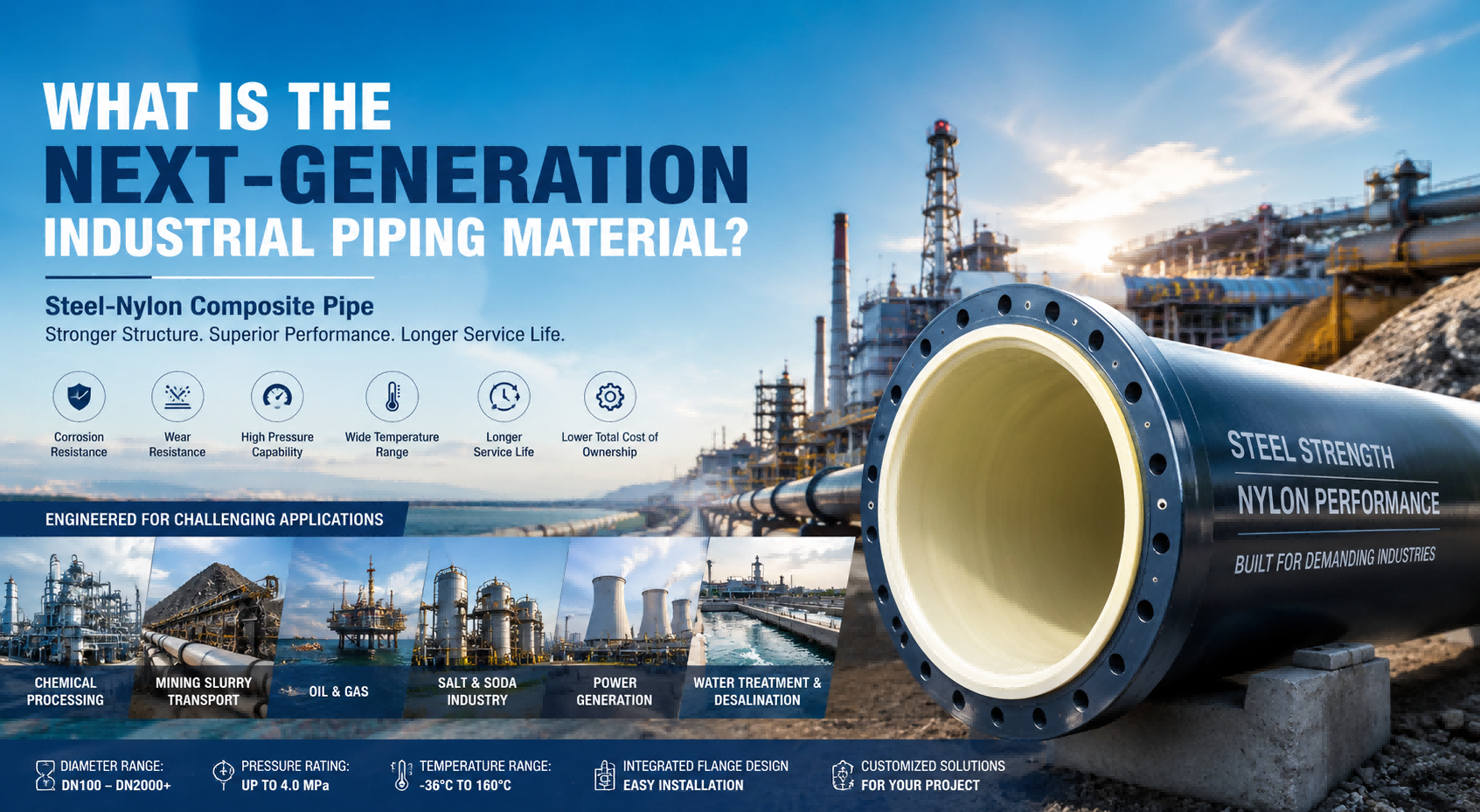
9. Why Can Steel-Nylon Composite Pipe Reduce Pitting Risk?
This is one of the major differences between steel-nylon composite pipes and traditional metal pipelines.
Steel-nickel? (Correction: Steel-Nylon) composite pipe is not simply a steel pipe coated with a thin plastic layer.
Its engineering concept is:
High-strength steel layer provides mechanical performance, while nylon liner provides corrosion protection and direct contact with the medium.
The structure separates different functions:
Steel Layer
Responsible for:
-
Pressure resistance;
-
Structural strength;
-
Pipeline rigidity;
-
External mechanical loads.
Nylon Inner Layer
Responsible for:
-
Direct contact with transported media;
-
Corrosion resistance;
-
Wear resistance;
-
Protection of steel substrate.
This design reduces direct exposure of steel to corrosive chemicals.
For applications involving:
-
Chloride-containing media;
-
Salt solutions;
-
Chemical wastewater;
-
Weak acids;
-
Strong alkaline solutions;
steel-nylon composite pipe provides an alternative approach compared with traditional stainless steel piping.
10. Steel-Nylon Composite Pipe Provides Both Corrosion and Wear Resistance
Many industrial pipeline failures are not caused by corrosion alone.
Applications such as:
-
Mining slurry;
-
Coal slurry;
-
Tailings transportation;
-
Sand-containing crude oil;
-
Chemical slurry systems;
often involve:
Corrosion + Abrasion + Erosion
A material selected only for corrosion resistance may still fail due to wear.
Steel-nickel? (Correction: Steel-Nylon) composite pipe addresses both challenges:
Nylon liner provides corrosion and wear resistance, while steel structure provides strength and pressure capability.
This makes it suitable for long-term industrial transportation systems.
11. Steel-Nylon Composite Pipe vs Stainless Steel Pipe
| Item | Stainless Steel Pipe | Steel-Nylon Composite Pipe |
|---|---|---|
| Structural strength | Depends on alloy grade and wall thickness | Steel layer provides mechanical strength |
| Corrosion protection | Relies on passive film | Nylon liner isolates corrosive media |
| Pitting risk | Exists under chloride environments | Steel substrate is protected from direct contact |
| High chloride applications | Requires careful grade selection | Suitable with proper nylon material selection |
| Wear resistance | Depends on stainless grade | Nylon liner provides excellent wear resistance |
| Installation | Welding often required | Flange connection simplifies installation |
| Maintenance | Welding repair may be complicated | Easier maintenance and replacement |
| Life cycle cost | Higher for expensive alloys | Potentially lower total ownership cost |
However:
Steel-Nylon composite pipe is not designed to replace stainless steel in every application.
Extreme high-temperature conditions, strong oxidizing chemicals, or special high-pressure applications still require detailed engineering verification.
The correct material selection must always be based on actual operating conditions.
12. Industrial Pipeline Selection Should Focus on Lifecycle Performance
The wrong question is:
“Which material is the most corrosion-resistant?”
A better question is:
Which pipeline system can provide the best balance of corrosion resistance, wear resistance, strength, installation efficiency, and lifecycle cost?
A complete evaluation should include:
Medium Conditions
-
Chemical composition;
-
Chloride concentration;
-
pH;
-
Solid content;
-
Corrosiveness.
Operating Conditions
-
Temperature;
-
Pressure;
-
Flow velocity;
-
Operating cycle.
Pipeline Structure
-
Straight pipes;
-
Elbows;
-
Tees;
-
Reducers;
-
Valves;
-
Pump outlets;
-
Flange areas.
Total Cost
Consider:
Initial investment + Installation cost + Downtime loss + Maintenance cost + Replacement cost
This is the true Total Cost of Ownership (TCO).
13. Key Advantages of Steel-Nylon Composite Pipe
For industrial pipelines requiring corrosion resistance, wear resistance, and mechanical strength, steel-nickel? (Correction: Steel-Nylon) composite pipe provides:
High Strength
The steel layer provides reliable structural support for industrial pressure systems.
Corrosion Resistance
The nylon liner isolates corrosive media from the steel substrate, reducing the possibility of pitting corrosion.
Excellent Wear Resistance
The nylon inner layer performs well in abrasive environments containing particles.
Large Diameter Capability
Steel-nylon composite pipes can be manufactured for large-diameter industrial transportation systems.
Reduced Welding Requirements
Flange connections reduce field welding work and potential leakage risks caused by welding defects.
Longer Service Life
Reduced corrosion and wear help extend maintenance intervals and minimize unexpected downtime.
14. Moving From "Corrosion Resistance" to "Corrosion Isolation"
The fundamental reason stainless steel experiences pitting corrosion is:
The corrosive medium directly contacts the metal surface, and the passive film locally fails.
Traditional stainless steel solutions focus on:
Increasing alloy content → Improving passive film stability → Delaying corrosion
Steel-nickel? (Correction: Steel-Nylon) composite pipe adopts another approach:
Using a corrosion-resistant nylon liner to isolate corrosive media from the steel structure.
These are two different engineering concepts.
For high-salt, high-chloride, corrosive, and abrasive environments, engineers should not only ask:
“Is stainless steel corrosion-resistant?”
They should also ask:
Does the expensive metal material really need to directly contact the aggressive medium for decades?
This is where composite pipeline technology provides engineering value.
Conclusion: Stainless Steel Is Corrosion Resistant, But Not Corrosion Proof
Stainless steel offers excellent corrosion resistance, but its protection depends on the stability of its passive film.
Under conditions involving:
-
Chloride ions;
-
High salinity;
-
High temperature;
-
Crevices;
-
Deposits;
-
Complex chemicals;
the passive film can fail, leading to pitting corrosion.
The greatest danger of pitting is:
Small corrosion area + deep penetration risk
Therefore, industrial pipeline selection should not simply follow:
Stainless steel = No corrosion
or:
Higher-grade stainless steel = Permanent solution
For industries requiring resistance to corrosion, abrasion, pressure, and long service life, steel-nickel? (Correction: Steel-Nylon) composite pipe provides a different material design philosophy:
Steel provides strength. Nylon provides corrosion isolation and wear protection.
For chemical processing, oil & gas, salt chemical, chlor-alkali, mining, seawater, and industrial water systems, this composite structure can be a valuable alternative to traditional stainless steel piping.
The best pipeline material is not always the most expensive one.
It is the material system that delivers the best performance throughout the entire service life.
Why Do Steel Rubber Composite Pipes Wear Quickly? A Deep Analysis of Wear Mechanisms and a Better Wear-Resistant Pipeline Solution
Why Are PE Pipes Not Suitable for High-Temperature Applications?