Why Do Steel Rubber Composite Pipes Wear Quickly? A Deep Analysis of Wear Mechanisms and a Better Wear-Resistant Pipeline Solution

In industries such as mining, chemical processing, power generation, coal chemical, mineral processing, and tailings transportation, pipelines are often used to transport media containing solid particles, including slurry, coal slurry, ash, salt slurry, and corrosive mixtures. Due to high flow velocity, hard particles, and continuous erosion, pipeline wear has become one of the main factors affecting production reliability.
Steel rubber composite pipes were once widely used in wear-resistant pipeline systems because they combine the strength of steel with the wear resistance of rubber. However, after long-term industrial operation, many users have found that:
-
Rubber lining wears through quickly;
-
Localized areas suffer accelerated abrasion;
-
Rubber separates from the steel substrate;
-
Maintenance intervals become shorter, increasing downtime costs.
So, why do steel rubber composite pipes wear quickly?
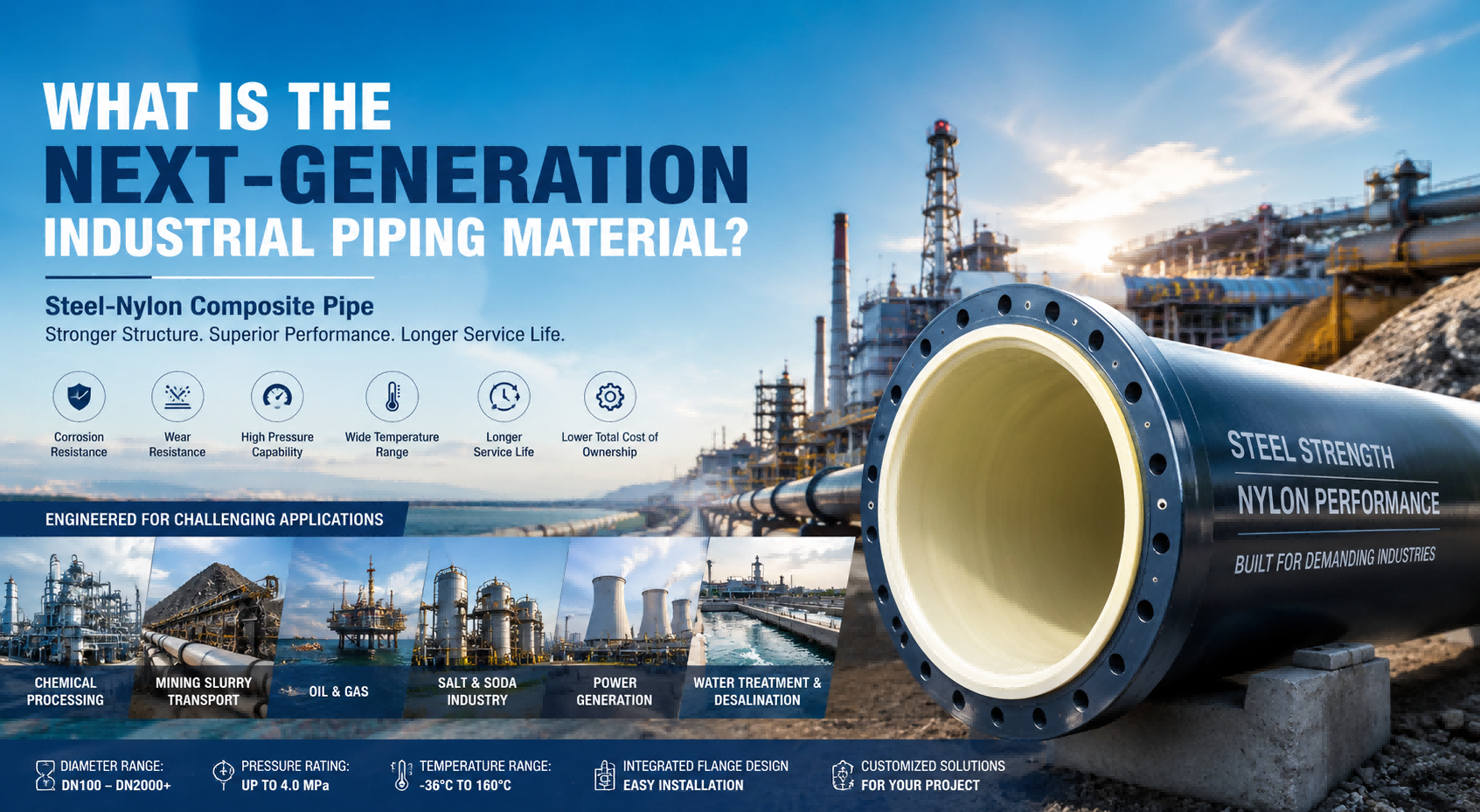
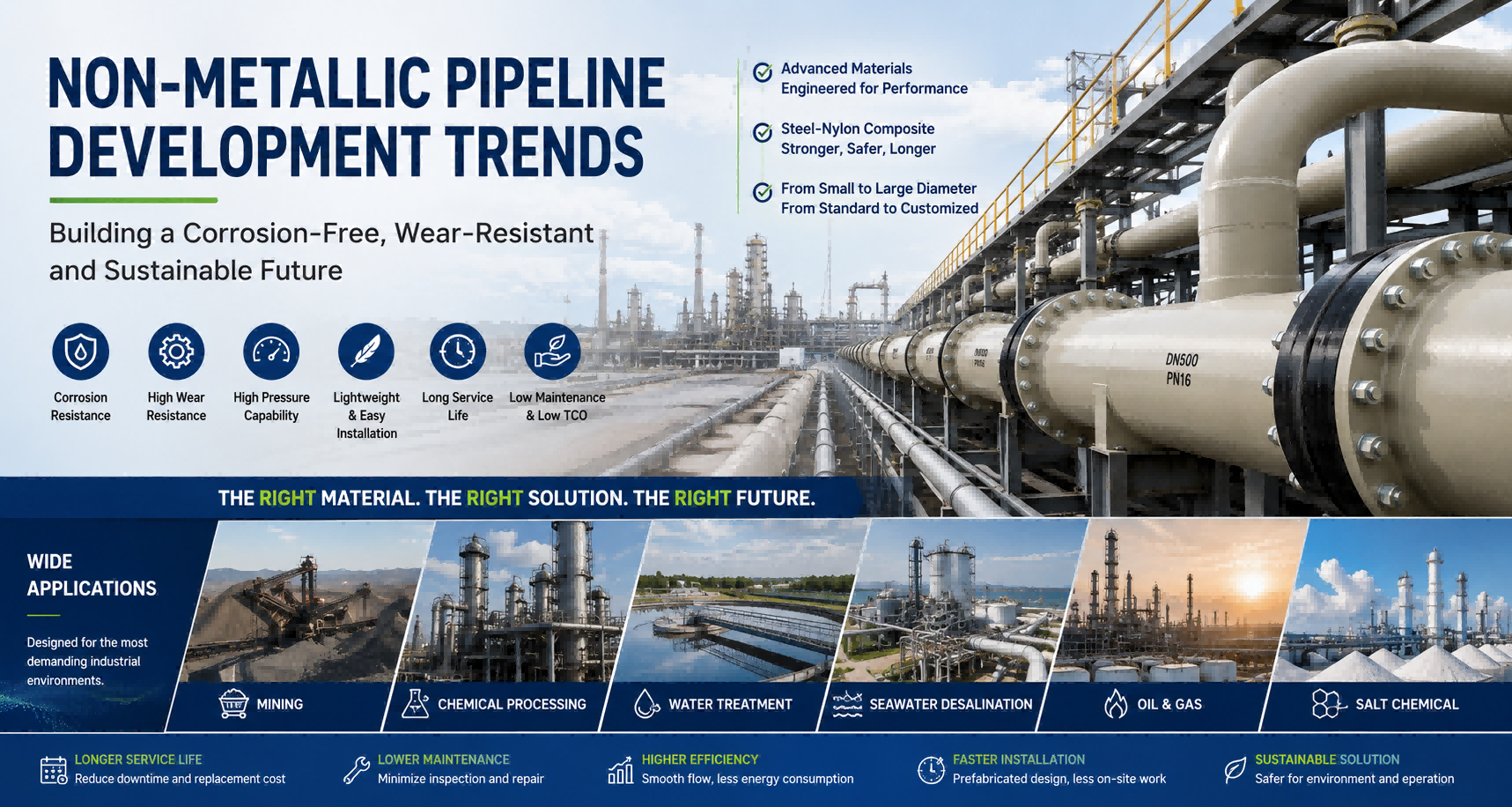
This article analyzes the wear mechanisms, material limitations, and application challenges of steel rubber composite pipes, and introduces a more suitable solution for demanding industrial environments — Steel Nylon Composite Pipes.
1. Basic Structure and Working Principle of Steel Rubber Composite Pipes
Steel rubber composite pipes generally consist of three layers:
1. Outer Steel Pipe
The steel layer provides:
-
Mechanical strength;
-
Pressure resistance;
-
Structural support.
2. Bonding Layer
The bonding layer connects the rubber lining with the steel pipe.
3. Inner Rubber Lining
The rubber layer provides:
-
Elastic impact absorption;
-
Protection against direct particle erosion;
-
Reduced impact damage from solid particles.
In theory, this structure combines strength and wear resistance.
However, actual industrial operating conditions are much more complex than laboratory testing environments.
During long-term operation, the limitations of rubber materials can significantly reduce service life.
2. Five Main Reasons Why Steel Rubber Composite Pipes Wear Quickly
1. Limited Resistance to Cutting Wear
Many users believe:
Rubber is elastic, therefore it must be highly wear-resistant.
However, rubber’s main advantages are:
-
Impact absorption;
-
Energy dissipation;
-
Resistance to sudden impact.
When exposed to continuous high-speed particle erosion, rubber is vulnerable to:
-
Cutting wear;
-
Fatigue wear;
-
Surface tearing.
Especially in applications such as:
-
Mining slurry transportation;
-
Tailings pipelines;
-
Sand slurry systems;
hard particles repeatedly impact the rubber surface, gradually breaking down the rubber molecular structure.
The failure process usually follows:
Surface damage → Local pits → Rubber thinning → Steel exposure → Rapid pipeline failure
2. Rubber Fatigue Aging Under Long-Term Operation
Industrial pipelines often operate continuously for years.
During operation, rubber is affected by:
-
Pressure fluctuations;
-
Temperature changes;
-
Medium impact;
-
Pipeline vibration.
Over time, internal fatigue cracks may develop.
This is especially common in:
-
Pump discharge sections;
-
Elbows;
-
Tees;
-
Reducers.
Due to turbulent flow and frequent impact, rubber damage accelerates.
Eventually, problems such as:
-
Rubber cracking;
-
Rubber peeling;
-
Steel corrosion;
may occur.
3. Delamination Risk Between Rubber and Steel
One of the biggest structural risks of steel rubber composite pipes is:
Steel and rubber are completely different material systems.
They have different:
-
Elastic modulus;
-
Thermal expansion coefficients;
-
Deformation behavior.
During temperature changes and pressure cycles:
The steel layer remains rigid,
while the rubber layer continuously expands and contracts.
After long-term operation, stress may accumulate at the bonding interface, causing:
-
Micro cracks;
-
Layer separation;
-
Local hollow areas.
Once delamination occurs:
The transported medium can penetrate into the gap.
This results in:
-
Further rubber damage;
-
Steel corrosion;
-
Premature pipeline failure.
4. Significant Limitations Under High-Temperature Conditions
Most rubber materials have limited long-term temperature resistance.
In applications involving:
-
Hot salt water;
-
Chemical slurry;
-
High-temperature circulating water;
-
Hot alkaline solutions;
rubber may experience:
-
Hardening;
-
Softening;
-
Accelerated aging.
As temperature increases, rubber service life decreases significantly.
Therefore, steel rubber composite pipes are generally not ideal for:
-
High-temperature chemical transportation;
-
Strong corrosive environments;
-
Long-term unmanned pipeline systems.
5. Localized Wear Reduces Overall Pipeline Life
Industrial pipelines rarely experience uniform wear.
In real applications:
Elbows, tees, pump outlets, and valve sections often account for more than 80% of total wear damage.
Once a local area wears through:
The performance of the entire pipeline section is compromised.
Maintenance usually requires:
-
Shutdown;
-
Pipe cutting;
-
Section replacement;
-
Reinstallation.
This leads to:
-
Higher maintenance costs;
-
Increased production losses.
3. Steel Rubber Composite Pipe VS Steel Nylon Composite Pipe
To overcome these limitations, more industrial users are upgrading from traditional steel rubber composite pipes to Steel Nylon Composite Pipes.
Steel Nylon Composite Pipes use:
High-strength steel as the structural layer + reinforced nylon as the wear-resistant and corrosion-resistant inner layer
This creates a highly stable composite structure.
1. Superior Abrasion Resistance of Reinforced Nylon
Reinforced nylon provides:
-
Self-lubricating properties;
-
Low friction coefficient;
-
Excellent wear resistance.
When transporting:
-
Mining slurry;
-
Sand slurry;
-
Salt slurry;
-
Coal slurry;
nylon effectively reduces:
-
Particle cutting;
-
Erosion damage;
-
Friction loss.
Compared with rubber:
Nylon is less likely to tear or degrade under continuous particle impact.
2. Reduced Delamination Risk with Steel Nylon Composite Structure
Steel Nylon Composite Pipes use advanced composite manufacturing technology to create a stable bond between steel and nylon.
Advantages include:
-
No dependence on traditional rubber adhesive bonding;
-
Reduced risk of hollow areas;
-
Long-term operational stability.
They are especially suitable for:
-
Long-distance pipelines;
-
High-pressure systems;
-
Continuous production environments.
3. Wider Temperature Resistance Range
Steel Nylon Composite Pipes can operate within:
-36°C to 160°C
They are suitable for:
-
Chemical industries;
-
Salt chemical plants;
-
Alkali transportation systems;
-
Hot medium applications.
Compared with conventional rubber lining:
Steel Nylon Composite Pipes provide better temperature stability.
4. Higher Pressure Capability
Steel Nylon Composite Pipes offer:
-
Pressure rating:
1.0–4.0 MPa -
Diameter range:
DN100–DN2000+
They are suitable for both small systems and large-scale industrial pipelines, including:
-
Large-diameter slurry pipelines;
-
Long-distance transportation networks.
5. Integrated Flange Design Improves Installation Reliability
Steel Nylon Composite Pipes feature:
Integrally formed flange connections
Advantages:
-
No on-site welding required;
-
Reduced welding defects;
-
Lower leakage risk;
-
Faster installation.
This is especially beneficial for:
-
Mining sites;
-
Chemical plants;
-
Remote industrial locations.
4. Which Applications Are Better Suited for Steel Nylon Composite Pipes?
Steel Nylon Composite Pipes are widely used in:
Mining Industry
Applications:
-
Tailings transportation;
-
Mineral slurry pipelines;
-
Backfill pipelines.
Advantages:
-
High wear resistance;
-
Longer maintenance intervals;
-
Reduced downtime.
Chemical Industry
Applications:
-
Chlor-alkali industry;
-
Soda ash production;
-
Phosphate chemical industry;
-
Salt chemical plants.
Advantages:
-
Corrosion resistance;
-
Wear resistance;
-
Long service life.
Oil Industry
Applications:
-
High sand-content oil production systems;
-
Polymer transportation;
-
Gathering pipelines.
Case Example:
A Shengli Oilfield production plant upgraded its anti-corrosion and wear-resistant pipeline system using steel nylon composite pipes. More than 2.6 km of pipelines were installed, including valve groups, elbows, reducers, manifolds, and main pipelines. The system has maintained stable operation under challenging conditions such as high water content, heavy crude oil, and sand-containing media.
5. Pipeline Selection Should Consider Total Lifecycle Cost
Many projects initially choose steel rubber composite pipes because of lower purchase costs.
However, actual operating costs include:
-
Replacement expenses;
-
Production downtime;
-
Labor costs;
-
Spare parts inventory;
-
Operational losses.
Therefore, the key factor is:
Total Cost of Ownership (TCO).
Although Steel Nylon Composite Pipes may have a higher initial investment, their:
-
Longer service life;
-
Lower maintenance requirements;
-
Reduced downtime risks;
provide better long-term economic benefits.
Conclusion: Steel Rubber Composite Pipes Are Not Always the Best Choice for Wear Applications
Steel rubber composite pipes still have advantages in low-impact, low-temperature, and short-cycle applications.
However, under demanding conditions involving:
-
High solid particle concentration;
-
Long-distance transportation;
-
High temperatures;
-
Strong corrosion;
-
Continuous operation;
wear, aging, and delamination of rubber linings can significantly reduce service life.
Compared with traditional steel rubber composite pipes, Steel Nylon Composite Pipes provide higher wear resistance, excellent corrosion protection, better temperature stability, integrated flange connections, and ultra-large diameter manufacturing capability, making them an advanced solution for modern industrial pipeline systems.
For industrial projects requiring long-term reliability and reduced maintenance costs, Steel Nylon Composite Pipes offer a more durable and cost-effective alternative.
Common Failure Modes of Rubber-Lined Steel Pipes: Why Do Their Corrosion and Wear Resistance Decline Over Time?
Why Does Stainless Steel Pipe Suffer from Pitting Corrosion?