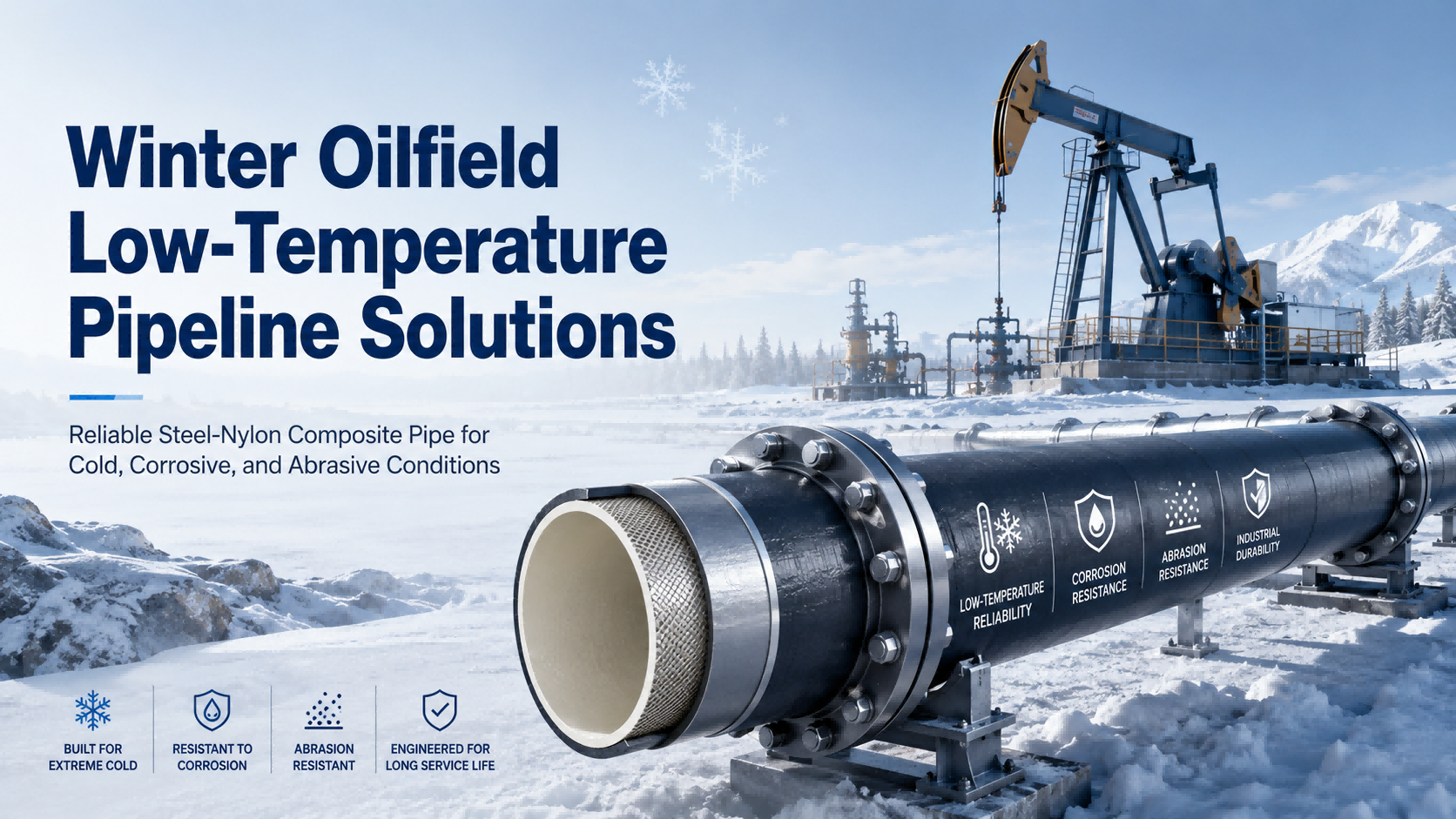
Winter Oilfield Low-Temperature Pipeline Solutions: How to Balance Low-Temperature Resistance, Corrosion Resistance, and Long-Term Reliability
For oilfield gathering and transportation systems, the real challenge is that low temperature, corrosion, high water cut, salinity, pressure fluctuations, increased fluid viscosity, and frequent start-stop conditions often occur at the same time.
A pipeline that performs reliably at normal temperatures may experience very different failure mechanisms once exposed to prolonged low-temperature conditions. Some non-metallic materials may lose toughness, conventional carbon steel still faces internal corrosion and scaling, while certain traditional lined structures may develop interfacial stress due to differences in thermal expansion between materials.
Therefore, winter oilfield pipeline selection should not focus only on one question:
“How low a temperature can this pipe withstand?”
A more important question is:
Can the pipeline system maintain structural stability and reliable transportation under the combined effects of low temperature, corrosion, pressure, and long-term thermal cycling?
This is one of the reasons steel-nylon composite pipe deserves attention in oilfield transportation systems operating in cold regions.
1. Why Are Winter Oilfield Pipelines More Difficult to Design Than Conventional Industrial Pipelines?
Pipelines in cold-region oilfields usually face multiple variables simultaneously rather than a single low-temperature condition.
1.1 Ambient Temperatures May Remain Below 0°C for Long Periods
In some oilfield regions, winter temperatures may fall to -20°C, -30°C, or even lower.
For outdoor pipe racks, wellsite gathering lines, station process pipelines, and pipelines exposed to the environment for long periods, low temperature can directly affect mechanical properties.
Key factors include:
-
Low-temperature impact performance
-
Risk of material embrittlement
-
Reliability of flanges and connection points
-
Stress concentration at supports
-
Additional loads caused by thermal expansion and contraction
-
Thermal stress caused by rapid temperature changes during start-up and shutdown
Therefore, evaluating only room-temperature mechanical strength is not enough when designing oilfield pipelines for cold environments.
2. The Real Risk Is Not Low Temperature Alone, but the Combination of Multiple Factors
Many pipeline failures are not caused by a single factor.
Instead, they result from several operating conditions acting together.
For example:
Low Temperature + High Water Cut + CO₂/H₂S + Chlorides + Pressure Fluctuations + Sand Erosion
Such operating conditions are not uncommon in oil and gas gathering systems.
This means pipeline materials need to solve several problems at the same time.
Low-Temperature Performance
The material must maintain sufficient toughness and dimensional stability under low-temperature conditions.
Internal Corrosion
Produced fluids and oilfield wastewater may contain:
-
Cl⁻
-
CO₂
-
H₂S
-
Dissolved salts
-
Microorganisms
-
Other corrosive components
If conventional carbon steel is directly exposed to these media, long-term operation may lead to general corrosion, localized corrosion, and eventually perforation.
Erosion and Abrasion
Produced fluids may carry sand and solid particles.
Severe localized erosion often occurs at:
-
Elbows
-
Tees
-
Reducers
-
Upstream and downstream of valves
-
Pump outlets
-
High-velocity sections
Scaling
Temperature changes can alter the solubility balance of dissolved salts.
As a result, winter operation may involve:
Corrosion + Scaling + Increased Hydraulic Resistance
This combination is an important reason why lifecycle costs continue to rise in many oilfield pipeline systems.
3. What Problems Do Common Pipeline Materials Face in Winter Oilfield Conditions?
Every pipeline material has advantages, but complex cold-region oilfield applications require an overall operating-condition assessment rather than a comparison based only on initial purchase price.
3.1 Carbon Steel Pipe
Carbon steel remains widely used because it is mature, mechanically strong, and supported by an established supply chain.
However, if the transported medium itself is corrosive, low temperature does not eliminate internal corrosion.
This becomes particularly important when mature oilfields enter the middle or late stage of production and water cut continues to increase.
The transported medium may increasingly resemble:
“Corrosive water containing oil.”
As water cut rises, the steel surface remains in contact with the aqueous phase for longer periods, increasing corrosion risk.
Potential consequences include:
-
Progressive wall thinning
-
Pitting
-
Perforation
-
Leakage
-
Repair welding
-
Partial pipeline replacement
-
Unplanned shutdowns
For this reason, simply increasing carbon steel wall thickness is usually not a fundamental long-term solution to corrosion in cold-region oilfields.
3.2 PE and HDPE Pipe
PE and HDPE offer excellent corrosion resistance and are widely used in many low-pressure water transportation systems.
However, oilfield applications require more than corrosion resistance.
Engineers must also consider:
-
Operating pressure
-
Temperature
-
Pipe diameter
-
Long-term creep
-
Support spacing
-
Vacuum or negative-pressure conditions
-
Mechanical loading
-
Temperature fluctuations
For higher-pressure industrial systems, large-diameter pipelines, or applications with higher structural requirements, the long-term mechanical capability of thermoplastic pipelines must be carefully evaluated.
3.3 FRP Pipe
FRP pipe is lightweight and resistant to many corrosive media, making it widely used in chemical and water-treatment applications.
However, FRP is a fiber-reinforced composite structure.
Under long-term temperature cycling, pressure fluctuations, installation deviations, and complex mechanical loads, attention should be paid to:
-
Interlaminar performance
-
Joint reliability
-
Impact damage
-
Localized stress
-
Long-term fatigue
Therefore, for high-reliability winter oilfield transportation systems, material selection should not be based on corrosion resistance alone.
3.4 Stainless Steel Pipe
304, 316L, and higher-grade stainless steels provide strong mechanical performance.
However, in chloride-containing and complex aqueous environments, engineers still need to evaluate risks such as:
-
Pitting corrosion
-
Crevice corrosion
-
Stress corrosion cracking
-
Weld-area corrosion
In addition, using high-grade alloy materials across a large oilfield pipeline network can significantly increase capital expenditure.
The more important engineering question is therefore not:
“Which material is the most expensive or has the highest nominal performance?”
It is:
“Which material system can address the main failure mechanisms at a reasonable lifecycle cost?”
4. Why Is Steel-Nylon Composite Pipe Suitable for Complex Low-Temperature Oilfield Conditions?
The design principle of steel-nylon composite pipe is not simply to combine two materials.
Its real value lies in functional separation.
Let Steel Handle Structure, and Nylon Handle the Process Medium
The external steel structure primarily provides:
-
Pressure resistance
-
Hoop strength
-
Mechanical load capacity
-
Structural support
-
Stability for large-diameter pipelines
The internal reinforced nylon functional layer primarily faces:
-
Corrosive media
-
Salts
-
Oilfield wastewater
-
Solid particles
-
Fluid erosion
This is essentially a function-oriented composite material design concept.
Instead of forcing one material to simultaneously provide structural strength, corrosion resistance, wear resistance, and fluid-handling capability, each material performs the function it is best suited for.
For complex oilfield conditions, this approach can provide significant engineering value.
5. Advantage One: Suitable for Common Low-Temperature Oilfield Environments
Depending on product specification and engineering design, our steel-nylon composite pipes can cover an operating temperature range of approximately:
-36°C to 160°C
This means that, with appropriate selection and system design, the product can meet the low-temperature requirements of many industrial pipeline applications in cold regions.
However, engineering design should not focus only on the minimum temperature rating.
It should also consider:
-
Low-temperature toughness
-
Pressure class
-
Pipeline restraint conditions
-
Flange sealing reliability
-
Thermal cycling
-
Installation stress
For winter oilfield projects, we recommend selecting the pipeline system according to minimum design temperature, process-fluid temperature, and start-stop operating conditions.
6. Advantage Two: Addressing Internal Corrosion in High-Water-Cut Oilfields
In many mature oilfields, the most serious problem is not crude oil itself.
It is the continuously increasing water cut.
When produced-fluid water content becomes very high, conventional carbon steel pipelines may remain in long-term contact with saline water.
If CO₂, H₂S, and chlorides are also present, the corrosion environment becomes significantly more aggressive.
Steel-nylon composite pipe uses an internal nylon functional layer to isolate the corrosive fluid from the steel pressure-bearing structure.
Its corrosion-protection philosophy is therefore different from:
“Making the steel more corrosion resistant.”
Instead, the objective is:
To minimize direct contact between corrosive media and the steel substrate.
From a materials engineering perspective, this can be a more direct approach to corrosion control.
7. Advantage Three: Suitable for Oilfield Wastewater and Sand-Containing Media
Corrosion is not the only challenge in oilfield pipelines.
Sand and suspended solids can also cause serious wear.
Elbows, tees, reducers, and other direction-changing components are particularly vulnerable because local turbulence and impact become more severe.
Nylon materials offer good abrasion resistance and impact resistance.
Therefore, steel-nylon composite pipe is designed to address not only:
Corrosion Resistance
but also:
Abrasion Resistance
This is especially important for oilfield gathering systems where corrosion and erosion occur simultaneously.
8. Advantage Four: Smooth Inner Surface Helps Reduce Scaling and Flow Resistance
Crude oil viscosity generally increases as temperature decreases.
If the inner surface of the pipeline also accumulates:
-
Rust
-
Corrosion products
-
Deposits
-
Mineral scale
the effective internal diameter can gradually decrease.
The result may be:
Higher flow resistance
↓
Higher pumping pressure
↓
Higher energy consumption
↓
Lower transportation capacity
↓
More frequent pigging and maintenance
Steel-nylon composite pipe has a relatively smooth internal transportation surface, helping reduce the influence of surface roughness on hydraulic resistance and deposit accumulation.
For long-term gathering and transportation pipelines, this advantage can translate into improved operating efficiency.
9. Advantage Five: Steel Structure Provides Industrial Pressure Capability
Low-temperature oilfield pipelines are very different from conventional water pipelines.
Some systems operate under relatively high pressure.
Our steel-nylon composite pipes can be engineered for different pressure classes, including:
1.0–4.0 MPa
The steel structure provides the primary pressure-bearing capability, allowing the composite pipe to retain internal corrosion resistance while maintaining the structural foundation required for industrial pressure piping.
This makes the solution particularly relevant to:
-
Oil and gas gathering lines
-
Produced-water pipelines
-
Water-injection systems
-
Station process pipelines
-
Valve-group pipelines
-
Pump outlet pipelines
10. Advantage Six: Integral Flange Connections Reduce Winter Installation Complexity
Field welding becomes more difficult under cold-weather conditions.
Winter welding may require stricter control over:
-
Surface preparation
-
Preheating
-
Welding procedures
-
Ambient temperature
-
Post-weld inspection
-
Field coating repair
Steel-nylon composite pipe can use integrally formed flange connections.
The pipeline body and connection structure are designed as an integrated system, allowing field sections to be connected through flanges.
For winter projects, this can reduce part of the field hot-work requirement and make installation more standardized.
This can be particularly valuable in:
-
Well sites
-
Central processing stations
-
Valve groups
-
Maintenance areas
-
Flammable and explosive environments
Reducing field hot work can provide meaningful construction and safety benefits.
11. Do Not Focus Only on Straight Pipe—Fittings Are Often the Highest-Risk Components
A common mistake in oilfield pipeline material selection is focusing heavily on kilometers of straight pipe while overlooking the relatively small number of elbows, tees, and reducers.
In actual operation, high-risk locations often include:
Elbows
Changes in flow direction can cause severe erosion on the outer radius.
Tees
Complex flow patterns may create localized turbulence.
Reducers
Velocity changes can increase both local stress and erosion.
Upstream and Downstream of Valves
Pressure and velocity changes can make local conditions more aggressive.
Pump Outlets
These areas may experience high velocity, vibration, and pressure fluctuations simultaneously.
Therefore, a complete winter oilfield pipeline solution should include:
Straight Pipe + Elbows + Tees + Reducers + Valve Sections + Pump Outlet Sections
rather than simply replacing one type of straight pipe.
12. Existing Oilfields Do Not Always Need to Replace the Entire Pipeline Network at Once
Many oilfields face a practical problem:
Their existing pipeline networks are extremely large.
Replacing the entire network at once may require substantial capital investment and can disrupt normal production.
A more realistic upgrade strategy is:
Start with the highest-failure-rate locations.
Priority areas may include:
-
Frequently perforated pipeline sections
-
Elbows and tees
-
Valve-group areas
-
Pump outlets
-
High-water-cut branch lines
-
Highly corrosive produced-water pipelines
-
100–500 meter sections with the highest historical maintenance frequency
Actual operating data can then be compared, including:
-
Leakage frequency
-
Wall-thickness change
-
Maintenance frequency
-
Pressure loss
-
Pigging frequency
-
Shutdown time
Based on these results, the operator can decide whether to expand the application.
This approach can significantly reduce the risk of introducing a new pipeline material.
13. Recommended Parameters for Winter Oilfield Pipeline Selection
For cold-region oilfield projects, at least the following parameters should be collected before selecting pipeline materials:
| Parameter | Why It Matters |
|---|---|
| Minimum ambient temperature | Determines low-temperature suitability |
| Normal fluid temperature | Defines long-term operating condition |
| Start-up/shutdown temperature | Evaluates thermal cycling |
| Operating pressure | Determines required pressure class |
| Maximum transient pressure | Evaluates pressure-surging risk |
| CO₂ content | Indicates corrosion risk |
| H₂S content | Indicates sour-service corrosion risk |
| Cl⁻ concentration | Indicates saline corrosion environment |
| Water cut | Indicates aqueous-phase corrosion exposure |
| Sand content | Determines abrasion severity |
| Flow velocity | Influences erosion rate |
| Pipe diameter | Influences structural design |
| Pipeline length | Influences pressure drop and investment |
| Indoor/outdoor installation | Influences environmental design |
| Aboveground/buried installation | Influences external protection and structure |
Only by combining these parameters can pipeline material selection be performed on a true engineering basis.
14. Low Purchase Price Does Not Mean Low Project Cost
Oilfield infrastructure is typically evaluated over ten years or more.
Therefore, pipeline economics should not be measured only by:
Cost per meter
It should be evaluated through:
Total Cost of Ownership — TCO
In simplified form:
TCO = Initial Purchase + Installation + Maintenance + Replacement + Shutdown Losses + Energy + Operating Costs
A conventional pipe may have a lower initial purchase price.
But if it repeatedly suffers from:
-
Corrosion perforation
-
Leakage
-
Repair welding
-
Replacement
-
Production shutdowns
the initial savings may be much smaller than the subsequent maintenance and downtime costs.
This becomes even more important in winter oilfield operations.
Cold-weather emergency repair usually involves higher:
-
Labor costs
-
Equipment costs
-
Safety-management costs
-
Construction complexity
-
Shutdown risk
Therefore, preventing just one unplanned winter shutdown may sometimes create more value than the purchase cost of the pipeline section itself.
15. The Better Investment Is a Lower-Maintenance Pipeline System
Oilfield pipeline procurement philosophy is changing.
In the past, projects often focused on:
“How much does this pipe cost per meter?”
Increasingly, operators are asking:
“How many times will this pipeline need to be repaired over the next 10 years?”
These two questions represent fundamentally different purchasing strategies.
For cold-region projects, this shift is especially important because winter conditions further increase maintenance costs.
An ideal winter oilfield pipeline solution should therefore aim to provide:
-
Low-temperature resistance
-
Corrosion resistance
-
Abrasion resistance
-
High mechanical strength
-
Industrial pressure capability
-
Reduced scaling tendency
-
Reliable connections
-
Less field welding
-
Long-term outdoor durability
-
Low maintenance requirements
These are exactly the problems steel-nylon composite pipe is designed to address.
16. Why Does the Steel-Nylon Composite Structure Deserve Attention in Cold-Region Oilfields?
Steel-nylon composite pipe is not simply intended to replace steel, PE, FRP, or stainless steel.
It represents a different materials-engineering approach:
Metal Strength + Polymer Corrosion Resistance
In this structure:
The Steel Layer Provides Structural Performance
Including:
-
Rigidity
-
Pressure resistance
-
Mechanical strength
-
Structural stability for industrial piping
The Reinforced Nylon Layer Provides Functional Performance
Including:
-
Corrosion resistance
-
Abrasion resistance
-
Smooth internal surface
-
Reduced scaling tendency
-
Isolation from aggressive process media
This combination creates a separation between:
“Structural Pressure Bearing” and “Media Corrosion Resistance.”
This is also one of the reasons composite materials are increasingly influencing the traditional industrial pipeline market.
17. From “Winter Emergency Repair” to “Lifecycle Reliability”
For cold-region oilfields, the most expensive pipeline is often not the one with the highest purchase price.
It is:
The pipeline that fails in winter.
A single leak may involve:
Emergency shutdown
→ Cold-weather repair
→ Pipeline depressurization and draining
→ Site cleanup
→ Cutting damaged sections
→ Welding or replacement
→ Inspection
→ Production restart
The total cost of this process can be far greater than the cost of several meters of pipe.
For this reason, a mature oilfield pipeline strategy should gradually shift from:
Purchase Price
to:
Lifecycle Reliability
In other words:
Reliability across the entire operating life of the pipeline.
18. Conclusion
Winter oilfield pipeline selection is not simply a matter of choosing a “low-temperature-resistant material.”
It is a system engineering challenge involving:
Low Temperature + Pressure + Corrosion + Abrasion + Scaling + Installation + Maintenance + Lifecycle Cost
Conventional carbon steel offers excellent mechanical strength but continues to face internal corrosion. Pure thermoplastic systems provide corrosion resistance but may require additional evaluation under certain industrial pressure and structural conditions. Stainless steel offers excellent performance, but can involve significantly higher investment and still requires careful material-grade selection for specific corrosion environments.
Steel-nylon composite pipe offers another approach:
Use Steel for Pressure and Structure, and Reinforced Nylon for Corrosion and Abrasion Resistance.
With a product operating temperature range of approximately -36°C to 160°C, multiple pressure classes of 1.0–4.0 MPa, corrosion resistance, abrasion resistance, a smooth internal surface, and integral flange connection technology, steel-nylon composite pipe can be evaluated as a solution for cold-region oilfield gathering systems, produced-water pipelines, water-injection systems, and station process piping.
For oilfields currently facing challenges such as:
-
Frequent winter pipeline leakage
-
Carbon steel corrosion caused by high-water-cut fluids
-
CO₂ and H₂S corrosion
-
Saline-water corrosion
-
Sand erosion
-
Pipeline scaling
-
Frequent elbow wear
-
Difficult winter maintenance
-
High shutdown losses
-
High long-term maintenance costs
the question may no longer be:
“Which conventional pipe should we replace it with next?”
A more important question may be:
“Should we redesign the material structure of the pipeline itself?”
That is where the value of steel-nylon composite pipe becomes especially relevant.
FAQ: Common Questions About Low-Temperature Oilfield Pipelines
1. What Are the Most Important Parameters When Selecting Pipelines for Cold-Region Oilfields?
Do not evaluate only the minimum ambient temperature. Minimum design temperature, fluid temperature, pressure, CO₂, H₂S, chloride concentration, water cut, sand content, velocity, pipe diameter, and start-stop frequency should all be considered.
2. Is Steel-Nylon Composite Pipe Suitable for Oilfield Produced Water?
For produced-water systems involving corrosion, salinity, and a certain level of solid-particle erosion, steel-nylon composite structures can offer meaningful engineering advantages. Final selection should still be based on actual fluid composition, temperature, pressure, and flow velocity.
3. Can Steel-Nylon Composite Pipe Be Used in Higher-Pressure Oilfield Systems?
Our products can be engineered for pressure classes ranging from 1.0 to 4.0 MPa, depending on specification. Final design pressure should be determined according to operating conditions, pipe diameter, temperature, and applicable engineering standards.
4. Why Is Steel-Nylon Composite Pipe Suitable for Cold Regions?
Its advantage is not simply “low-temperature resistance.” The more important benefit is its ability to combine steel structural strength with internal corrosion resistance, abrasion resistance, and lower maintenance requirements under cold operating conditions.
5. Does an Existing Oilfield Need to Replace the Entire Pipeline Network?
Not necessarily. A practical approach is to begin with elbows, valve groups, pump outlets, and 100–500 meter high-failure-rate trial sections. Actual operating performance can then be evaluated before broader implementation.
Steel-Nylon Composite Pipe — Designed for Harsh Oilfield Conditions
Low Temperature. Corrosion. Abrasion. Pressure. One Integrated Pipeline Solution.
Why Are Oilfields Starting to Adopt Steel–Nylon Composite Pipes?
High-Salinity Produced Water Pipeline Solutions: How to Reduce Corrosion, Scaling, Erosion, and Frequent Leakage