For Caustic Soda Transport in the Chlor-Alkali Industry: Which Pipe Combines Corrosion Resistance and Real Cost Savings?

In the chlor-alkali industry, pipeline systems for conveying caustic soda (sodium hydroxide) constantly face multiple challenges: strong alkali corrosion, temperature fluctuations, and mechanical wear. Choosing the wrong material can lead at best to leaks and spills, and at worst to serious safety incidents. Many plant owners and engineers ask the same question: while ensuring safety and durability, which pipe material is both corrosion-resistant and truly cost-effective? This article begins with the corrosion mechanism of caustic soda, compares mainstream piping solutions on the market, and focuses on the unique advantages of nylon pipe and steel-nylon composite pipe in caustic soda transport, helping you make a decision that delivers superior total life cycle cost performance.
The Corrosion Nature of Caustic Soda Transport – More Than Just "Alkali Resistance"
The corrosion mechanisms of sodium hydroxide (NaOH) on metallic and non-metallic materials differ significantly and cannot be generalized simply as "acid and alkali resistance."
**For metallic materials:** Under high-temperature, high-concentration caustic soda conditions, carbon steel can suffer caustic embrittlement, while stainless steel may undergo stress corrosion cracking (SCC). In particular, for 304 and 316 series stainless steels at temperatures above 80°C and concentrations exceeding 30%, the combined effect of chloride ions and high alkali concentration dramatically increases the risk of cracking.
**For non-metallic materials:** Many plastics may swell, degrade, or experience environmental stress cracking in alkaline environments. For example, the resistance of ordinary PVC to caustic soda rapidly declines above 50°C. For some glass fiber reinforced plastics (FRP), if the resin is improperly selected, strong alkali can attack the glass fiber interface, leading to delamination and bursting of the pipe.
**For non-metallic materials:** Many plastics may swell, degrade, or experience environmental stress cracking in alkaline environments. For example, the resistance of ordinary PVC to caustic soda rapidly declines above 50°C. For some glass fiber reinforced plastics (FRP), if the resin is improperly selected, strong alkali can attack the glass fiber interface, leading to delamination and bursting of the pipe.
Therefore, assessing whether a pipeline is suitable for caustic soda transport requires a simultaneous evaluation of its chemical resistance, permeation resistance, and mechanical strength retention under specific concentration, temperature, pressure, and mechanical stress conditions.
Comparison of Mainstream Caustic Soda Piping Materials – Each Has Its Shortcomings
The piping materials commonly used for caustic soda transport in the chlor-alkali industry today include:
1. **Stainless Steel Pipe (304/316L)**
Advantages: High mechanical strength, good temperature resistance.
Problems: Material and installation costs are extremely high. Under high-temperature, high-concentration alkali, SCC risk still exists. Susceptibility to failure is even greater when conveying crude alkali liquor containing chloride ions. Welded joints require solution annealing treatment, making maintenance difficult.
Advantages: High mechanical strength, good temperature resistance.
Problems: Material and installation costs are extremely high. Under high-temperature, high-concentration alkali, SCC risk still exists. Susceptibility to failure is even greater when conveying crude alkali liquor containing chloride ions. Welded joints require solution annealing treatment, making maintenance difficult.
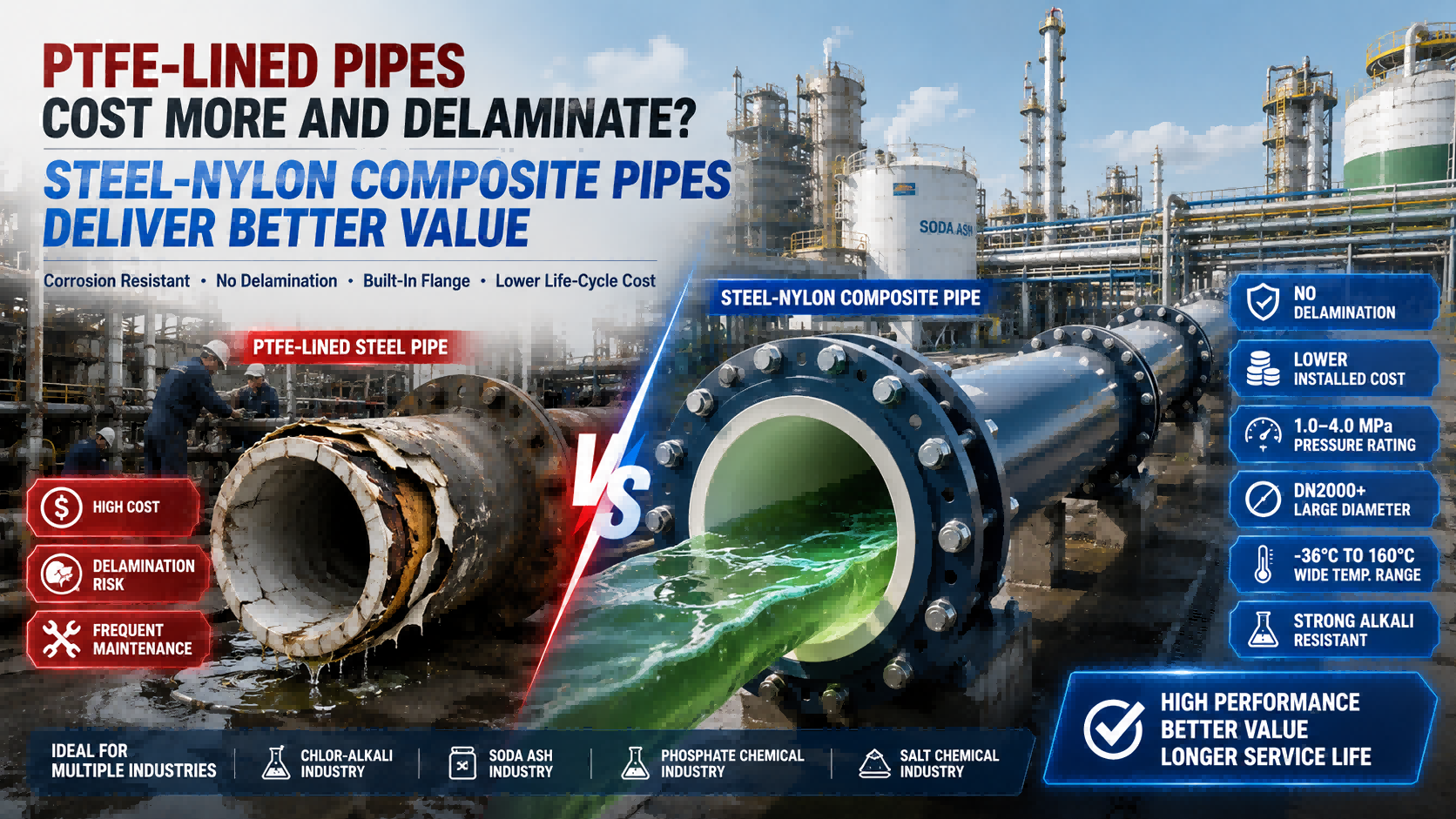
2. **Steel-Lined PTFE (Polytetrafluoroethylene) Pipe**
Advantages: Resistant to virtually all concentrations of caustic soda, excellent temperature resistance.
Problems: Very expensive. Once the inner lining is damaged by negative pressure suction, severe temperature fluctuations, or mechanical scratches, the steel casing corrodes rapidly, and the point of damage is extremely difficult to detect. Flange connections are prone to permeation, and repairs and replacements come at a high cost.
Advantages: Resistant to virtually all concentrations of caustic soda, excellent temperature resistance.
Problems: Very expensive. Once the inner lining is damaged by negative pressure suction, severe temperature fluctuations, or mechanical scratches, the steel casing corrodes rapidly, and the point of damage is extremely difficult to detect. Flange connections are prone to permeation, and repairs and replacements come at a high cost.
3. **CPVC (Chlorinated Polyvinyl Chloride) Pipe**
Advantages: Moderate cost, good chemical resistance.
Problems: Significant strength degradation in high-concentration caustic soda above 60°C; high brittleness and low impact resistance. Long-term use poses a pipe burst risk, especially unsuitable for outdoor applications with large temperature differences or vibration.
Advantages: Moderate cost, good chemical resistance.
Problems: Significant strength degradation in high-concentration caustic soda above 60°C; high brittleness and low impact resistance. Long-term use poses a pipe burst risk, especially unsuitable for outdoor applications with large temperature differences or vibration.
4. **PPH (Homopolymer Polypropylene) Pipe**
Advantages: Strong alkali resistance, low cost.
Problems: The upper service temperature limit usually does not exceed 80-90°C, and its high coefficient of linear thermal expansion requires numerous compensators. Easily damaged by mechanical impact. Rapid UV aging, requiring additional protection when used outdoors.
Advantages: Strong alkali resistance, low cost.
Problems: The upper service temperature limit usually does not exceed 80-90°C, and its high coefficient of linear thermal expansion requires numerous compensators. Easily damaged by mechanical impact. Rapid UV aging, requiring additional protection when used outdoors.
5. **FRP (Fiberglass Reinforced Plastic) Pipe**
Advantages: Highly designable, corrosion resistant.
Problems: Long construction cycles, difficult on-site bonding quality control. Under long-term exposure to strong alkali, if the resin layer is not sufficiently dense, alkali penetration and crystallization easily occur, leading to structural failure. High post-maintenance costs and difficult local repairs.
Advantages: Highly designable, corrosion resistant.
Problems: Long construction cycles, difficult on-site bonding quality control. Under long-term exposure to strong alkali, if the resin layer is not sufficiently dense, alkali penetration and crystallization easily occur, leading to structural failure. High post-maintenance costs and difficult local repairs.
These solutions often fail to simultaneously meet the combined requirements of **corrosion resistance, high safety, low cost, and ease of installation**. This is precisely the pain point that nylon pipe and steel-nylon composite pipe are designed to address.
The Targeted Advantages of Nylon Pipe and Steel-Nylon Composite Pipe
Our company specializes in the R&D and production of high-performance nylon (PA) and steel-nylon composite pipes. These two types of pipes demonstrate significant performance advantages in caustic soda transport within the chlor-alkali industry, truly achieving "both corrosion-resistant and cost-effective."
1. Nearly Perfect Alkali Resistance, Unafraid of High Concentration and High Temperature
The inner layer pipe, made from specially modified nylon (e.g., PA612, PA12, semi-aromatic nylon alloys), features high molecular chain saturation and dense hydrogen bonding between amide groups. It can withstand long-term immersion in caustic soda with concentrations up to 70% and temperatures up to 90°C. Experimental data show that after 1000 hours of continuous immersion in a 48% NaOH solution at 80°C, tensile strength retention exceeds 90%, and the mass change rate is less than 1.5%, far superior to PPH and CPVC. The alkali liquor permeability rate is extremely low, fundamentally eliminating the risk of "internal corrosion leading to external leakage."
The inner layer pipe, made from specially modified nylon (e.g., PA612, PA12, semi-aromatic nylon alloys), features high molecular chain saturation and dense hydrogen bonding between amide groups. It can withstand long-term immersion in caustic soda with concentrations up to 70% and temperatures up to 90°C. Experimental data show that after 1000 hours of continuous immersion in a 48% NaOH solution at 80°C, tensile strength retention exceeds 90%, and the mass change rate is less than 1.5%, far superior to PPH and CPVC. The alkali liquor permeability rate is extremely low, fundamentally eliminating the risk of "internal corrosion leading to external leakage."
2. Smooth Inner Wall, No Scaling or Clogging Long-Term
Caustic soda solutions often carry trace salt precipitates or impurities during production. The rough inner walls of ordinary metal pipes make scaling and diameter reduction very easy. Nylon pipe possesses self-lubricating properties and an extremely low surface energy, with a friction coefficient of only 0.1–0.2 (compared to 0.5–0.8 for steel). Impurities struggle to adhere, resulting in minimal pressure drop during long-term operation and eliminating the need for frequent acid-cleaning descaling operations. This not only improves conveying efficiency but also reduces maintenance costs.
Caustic soda solutions often carry trace salt precipitates or impurities during production. The rough inner walls of ordinary metal pipes make scaling and diameter reduction very easy. Nylon pipe possesses self-lubricating properties and an extremely low surface energy, with a friction coefficient of only 0.1–0.2 (compared to 0.5–0.8 for steel). Impurities struggle to adhere, resulting in minimal pressure drop during long-term operation and eliminating the need for frequent acid-cleaning descaling operations. This not only improves conveying efficiency but also reduces maintenance costs.
3. Steel-Nylon Composite Structure – Combining Rigidity and Flexibility for Pressure-Resistant Durability
While pure nylon pipe offers excellent corrosion resistance, it may lack sufficient rigidity for large-diameter, high-pressure transport scenarios. Our proprietary **steel-nylon composite pipe** uses an outer layer of high-strength carbon steel as the load-bearing skeleton, lined with a dense nylon anti-corrosion layer, formed into an integrated structure through a hot-melt composite process. This design inherits the pressure-bearing capacity of metal pipes (up to 10 MPa and above) while retaining nylon’s alkali-resistant, wear-resistant, and impact-resistant characteristics, completely avoiding the liner collapse and delamination issues common with steel-lined PTFE. The bonding strength between the inner and outer layers exceeds 15 N/mm, allowing it to maintain integrity even under negative pressure conditions.
While pure nylon pipe offers excellent corrosion resistance, it may lack sufficient rigidity for large-diameter, high-pressure transport scenarios. Our proprietary **steel-nylon composite pipe** uses an outer layer of high-strength carbon steel as the load-bearing skeleton, lined with a dense nylon anti-corrosion layer, formed into an integrated structure through a hot-melt composite process. This design inherits the pressure-bearing capacity of metal pipes (up to 10 MPa and above) while retaining nylon’s alkali-resistant, wear-resistant, and impact-resistant characteristics, completely avoiding the liner collapse and delamination issues common with steel-lined PTFE. The bonding strength between the inner and outer layers exceeds 15 N/mm, allowing it to maintain integrity even under negative pressure conditions.
4. Easy Installation, Significantly Reduced Life Cycle Costs
Compared to the high labor cost of welding stainless steel and the precise tightening requirements of steel-lined PTFE flanges, nylon pipe and steel-nylon composite pipe can be joined using quick couplings, grooved connections, or butt fusion, increasing installation speed by over 40%. Custom pipe lengths reduce the number of joint leakage points. There is no need for on-site construction and curing like FRP, nor regular anti-corrosion painting. Factoring in material costs, installation costs, downtime losses, and maintenance expenses, the total life cycle cost can be 30%–50% lower than stainless steel solutions and 20%–40% lower than steel-lined PTFE solutions.
Compared to the high labor cost of welding stainless steel and the precise tightening requirements of steel-lined PTFE flanges, nylon pipe and steel-nylon composite pipe can be joined using quick couplings, grooved connections, or butt fusion, increasing installation speed by over 40%. Custom pipe lengths reduce the number of joint leakage points. There is no need for on-site construction and curing like FRP, nor regular anti-corrosion painting. Factoring in material costs, installation costs, downtime losses, and maintenance expenses, the total life cycle cost can be 30%–50% lower than stainless steel solutions and 20%–40% lower than steel-lined PTFE solutions.
5. Wear-Resistant and Impact-Resistant, Adapting to Complex Working Conditions
Caustic soda workshops often experience vehicle traffic and tool impacts, where purely plastic pipes are highly susceptible to damage. Nylon material itself is renowned for its excellent toughness and wear resistance (nylon’s wear resistance is over 3 times that of PP). The outer steel armor of the steel-nylon composite pipe provides additional mechanical protection, allowing it to withstand accidental impacts without leakage. Even under the scouring action of crude alkali liquor containing solid particles, the inner wall wear rate is only 1/10th that of carbon steel, significantly extending the pipeline’s service life.
Caustic soda workshops often experience vehicle traffic and tool impacts, where purely plastic pipes are highly susceptible to damage. Nylon material itself is renowned for its excellent toughness and wear resistance (nylon’s wear resistance is over 3 times that of PP). The outer steel armor of the steel-nylon composite pipe provides additional mechanical protection, allowing it to withstand accidental impacts without leakage. Even under the scouring action of crude alkali liquor containing solid particles, the inner wall wear rate is only 1/10th that of carbon steel, significantly extending the pipeline’s service life.
Case Study as Proof
A large chlor-alkali enterprise originally used 316L stainless steel pipes to transport 50% high-temperature caustic soda (approx. 85°C). After two years of operation, stress corrosion cracks frequently appeared at the welds, leading to annual inspection and shutdown losses exceeding one million RMB. After switching to our steel-nylon composite pipe, the operating temperature and concentration conditions were perfectly matched. It has run continuously for five years without any leaks, the inner wall remains smooth and scale-free, and daily maintenance is virtually "zero." The total pipeline investment for this project was approximately 35% less than the stainless steel solution and 28% less than the steel-lined PTFE solution, with an investment payback period of only 11 months.
Conclusion
When selecting piping for caustic soda transport, one cannot only look at the initial purchase price. A comprehensive life cycle cost assessment should be performed across multiple dimensions, including chemical resistance, mechanical properties, installation convenience, maintenance frequency, and operational lifespan. With their outstanding alkali resistance, extremely low scaling tendency, high pressure-bearing capacity and impact resistance from the composite structure, and significant total cost advantages, nylon pipe and steel-nylon composite pipe are increasingly becoming the preferred choice for caustic soda transport in many chlor-alkali enterprises.
If you are planning or optimizing your caustic soda transport pipeline network, feel free to contact us. Based on your specific medium concentration, temperature, pressure, and site conditions, we will provide a free one-on-one pipe selection consultation and a total life cycle cost analysis report, empowering your safe, stable, long-term, and optimal operation with professional solutions.
The Ultimate Abrasion Resistance Test for Mine Backfill Pipes: Why Steel-Nylon Pipes Completely Outperform Traditional Steel-Rubber Pipes
The Ultimate Guide to Oil & Gas Pipeline Selection: How to Meet High Pressure, Corrosion Resistance, and Low Temperature Simultaneously
Related blog