How Much Easier Are Integral-Flanged Industrial Pipes? Fast Installation, Leak-Proof, and Full-Scene Coverage from 1.0 to 4.0 MPa
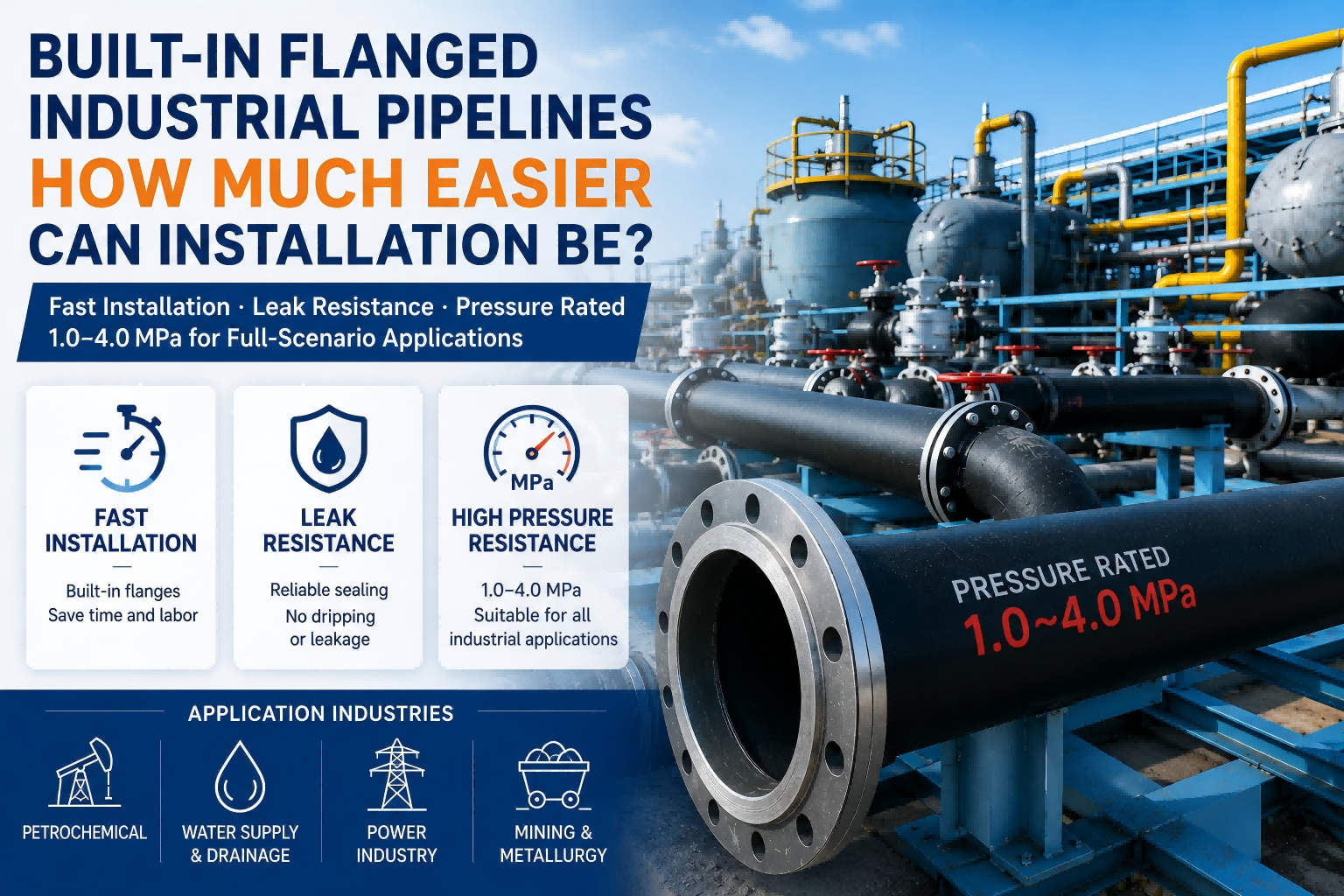
Ask any field engineer, pipefitter, or project manager what consumes the most time, money, and nerves on an industrial piping project, and you will often hear the same answer: the joints. Welding, aligning, inspecting, coating, and reworking pipe connections can easily account for 40–60% of the total installation cost and schedule. Then, years later, those same joints become the primary failure points—weld corrosion, gasket creep, liner delamination. What if the pipe arrived on site with its joints already made, fully integrated, and sealed at the factory? That is exactly the proposition of pipes with **integral flanges**. In our reinforced Nylon and steel-Nylon composite pipe systems, the flange is not an add-on—it is part of the pipe itself. This article unpacks just how much easier, faster, safer, and more reliable your next project can be when you choose a pipe that comes ready to bolt.
The Hidden Cost of Conventional Pipe Joints
To appreciate the integral flange advantage, it helps to quantify the burden of traditional field-fabricated connections.
**Welded Steel Pipe Joints:**
- Require hot work permits and fire watches, especially costly in hydrocarbon or chemical plant classified areas.
- Need multiple passes for thick-wall pipes, plus pre-heating and post-weld heat treatment in some alloys.
- Must be non-destructively tested (radiography or ultrasonic), adding third-party inspection costs and schedule uncertainty.
- Demand internal field-joint coating or lining repair after welding—a difficult quality-controlled step that leaves a weak point if done imperfectly.
- Skilled welders are in critically short supply globally; a single welder’s productivity limits the entire pipe crew.
- Require hot work permits and fire watches, especially costly in hydrocarbon or chemical plant classified areas.
- Need multiple passes for thick-wall pipes, plus pre-heating and post-weld heat treatment in some alloys.
- Must be non-destructively tested (radiography or ultrasonic), adding third-party inspection costs and schedule uncertainty.
- Demand internal field-joint coating or lining repair after welding—a difficult quality-controlled step that leaves a weak point if done imperfectly.
- Skilled welders are in critically short supply globally; a single welder’s productivity limits the entire pipe crew.
**Flanged Steel Pipe Joints (loose/slip-on flanges):**
- Still require welding the flange to the pipe, bringing all the same hot work and NDT issues.
- The internal weld root is a crevice and metallurgical discontinuity—a corrosion accelerator in aggressive services.
- For plastic-lined steel, the flange face relies on a separate plastic face that must be fused or pressed, creating a potential leak path between the liner and the steel.
- Still require welding the flange to the pipe, bringing all the same hot work and NDT issues.
- The internal weld root is a crevice and metallurgical discontinuity—a corrosion accelerator in aggressive services.
- For plastic-lined steel, the flange face relies on a separate plastic face that must be fused or pressed, creating a potential leak path between the liner and the steel.
**HDPE/PE Butt-Fusion Joints:**
- No hot work permit needed, but the fusion process is slow, heavily weather-dependent, and requires large, specialized fusion machines.
- A single bad fusion joint (due to contamination, wind, or misalignment) can cause a hidden future leak; every joint must be inspected and documented.
- No hot work permit needed, but the fusion process is slow, heavily weather-dependent, and requires large, specialized fusion machines.
- A single bad fusion joint (due to contamination, wind, or misalignment) can cause a hidden future leak; every joint must be inspected and documented.
In short, conventional joints are the bottleneck of pipe installation and the Achilles’ heel of long-term integrity.
What Does “Integral Flange” Actually Mean?
An integral flange is formed directly from the pipe material as one continuous piece. In our manufacturing process:
**For reinforced Nylon solid-wall pipe:** The pipe body and the flange stub are molded or machined from the same Nylon billet or extrusion. The flange sealing face, the bolt holes, the back face—all are solid Nylon. There is no liner-to-flange interface, no weld, no bond line.
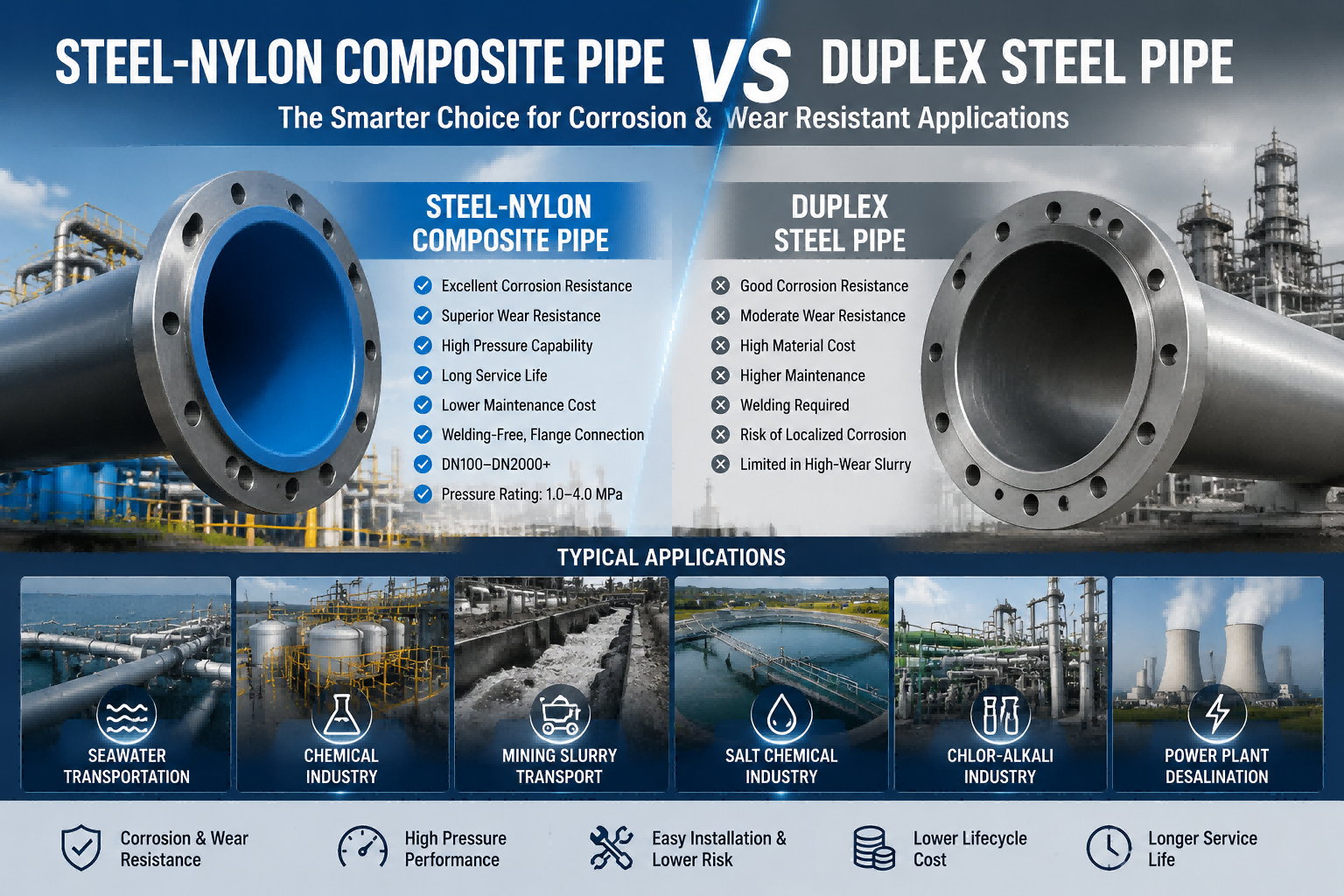
**For steel-Nylon composite pipe:** The steel outer shell and the internal Nylon liner are co-formed at the flange end. The sealing face is covered with or entirely made of Nylon. The steel provides the pressure rating; the Nylon provides the continuous corrosion barrier, from the inside of one pipe spool, across the flange face, and into the next spool.
**For steel-Nylon composite pipe:** The steel outer shell and the internal Nylon liner are co-formed at the flange end. The sealing face is covered with or entirely made of Nylon. The steel provides the pressure rating; the Nylon provides the continuous corrosion barrier, from the inside of one pipe spool, across the flange face, and into the next spool.
In both cases, when you look through the bore of a connected pipe, you see one homogeneous, seamless surface from inlet to outlet. The medium—whether corrosive acid, abrasive slurry, high-purity water, or seawater—never touches metal.
The Five Transformative Benefits of Integral-Flanged Pipes
1. Installation Speed That Redefines Project Schedules
A bolted flange joint can be made in minutes. A crew lowers the pipe into position, inserts the gasket, aligns the bolts, and tightens in a star pattern with a torque wrench. No welding machine, no fusion heater, no curing wait. On large-diameter pipelines (DN800 to DN2000+), a crew can install dozens of joints per shift instead of one or two welded joints. For a multi-kilometer pipeline project, this speed compresses the critical path by weeks or even months.
The faster installation directly reduces:
- Crane and heavy equipment rental time
- Man-hours in the trench or on the pipe rack
- Traffic disruption and public inconvenience in urban projects
- Camp and logistics costs in remote mine or desert sites
- Crane and heavy equipment rental time
- Man-hours in the trench or on the pipe rack
- Traffic disruption and public inconvenience in urban projects
- Camp and logistics costs in remote mine or desert sites
2. Leak-Proof Sealing from Vacuum to 4.0 MPa
The flat, machined Nylon flange face provides an ideal sealing surface. It is smooth, rigid, and chemically inert—compatible with standard gaskets like EPDM, PTFE, FKM (Viton®), and compressed fiber. The bolt load compresses the gasket uniformly; the flange itself does not warp or creep over time.
Our integral-flanged systems are rated and proven for:
**Full vacuum service** (e.g., vacuum salt plants, condenser water legs)
**Low-pressure water and drainage (up to 1.0 MPa)**
**Medium-pressure process piping (1.0–2.5 MPa)**
**High-pressure composite pipe (up to 4.0 MPa)** for long-distance transport, pump station discharge, and oil and gas gathering
**Low-pressure water and drainage (up to 1.0 MPa)**
**Medium-pressure process piping (1.0–2.5 MPa)**
**High-pressure composite pipe (up to 4.0 MPa)** for long-distance transport, pump station discharge, and oil and gas gathering
Hydrotesting of every spool before shipment and of the completed line is standard practice. Joints consistently pass first time because the seal is factory-built, not field-dependent.
3. Elimination of Corrosion-Prone Weld Joints
A weld zone is chemically and metallurgically different from the parent metal. It is the preferred site for:
Pitting and crevice corrosion in chlorides and acids
Caustic stress corrosion cracking in hot NaOH service
Galvanic corrosion between the weld metal and pipe body
Hydrogen sulfide attack in sour service
Pitting and crevice corrosion in chlorides and acids
Caustic stress corrosion cracking in hot NaOH service
Galvanic corrosion between the weld metal and pipe body
Hydrogen sulfide attack in sour service
By removing field welds from the equation, integral-flanged pipe removes these failure modes. The entire internal flow path is inert Nylon. There is simply no place for corrosion to start.
4. Reduced Total Cost of Ownership
While the initial purchase price of a factory-integral-flanged pipe may be higher than a plain-end pipe, the total installed cost and lifecycle cost are dramatically lower:
**Lower installation cost:** No welding, no NDT, no skilled welder premiums, less heavy equipment time.
**Lower indirect costs:** No fire watch, fewer permits, less QA/QC documentation, faster hydrotest acceptance.
**Lower maintenance cost:** No internal joint coating to repair every turnaround; joints don't leak.
**Lower downtime cost:** If a section ever does need replacement (e.g., after decades of service or due to external damage), it can be unbolted and a new spool inserted in under an hour, rather than requiring a full line cut-and-weld operation.
**Lower inventory cost:** Standardized flanged spools can be stocked as universal spares and reused across multiple locations.
**Lower indirect costs:** No fire watch, fewer permits, less QA/QC documentation, faster hydrotest acceptance.
**Lower maintenance cost:** No internal joint coating to repair every turnaround; joints don't leak.
**Lower downtime cost:** If a section ever does need replacement (e.g., after decades of service or due to external damage), it can be unbolted and a new spool inserted in under an hour, rather than requiring a full line cut-and-weld operation.
**Lower inventory cost:** Standardized flanged spools can be stocked as universal spares and reused across multiple locations.
Across a 20–30 year operating life, total lifecycle savings of 20–40% compared to traditional welded or fusion-jointed systems are common.
5. Safety and Regulatory Compliance
Removing welding from the installation sequence removes a leading cause of construction injuries and fatalities—fires, explosions, arc flash, toxic fumes. In plants where flammable gases, explosive dust, or pure oxygen atmospheres exist, cold bolt-up installation is inherently safer.
Further, integral flanges meet global piping codes and standards. We machine bolt patterns to:
**ANSI/ASME B16.5** (Class 150, 300, 600, 900)
**AWWA C207** (municipal water flanges)
**DIN EN 1092** (European standard)
**JIS B 2220** (Japanese standard)
**BS 4504** (British standard)
**GOST 33259** (Russian/Eurasian standard)
Any custom pattern required by the project
**AWWA C207** (municipal water flanges)
**DIN EN 1092** (European standard)
**JIS B 2220** (Japanese standard)
**BS 4504** (British standard)
**GOST 33259** (Russian/Eurasian standard)
Any custom pattern required by the project
Full material traceability and certified hydrotest documentation support regulatory review.
Full-Scene Coverage: One Flange System for All Your Pressure and Service Needs
The title’s promise—“full-scene coverage from 1.0 to 4.0 MPa”—is not marketing hyperbole. Because we offer two complementary product families, a unified approach to flanges is possible across an entire plant:
| Service Scenario | Typical Pressure Range | PAMC Pipe Type | Flange Standard |
|---|---|---|---|
| Gravity drains, vent lines, low-pressure chemical transfer | < 1.0 MPa | Reinforced Nylon solid-wall | ANSI 150 / DIN PN10 |
| Process piping: brine, acid, alkali, cooling water | 1.0–2.5 MPa | Reinforced Nylon solid-wall | ANSI 300 / DIN PN25 |
| Long-distance slurry transport, high-pressure chemical feed | 2.5–4.0 MPa | Steel-Nylon composite | ANSI 600 / DIN PN40 |
| Pump station discharge headers, oil & gas gathering | 4.0 MPa+ (custom) | Steel-Nylon composite | ANSI 900 / custom |
Flange drilling is consistent across the range, so a 2.5 MPa Nylon pipe can mate to a 4.0 MPa steel-Nylon pipe using the same standard flange class—only the pressure shell differs. This standardization dramatically simplifies plant piping design, material takeoff, and spares holding.
Real-World Installation: The Difference an Hour Makes
Consider a DN600 caustic brine line replacement in a chemical plant:
**Welded steel alternative:** Cut out old spool (2 hours). Prepare bevels, purge, set up welding enclosure (1 hour). Weld both joints, multiple passes (3 hours). Cool, X-ray or UT inspection (2 hours). Apply internal joint coating, wait for cure (4 hours). Total: **12+ hours line downtime.**
**Integral-flanged PAMC alternative:** Unbolt old spool (30 minutes). Position new spool with gaskets (15 minutes). Insert and torque bolts (30 minutes). Total: **1 hour 15 minutes.** No curing wait; line can be hydrotested and returned to service immediately.
**Integral-flanged PAMC alternative:** Unbolt old spool (30 minutes). Position new spool with gaskets (15 minutes). Insert and torque bolts (30 minutes). Total: **1 hour 15 minutes.** No curing wait; line can be hydrotested and returned to service immediately.
Multiply this by hundreds of joints across a major project, and the schedule and cost impact becomes transformational.
40 Years of Flanged Experience, Ready for Your Project
We have been manufacturing integral-flanged Nylon and steel-Nylon composite pipes for over four decades, supplying tens of thousands of joints to China’s most demanding chemical, oil and gas, mining, power, and municipal water projects. Over those years, we have refined flange design details—bolt-circle tolerances, face flatness, gasket groove options—to ensure foolproof sealing in every shipment.
Our engineering team can work with your EPC contractor or in-house design group to:
Review piping isometrics and recommend spool lengths optimized for shipping and installation.
Specify flange classes and facings (flat face, raised face, RTJ if required).
Provide gasket and bolt torque recommendations based on your service conditions.
Supply complete jointing procedure documentation.
Specify flange classes and facings (flat face, raised face, RTJ if required).
Provide gasket and bolt torque recommendations based on your service conditions.
Supply complete jointing procedure documentation.
Conclusion: The Smarter Pipe Arrives Ready to Connect
A pipe that arrives on site with its flanges already built in is more than a convenience—it is a strategic advantage. It removes the biggest variable in pipeline quality (field welding), collapses installation schedules, eliminates joint-driven corrosion, and dramatically reduces the lifetime cost of ownership. Whether your service pressure is 1.0, 2.5, or 4.0 MPa, our integral-flanged reinforced Nylon and steel-Nylon composite pipe systems cover the full spectrum with one reliable joining philosophy: bolt it and forget it.
If you are planning a new line, an expansion, or a retrofit, contact our technical sales team with your pipe class and service conditions. We will provide a detailed total-installed-cost comparison versus welded alternatives and a flange compatibility review with your existing pipework. **Experience the ease of a pipe that’s ready to work the moment it arrives.**
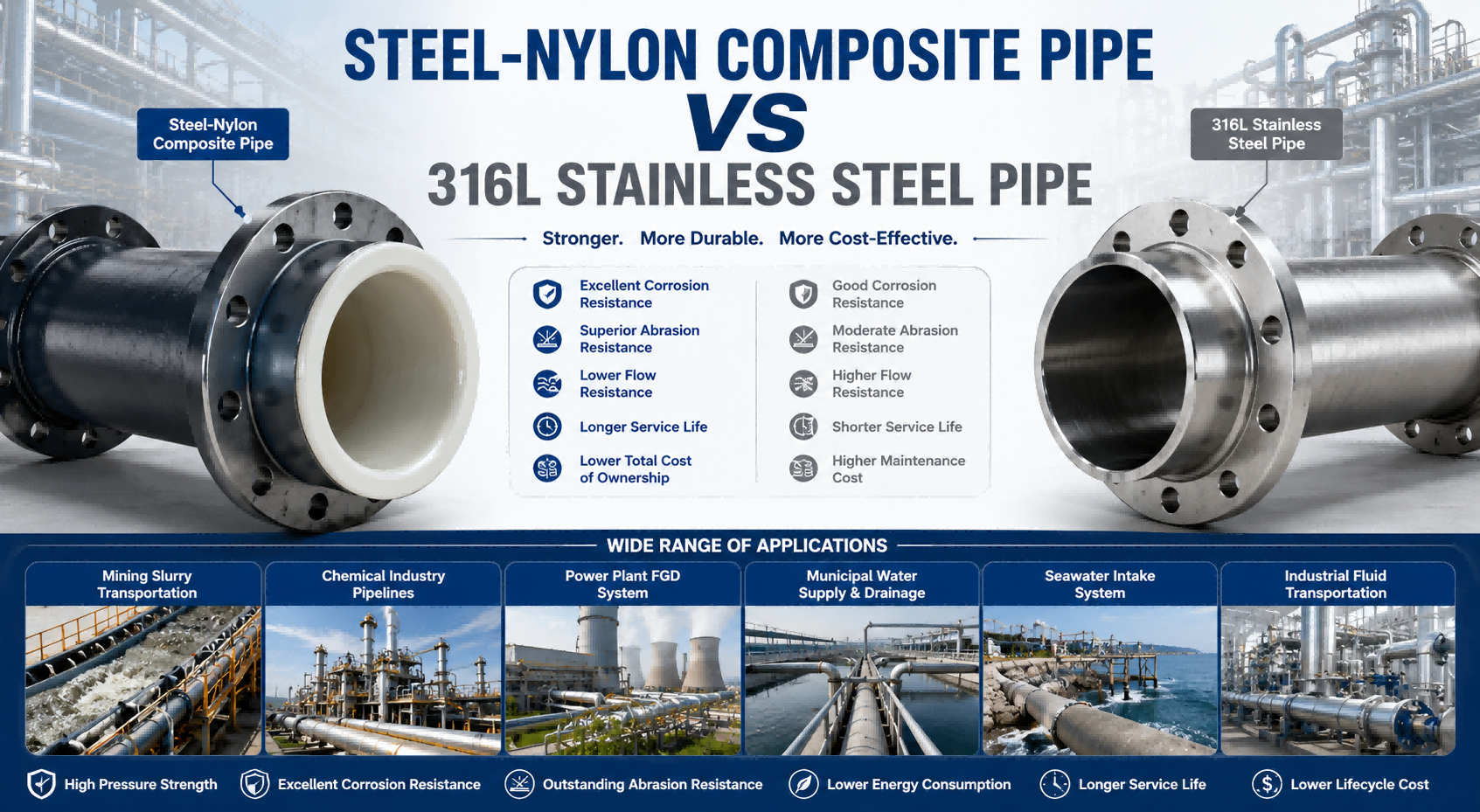
Why Are More and More Companies Abandoning 316L Stainless Steel in Favor of Steel-Nylon Composite Pipes?
Extreme-Service Pipe Selection Guide: From Mine Tailings to Power Plant Circulating Water—Steel-Nylon Composite Pipe as the One-Stop Solution
Related blog