Mastering Extreme Temperatures and Strong Alkali? The New Benchmark for Oil & Gas Specialty Pipes: A Hardcore Performance Breakdown of Nylon-Steel Composite Pipes

As oil and gas development pushes deeper into challenging frontiers — deep formations, polar regions, deserts, and complex chemical flooding — surface and downhole pipelines are facing unprecedented “hellish” conditions: **blazing sunlight can push surface temperatures to 70°C, while night chills plunge them to -40°C; high-pressure injection of strong alkali, high-salinity brine, and sand-laden crude oil scour the pipe walls relentlessly, day and night.** Under such abuse, traditional steel pipes quickly suffer corrosion and perforation, while plastic pipes fail to cope due to insufficient strength and severe thermal deformation. As the industry searches for a pipeline that can withstand extreme temperature swings, remain immune to strong alkali corrosion, and endure high pressure with frequent pressure fluctuations, **nylon-steel composite pipe** has quietly emerged as the new benchmark for demanding oil and gas projects. Today, we’ll hardcore dissect the core performance of this specialty pipe — from its material genes to field performance.
Structure Decoded: Why “Nylon + Steel” Achieves 1+1 > 2
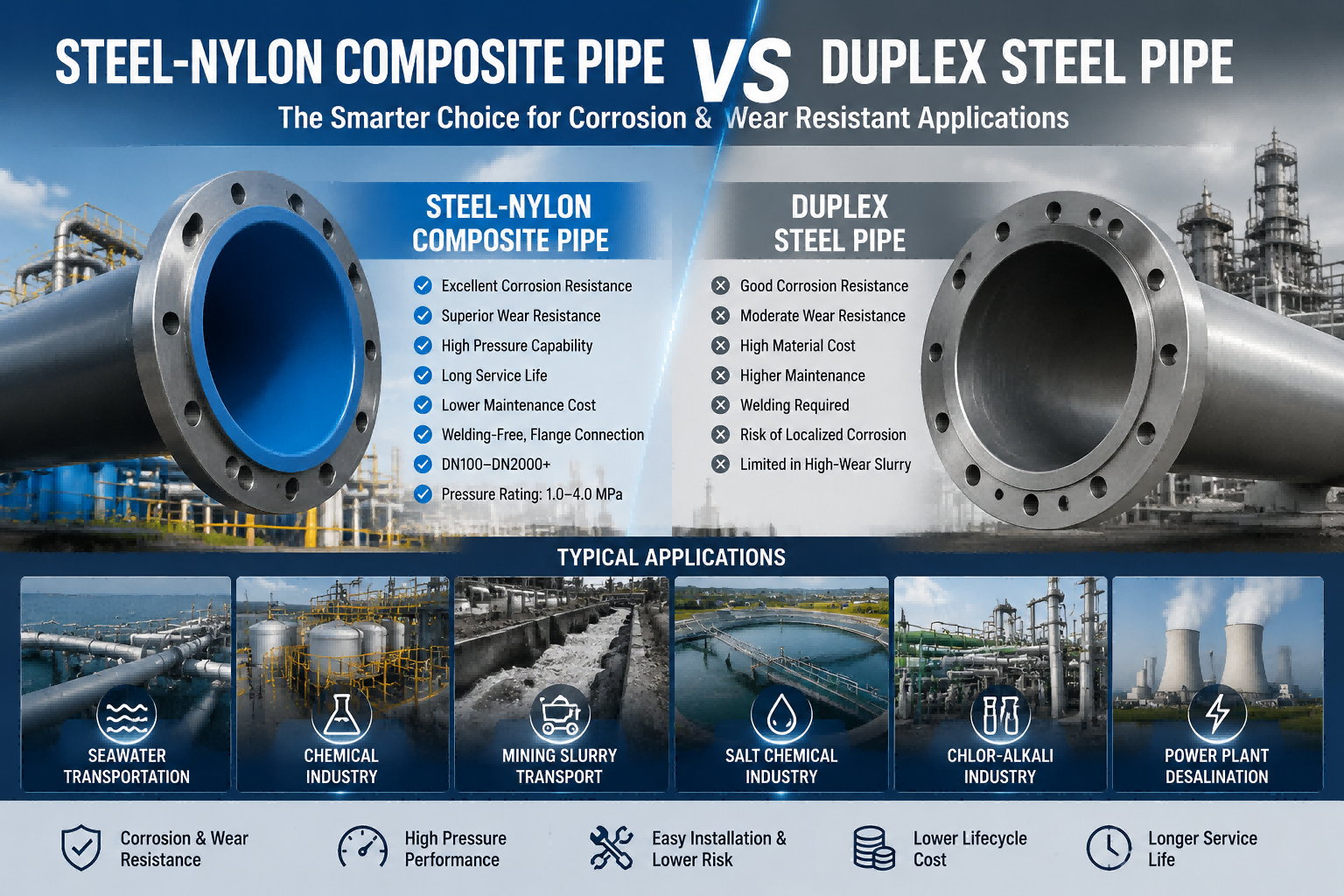
Nylon-steel composite pipe is not a simple coating. It uses a high-quality carbon steel or alloy steel seamless pipe as the outer substrate, with a specially modified nylon layer (often PA12, PA11, or toughened and reinforced PA6) tightly lined on the inner wall through a specialized process, forming high-strength mechanical anchoring and chemical bonding between the two layers. It’s like putting a highly elastic, corrosion-resistant “nylon armor” on a steel giant:
**Outer steel skeleton**: Takes on all the pipeline pressure, external impacts, and structural loads, ensuring absolute safety at design pressures (up to 30 MPa and beyond).
**Inner nylon liner**: Completely blocks contact between corrosive media and the steel, while providing an extremely low friction coefficient, exceptional wear resistance, and a broad temperature adaptability.
This function-separated design fundamentally resolves the conflict that no single material can simultaneously deliver “high strength + total corrosion resistance + wide temperature range”.
Hardcore Performance 1: Composed Handling of Extreme Temperatures
The biggest temperature challenge in oil and gas fields is undoubtedly the combination of high-low temperature cycling and extreme thermal conditions. In the Alaskan permafrost, pipes must resist brittle fracture at -50°C; in heavy oil steam flooding lines, the medium temperature often fluctuates between 90°C and 110°C year-round.
**Low-temperature toughness**: The selected specialty nylon retains an extremely high elongation at break even at -50°C, completely unlike ordinary plastics that become brittle and crack. The external steel pipe itself possesses reliable impact toughness at low temperatures, providing dual assurance for safe unloading, handling, and buried installation in extreme cold regions.
**High-temperature strength retention**: Thanks to long-chain nylons (such as PA12 and PA11) and heat stabilization modification, the nylon liner shows minimal degradation in tensile strength and pressure-bearing capacity in oil-water mixtures at 110°C, and even up to 120°C for short periods. Its high heat deflection temperature means it won’t soften or collapse. This allows it to cover the vast majority of oilfield thermal requirements — from cold water injection to steam huff-and-puff — truly “mastering both high and low temperatures.”
Hardcore Performance 2: Unfazed by Strong Alkali and Complex Chemical Media
In tertiary oil recovery, alkali flooding and alkaline-surfactant-polymer (ASP) flooding involve long-term injection of high-concentration NaOH or Na₂CO₃ solutions, with pH values commonly reaching 12–14. Steel pipes in this environment suffer severe caustic embrittlement and corrosion, while stainless steel struggles to avoid stress corrosion cracking. The nylon liner of the composite pipe is one of the very few polymer materials naturally immune to strong alkali.
**Chemical inertness**: After immersion in a 30% NaOH solution at 80°C for tens of thousands of hours, PA12 liner shows over 95% retention in both weight change and mechanical properties, with virtually no swelling or degradation.
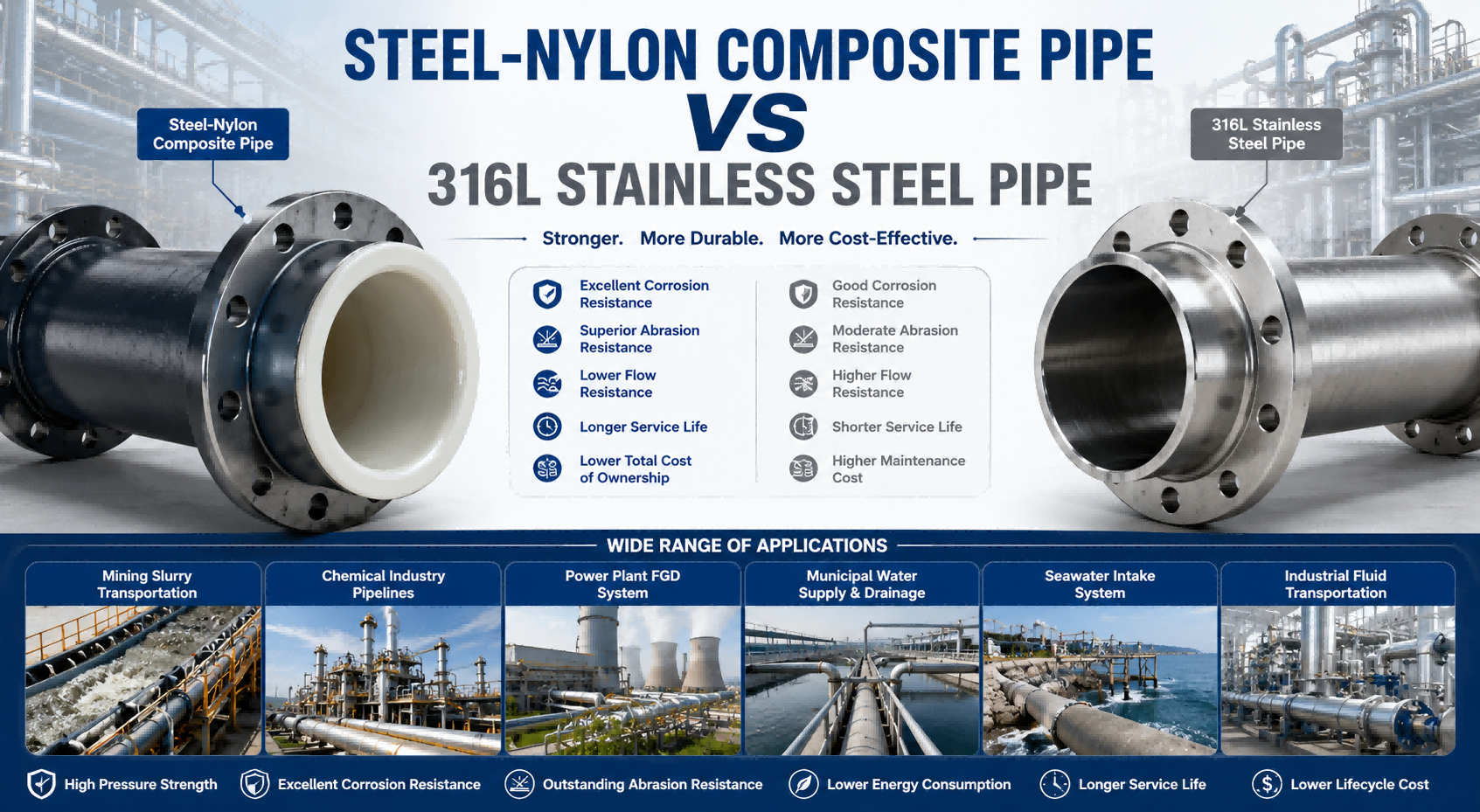
**Permeation resistance and blistering prevention**: The composite pipe’s uniquely dense crystalline structure and tight bonding with the steel layer effectively block the permeation of small molecules and dissolved gases, eliminating liner blistering (RGD failure) caused by rapid gas decompression. In sour oil and gas environments containing H₂S and CO₂, it also demonstrates extremely low permeability, with an anti-corrosion lifespan far exceeding that of duplex stainless steel.
Comparative tests show that in an alkaline solution circulating environment with pH >13, the annual corrosion rate of nylon-steel composite pipe is virtually undetectable, whereas carbon steel pipelines under the same conditions suffer perforation and failure within less than a year.
Hardcore Performance 3: Ultra-High Strength and Fatigue Life Resistance
Oil and gas pipelines frequently face multiple challenges such as ground subsidence, pressure fluctuations, and water hammer. Purely non-metallic pipes often fail due to insufficient ring stiffness or fatigue. Nylon-steel composite pipe perfectly inherits the strength genes of steel:
**Pressure rating**: Pipe design pressures easily cover the range from 4 MPa to 35 MPa, with a burst pressure safety factor ≥ 3 times, meeting the demands of deep-well water injection and high-pressure gathering and transportation.
**Anti-fatigue characteristics**: The steel substrate’s fatigue limit is far higher than that of plastics, and coupled with the damping and cushioning effect of the nylon liner, the pipeline demonstrates an ultra-long service life under frequent pressure cycling and vibration conditions. At a high-pressure alkali injection station in Xinjiang, φ168×12 nylon-steel composite pipes have operated continuously for over 7 years without leakage, whereas previously used stainless steel and FRP pipes both developed leaks within 2–3 years.
Hardcore Performance 4: Wear Resistance and Drag Reduction for Constant Transport Efficiency
Sand- and polymer-laden produced fluids not only create bottom erosion grooves in steel pipes but also cause scaling on the inner wall, leading to a gradual decline in flow rate over years. The inner surface of nylon-steel composite pipe rivals that of polished stainless steel in smoothness, with a friction coefficient of only 0.02–0.03, and it has self-lubricating properties.
**Wear resistance**: Modified nylon has a wear resistance index 3–5 times that of carbon steel. In high-velocity erosion tests with 10% sand content, its weight loss was only one-quarter that of a steel pipe liner.
**Scale prevention and energy saving**: The non-polar surface makes it difficult for inorganic scale to adhere; the inner diameter remains virtually unchanged over long-term operation. This reduces pumping energy consumption by 10%–20% compared to steel pipes, substantially cutting transportation costs over the entire life cycle.
Becoming the New Benchmark: Speaking with Total Life-Cycle Cost
The reason nylon-steel composite pipe is defined as the new benchmark for oil and gas field specialty pipes is not just its breakthrough in any single performance aspect, but that it fundamentally rewrites the material selection logic for piping under difficult operating conditions — **no longer does one need to sacrifice strength for corrosion resistance, nor compromise with expensive specialty alloys for temperature and pressure tolerance.**
**Overall investment optimization**: Although the per-meter price is higher than ordinary carbon steel pipe, it eliminates the need for additional internal anti-corrosion, cathodic protection, or frequent replacement, reducing comprehensive construction and maintenance costs by 30%–50%.
**Zero leakage, zero pollution**: Achieving corrosion-free and leak-free operation in strong alkali and high-temperature oil media truly fulfills HSE management objectives.
**Swift construction**: Long single-piece lengths, flexible connection methods (threaded, flanged, or specialized mechanical couplings), and a weight significantly lower than solid metal specialty pipes shorten the commissioning cycle.
From ASP flooding alkali injection trunk lines in Daqing Oilfield, to high-temperature oil gathering in Middle Eastern deserts, to offshore platform ballast lines with stringent volume and weight limits, the benchmark-setting application of nylon-steel composite pipe is being replicated globally.
**Conclusion**
When a pipeline faces the triple challenge of extreme high and low temperatures, strong alkali corrosion, and high-pressure erosion simultaneously, traditional thinking of “cost-effectiveness” no longer applies. Only a product reconstructed from the very foundation of material composite science can deliver an answer. With its steel skeleton and nylon chemical armor, nylon-steel composite pipe has submitted a hardcore engineering answer sheet. If you are looking for a long-life, maintenance-free pipeline solution for transporting aggressive media, welcome to contact our technical team for tailored composite pipe technical specifications and selection guidance.
How to Extend the Lifespan of Urban Water Supply and Drainage Pipes by 50 Years? The Secret Lies in the Corrosion-Resistant Genes of Nylon Pipes
Built-In Flange, Integrally Formed – Installation Twice as Fast: How Nylon Pipes Are Redefining Construction Efficiency for Chemical Pipelines
Related blog