Phosphate Chemical Slurry Pipes Wearing Through Too Fast? Try High-Wear-Resistant Reinforced Nylon Pipe—Drastically Reduce Unplanned Shutdowns

In phosphate fertilizer and phosphoric acid plants, there is a sound that plant managers dread: the sudden gush of slurry from a pipe that has finally worn through. Phosphate rock slurry—a dense, fast-moving mixture of ground phosphate ore, sand, clay, and often recycled acidic water—is one of the most abrasive substances ever put through a pipe. The hard, angular silica and phosphate particles scour the pipe wall relentlessly. A carbon steel pipe that might last years in clean water service can be perforated in a matter of months, sometimes weeks, in slurry duty. Every unexpected leak triggers an unplanned shutdown, halting production, diverting maintenance crews from planned work, and eating into profitability. But there is a proven alternative: **High-Wear-Resistant Reinforced Nylon Pipe**, an engineered polymer piping system that laughs at abrasion, resists the corrosive acids that accompany phosphate processing, and arrives with integral flanges to slash installation and repair time. This article explores why reinforced Nylon pipe is fast becoming the go-to slurry solution for phosphate operations worldwide.
The Merciless Wear Mechanisms in Phosphate Slurry
To understand why Nylon pipe is so effective, we must first recognize the forces destroying conventional pipes:
**Two-Body and Three-Body Abrasion:** Sliding bed of particles at the pipe invert (bottom) causes gouging abrasion, while suspended particles in turbulent flow strike the wall at higher velocities, creating erosion. Phosphate ore typically contains quartz (Mohs hardness 7) and apatite (Mohs hardness 5), capable of cutting through steel with ease.
**Velocity Multiplier:** Wear rate in slurry pipelines increases exponentially with flow velocity—often proportional to velocity cubed. Phosphate plants push slurries at 2 to 5 m/s to keep solids suspended. At these speeds, the kinetic energy of each particle impact is enormous.
**Corrosion–Erosion Synergy:** The slurry water is rarely neutral. In wet-process phosphoric acid plants, the slurry is acidic (pH 1–3, containing sulfuric and phosphoric acids). This acid attacks the steel, removing work-hardened surfaces and continuously exposing fresh, softer metal to particle erosion. The two mechanisms feed each other, and pipe life plummets.
**Bends and Tees as Failure Hotspots:** Centrifugal force throws particles against the outer radius of elbows, making them wear through at the back faster than any straight section. Traditional solutions—ceramic-backed elbows, hardfacing, wear-back tees—add cost, weight, and complexity while still being consumed eventually.
**Velocity Multiplier:** Wear rate in slurry pipelines increases exponentially with flow velocity—often proportional to velocity cubed. Phosphate plants push slurries at 2 to 5 m/s to keep solids suspended. At these speeds, the kinetic energy of each particle impact is enormous.
**Corrosion–Erosion Synergy:** The slurry water is rarely neutral. In wet-process phosphoric acid plants, the slurry is acidic (pH 1–3, containing sulfuric and phosphoric acids). This acid attacks the steel, removing work-hardened surfaces and continuously exposing fresh, softer metal to particle erosion. The two mechanisms feed each other, and pipe life plummets.
**Bends and Tees as Failure Hotspots:** Centrifugal force throws particles against the outer radius of elbows, making them wear through at the back faster than any straight section. Traditional solutions—ceramic-backed elbows, hardfacing, wear-back tees—add cost, weight, and complexity while still being consumed eventually.
The result of this unforgiving environment is a maintenance nightmare: emergency pipe repairs, replacement spool inventory, scaffold erection in acid-contaminated areas, and thousands of tonnes of lost production while the line is isolated and drained. For a large phosphate complex, unplanned slurry line shutdowns can easily cost hundreds of thousands of dollars per event.
Why Traditional Materials Fall Short
**Carbon Steel:** Cheap to buy but devoured by the combined acid–erosion attack. Often requires continuous hardfacing or internal ceramic tile lining, which adds weight and is prone to tile loss, leaving exposed steel patches.
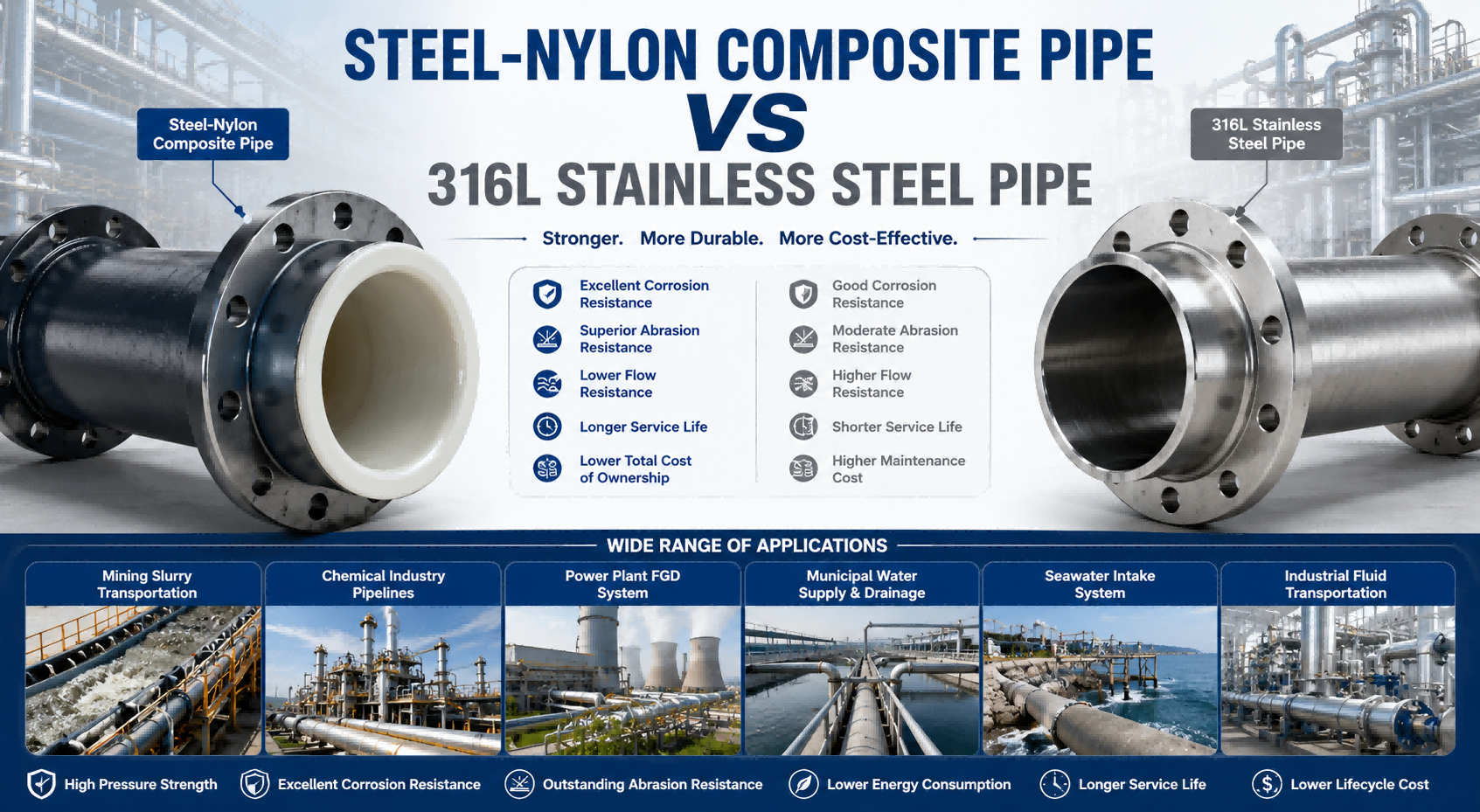
**Stainless Steels (304L, 316L):** Offer better acid resistance but little improvement in hardness. They are still soft compared to quartz; erosion–corrosion still dominates. Pitting and chloride attack also enter if the water chemistry varies.
**Rubber-Lined Steel:** Rubber provides good particle absorption, but at high particle sharpness, it can be cut or gouged. In acidic, high-temperature slurry (above 80°C), rubber linings can debond, swell, or harden and crack. Inspecting a rubber lining requires scaffolding and confined-space entry, so failures are often undetected until the steel shell leaks.
**Ceramic-Lined or Basalt-Lined Pipe:** Excellent wear resistance but extremely heavy, brittle, and limited in length. Flanged connections are complex; a dropped tool during install can crack a lining segment. Ceramic pipes are also economically impractical in diameters above DN300–400.
**HDPE and PP Pipes:** While corrosion-proof, these are relatively soft; sharp phosphate particles will cut and erode them rapidly, especially at elevated temperatures.
Enter Reinforced PAMC Pipe: A Material Born to Resist Abrasion
Reinforced Nylon (Polymer Alloy Matrix Composite) pipe is a high-performance thermoplastic engineered from a carefully balanced alloy of polymers and internal reinforcing agents. It is not a simple polyolefin; molecular modification and reinforcement give it an unusual combination of properties that make it ideal for aggressive slurries:
**Exceptionally High Wear Resistance:** Standardized abrasion tests (such as the sand-slurry or Taber test) consistently show reinforced PAMC to be **3 to 5 times more wear-resistant than ordinary carbon steel**, and in many cases outperforming even hardened alloy steels. This is due to the material’s inherent ductility, which absorbs impact energy without micro-fracturing, and its self-lubricating surface that reduces the coefficient of sliding friction. Particles tend to skid rather than dig in.
**No Corrosion Component in the Wear Equation:** Nylon is chemically inert to sulfuric acid, phosphoric acid, hydrofluoric acid (in low concentrations often found in certain phosphate processes), and any acidic brine. Therefore, there is no corrosion softening the pipe wall—the only material loss is pure mechanical wear, which occurs at a predictably slow rate. The self-reinforcing wear surface remains hard throughout the life of the pipe.
**Smooth Bore, No Scaling:** Phosphate slurries often contain gypsum or other precipitates that form scale on steel and rubber-lined pipes, reducing internal diameter and increasing flow velocity and wear in remaining open areas. Nylon’s extremely low surface energy resists scale adhesion. The pipe stays clear, maintaining design velocities and minimizing localized turbulence-related wear.
**Broad Temperature Capability (-36°C to 160°C):** Many phosphate process streams, such as reactor discharge and hot phosphoric acid interstage lines, run at 80–120°C. Rubber-lined pipes are temperature-limited; Nylon operates comfortably in this range without softening or losing abrasion resistance.
**Impact Toughness:** Unlike ceramic-lined pipes, Nylon will not crack under the sudden impact of a large lump of rock or during rough handling during maintenance. It is tough and resilient.
**No Corrosion Component in the Wear Equation:** Nylon is chemically inert to sulfuric acid, phosphoric acid, hydrofluoric acid (in low concentrations often found in certain phosphate processes), and any acidic brine. Therefore, there is no corrosion softening the pipe wall—the only material loss is pure mechanical wear, which occurs at a predictably slow rate. The self-reinforcing wear surface remains hard throughout the life of the pipe.
**Smooth Bore, No Scaling:** Phosphate slurries often contain gypsum or other precipitates that form scale on steel and rubber-lined pipes, reducing internal diameter and increasing flow velocity and wear in remaining open areas. Nylon’s extremely low surface energy resists scale adhesion. The pipe stays clear, maintaining design velocities and minimizing localized turbulence-related wear.
**Broad Temperature Capability (-36°C to 160°C):** Many phosphate process streams, such as reactor discharge and hot phosphoric acid interstage lines, run at 80–120°C. Rubber-lined pipes are temperature-limited; Nylon operates comfortably in this range without softening or losing abrasion resistance.
**Impact Toughness:** Unlike ceramic-lined pipes, Nylon will not crack under the sudden impact of a large lump of rock or during rough handling during maintenance. It is tough and resilient.
Integral Flanges: The Answer to Rapid Repair and Expansion
In a phosphate plant, how fast you can replace or extend a slurry line directly impacts production. A fundamental advantage of our reinforced Nylon pipe system is that it comes **with integral flanges molded as one piece with the pipe**. This is not an add-on; the entire wetted surface from one flange face to the other is seamless Nylon.
Compare a repair scenario:
**Steel pipe repair:** Isolate, drain, purge, hot work permit, cut out damaged spool, weld new spool in place, perform weld NDT, apply internal coating or lining repair, wait for cure, return to service. Can take 12–24 hours or longer.
**Nylon pipe repair:** Isolate, drain, unbolt damaged spool, bolt in pre-fabricated spare spool with integral flanges, torque, and return to service. A crew can complete the changeout in under two hours.
This speed fundamentally changes how a plant can manage slurry line maintenance. Strategic spare spools can be kept on hand; unplanned outages become short planned interventions. In greenfield projects, the bolt-up-only installation saves weeks in the construction schedule and eliminates all field welding in slurry pipe sections, radically improving construction safety.
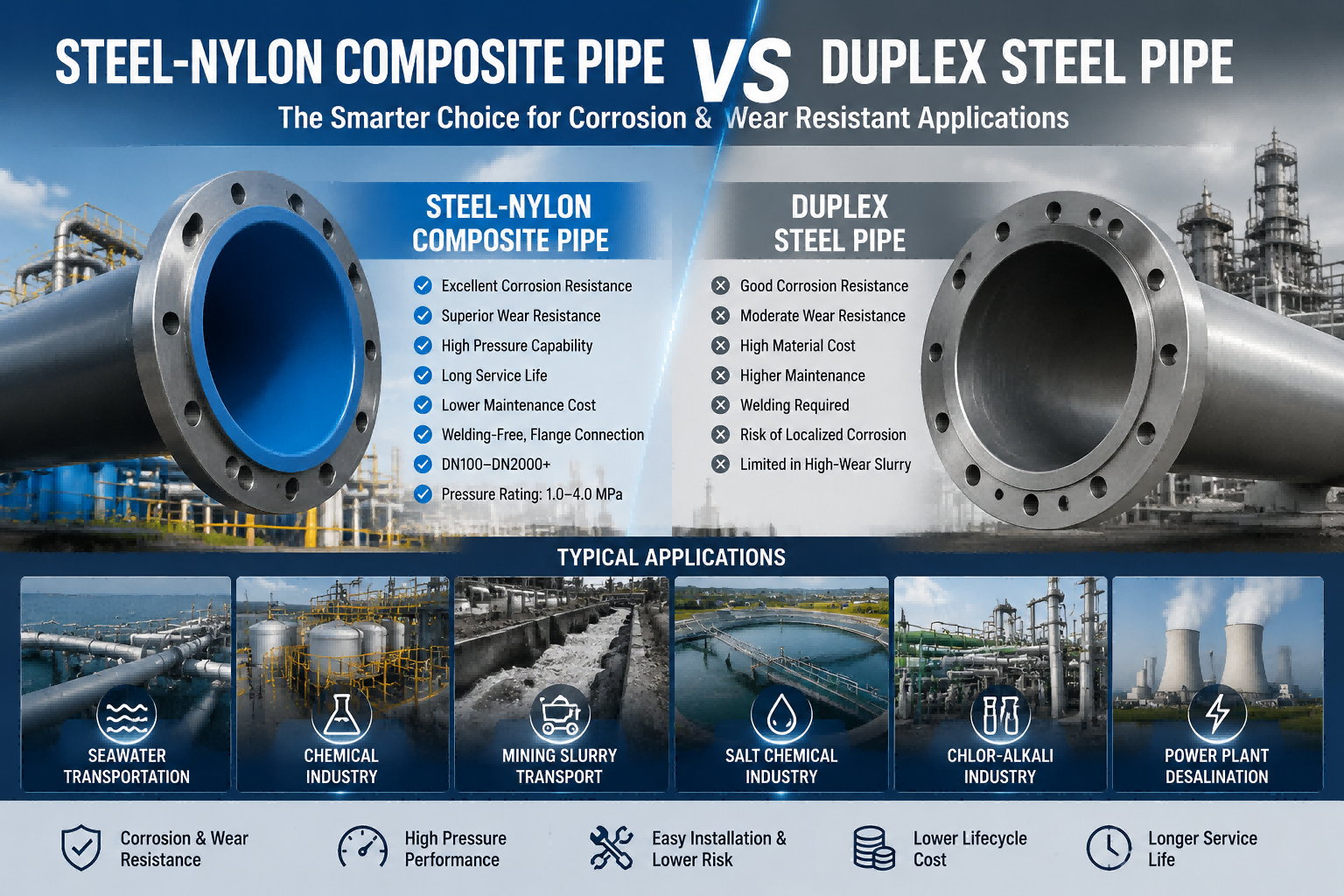
Flanges can be drilled to any international standard (ANSI, DIN, JIS, etc.) to match existing plant specifications. Gasket sealing is reliable from vacuum up to the full 2.5 MPa rating of solid-wall Nylon pipe. For even higher-pressure slurry transport (e.g., long-distance phosphate concentrate pipelines), we offer **Steel-Nylon Composite Pipe**, combining the identical Nylon liner and integral flange with a pressure-bearing steel shell rated to 4.0 MPa.
Beyond the Pipe: A Full System of Fittings
Wear is rarely uniform; elbows typically wear fastest. We manufacture complete Nylon-lined or solid-Nylon fittings including elbows (long-radius and short-radius), tees, wyes, reducers, and stub ends—all with integral flanges, all with the same 3–5× wear advantage. For the most aggressive wear points, we can increase wall thickness or provide wear-back tees in Nylon without introducing any metal-to-slurry contact.
Quantifying the Reduction in Unplanned Downtime
Consider a typical phosphoric acid attack section with multiple slurry transfer lines and recycle lines:
**Before Nylon (rubber-lined steel):** Average pipe spool life in critical high-wear positions: 6 to 12 months. Emergency line breaks: 4–6 per year. Each break causes 8–16 hours of downtime on a connected production train producing 500 tonnes P₂O₅ per day. Annual unplanned downtime due to pipe failures: over 100 hours.
**After Nylon conversion:** Spool life extends to over 5 years in identical positions. Emergency breaks drop to near zero. The plant can schedule bulk replacement during planned biennial turnarounds. The production gain alone pays for the incremental pipe material cost within the first year.
**After Nylon conversion:** Spool life extends to over 5 years in identical positions. Emergency breaks drop to near zero. The plant can schedule bulk replacement during planned biennial turnarounds. The production gain alone pays for the incremental pipe material cost within the first year.
These are not theoretical numbers; they are drawn from real installations in China’s major phosphate fertilizer complexes, where reinforced Nylon pipe has been the standard for slurry services for over four decades.
40 Years of Proven Performance in Phosphate and Chemical Industries
Our company has been at the forefront of solving the slurry pipe problem since the early 1980s. In that time, we have supplied reinforced Nylon and steel-Nylon composite pipe systems to virtually every large phosphate fertilizer and phosphoric acid producer in China, including integrated complexes for DAP, MAP, and purified wet-process phosphoric acid. This long operational history has given us deep knowledge of wear patterns, optimum flow velocities, support spacing, and thermal expansion compensation specific to phosphate slurries. We can offer design guidance, not just pipes.
Our manufacturing capability extends from DN25 up to **DN2200 and beyond**, in pressure ratings from 1.0 to 4.0 MPa. We provide full system take-offs, including pipes, flanges, fittings, expansion joints, and valves where required.
Conclusion: Stop Feeding the Scrap Bin. Feed Production Instead.
Every unplanned shutdown a phosphate plant suffers from a worn-out slurry pipe is an avoidable loss. The pipe material exists that can handle the punishing combination of abrasion and acid corrosion: reinforced Nylon. It outlasts steel by a factor of three to five; it installs and repairs in a fraction of the time thanks to integral flanges; and it removes the hidden costs of corrosion, scaling, and product contamination. For plant managers looking to stabilize their operations and reduce the maintenance budget, converting critical slurry circuits to reinforced Nylon pipe is one of the highest-return decisions available.
Contact our engineering team with your pipe class, slurry analysis, and flow parameters. We will prepare a detailed technical proposal, an estimated service life comparison against your current material, and a customized economic justification.
Urban Water Supply and Drainage Network Upgrades: Why More and More Projects Choose Non-Toxic Reinforced Nylon Pipe
How to Choose Pipes for Salt Chemical and Seawater Transport? Non-Toxic, Corrosion-Resistant, Integral-Flanged Reinforced Nylon Pipe—A Complete Package
Related blog