Extreme-Service Pipe Selection Guide: From Mine Tailings to Power Plant Circulating Water—Steel-Nylon Composite Pipe as the One-Stop Solution

Industrial piping systems do not get to choose their environment. Some must swallow rivers of sharp, acidic tailings slurry thundering through a pipeline at five meters per second. Others must endure decades of hot, oxygenated, scaling circulating water in a power plant, where a single pinhole leak can force a unit offline. Still others handle both regimes on the same site. In these extreme services, selecting the wrong pipe material leads to rapid failure, unplanned downtime, and endless maintenance. The traditional approach—picking a different specialized material for each service—multiplies inventory, complicates training, and still leaves weak links. This guide presents an alternative that is changing how heavy industry approaches extreme-duty piping: **Steel-Nylon Composite Pipe**, a single, unified pipe platform that excels from mine tailings to power plant water circuits and almost everything aggressive in between.
What Exactly Is “Extreme Service” in Piping?
Before selecting a pipe, you must define the enemy. Extreme service usually involves a combination of several of the following:
**High Abrasion/Wear:** Conveying slurries with hard, angular solids (silica sand, ore, bottom ash, limestone).
**Severe Corrosion:** Acidic or alkaline process water, high chlorides, H₂S, or microbiological activity.
**High Pressure:** Long-distance transport or deep pump stations pushing 2.5 to 4.0 MPa and beyond.
**Wide Temperature Swings:** From subzero winter exposure to process temperatures exceeding 100°C.
**Large Diameter:** Mains over DN1000, where the mass and cost of metallic pipes become overwhelming.
**Erosion–Corrosion Synergy:** The combined attack that eats through protective scales and coatings.
**Severe Corrosion:** Acidic or alkaline process water, high chlorides, H₂S, or microbiological activity.
**High Pressure:** Long-distance transport or deep pump stations pushing 2.5 to 4.0 MPa and beyond.
**Wide Temperature Swings:** From subzero winter exposure to process temperatures exceeding 100°C.
**Large Diameter:** Mains over DN1000, where the mass and cost of metallic pipes become overwhelming.
**Erosion–Corrosion Synergy:** The combined attack that eats through protective scales and coatings.
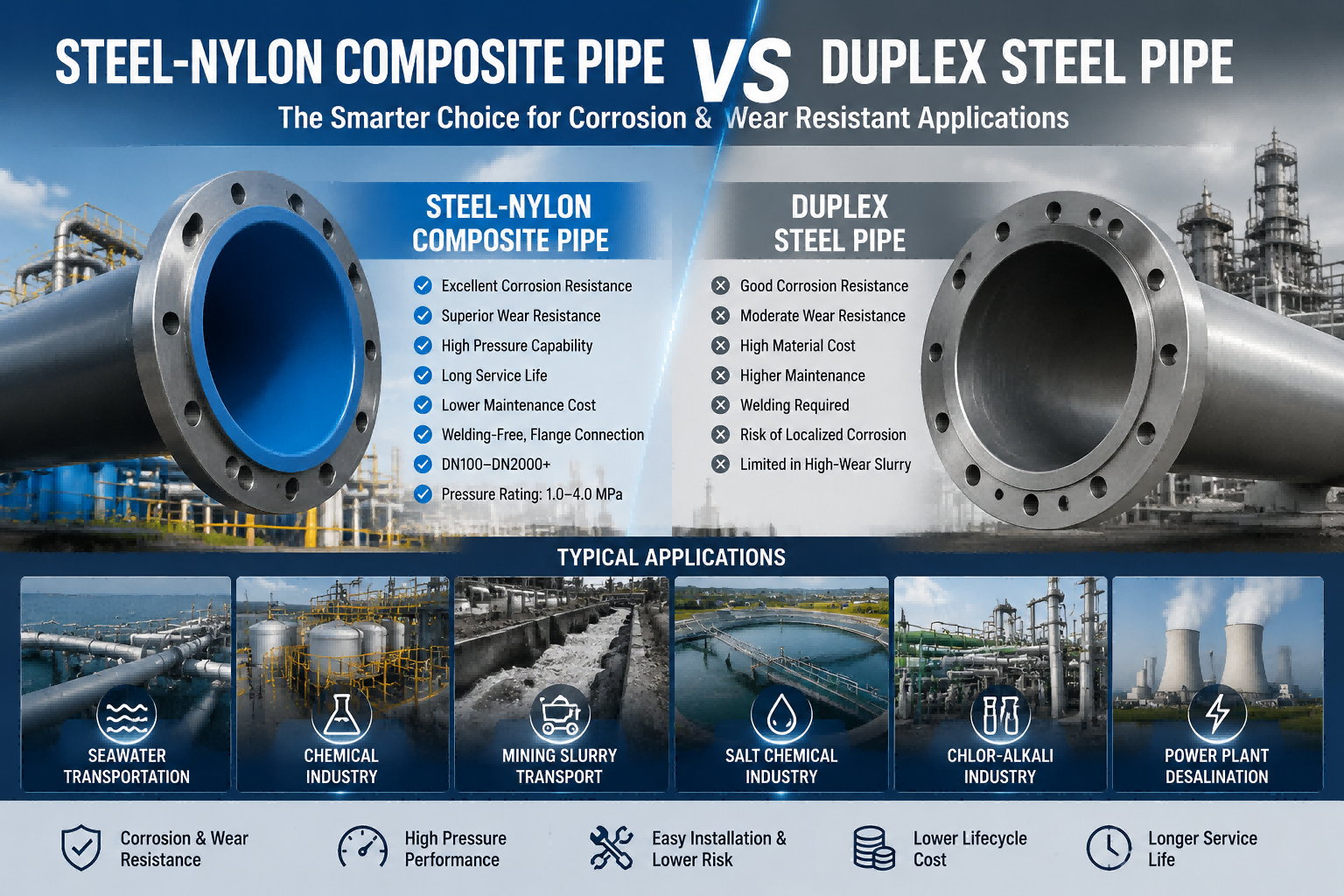
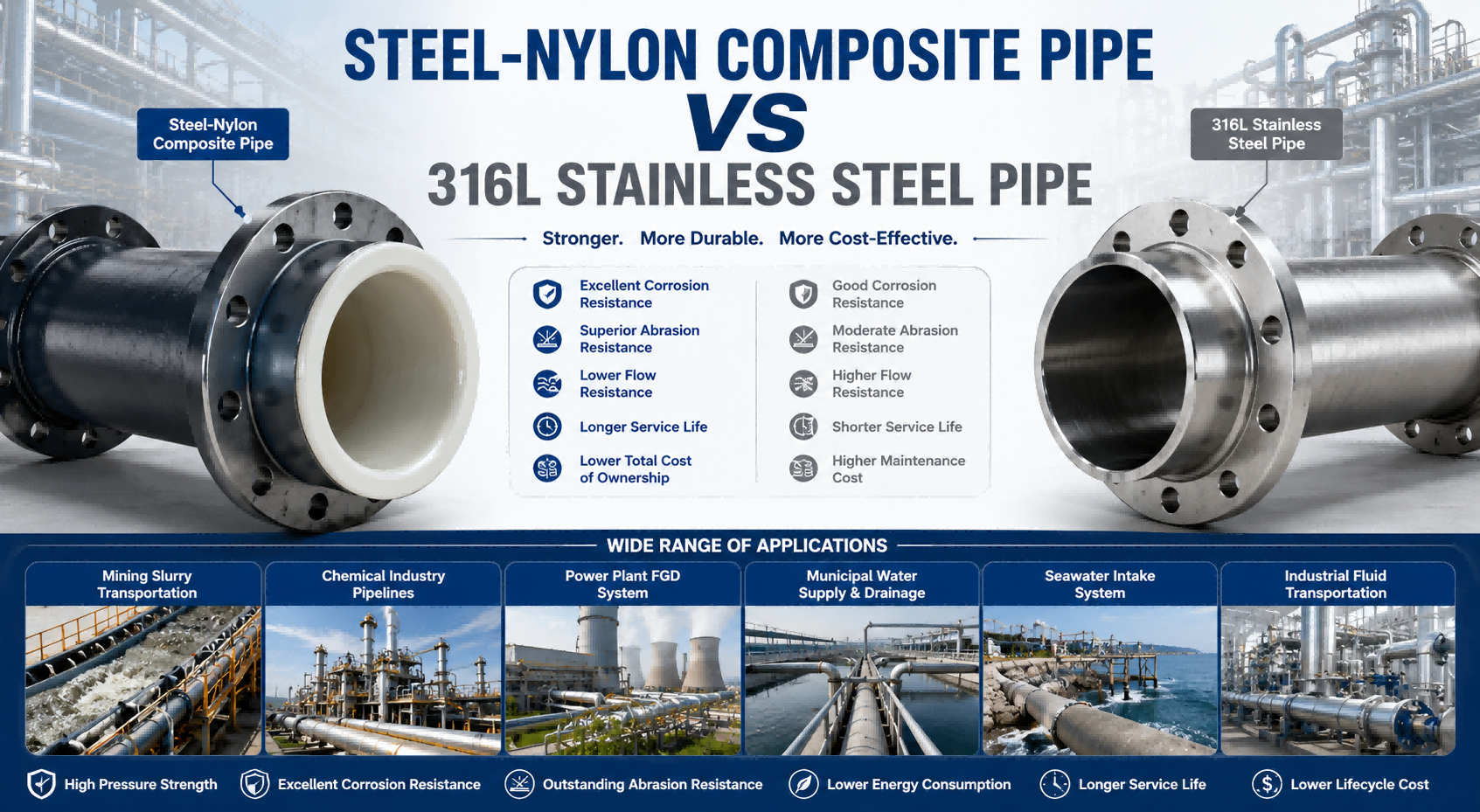
When even two of these factors overlap, conventional single-material pipes—bare steel, rubber-lined steel, HDPE, or GRP—begin to reveal their fatal compromises. Steel-Nylon composite pipe was designed precisely for these overlapping, unforgiving conditions.
The Anatomy of Steel-Nylon Composite Pipe
Steel-Nylon composite pipe is a dual-material system:
1. **An outer carbon steel shell**, engineered to carry all pressure-induced hoop stress. This shell provides the mechanical backbone, enabling high pressure ratings (1.0 to 4.0 MPa) across a vast diameter range—from small-bore lines to **DN2000+ trunk mains**.
2. **An inner continuous liner of reinforced Nylon** , molecularly bonded or mechanically interlocked to the steel wall. This liner is the working surface: it touches the fluid, resists abrasion and corrosion, provides a permanently smooth bore, and isolates the steel from any chemical or erosive attack.
2. **An inner continuous liner of reinforced Nylon** , molecularly bonded or mechanically interlocked to the steel wall. This liner is the working surface: it touches the fluid, resists abrasion and corrosion, provides a permanently smooth bore, and isolates the steel from any chemical or erosive attack.
Unlike loose-fit liners that can collapse or debond under vacuum or temperature cycling, the Nylon liner in our composite pipe is integrated into a single structural unit. The combination yields a pipe that simultaneously resists pressure, wear, corrosion, and temperature—without asking the steel to be chemically inert or the polymer to be a pressure vessel.
Extreme Service No. 1: Mine Tailings and Slurry Transport
Mining operations—copper, gold, iron ore, phosphate, oil sands—produce tailings and concentrate slurries that are legendary pipe killers. Consider a typical copper tailings line: the slurry is 40–50% solids by weight, loaded with hard, freshly crushed silicates (quartz, feldspar). It flows at 3–5 m/s to prevent settling. The carrier water is often acidic due to sulfide oxidation. This is a perfect storm of abrasion, corrosion, and hydraulic stress.
**Why Steel-Nylon composite pipe for tailings?**
**Wear Resistance:** The Nylon liner delivers **3 to 5 times the wear life of carbon steel** in abrasive slurry service. Its self-lubricating surface allows particles to skid rather than gouge. In many installations, the liner shows minimal measurable thickness loss after years of continuous operation.
**Acid and Alkaline Immunity:** Unlike steel, which softens under acidic attack and then erodes faster, Nylon is chemically inert to weak acids, alkaline cyanide leachates, and saline process water. There is no corrosion component accelerating the wear.
**No Scaling or Freezing of Slurry in Place:** The ultra-smooth bore resists calcium sulfate or gypsum scaling common in gold tailings. In sub-Arctic mines, the pipe remains impact-tough down to **-36°C**, eliminating brittle fracture during seasonal shutdowns.
**High Pressure, Long Distance:** Steel-Nylon composite pipe can be rated to 4.0 MPa, allowing tailings to be pumped tens of kilometers to the disposal area without intermediate booster stations. The pressure containment comes from the steel shell, not the liner, so wall thickness is predictable and design is code-compliant.
**Integral Flanges for Fast Field Assembly:** Tailings lines are often laid over rough terrain. Our pipes ship with factory-integral flanges. Field crews bolt them together—no field welding, no X-ray inspection, no liner burn-through. A new tailings line can be brought online in a fraction of the time of a welded steel line.
**Acid and Alkaline Immunity:** Unlike steel, which softens under acidic attack and then erodes faster, Nylon is chemically inert to weak acids, alkaline cyanide leachates, and saline process water. There is no corrosion component accelerating the wear.
**No Scaling or Freezing of Slurry in Place:** The ultra-smooth bore resists calcium sulfate or gypsum scaling common in gold tailings. In sub-Arctic mines, the pipe remains impact-tough down to **-36°C**, eliminating brittle fracture during seasonal shutdowns.
**High Pressure, Long Distance:** Steel-Nylon composite pipe can be rated to 4.0 MPa, allowing tailings to be pumped tens of kilometers to the disposal area without intermediate booster stations. The pressure containment comes from the steel shell, not the liner, so wall thickness is predictable and design is code-compliant.
**Integral Flanges for Fast Field Assembly:** Tailings lines are often laid over rough terrain. Our pipes ship with factory-integral flanges. Field crews bolt them together—no field welding, no X-ray inspection, no liner burn-through. A new tailings line can be brought online in a fraction of the time of a welded steel line.
Extreme Service No. 2: Power Plant Circulating Water and Ash Handling
Thermal power plants—coal, gas, nuclear, and concentrated solar—depend on vast volumes of circulating water for condenser cooling. This water is often drawn from rivers, lakes, or the sea, bringing with it silt, sand, and aggressive chemistry. Simultaneously, coal-fired plants deal with highly abrasive bottom ash and fly ash slurries.
**Circulating water challenges and the Nylon solution:**
**Internal Corrosion and Biofouling:** Seawater and brackish water attack carbon steel, causing tuberculation and pitting. Micro- and macro-fouling (barnacles, mussels) colonize rough, corroded pipes, choking flow and increasing pumping costs. Nylon’s glass-smooth, biologically inert surface resists adhesion. No corrosion means no rusty nodules for larvae to grip.
**Erosion at High Velocities:** Circulating water lines can run at 2.5–3.5 m/s. Sand and silt in the water erode steel and concrete pipes over time. Nylon’s abrasion resistance maintains the wall profile, preserving pressure integrity and hydraulic efficiency.
**Wide Temperature Tolerance:** From near-freezing lake water to condenser outlet temperatures of 40–60°C (or hotter in district heating and some combined-cycle configurations), Nylon’s continuous range to **160°C** gives an enormous safety margin. Thermal expansion is managed with standard Nylon expansion joints, and the steel outer shell provides restraint when buried.
**Erosion at High Velocities:** Circulating water lines can run at 2.5–3.5 m/s. Sand and silt in the water erode steel and concrete pipes over time. Nylon’s abrasion resistance maintains the wall profile, preserving pressure integrity and hydraulic efficiency.
**Wide Temperature Tolerance:** From near-freezing lake water to condenser outlet temperatures of 40–60°C (or hotter in district heating and some combined-cycle configurations), Nylon’s continuous range to **160°C** gives an enormous safety margin. Thermal expansion is managed with standard Nylon expansion joints, and the steel outer shell provides restraint when buried.
**Ash handling challenges:**
- Bottom ash and economizer ash are extremely erosive, containing hard, glassy silica particles. Rubber-lined steel wears out quickly and requires frequent repair. Ceramic-lined pipe is expensive and limited in diameter.
- Steel-Nylon composite pipe provides high-wear resistance up to **DN1000 and beyond** in ash slurry service. Integral flanges eliminate weld corrosion at joints, a notorious failure point in ash lines.
- The Nylon liner does not require cure time after installation—ash systems can be commissioned immediately after bolting.
- Steel-Nylon composite pipe provides high-wear resistance up to **DN1000 and beyond** in ash slurry service. Integral flanges eliminate weld corrosion at joints, a notorious failure point in ash lines.
- The Nylon liner does not require cure time after installation—ash systems can be commissioned immediately after bolting.
Extreme Service No. 3: Beyond Mining and Power—The All-Rounder
One of the most compelling arguments for Steel-Nylon composite pipe is its versatility across multiple plant services, dramatically simplifying the piping specification:
**Chemical and fertilizer plants:** Phosphoric acid, sulfuric acid, chlorides, hot caustic—all handled without stainless steel's pitting risk.
**Desalination plants:** Seawater intake, brine outfall, dual-media filter feed lines—corrosion-proof, non-toxic to marine life.
**Steel mills:** Pickling acid, rinse water, high-pressure descaling water, and blast furnace gas scrubber slurry—a single pipe material instead of four.
**Dredging and port terminals:** High-density sediment slurry at high flow rates; Nylon’s low friction surface reduces pumping power and resists gouging from shells and debris.
**Urban water mega-projects:** DN2000+ steel-Nylon composite pipes for water diversion mains, combining high pressure and massive flow with zero internal corrosion.
**Desalination plants:** Seawater intake, brine outfall, dual-media filter feed lines—corrosion-proof, non-toxic to marine life.
**Steel mills:** Pickling acid, rinse water, high-pressure descaling water, and blast furnace gas scrubber slurry—a single pipe material instead of four.
**Dredging and port terminals:** High-density sediment slurry at high flow rates; Nylon’s low friction surface reduces pumping power and resists gouging from shells and debris.
**Urban water mega-projects:** DN2000+ steel-Nylon composite pipes for water diversion mains, combining high pressure and massive flow with zero internal corrosion.
By selecting Steel-Nylon composite pipe as the “base” pipe specification for aggressive fluids, a plant or project can:
**Reduce material types** held in inventory.
**Simplify welding and NDE procedures** to flange bolt-up only.
**Eliminate multi-vendor piping packages**—all pipes, flanges, elbows, and tees from one source, all with identical Nylon-lined integrity.
**Train one construction crew** on one joining method (bolted flanges) for most services.
**Achieve confidence in interconnections:** no galvanic corrosion between different pipe materials sharing a pipe rack.
**Simplify welding and NDE procedures** to flange bolt-up only.
**Eliminate multi-vendor piping packages**—all pipes, flanges, elbows, and tees from one source, all with identical Nylon-lined integrity.
**Train one construction crew** on one joining method (bolted flanges) for most services.
**Achieve confidence in interconnections:** no galvanic corrosion between different pipe materials sharing a pipe rack.
The Integral Flange Difference: Speed, Safety, and Certainty
Every extreme-service pipe system is only as reliable as its joints. The factory-integral Nylon flange built into our composite pipes is a critical engineering feature, not an accessory:
**Homogeneous corrosion barrier across the joint:** The Nylon flange face means there is zero exposed metal at the gasket interface. No under-lining wicking, no crevice, no weld root corrosion.
**Rapid field installation:** Bolt, torque, pressure test. No hot work, no weather-dependent welding. For remote mines, this decouples pipeline installation from the availability of specialized welders and reduces camp costs.
**Reconfigurability:** A tailings line extension, a cooling water reroute, or an ash system upgrade can be achieved by unbolting, re-routing, and adding spools. Reusability is inherent.
**Rapid field installation:** Bolt, torque, pressure test. No hot work, no weather-dependent welding. For remote mines, this decouples pipeline installation from the availability of specialized welders and reduces camp costs.
**Reconfigurability:** A tailings line extension, a cooling water reroute, or an ash system upgrade can be achieved by unbolting, re-routing, and adding spools. Reusability is inherent.
Flanges are machined to ANSI, AWWA, DIN, JIS, BS, or GOST standards as required. Sealing from full vacuum to 4.0 MPa with standard gaskets is proven and reliable.
Selecting the Right Grade: A Practical Guide
Our Steel-Nylon composite pipe engineering team uses the following decision tree for extreme service:
1. **Characterize the Medium:** Provide a complete chemical analysis, particle size distribution, and solids concentration.
2. **Define Operating Envelope:** Maximum pressure (including surge), maximum and minimum temperature, design life.
3. **Determine Diameter and Velocity:** Desired pipe ID, flow velocity range, any transient slug or dune flow.
4. **Select Pressure Shell:** Based on pressure and diameter, we select the steel grade and wall thickness per code (ASME B31.3/B31.4, AWWA, ISO, or customer-specified).
5. **Specify Liner Thickness:** Based on predicted wear rate (using decades of empirical data across ore types) plus a safety factor, we select the Nylon liner thickness. For extreme wear points like elbows, we can thicken the liner locally or provide wear-back fittings.
6. **Flange Selection:** Flange class and drilling per project piping specification.
2. **Define Operating Envelope:** Maximum pressure (including surge), maximum and minimum temperature, design life.
3. **Determine Diameter and Velocity:** Desired pipe ID, flow velocity range, any transient slug or dune flow.
4. **Select Pressure Shell:** Based on pressure and diameter, we select the steel grade and wall thickness per code (ASME B31.3/B31.4, AWWA, ISO, or customer-specified).
5. **Specify Liner Thickness:** Based on predicted wear rate (using decades of empirical data across ore types) plus a safety factor, we select the Nylon liner thickness. For extreme wear points like elbows, we can thicken the liner locally or provide wear-back fittings.
6. **Flange Selection:** Flange class and drilling per project piping specification.
Our database includes performance histories against copper, gold, iron, phosphate, bauxite, coal, oil sands, and many other slurries. We translate these into predicted wear lives that are conservative and field-validated.
40 Years Across China’s Toughest Industries
The claims in this guide are backed by forty years of operation in China’s largest mining, power, chemical, and water infrastructure projects. Our Steel-Nylon composite pipes have carried phosphate tailings in Yunnan, copper concentrates in Jiangxi, circulating seawater in coastal power stations in Shandong, and bottom ash in Inner Mongolia. These installations have provided the empirical foundation for our wear models, installation procedures, and life-cycle cost assessments.
Today, we serve international projects with the same engineering rigor, offering:
- Complete system take-offs and 3D pipe routing support.
- Full material test certificates, hydrotest reports, and third-party inspection facilitation.
- On-site technical advisory for installation and commissioning.
- Spare parts and long-term service agreements.
- Full material test certificates, hydrotest reports, and third-party inspection facilitation.
- On-site technical advisory for installation and commissioning.
- Spare parts and long-term service agreements.
Conclusion: One Pipe System to Unify Your Extreme Services
Extreme service piping should not require a museum of different materials to address each unique stress. Steel-Nylon composite pipe is the nearest thing to a universal extreme-duty pipe system available today. It combines the pressure strength of steel with the corrosion and wear immunity of an advanced polymer alloy, delivers it with integral flanges for rapid field assembly, and has a track record spanning four decades. Whether you are building a new tailings thickener, retrofitting a power plant circulating water line, or developing a greenfield chemical complex, a single call to our engineering team can initiate a piping solution that simplifies design, accelerates construction, and slashes total cost of ownership.
**Contact us with your extreme service challenge. Let’s engineer a pipe that thrives where others fail.**
How Much Easier Are Integral-Flanged Industrial Pipes? Fast Installation, Leak-Proof, and Full-Scene Coverage from 1.0 to 4.0 MPa
Urban Water Supply and Drainage Network Upgrades: Why More and More Projects Choose Non-Toxic Reinforced Nylon Pipe
Related blog