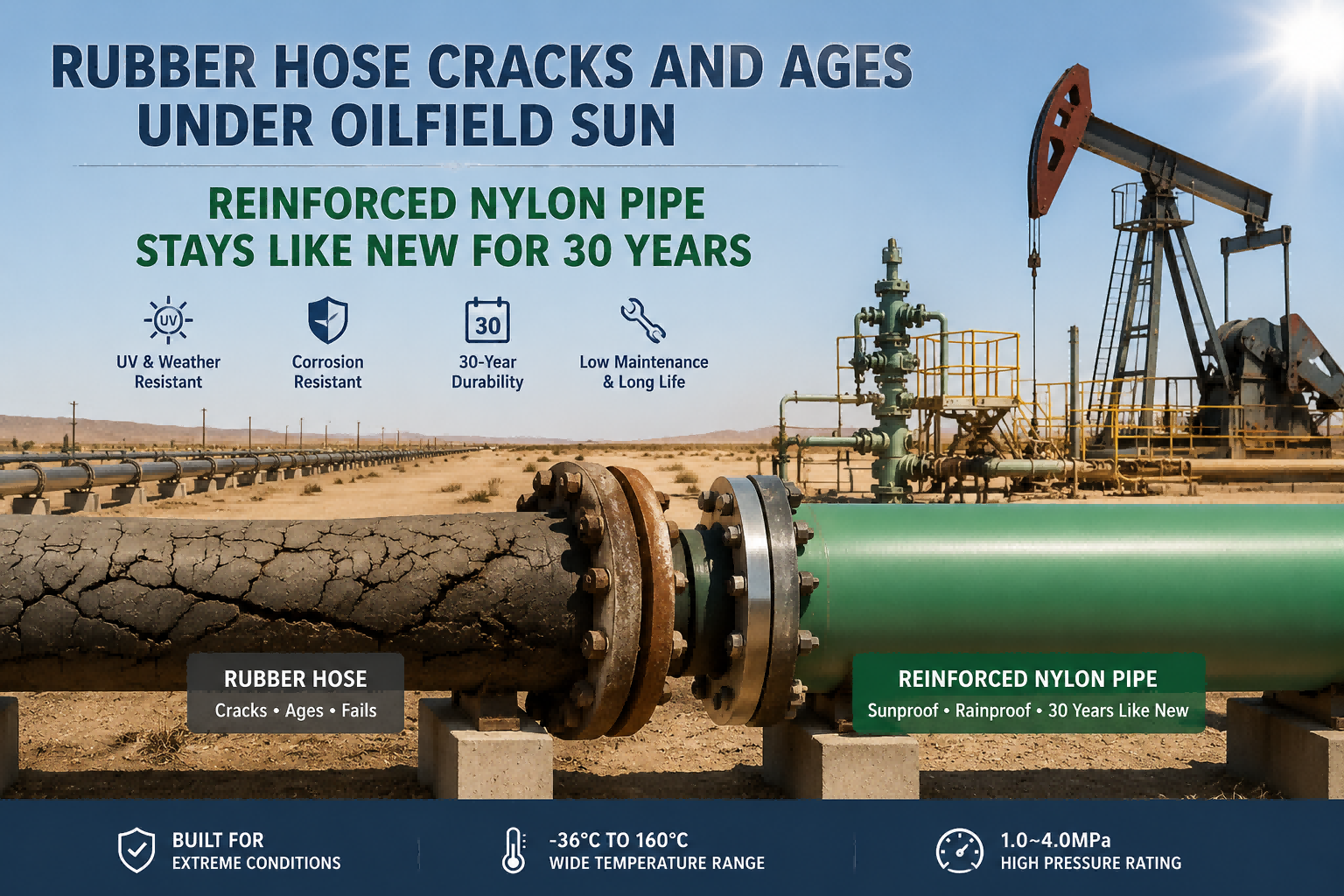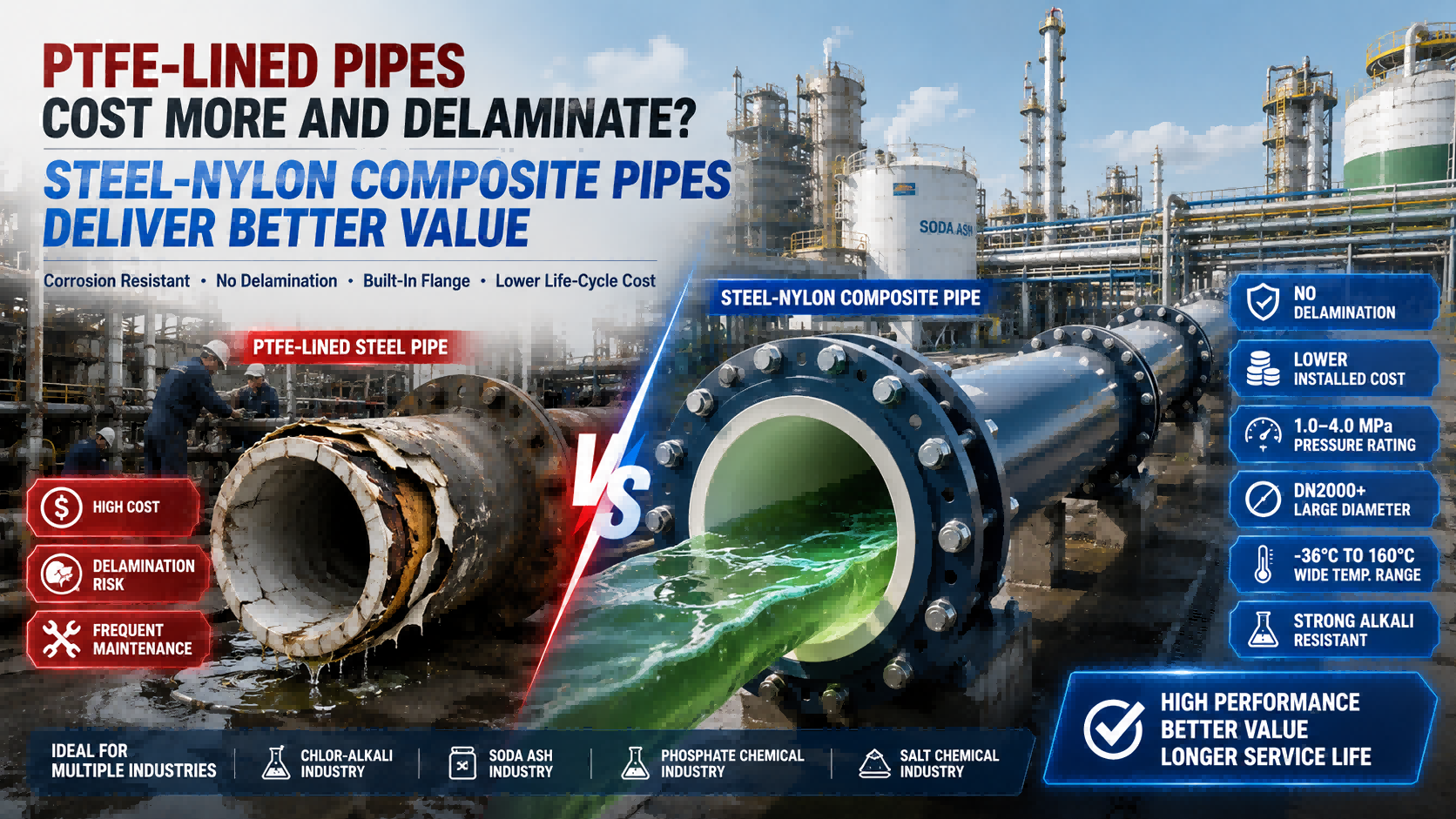
Short Service Life of High-Pressure Gathering Pipelines in Oil & Gas Fields? Steel-Nylon Composite Pipe Delivers a New Answer in Wear and Pressure Resistance
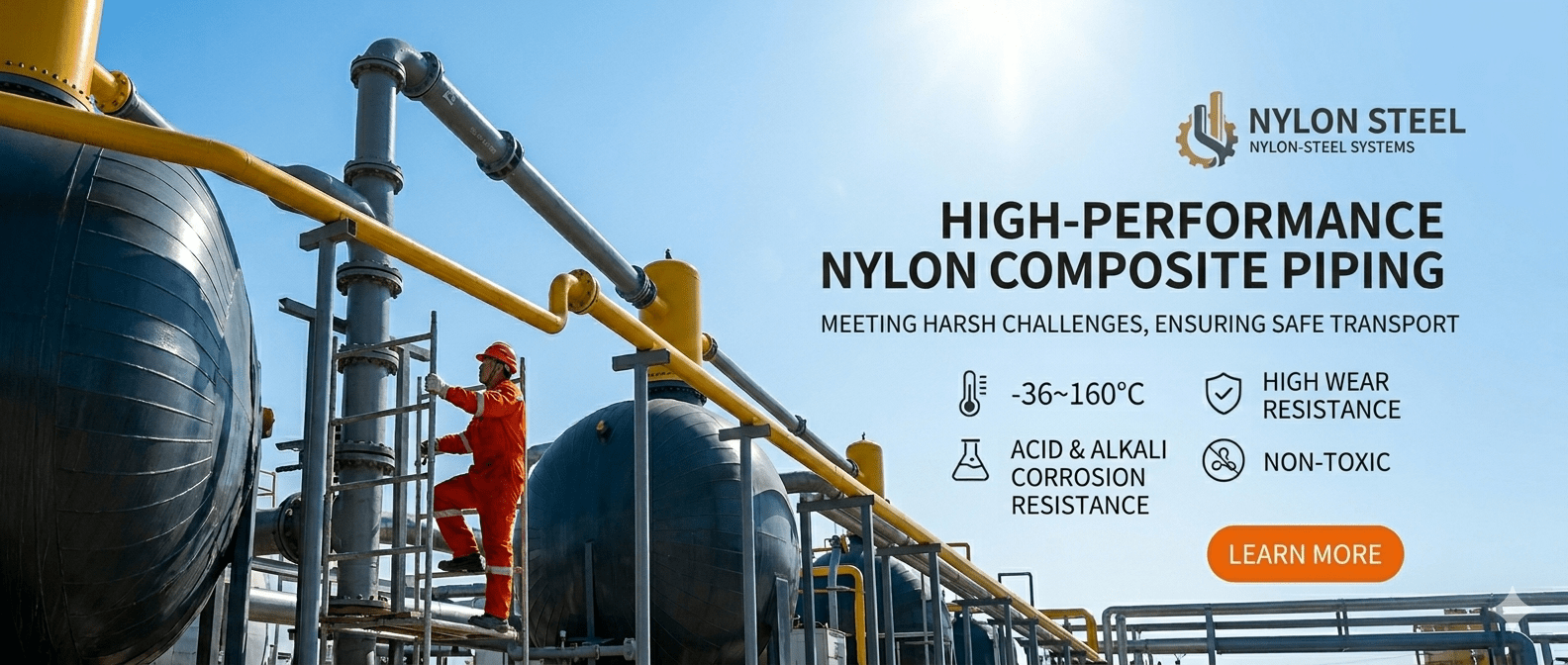
High-pressure gathering and transportation pipelines form the critical arteries of any oil and gas operation. They carry untreated well fluids—crude oil, natural gas, produced water, sand, and corrosive gases—over long distances to processing facilities. Yet one complaint echoes across fields from the Middle East to North America: these pipelines don't last. Premature failures caused by internal corrosion, erosion, and pressure surges lead to leaks, production shutdowns, expensive emergency repairs, and environmental liability. For decades, operators have been forced to choose between carbon steel (strong under pressure but vulnerable to corrosion and wear) and various non-metallic or lined pipes (corrosion-resistant but often limited in pressure rating and temperature range). Enter **Steel-Nylon Composite Pipe**, a hybrid solution engineered to break this compromise. It combines the pressure-bearing strength of steel with the chemical and abrasion resistance of a high-performance Polymer Alloy Matrix Composite (Nylon) lining, offering a reliable, long-life pipeline system built for the real conditions of modern oil and gas fields.
The Real-World Killers of Gathering Line Longevity
To understand why Steel-Nylon composite pipe is a superior answer, we first need to pinpoint what shortens conventional pipeline life:
**Internal Corrosion:** Produced water contains dissolved CO₂, H₂S, chlorides, and bacteria, which cause rapid internal pitting, grooving, and hydrogen-induced cracking in carbon steel. Even corrosion-resistant alloys (CRA) can struggle with microbial and under-deposit corrosion.
**Erosion and Wear:** High-velocity multiphase flow carrying sand, scale particles, and corrosion debris scours the pipe wall, thinning it from the inside. Erosion is particularly aggressive at bends, tees, and downstream of chokes.
**Pressure and Temperature Cycling:** Gathering systems experience fluctuating pressures (1.5 to 4.0 MPa and higher) and temperatures up to 100°C or beyond with thermal recovery. Many plastic and lined pipes lose strength or debond under these cycles.
**Galvanic and External Corrosion:** Welded steel joints in buried or wet environments are susceptible to corrosion at the heat-affected zone, requiring costly coatings, cathodic protection, and inspections.
Conventional remedies include using corrosion inhibitors (ongoing opex, inconsistent film coverage), upgrading to duplex stainless or CRA (massively higher capex, still vulnerable to chlorides at elevated temperatures), or installing HDPE-lined steel (limited temperature ceiling, risk of liner collapse or debonding). Steel-Nylon composite pipe was developed to address all these failure modes simultaneously.
How Steel-Nylon Composite Pipe Works
**Steel-Nylon composite pipe** consists of an outer carbon steel shell that provides structural strength and pressure containment, and an inner continuous Nylon liner that serves as a corrosion-proof, wear-proof barrier. The liner is not a loose sleeve; it is molecularly bonded or mechanically locked to the steel wall through a proprietary process, creating a unified structure that handles pressure as if it were solid.
The Nylon material itself is a Polymer Alloy Matrix Composite—a thermoplastic engineered from multiple high-performance polymer alloys, enhanced with reinforcing elements at the molecular level. It delivers:
**Near-zero permeation:** Resistant to H₂S, CO₂, and CH₄ diffusion that can cause blistering in other polymer liners.
**Extreme wear resistance:** 3 to 5 times better than carbon steel in slurry and sand-laden flow, thanks to its inherent lubricity and high scratch hardness.
**Broad chemical inertness:** Unaffected by brines, acids (including organic acids found in oilfield fluids), alkalis, and produced water with high chloride content.
**Wide temperature range (-36°C to 160°C):** It remains impact-tough in the frozen pipelines of Siberia and thermally stable in the steam-assisted gravity drainage (SAGD) lines of Canadian oil sands.
Breaking Down the Performance Advantages in Detail
1. Pressure Resistance Up to 4.0 MPa—Even at Extra-Large Diameters
Because the steel outer wall takes the hoop stress, our steel-Nylon composite pipe routinely handles working pressures from 1.0 to 4.0 MPa. Critically, this high-pressure capability extends to **diameters exceeding DN2000 (2 meters)**. For large-scale central gathering stations and trunk lines where flow capacity and strength are both essential, few alternative materials can compete. We can tailor wall thickness and steel grade (e.g., API 5L X42 to X70) to match exact pressure requirements and provide full compliance with international design codes.
2. 3-5× the Wear Life of Carbon Steel
Sand production is a fact of life in many reservoirs. While steel pipe walls can thin to failure in a matter of months under sand erosion, the Nylon liner acts as a “sacrifice-worthy” barrier that actually resists abrasion far better than steel itsel. In direct comparison tests, Nylon’s volume loss under slurry erosion is a fraction of that of carbon steel. This means gathering lines maintain their pressure integrity for decades, not years, even with wet, sandy crude.
3. Zero Internal Corrosion, No Inhibitors Needed
A contiguous Nylon liner completely isolates the steel from the corrosive fluid. There is no weld seam inside, no crevice where chlorides or microbes can concentrate. Operators can often reduce or eliminate continuous chemical injection, simplify process design, and stop worrying about under-deposit corrosion. The liner also serves as an insulating barrier against galvanic coupling with downhole equipment or other pipeline materials.
4. Integration Flanges: No On-Site Welding, Faster Installation
Our manufacturing process can form **integral stub ends and flanges directly on the composite pipe**, constructed from the same Nylon material or protected by it, so the entire internal surface is lined and seamless. The benefits are immediate in oilfield construction:
- Eliminates field welding of joints in hazardous areas, removing a major fire and explosion risk.
- No post-weld internal coating or patching needed—flange connections are intact as delivered.
- Drastically faster installation: bolt-up only, reducing crane and manpower time, and allowing rapid reconfiguration of gathering networks when well patterns change.
- Leak-proof sealing face fully compatible with standard ANSI, API, DIN, or GOST flanges and gaskets.
5. Thermal Resistance Without Derating
Many polymer-lined pipes have maximum service temperatures of 60°C–80°C. Our PAMC liner, capable of continuous service at 160°C, comfortably handles the elevated temperatures found in enhanced oil recovery (steam injection, hot water flooding) and deep, high-temperature gas fields. It does not become brittle in subzero winters, maintaining toughness at -36°C, thus preventing stress cracks during transport and installation in remote Arctic regions.
40 Years of Field-Proven Reliability, Now Available Worldwide
Our Steel-Nylon composite pipe series has been deployed in China's most demanding oil and gas fields for over four decades, from the high-H₂S sour gas fields of Sichuan to the sandy heavy oil regions of Liaohe, and recently in high-pressure gathering networks in Xinjiang. During this time, we’ve refined the material formulations and manufacturing processes based on continuous field feedback. Today, we offer:
- Diameters from small-diameter flowlines to **over DN2000 trunklines**
- Pressure ratings from 1.0 to 4.0 MPa, custom-engineered higher if required
- Complete piping packages: pipes, integral flanges, elbows, tees, reducers, all fully lined
- Certification-ready material test reports and hydrotest documentation
This is not a laboratory curiosity—it is a mature industrial technology that has already proven it can outlast carbon steel gathering systems by a factor of three to five times in real production environments, dramatically lowering the total cost of ownership (TCO) when you account for reduced downtime, no inhibitor spending, and fewer replacements over the 20–30 year life of a field.
Application Scenarios Where Steel-Nylon Excels
**Multiphase gathering from wellhead to manifold:** Wet, sandy, corrosive flow—no problem.
**Produced water transfer and injection lines:** Perfect immunity to saline water and bacteria.
**Gas gathering with H₂S and CO₂:** No embrittlement, no internal scaling.
**Thermal recovery distribution lines:** 160°C capability pairs well with steam; the pipe does not creep or lose pressure rating.
**Large-diameter cross-country trunk lines:** DN2000+ at 2.5 MPa enables cost-effective central processing facility (CPF) consolidation.
**Replacement of aged, corroded steel pipelines:** Use the same right-of-way without significant change in support or burial methods.
Conclusion: A Smarter Investment for Your Next Gathering System
Short pipeline service life is not inevitable—it’s the result of using materials that weren’t designed for the relentless combination of pressure, abrasion, and corrosion found in oil and gas operations. Steel-Nylon composite pipe replaces the cycle of inspect-repair-replace with a system engineered to last decades with minimal intervention. Its built-in flanges speed up construction, its liner eliminates internal corrosion, and its wear resistance stands up to the most erosive flow regimes.
If you are planning new gathering infrastructure, loop lines, or a rehabilitation project, we invite you to speak with our engineering team. We can provide a detailed technical proposal, a whole-life cost comparison versus your current pipe specification, and reference cases from fields comparable to yours. **Make your next pipeline the last one you’ll need to replace for a generation.**
Frequent Corrosion Leaks in Chlor-Alkali and Soda Ash Pipelines? Strong-Alkali & Weak-Acid Resistant Reinforced Nylon Pipe Has Become the Industry Standard
Why Are Reinforced Nylon Tubes So Powerful? — Wide Temperature Range (-36°C to 160°C), Wear & Corrosion Resistance, and Integrated Flanges