Tubing Selection for Harsh Oil & Gas Field Conditions: Why Flanged Nylon-Steel Composite Pipe Is Becoming the New Industry Darling

The surface gathering and transportation pipelines in oil and gas fields are arguably the most silent and vulnerable link in the entire production system. They are constantly soaked in acidic media containing hydrogen sulfide (H₂S), carbon dioxide (CO₂), and high concentrations of chloride ions (Cl⁻), while simultaneously enduring pressure fluctuations, temperature changes, and mechanical stress. Any tiny corrosion-induced perforation can escalate into a production shutdown costing tens of millions, or even trigger a major safety and environmental disaster.
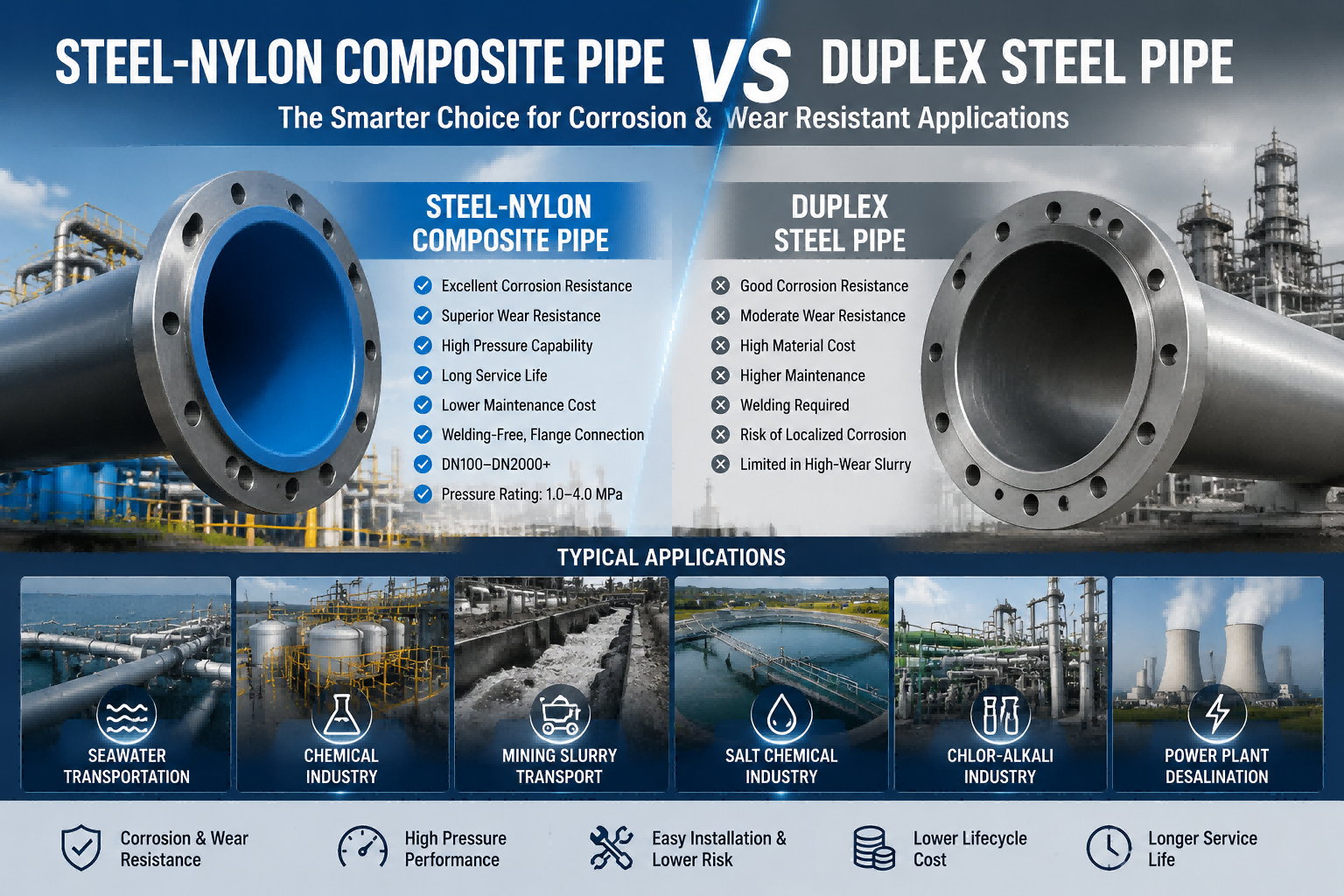
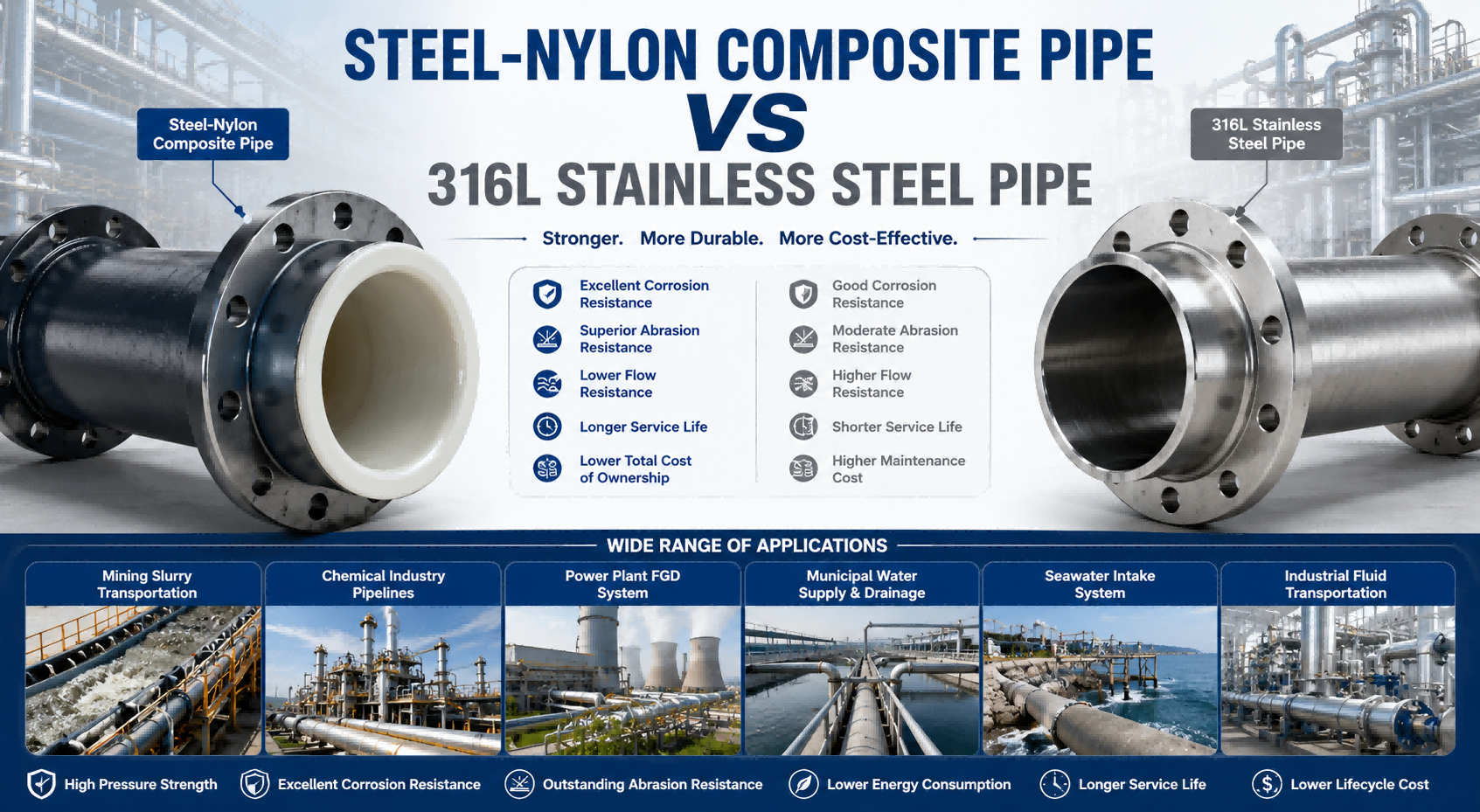
Caught between the fatigue of traditional carbon steel pipes and the prohibitively high cost of pure alloy pipes, a "pre-flanged" nylon-steel composite pipe is quietly moving from a supporting role to center stage. Between 2025 and 2026, Sinopec Shengli Oilfield has issued multiple rounds of open tenders for nylon-steel composite pipes and fittings framework agreements, covering specifications from DN100 to DN700. This is not a simple material substitution; it is a profound signal that the logic behind industry material selection is shifting.
Corrosion Maze: The Compound Dilemma Facing Oil & Gas Field Tubing
To understand why nylon-steel composite pipe is emerging, we must first see how truly "harsh" the environment it faces really is.
Internal corrosion in oil and gas field pipelines is typically not caused by a single factor, but by a coupled effect of H₂S, CO₂, Cl⁻, and microbiological influences (such as sulfate-reducing bacteria, SRB). Taking a typical block as an example, the salinity of produced water can reach 10,000–45,000 mg/L, with Cl⁻ accounting for about 50% of the total salinity. As a catalyst in the corrosion process, Cl⁻ can penetrate the corrosion product film into the substrate, forming localized pitting pits, which then form corrosion micro-cells with the surrounding corrosive solution, accelerating the corrosion process.
The situation in a block of Tahe Oilfield is more representative: the gathering pipelines have significant undulations along the route, the flow regime of the medium inside the pipe is highly variable, and the conveyed medium contains H₂O, CO₂, H₂S, Cl⁻, etc., creating a complex internal corrosion environment. Even when L360QS sour service steel was used along with corrosion inhibitors, the corrosion problem showed no significant improvement. The reason is that once localized pitting forms, corrosion products like CaCO₃ and CaSO₄ deposit on the metal surface and form occluded cells; the electrolyte inside the occluded area cannot effectively exchange with the outside, leading to under-deposit concentration cell corrosion.
This means that relying on "passive corrosion resistance"—that is, depending on the inherent properties of the steel or external chemical inhibition—often fails to handle one aspect while neglecting another in a compound corrosive environment. A pipeline may remain intact over large sections but perforate rapidly in localized, low-lying areas where liquid accumulates. Statistics are even more alarming: corrosion-related incidents account for more than 25% of total accidents in the oil and gas industry.
Tubing Evolution: From Pure Metal to the "Play to Strengths" Composite Approach
Faced with these predicaments, engineers did not stop at merely increasing steel grades. In fact, over the past two decades, tubing technology has traced a clear evolutionary path:
**First Generation: Pure Metal Pipes.** Carbon steel and low-alloy steel remain the most widely used tubing today, with the most mature manufacturing, construction, and acceptance systems. However, in environments with high H₂S and high CO₂, their service life often falls short of three years. The production losses from frequent replacements far exceed the procurement cost of the pipe itself.
**Second Generation: Fully Non-Metallic / Lined Pipes.** Using thermoplastics such as HDPE and PVDF as a liner, these are inserted into steel pipelines using trenchless methods to form a "pipe-within-a-pipe" composite structure, effectively solving the internal corrosion problem of steel pipes and significantly extending service life. However, single-layer plastic pipes have limited pressure-bearing capacity and temperature ranges. Materials like HDPE and PA12 are typically only suitable for well environments up to 2,000–3,000 meters.
**Third Generation: Metal-Non-Metal Composite Pipes.** Represented by steel-reinforced plastic composite pipes and reinforced thermoplastic pipes (RTP), these organically combine the mechanical strength of metal with the corrosion resistance of non-metals. Tarim Oilfield began using steel-reinforced plastic composite pipes for low-pressure oil gathering lines as early as 2001. Metallic composite pipes, by overlaying a corrosion-resistant alloy liner on a carbon steel base, can save up to 50% in costs compared to pure corrosion-resistant alloy materials, yielding a lower total life cycle cost in oil and gas fields with high concentrations of corrosive media.
It is along this evolutionary trajectory that nylon-steel composite pipe, leveraging the unique material properties of PA6 (Polyamide 6), has stepped onto the critical track to become the next generation of tubing.
PA 6: The Key to Solving the Acidic Media Corrosion Puzzle
Among numerous engineering plastics, PA6 stands out because of its unique chemical inertness to hydrocarbons and its stable mechanical performance across a wide temperature range.
PA6 has been certified for use in offshore flexible risers for hydrocarbon transport and natural gas distribution networks; when in contact with hydrocarbons, natural gas condensates, and refined fuels, its mechanical properties remain sound. The VESTAMID® NRG series of PA6 materials developed by Evonik Industries complies with the API 17J specification, enabling the safe transport of acidic hydrocarbon fluids in marine environments, while also performing water and gas injection operations.
More importantly, there are quantitative advantages in mechanical performance. VESTAMID® NRG 2101, a high-molecular-weight PA6 material, is highly suitable for larger diameter thermoplastic piping systems under high pressure. Compared with similar high-pressure plastic materials, its piping system allows a 25% increase in pressure rating. According to data from the 21st International Conference on Plastic Pipes, PA6 pipes can achieve a maximum pressure of 525 psi (about 3.6 MPa) at 23°C, and long-term strength tests indicate that the knee point (the performance transition point caused by hydrolytic degradation) first appears at about 70°C after approximately 50 years—meaning that under design conditions, PA12 pipes can provide stable service for decades.
In summary, the core advantages of PA6 in oil and gas field tubing are reflected in three dimensions: excellent chemical resistance to H₂S and CO₂, the ability to maintain mechanical properties over a wide temperature range, and a higher pressure rating compared to traditional plastics like HDPE. These three advantages make it an ideal liner material for handling the harsh operating conditions of acidic media.
The Structural Code: Why Is the Integrated Flange So Important?
After understanding the material advantages of PA6, a more engineering-relevant proposition emerges: How do you reliably bond the corrosion-resistant nylon layer with the pressure-bearing steel layer, while maintaining the same anti-corrosion continuity at the pipe connections?
The answer lies precisely in the "pre-flanged" integrated structural design. Relevant patent technology shows that the flanged metal-nylon composite pipe employs a three-layer wall structure, consisting of an MC nylon layer, a metal layer, and an outer protective layer from the inside out; both ends of the metal layer are welded to the connecting faces of two flanges, and a fastening structure is provided on the inner wall of the flange. This design fundamentally solves two major pain points in the application of composite pipes:
**Pain Point One: Pipe-End Sealing and Anti-Corrosion Continuity.** Traditional lined pipes require separate on-site treatment of pipe ends, and the flange face is often the weakest point where corrosive media can most easily penetrate. The integrated flange structure allows the nylon layer to form a complete encapsulation at the pipe end, eliminating pathways for media to penetrate the metal substrate.
**Pain Point Two: Installation Efficiency and Quality Control.** Traditional steel pipe connections require processes such as welding and non-destructive testing, leading to long construction cycles and quality highly dependent on the skill of field operators. Flanged nylon-steel composite pipes utilize standardized fittings—equal tees, elbows, reducers, etc., are all delivered in flange-connected form—greatly simplifying the on-site installation process. In practice at the Northwest Oilfield, the construction efficiency of lightweight flexible composite pipes improved by 30% compared to traditional steel pipes.
From an industry standards perspective, nylon-steel composite pipe has been incorporated into the SY/T 6662.3 standard system, signaling that its product specifications are moving from enterprise standards to unified industry standards. This is an important prerequisite for large-scale application of an emerging tubing category.
The Final Judgment of Economics: Total Life Cycle Cost (TCO)
Every material innovation in the engineering field ultimately must stand the test of economics. In oil and gas field tubing selection, the core evaluation framework has long since shifted from a single procurement cost to the Total Cost of Ownership (TCO), a full-process sum covering pipe procurement, construction and installation, operation and maintenance, production downtime losses, replacement, and end-of-life costs.
Based on the TCO model, a comparison of three typical solutions:
| Comparison Dimension | Ordinary Carbon Steel Pipe | Pure Corrosion-Resistant Alloy Pipe | Nylon-Steel Composite Pipe |
|---|---|---|---|
| Procurement Cost | Lowest (Baseline) | Highest (2-3x Baseline) | Moderate (1.5-2x Baseline) |
| Service Life | 1-3 years (high corrosion conditions) | ≥8 years | ≥8 years |
| O&M Cost | 20%-30% of procurement cost/year | Less than 5%/year | Less than 5%/year |
| Downtime Loss | Average 1-3 unplanned shutdowns/year | Almost zero | Almost zero |
| 8-Year TCO Level | Approx. 28 million CNY (high sour conditions) | Approx. 19 million CNY | Approx. 9.5 million CNY |
Note: TCO comparison data is based on a reference for a single well working condition in the high-sour gas field of northeastern Sichuan.
The data reveal a counter-intuitive conclusion: the seemingly cheap carbon steel pipe ends up being the most expensive in terms of composite cost under highly corrosive conditions due to frequent replacements and downtime losses; while composite pipe achieves the optimal balance between "moderate procurement cost and extremely low operation/downtime/replacement costs," reducing overall costs by more than 70% over the entire life cycle.
This conclusion has been continuously validated in industry practice. The flexible composite pipe gathering and transportation technology system developed by Northwest Oilfield has been successfully applied to 819 pipelines totaling 2,088.3 kilometers, reducing average single-well construction costs by 22%, improving construction efficiency by 30%, and significantly lowering the total life cycle cost.
Industry Winds: The Market Inflection Point from Trial to Mainstream
If technical parameters and cost data alone are insufficient to judge whether a category has truly entered the mainstream, the signals from the procurement side provide more direct market evidence.
From 2025 to 2026, Sinopec Shengli Oilfield Company has continuously issued open tenders for nylon-steel composite pipes and fittings framework agreements, covering a full range of flange-connected fittings from DN100 PN16 to DN700 PN10, with all tender project funds coming from state-owned capital. This kind of large-scale framework agreement procurement signifies that nylon-steel composite pipe is no longer a sporadic trial application but has been incorporated into the standardized procurement system of a major oilfield.
Looking at broader market data, the global market size for composite pipes used in oil and gas was approximately 55.05 billion CNY in 2024, and is expected to approach 75.28 billion CNY by 2031, with a compound annual growth rate of about 4.6%. Driven by the dual forces of low-carbon transition and the need to increase reserves and production, the development proportion of extreme-condition oil and gas fields such as high-sour, deepwater, and shale plays is continuously rising, and the demand for corrosion-resistant composite pipes will enter a long-term growth channel.
Application Boundaries and a Rational Outlook
Of course, any material has its applicable boundaries. Under normal, low-corrosion conditions, the overall economic efficiency of carbon steel pipes still prevails. The service temperature of PA12 is mainly suitable for medium and low-temperature environments (typically below 70°C for continuous use). For ultra-high-temperature, ultra-high-pressure downhole tubing scenarios, pure alloys or higher-grade materials like PEEK are still required.
For engineering designers, the core logic of material selection decisions should be "condition matching": For harsh corrosive environments with high H₂S, high CO₂, and high Cl⁻, nylon-steel composite pipe, with PA12's chemical resistance, the structural reliability of integrated flanges, and its total life cycle cost advantage, provides an optimal solution that is "affordable, long-lasting, and safe to use." For mildly corrosive environments, traditional solutions can continue to be utilized.
From an industry chain perspective, while domestic enterprises are relatively mature in mechanical composite processes, there is still room to catch up in higher-end fields such as metallurgical bonding. With the refinement of industry standards like SY/T 6662.3 and the scaled promotion through framework agreement procurement, nylon-steel composite pipe is poised to grow from today's "new industry darling" into the "standard configuration" for harsh operating conditions.
The selection of oil and gas field tubing, in the final analysis, is not about choosing the cheapest or the strongest pipe, but about finding a sustainable engineering optimum among complex corrosive media, dynamic operating conditions, and limited budgetary constraints. The flanged nylon-steel composite pipe is becoming an increasingly weighty answer in this process of seeking solutions.
Unveiling the Total Cost of Ownership (TCO) of Industrial Piping: FRP, 316 Stainless Steel, and Nylon-Steel Composite Pipe – Which One Reigns Supreme?
Anti-Corrosion Guide for Chlor-Alkali & Salt Chemical Piping: Why Traditional Metal Pipes Frequently Corrode—And How Steel-PAMC Composite Pipes Solve It Once and for All
Related blog