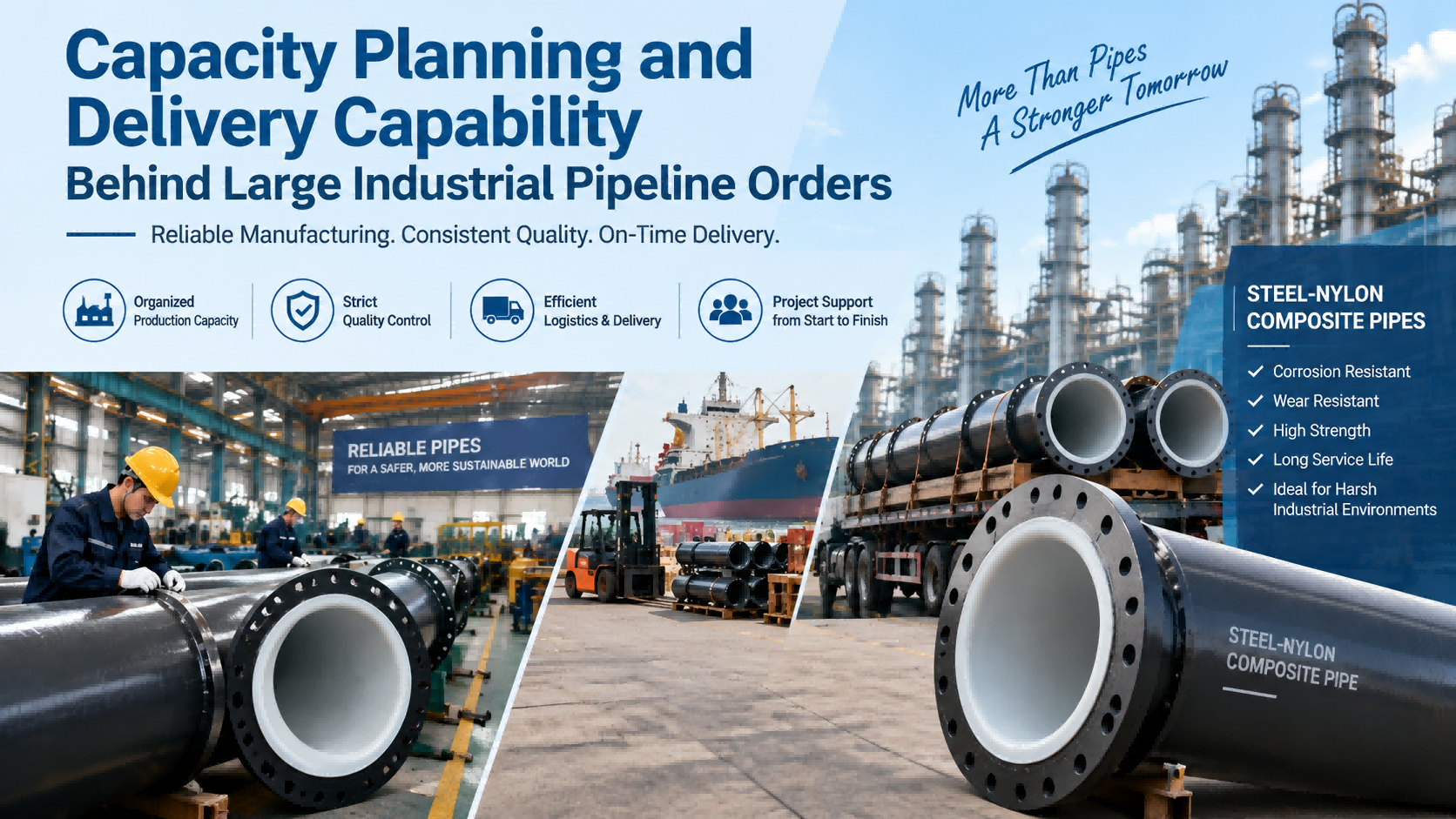
How Are Industrial Pipes Rated for 1.0–4.0 MPa Manufactured Consistently and Reliably?

In industrial piping projects, working pressure is often one of the first specifications engineers and procurement teams look at.
However, for pipelines that must operate continuously under demanding industrial conditions, being able to withstand a certain pressure during testing is not the same as being able to operate safely and reliably at that pressure for years.
This distinction becomes especially important for industrial pipelines rated from 1.0 to 4.0 MPa and used in chemical processing, oil and gas fields, salt chemical plants, soda ash production, chlor-alkali facilities, mining operations, and other process-fluid transportation systems.
A real industrial pipeline does not experience internal pressure alone.
During operation, it may simultaneously be exposed to:
-
Continuous static pressure
-
Pressure fluctuations caused by frequent startup and shutdown
-
Transient pressure surges caused by pumps and valve operation
-
Pipe dead weight and support loads
-
Thermal stresses caused by temperature changes
-
Continuous corrosion from aggressive media
-
Erosion from suspended solid particles
-
Localized stresses around flanges, elbows, tees, and reducers
Therefore, manufacturing a reliable pipeline for 1.0–4.0 MPa pressure classes is not simply a matter of increasing wall thickness.
It requires an integrated engineering and manufacturing system covering:
structural design, raw materials, steel load-bearing structures, nylon functional layers, composite interfaces, forming processes, flange systems, dimensional control, quality inspection, and pressure testing.
This is also one of the fundamental differences between steel–nylon composite pipes and many conventional single-material piping systems.
1. Why 1.0–4.0 MPa Should Not Be Treated as Just a Pressure Number
Industrial projects commonly specify pressure classes such as:
-
PN1.0
-
PN1.6
-
PN2.5
-
PN4.0
It is easy to assume that higher pressure simply requires a thicker pipe wall.
In practice, pressure capability is the result of an entire engineering system.
At minimum, engineers must evaluate:
Design Pressure + Operating Temperature + Pipe Diameter + Material Properties + Wall Structure + Connection Method + Process Medium + Pressure Cycling + Manufacturing Tolerances
For example, two pipelines may both operate at 2.5 MPa.
However, a DN100 pipeline and a DN1000 pipeline present completely different structural and manufacturing challenges.
Similarly, transporting clean water at ambient temperature is very different from transporting high-salinity brine, concentrated alkaline solutions, or particle-containing slurry.
If the manufacturer simply increases wall thickness without addressing:
-
Material degradation
-
Corrosion-induced wall thinning
-
Flange stress concentration
-
Composite interface stability
-
Large-diameter roundness
-
Dimensional consistency
the pipeline may still experience leakage or structural failure after long-term operation.
Therefore, pressure classification should first be understood as a system-level engineering capability, rather than merely a material specification.
2. Stable Pressure Manufacturing Begins with a Clearly Defined Load-Bearing Structure
One of the fundamental design concepts of a steel–nylon composite pipe is to allow different materials to perform different functions.
Conventional single-material pipes often require one material to simultaneously provide:
-
Structural strength
-
Internal pressure resistance
-
Corrosion resistance
-
Wear resistance
-
Temperature resistance
-
External load capacity
-
Connection strength
This places very demanding and sometimes conflicting requirements on a single material.
Steel–nylon composite piping follows a different engineering philosophy.
Steel Provides Structural Strength
The steel structure primarily carries:
-
Internal pressure loads
-
Mechanical loads on the pipeline
-
Structural stiffness for large-diameter pipes
-
Flange connection loads
-
Installation loads
Reinforced Nylon Provides Functional Protection
The reinforced nylon layer primarily provides:
-
Corrosion resistance
-
Wear resistance
-
Isolation between aggressive media and the steel structure
-
Reduced scaling tendency
-
A smooth internal flow surface
This structure can be summarized as:
Structural Strength + Functional Protection
For pipelines operating between 1.0 and 4.0 MPa, this division of functions is highly valuable.
Steel provides proven structural load-bearing capability, while reinforced nylon helps prevent aggressive process media from directly attacking the steel pressure-bearing structure.
As a result, pressure resistance and corrosion resistance no longer need to rely entirely on a single material.
3. Higher Pressure Classes Require Greater Raw-Material Consistency
Stable industrial pipe manufacturing starts with raw-material control—not final product inspection.
If raw-material properties fluctuate significantly between batches, even highly controlled manufacturing processes may struggle to achieve long-term product consistency.
Steel–nylon composite pipes involve at least two major material systems.
3.1 Steel Load-Bearing Structure
Important parameters include:
-
Steel grade
-
Yield strength
-
Tensile strength
-
Wall-thickness tolerance
-
Weld quality
-
Geometric dimensions
-
Surface condition
As pressure requirements increase, structural design becomes increasingly sensitive to variations in material properties.
This becomes especially important for large-diameter pipes.
If wall thickness, roundness, or local weld quality deviates excessively from specifications, local stress concentrations may develop under pressure.
3.2 Reinforced Nylon Material
The nylon layer is not simply a conventional “plastic liner.”
Its long-term performance influences:
-
Wear resistance
-
Corrosion resistance
-
Thermal stability
-
Dimensional stability
-
Forming consistency
-
Long-term compatibility with the structural system
Manufacturing therefore requires careful control of:
-
Raw-material batches
-
Material formulation
-
Moisture condition
-
Processing temperature
-
Forming parameters
For industrial piping systems designed for long service life:
Consistent material performance is often more important than achieving a single maximum laboratory performance value.
4. Why Does Manufacturing Become More Difficult as Pipe Diameter Increases?
Large-diameter pipes are not simply enlarged versions of small pipes.
As the nominal diameter increases, manufacturing complexity increases significantly.
Under internal pressure, larger pipes experience greater overall structural loads.
At the same time, large-diameter pipe manufacturing must address:
-
Roundness control
-
Uniform wall thickness
-
Flange flatness
-
Pipe straightness
-
Consistency of the composite layer
-
Pipe-end concentricity
-
Transportation deformation
-
Lifting deformation
-
Large-diameter sealing reliability
Moving from DN100 to DN1000, DN1600, or even DN2000 and above therefore requires much more than simply installing larger manufacturing equipment.
It requires simultaneous development of:
-
Structural design capabilities
-
Forming equipment
-
Tooling systems
-
Process controls
-
Quality inspection systems
This is one of the key technical barriers in manufacturing large-diameter, pressure-rated composite piping.
5. One of the Greatest Risks in Pressure Piping: Local Weak Points
Industrial pipelines rarely fail because the entire pipe reaches its ultimate strength simultaneously.
Failure more commonly begins at a local weak point, such as:
-
Pipe ends
-
Flange roots
-
Weld areas
-
Locally thin wall sections
-
Composite defects
-
Elbows
-
Tees
-
Reducers
-
Pump discharge sections
Therefore, high-quality manufacturing is not simply about achieving good “average performance.”
The goal is to minimize the weakest-link effect throughout the entire piping system.
In other words:
The reliability of a pipeline is often determined not by its strongest section, but by its weakest one.
This is why industrial pipe manufacturing requires comprehensive process control from raw material to finished product.
6. Why Is the Steel–Nylon Composite Interface So Important?
One fundamental difference between composite piping and conventional single-material piping is the existence of an interface between different materials.
If the composite structure is poorly designed or manufactured, potential problems may include:
-
Bulging
-
Layer separation
-
Local detachment
-
Dimensional changes during thermal cycling
-
Interface instability under long-term pressure
For this reason, one of the key technologies in steel–nylon composite pipe manufacturing is the creation of a stable composite structure.
Our engineering approach is not simply to “bond” one material onto another.
Instead, the steel structure and reinforced nylon material are designed to work together as an integrated piping system.
This becomes especially important under conditions involving:
-
Continuous operation
-
High- and low-temperature cycling
-
Frequent pressure fluctuations
-
Large pipe diameters
-
Highly corrosive fluids
-
Abrasive media
For a true industrial composite pipe:
Composite technology is not simply the stacking of two materials. It is the engineering integration of two materials into one functional piping structure.
7. Why Are Integrated Flange Connections Important for 1.0–4.0 MPa Pipelines?
Many industrial piping leaks do not originate from straight pipe sections.
They occur at connections.
Therefore, industrial piping should never be evaluated based only on the pipe body itself.
The complete system should be considered:
Pipe + Fittings + Flanges + Sealing System
Steel–nylon composite pipes use a flange-based connection system, reducing the need for complicated field welding or heat-fusion processes.
This can be particularly valuable in:
-
Chemical plants
-
Oilfields
-
Mining facilities
-
Existing production units undergoing upgrades
7.1 Reduced On-Site Welding
Traditional steel piping often requires field welding.
This may introduce:
-
Hot-work permit requirements
-
Variation in weld quality
-
Additional corrosion protection for weld joints
-
On-site inspection requirements
-
Longer installation schedules
For operating chemical facilities, reducing hot work can itself provide significant engineering value.
7.2 Greater Installation Consistency
Flange connections provide a more standardized installation method.
When flange flatness, bolt preload, gasket selection, and sealing geometry are properly controlled, connection consistency can be improved significantly.
7.3 Easier Maintenance and Partial Replacement
Industrial facilities require maintenance.
A flange-based system makes it easier to:
-
Remove pipe sections
-
Replace valves
-
Service pumps
-
Replace high-wear fittings
-
Upgrade trial sections
This makes flange connections especially valuable from a lifecycle maintenance perspective.
8. One Wall Thickness Cannot Cover Every Pressure Class
Different pressure classes require different structural designs.
As design pressure increases, engineers need to reconsider:
-
Steel wall thickness
-
Pipe diameter
-
Material strength
-
Flange geometry
-
Bolt loading
-
Sealing configuration
-
Temperature derating
-
Safety factors
-
Pressure fluctuations
Therefore, reliable industrial piping should follow the principle:
Different DN + Different PN + Different Temperature + Different Medium = Different Engineering Design
A single fixed wall thickness should not simply be applied across every application.
For example:
A DN200 PN1.0 MPa pipeline and a DN1200 PN4.0 MPa pipeline clearly require different structural engineering and manufacturing controls.
This is why industrial piping systems must be selected according to actual operating conditions.
9. Pressure Stability Is More Than Passing a Single Hydrostatic Test
Many purchasing specifications place significant emphasis on factory hydrostatic testing.
That is necessary.
However, it is important to distinguish between:
passing a pressure test
and
remaining reliable during long-term operation.
A factory pressure test primarily verifies whether:
-
Obvious structural defects are present
-
Leakage occurs
-
The connection system performs correctly
-
The pipe can withstand the specified test pressure
Long-term industrial operation introduces additional factors such as:
-
Tens of thousands of operating hours
-
Pressure cycling
-
Temperature changes
-
Corrosion
-
Erosion
-
Installation stress
-
Environmental aging
Therefore, genuine pressure stability must be designed into the product from the beginning.
It should not depend on final pressure testing alone.
A more complete quality-control philosophy is:
Design → Material → Manufacturing → Process Control → Inspection → Pressure Test
Pressure testing is the final verification step—not the entire quality system.
10. Why Does Corrosion Change the Actual Pressure Capacity of a Pipeline?
This is an important issue that can easily be overlooked.
A conventional carbon steel pipe may fully meet its pressure requirements when it is first installed.
However, if internal corrosion continues over time, the original wall thickness:
t₀
may gradually become:
t₁ < t₀
As the wall becomes thinner, the pipeline's actual structural safety margin also decreases.
This is especially relevant in systems handling:
-
High-salinity water
-
Oilfield produced water
-
CO₂-containing fluids
-
H₂S-containing media
-
Chloride-rich solutions
-
Chemical mother liquor
-
Strong alkaline media
-
Industrial wastewater
If corrosion continuously removes metal from the wall, the pipeline's actual safe pressure capacity can decline—even if operating pressure remains unchanged.
This is one of the key reasons for adopting a steel–nylon composite structure.
By using reinforced nylon to isolate aggressive process fluids from the steel structure, direct corrosion of the steel load-bearing layer can be significantly reduced.
The real engineering question therefore is not simply:
“Can this pipe withstand 2.5 MPa today?”
The more important question is:
“After years of operation, will the structure still retain sufficient pressure safety margin?”
11. Wear Can Also Affect Long-Term Pressure Reliability
In slurry, salt sludge, mother liquor, oilfield fluids containing sand, and other solid-liquid transportation systems, internal erosion can also become a major concern.
Continuous wear causes localized wall loss.
High-risk locations typically include:
-
Outer radii of elbows
-
Tees
-
Reducers
-
Pump discharge sections
-
High-velocity areas
-
Areas with sudden changes in flow direction
Local erosion rates may be significantly higher than those in straight pipe sections.
Therefore, when corrosion and abrasion occur simultaneously, simply using higher-strength steel does not completely solve the problem.
Reinforced nylon offers strong wear resistance and can help reduce erosion damage caused by particle-containing fluids.
In a steel–nylon composite system:
Steel provides structural strength, while reinforced nylon provides corrosion and wear protection.
This makes the system especially suitable for applications where:
Pressure + Corrosion + Abrasion
occur at the same time.
12. Temperature Is Just as Important as Pressure
Pressure and temperature should never be evaluated independently.
As temperature changes, so can:
-
Material strength
-
Elastic modulus
-
Thermal expansion
-
Long-term stability
Industrial specifications therefore should not simply state:
Working Pressure: 2.5 MPa
They should also define:
Operating Temperature
In other words:
Pressure class must always be evaluated together with design temperature.
Our steel–nylon composite piping systems can cover an application temperature range of approximately –36°C to 160°C, with final selection based on the specific medium, pressure, pipe diameter, and operating temperature.
This pressure-temperature design philosophy is particularly important for:
-
Cold-region oilfields
-
Elevated-temperature process fluids
-
Outdoor pipelines exposed to large temperature variations
13. Why Is It Difficult to Achieve High Pressure, Large Diameter, and Corrosion Resistance at the Same Time?
Most industrial pipe materials involve performance trade-offs.
Some thermoplastic piping systems offer excellent corrosion resistance.
However, as:
-
Pipe diameter increases
-
Operating temperature rises
-
Pressure increases
structural stiffness and pressure design become increasingly challenging.
Traditional metallic piping offers high mechanical strength but may face:
-
Internal corrosion
-
External corrosion
-
Pitting
-
Scaling
-
Long-term wall thinning
The steel–nylon composite pipe is designed to address this fundamental conflict.
Steel Provides:
Strength
Reinforced Nylon Provides:
Corrosion Resistance + Wear Resistance
Together, they create:
Strength + Corrosion Resistance + Wear Resistance
This is one of the key reasons why composite piping technologies continue to gain attention in demanding industrial applications.
14. Stable Manufacturing Requires Full-Process Quality Control
For industrial pipes rated from 1.0 to 4.0 MPa, we focus not only on final inspection, but on the entire manufacturing process.
A comprehensive quality-control process typically includes:
Raw Material Inspection
Inspection of steel, nylon raw materials, and other critical components.
↓
Steel Structure Fabrication
Key controls include:
-
Wall thickness
-
Roundness
-
Welding
-
Dimensions
-
Structural integrity
↓
Surface Preparation
Creating a suitable foundation for the composite structure.
↓
Nylon Forming
Strict control of:
-
Temperature
-
Time
-
Material formulation
-
Forming parameters
-
Wall thickness
↓
Composite Structure Control
Ensuring long-term structural stability between different materials.
↓
Flange and Pipe-End Machining
Critical parameters include:
-
Flatness
-
Concentricity
-
Dimensions
-
Sealing-surface quality
↓
Dimensional Inspection
Verification of:
-
Outside diameter
-
Inside diameter
-
Length
-
Wall thickness
-
Flange dimensions
↓
Visual and Structural Inspection
Identifying visible manufacturing defects.
↓
Pressure Testing
Verifying the pressure performance of the pipe body and connection system.
↓
Final Inspection
Confirming compliance with project specifications before shipment.
Stable pressure-rated manufacturing results from this entire process—not from hydrostatic testing alone.
15. Why Is Manufacturing Consistency More Important Than a Maximum Pressure Record?
Industrial purchasing decisions can sometimes be influenced by maximum performance claims such as:
“What is the highest pressure your pipe can withstand?”
For continuously operating industrial plants, however, another question is often more important:
Can the manufacturer maintain the same quality across 100 pipes, 500 pipes, or several kilometers of pipeline?
Industrial projects do not purchase one laboratory sample.
They construct complete process transportation systems.
If 99 out of 100 pipe sections perform perfectly but one contains a serious defect, the entire production system may still be forced into shutdown.
Industrial manufacturing therefore depends on:
Repeatability + Consistency + Traceability
These three capabilities are fundamental to reliable pressure-pipe manufacturing.
16. Why Are Our Steel–Nylon Composite Pipes Suitable for 1.0–4.0 MPa Industrial Applications?
We have long focused on the development and manufacture of reinforced nylon pipes and steel–nylon composite pipes.
Our products are not designed to solve only one problem such as corrosion resistance or pressure capacity.
They are engineered for complex industrial transportation environments where several challenges may occur simultaneously.
16.1 Pressure Classes from 1.0 to 4.0 MPa
Pipe structures can be engineered according to:
-
Pressure
-
Temperature
-
Nominal diameter
-
Process medium
-
Installation environment
16.2 Large-Diameter Manufacturing Capability
Our product range supports large-scale industrial transportation systems, with manufacturing capability extending to DN2000 and above.
Potential applications include:
-
Chemical mother liquor
-
Industrial circulating water
-
Slurry
-
Salt chemical systems
-
Large-scale water supply and drainage
-
Oil and gas gathering systems
16.3 Steel Provides Mechanical Strength
The steel structural layer supports applications requiring:
-
Large diameters
-
High structural rigidity
-
Industrial pressure ratings
-
Pipe-rack installation
-
Long-distance transportation
16.4 Reinforced Nylon Provides Corrosion and Wear Protection
The reinforced nylon functional layer is suitable for various:
-
Strong alkaline media
-
Salt solutions
-
High-mineralization water
-
Corrosive industrial fluids
-
Particle-containing fluids
16.5 Smooth Internal Surface with Reduced Scaling Tendency
The smooth internal surface helps reduce flow resistance and deposition.
Over the long term, this can influence:
-
Transportation efficiency
-
Pump energy consumption
-
Cleaning frequency
-
Maintenance costs
16.6 Integrated Flange Connections
Steel–nylon composite pipes use flange connections, reducing the need for field welding and heat-fusion operations.
This makes them particularly suitable for:
-
Chemical plant upgrades
-
Flammable or hazardous operating areas
-
Maintenance projects
-
Aging pipeline replacement
-
Partial pipeline replacement
17. Which Industries Are Particularly Suitable for Steel–Nylon Composite Piping?
Steel–nylon composite pipes are especially worth evaluating when a pipeline must simultaneously deal with pressure, corrosion, wear, and maintenance challenges.
Oil & Gas
Typical applications include:
-
Produced water
-
Gathering and transportation
-
Water injection
-
Oilfield wastewater
-
High-mineralization fluids
Soda Ash
Typical applications include:
-
Mother liquor
-
Salt sludge
-
Process water
-
Wastewater
Chlor-Alkali
Typical applications include:
-
Alkali solutions
-
Brine
-
Chloride-containing process fluids
Salt Chemical Industry
Suitable for transportation of highly saline and corrosive process media.
Mining
Applications may include:
-
Tailings
-
Slurry
-
Mine backfilling systems
-
Abrasive process fluids
Power Industry
Typical applications include:
-
Flue gas desulfurization systems
-
Industrial water
-
Corrosive slurry transportation
These industries share one important characteristic:
Pressure is rarely the only challenge.
The pipeline may also have to manage:
Corrosion + Wear + Scaling + Maintenance Costs
18. Industrial Pipe Selection Is Moving from “Design Pressure” to “Lifecycle Reliability”
In the past, industrial pipe purchasing decisions often focused heavily on:
-
Initial purchase price
-
PN pressure class
-
DN size
-
Wall thickness
Today, more industrial projects are beginning to evaluate:
-
Design service life
-
Leakage frequency
-
Replacement intervals
-
Production shutdown losses
-
Maintenance costs
-
Installation costs
-
Energy consumption
-
Total lifecycle cost
The key question is therefore changing from:
“Can this pipe withstand 2.5 MPa?”
to:
“Under 2.5 MPa pressure, corrosion, abrasion, and temperature cycling, how long can this piping system operate reliably?”
These are fundamentally different questions.
The first focuses on a product specification.
The second focuses on engineering reliability.
That is precisely where steel–nylon composite piping offers greater engineering value.
19. What Information Should Be Provided When Selecting a 1.0–4.0 MPa Industrial Pipe?
When requesting a quotation or technical proposal, it is better not to provide only:
DN + PN
For more accurate engineering selection, the following information is recommended:
-
Nominal pipe diameter (DN)
-
Normal operating pressure
-
Maximum operating pressure
-
Design pressure
-
Normal operating temperature
-
Maximum and minimum temperature
-
Transported medium
-
Medium concentration
-
Solid-particle content
-
Flow velocity
-
Whether vacuum or negative pressure may occur
-
Whether significant pressure fluctuations occur
-
Indoor or outdoor installation
-
Pipe-rack or buried installation
-
Required pipe length
-
Flange standard
-
Expected service life
The more complete the operating data, the more accurately the pipeline can be designed for the actual application.
20. Conclusion: Reliable Pressure-Pipe Manufacturing Is Ultimately About Long-Term Stability
From 1.0 MPa to 4.0 MPa, the pressure classes may appear to be just a series of numbers.
In industrial manufacturing, however, they represent an entire engineering system:
Material
↓
Structural Design
↓
Composite Technology
↓
Manufacturing Process
↓
Flange System
↓
Quality Control
↓
Pressure Verification
↓
Long-Term Reliability
A high-quality industrial pipe should not merely be able to:
“Withstand pressure.”
It should be capable of:
“Maintaining stable pressure performance under real industrial operating conditions over the long term.”
For industrial transportation systems where high pressure, corrosion, abrasion, scaling, and maintenance costs occur simultaneously, steel–nylon composite piping provides an alternative to traditional single-material piping systems.
Its engineering philosophy is straightforward:
Use steel to provide structural strength, reinforced nylon to provide corrosion and wear protection, and an integrated flange-based design to create a complete industrial piping system.
As industrial projects move away from simply “purchasing pipes” toward building long-term reliable fluid transportation systems, the criteria for pipe selection must also evolve beyond PN ratings.
The more comprehensive evaluation should include:
Pressure Stability + Corrosion Resistance + Wear Resistance + Installation Efficiency + Lifecycle Cost
These factors together form the real foundation for reliable operation of industrial piping systems rated from 1.0 to 4.0 MPa.
What Tests Does a Steel-Nylon Composite Pipe Undergo Before Leaving the Factory?
What Are the Technical Challenges in Manufacturing Large-Diameter Steel–Nylon Composite Pipes?