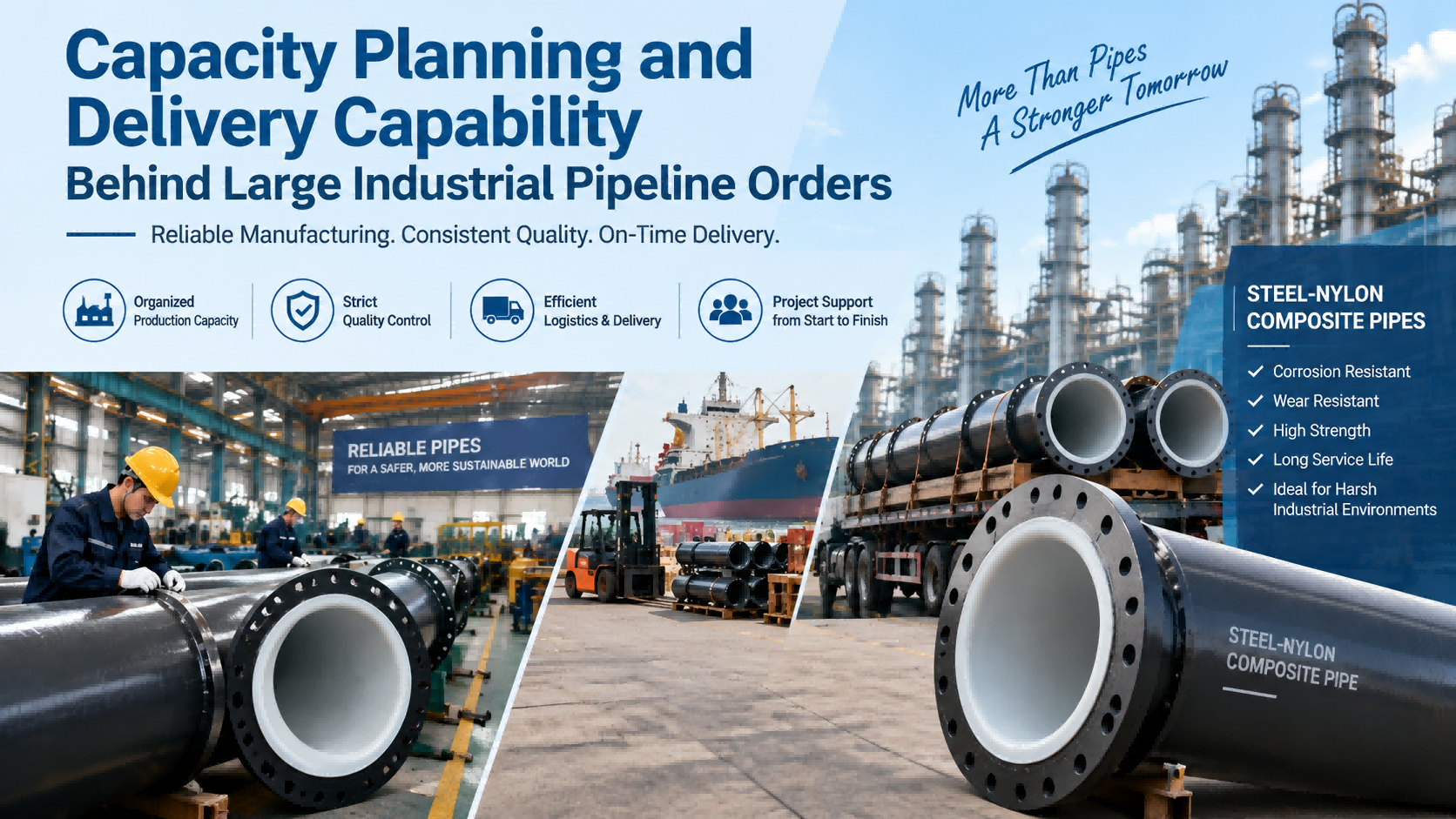
From Production Equipment to Quality Systems: What Capabilities Should a Modern Industrial Pipe Factory Have?

For chemical plants, oil and gas operations, mining projects, salt chemical facilities, chlor-alkali plants, soda ash production, and other heavy industrial applications, industrial piping is no longer simply a standardized construction material.
The reliability of a pipeline operating continuously under corrosion, abrasion, pressure, temperature fluctuations, and aggressive process conditions depends not only on what material is used, but also on how that material is manufactured, controlled, inspected, and consistently reproduced in production.
For this reason, when international engineering companies, EPC contractors, procurement teams, and industrial end users evaluate a pipe supplier, reviewing product catalogs, prices, and technical specifications alone is no longer sufficient.
The more important question is:
Can this factory consistently transform a product design into reliable industrial piping for real-world applications?
This is particularly important for steel-nylon composite pipes.
A steel-nylon composite pipe is not simply a steel pipe combined with a nylon layer. Its manufacture involves a series of technical challenges, including structural strength, nylon lining formation, composite structure stability, dimensional accuracy, connection design, and batch-to-batch consistency.
From this perspective, the true competitiveness of a modern industrial pipe manufacturer can be evaluated through several core capabilities.
1. Industrial Pipe Competition Is Shifting from Material Selection to Manufacturing Capability
In the past, industrial pipe procurement often began with a simple material comparison:
Carbon steel, stainless steel, HDPE, FRP, rubber-lined steel, plastic-lined steel, or composite pipe?
However, as industrial facilities place greater emphasis on continuous operation, safety, reliability, and lifecycle cost, simply identifying the pipe material is no longer enough for professional material selection.
The same type of material can perform very differently when produced by different manufacturers.
The long-term reliability of industrial piping can be affected by:
-
Raw material consistency
-
Manufacturing equipment
-
Process parameter control
-
Lining thickness uniformity
-
Steel structure dimensional accuracy
-
Flange and pipe concentricity
-
Stability of the steel and functional lining structure
-
Pressure testing capability
-
Dimensional inspection
-
Batch production consistency
-
Product traceability
-
Final quality control
For large industrial projects, customers are therefore purchasing more than a pipe material.
They are purchasing manufacturing reliability.
This is why mature industrial procurement systems are gradually moving away from price-only comparisons toward comprehensive supplier capability assessments.
2. Capability One: A Complete and Stable Manufacturing Equipment System
The first requirement for modern industrial pipe manufacturing is appropriate production equipment.
More equipment does not automatically mean stronger manufacturing capability.
What matters is whether the factory has a production system that matches its product structure, diameter range, pressure requirements, and manufacturing process.
For steel-nylon composite pipes, manufacturing involves several critical elements, including the steel pressure-bearing structure, nylon functional layer, flanges, connection structures, and composite forming processes.
The factory therefore needs coordinated equipment and process capabilities covering the entire production chain:
Raw Material Preparation → Steel Structure Fabrication → Forming → Nylon Composite Processing → Flange and Connection Manufacturing → Dimensional Control → Inspection → Product Protection → Packaging and Delivery
A weakness in any critical process can eventually affect product quality.
For example, large-diameter industrial pipes are more susceptible to manufacturing challenges such as:
-
Roundness deviation
-
Concentricity deviation
-
Flange face deviation
-
Uneven lining thickness
-
Localized stress concentration
-
Accumulated dimensional tolerances
These issues may be less obvious in short or small-diameter pipes, but they become increasingly important as diameter increases, pipeline length grows, and installation tolerances become stricter.
A mature industrial pipe manufacturer should therefore be capable not only of producing the pipe, but of:
Maintaining stable manufacturing quality across different diameters, lengths, pressure classes, and order volumes.
3. Capability Two: Large-Diameter and Complex-Specification Manufacturing
Industrial projects do not rely exclusively on standard small-diameter piping.
Large-diameter pipelines are common in applications such as:
-
Chemical mother liquor transportation
-
Slurry transportation
-
Salt mud transportation
-
Circulating water systems
-
Industrial wastewater
-
Oilfield gathering systems
-
Other high-flow industrial process systems
However, manufacturing difficulty generally increases with pipe diameter.
As diameter increases:
Structural stability becomes more difficult to control.
Roundness and straightness requirements become more demanding.
Uniformity of the composite lining becomes more challenging.
Flange alignment becomes increasingly important.
Transportation and field installation become more sensitive to dimensional consistency.
For steel-nylon composite pipes, large-diameter manufacturing capability is therefore not simply a question of whether a factory can manufacture a large pipe.
It reflects the manufacturer's overall capability in:
-
Tooling and fixture design
-
Forming control
-
Steel structure fabrication
-
Nylon composite processing
-
Thermal process control
-
Dimensional control
-
Flange manufacturing
-
Inspection
-
Lifting and handling
-
Logistics organization
When evaluating an industrial pipe manufacturer, procurement teams should therefore ask more than:
“What is the largest diameter you can manufacture?”
A more professional question is:
“How do you ensure dimensional and performance consistency during batch production of large-diameter pipes?”
The difference between these two questions reveals the difference between basic production capability and true industrial manufacturing capability.
4. Capability Three: A Controlled Steel-Nylon Composite Manufacturing Process
The fundamental value of steel-nylon composite pipe comes from combining the advantages of two different materials within one engineered structure.
The steel structure provides mechanical strength and pressure-bearing capability.
The nylon functional layer is exposed to the transported medium and provides corrosion resistance, abrasion resistance, low friction, and resistance to scaling.
This structural approach offers advantages in applications where conventional single-material piping may struggle to provide an effective balance of properties.
For example:
Carbon steel provides good mechanical strength but is vulnerable to corrosion in many industrial media.
Some plastic pipes provide excellent corrosion resistance but may have limitations related to pressure, temperature, rigidity, and large-diameter structural stability.
Certain stainless steels provide strong overall performance but still require careful evaluation in chloride-containing, corrosive, or abrasive environments, while their material costs can also be significant.
The fundamental engineering principle of steel-nylon composite pipe is therefore:
Let the structural layer provide strength while the wetted functional layer provides resistance to the process medium.
However, the real technical challenge lies not in the concept of combining steel and nylon.
It lies in consistently integrating two different material systems into a reliable industrial pipe.
Manufacturers therefore need strict control over:
-
Nylon raw material properties
-
Forming temperature
-
Processing time
-
Lining thickness
-
Pipe concentricity
-
Internal surface continuity
-
Pipe-end structure
-
Flange-area forming
-
Overall dimensions
-
Process repeatability
Without stable control of these variables, products may appear similar externally while delivering very different long-term performance in service.
5. Capability Four: Pressure Ratings Must Be Supported by Manufacturing Capability
For industrial piping, pressure rating is much more than a number printed in a product catalog.
Actual pressure capability depends on the entire structural design and manufacturing process.
It involves factors such as:
-
Steel structure design
-
Wall thickness
-
Material properties
-
Flange structure
-
Connection method
-
Manufacturing tolerances
-
Final pressure testing
A mature industrial pipe manufacturer should therefore establish a complete pressure-control process:
Design Pressure → Structural Design → Raw Materials → Manufacturing → Dimensional Inspection → Pressure Testing → Final Verification
Pressure performance should never be reduced to a marketing specification alone.
Our steel-nylon composite pipes can be designed for different industrial operating conditions and pressure requirements.
For actual projects, pipe configuration should be evaluated according to factors including:
-
Design pressure
-
Operating pressure
-
Operating temperature
-
Transported medium
-
Pipe diameter
-
Flow velocity
-
Installation method
-
Flange rating
-
Operating fluctuations
For industrial applications, this application-specific engineering approach is far more important than presenting a single universal pipe specification.
6. Capability Five: Quality Control Must Begin with Raw Materials
An effective quality system should not begin with final inspection.
If a problem is only discovered after the pipe has been completely manufactured, quality control has already occurred too late.
Modern industrial manufacturing emphasizes quality management throughout the entire production process.
For steel-nylon composite pipes, quality control should cover several critical stages.
6.1 Incoming Raw Material Control
Steel and nylon materials form the foundation of product performance.
Incoming materials should be verified according to defined quality requirements to ensure consistency before entering production.
The performance limits of an industrial pipe are, to a significant degree, already determined at the raw material stage.
6.2 Steel Structure Manufacturing
The steel structure performs important mechanical and pressure-bearing functions.
Important parameters include:
-
Pipe diameter
-
Wall thickness
-
Roundness
-
Straightness
-
Flange dimensions
-
Welding quality
-
Flange concentricity
-
Flange face perpendicularity
Dimensional control becomes particularly important in long pipeline systems.
If individual pipe sections have excessive dimensional variation, installation errors may accumulate across dozens or even hundreds of pipe sections.
This is one reason why production consistency is so important.
6.3 Nylon Functional Layer Manufacturing
In a steel-nylon composite pipe, the nylon layer is the component directly exposed to the transported medium.
Its quality therefore has a major influence on corrosion resistance, abrasion resistance, and long-term fluid transportation performance.
Important parameters include:
-
Lining continuity
-
Thickness consistency
-
Internal surface quality
-
Pipe-end construction
-
Local defect control
-
Process repeatability
Only when these factors are incorporated into a controlled manufacturing process can production move from simply achieving individual product compliance to achieving consistent batch quality.
6.4 Final Product Inspection
Final inspection confirms whether the pipe meets defined release requirements.
Depending on the product specification and project requirements, inspection may cover:
-
Dimensions
-
Appearance
-
Flanges
-
Structural integrity
-
Pressure-related performance
-
Other project-specific requirements
The ultimate purpose of an effective quality system is not simply to identify defective products.
It should use process control to:
Prevent defects from being created in the first place whenever possible.
7. Capability Six: Batch Consistency Matters More Than Producing One Good Pipe
There is an important distinction in industrial manufacturing:
Producing one qualified pipe and consistently producing hundreds or thousands of pipes with the same quality are completely different capabilities.
A laboratory may be able to produce an excellent prototype.
A small workshop may also produce a limited batch of products with an acceptable appearance.
But large industrial projects require something more demanding:
The first pipe and the five-hundredth pipe should maintain a high level of consistency.
This includes:
-
Dimensional consistency
-
Wall thickness consistency
-
Flange consistency
-
Lining quality consistency
-
Pressure performance consistency
-
Connection interface consistency
Why does this matter?
Because industrial piping ultimately functions as a system.
If a project contains hundreds of flange connections, even a small number of dimensional or flange alignment deviations can significantly increase field installation difficulty.
For mature industrial manufacturers, the question is therefore no longer:
“Can we manufacture this product?”
The more important question becomes:
“Can we manufacture it repeatedly, consistently, and reliably at scale?”
That is one of the most important distinctions between basic production and advanced industrial manufacturing.
8. Capability Seven: Connection Design Must Consider the Industrial Site, Not Just the Factory
Pipes ultimately need to be installed in the field.
A mature industrial pipe manufacturer must therefore understand installation conditions, not just factory production.
Flanged connections are an important part of our steel-nylon composite pipe design philosophy.
For many chemical plants, oilfields, mining operations, and existing pipeline replacement projects, flange connections provide significant practical advantages.
These can include:
-
Standardized installation
-
Easier connection to equipment
-
Compatibility with valves, pumps, and industrial fittings
-
Easier disassembly for maintenance
-
Reduced need for certain types of hot work at the installation site
-
Convenient replacement of individual pipe sections
-
Suitability for upgrading existing pipeline systems
For this reason, our product capability is not limited to straight pipe.
Solutions can also include:
-
Elbows
-
Tees
-
Reducers
-
Pump outlet pipe sections
-
Upstream and downstream valve sections
-
High-wear pipe sections
-
Trial pipeline sections
-
Partial replacement solutions for aging pipelines
The value of steel-nylon composite piping is therefore not simply about replacing one conventional pipe material with another.
It can increasingly become part of a more complete industrial piping system solution.
9. Capability Eight: The Factory Must Understand Combined Corrosion and Abrasion
Industrial pipeline problems rarely occur in isolation.
Many process media are both corrosive and abrasive.
Typical examples include:
-
Salt mud
-
Mineral slurry
-
Chemical mother liquor
-
Process slurry
-
Sand-containing fluids
-
Industrial wastewater
-
High-salinity media
-
Oilfield fluids with high water content
In such applications, corrosion resistance alone may not be enough.
A material may resist chemical corrosion effectively but still fail rapidly if its abrasion resistance is insufficient in high-velocity or particle-containing flow.
Likewise, increasing abrasion resistance while ignoring chemical compatibility can also create significant risk.
One of the important advantages of steel-nylon composite pipe is its ability to combine several performance characteristics within one piping structure:
Structural Strength + Corrosion Resistance + Abrasion Resistance + Smooth Internal Surface + Industrial Connection Capability
For weak acids, strong alkalis, salt-containing media, and certain particle-bearing industrial fluids, suitability can be further evaluated according to specific operating conditions such as concentration, temperature, pressure, and flow velocity.
It is important to emphasize that:
Industrial pipe material selection should never be based solely on a simplified corrosion resistance chart.
Professional material selection should consider:
Medium + Concentration + Temperature + Pressure + Flow Velocity + Solids Content + Pipe Diameter + Installation Environment
This is another reason why engineering application capability is essential for an industrial pipe manufacturer.
10. Capability Nine: A Quality System Should Provide Product Traceability
As industrial procurement becomes more sophisticated, especially in international projects, customers increasingly ask an important question:
If a pipe develops a problem, can the manufacturer trace how it was produced?
A mature manufacturing system should gradually establish traceability from raw material to finished product.
Ideally, a production batch should be traceable through:
Raw Material Information
↓
Production Batch
↓
Key Manufacturing Processes
↓
Inspection Records
↓
Finished Product Identification
↓
Project Order
↓
Customer Application
Why is traceability important?
Because quality management is not simply about proving that a pipe passed inspection.
When an abnormal condition occurs, manufacturers need to determine whether it is:
-
An isolated product issue
-
A batch-related issue
-
A manufacturing process issue
-
Or an application-condition compatibility issue
Only with this type of quality logic can a manufacturer continuously improve its products and production processes.
11. Capability Ten: Engineering Experience Should Drive Manufacturing Improvement
One of the major differences between industrial piping and consumer products is that industrial pipes must ultimately withstand long-term operating conditions in real facilities.
Valuable manufacturing capability should therefore not remain isolated inside the factory.
Field application experience should continuously feed information back into the manufacturing system.
For example:
Why do some pipe sections wear faster than others?
Why are elbows often exposed to more severe erosion than straight pipes?
Why are pump outlet sections particularly vulnerable to high-velocity wear?
Why do certain fluids produce more scaling?
Why do some connection points require more frequent maintenance?
Why do certain environments result in external corrosion?
Each of these questions can provide direction for future product improvement.
A mature industrial pipe manufacturer should therefore establish a continuous improvement cycle:
Field Application → Performance Feedback → Root Cause Analysis → Product Optimization → Manufacturing Process Improvement → Further Application
Long-term engineering experience is therefore not merely a marketing reference.
It is part of the manufacturer's technical capability.
12. Why Are Steel-Nylon Composite Pipes Suitable for Increasingly Complex Industrial Applications?
Steel-nylon composite pipes are not intended to replace every industrial pipe material.
Every material has its own optimum operating range.
However, for applications requiring a combination of mechanical strength, corrosion resistance, abrasion resistance, and reliable installation, steel-nylon composite construction provides an important technical option.
Its fundamental advantages come from the following structural characteristics.
12.1 Steel Structure Provides Mechanical Strength
The steel structure helps support industrial pressure requirements, equipment connections, and demanding installation conditions.
12.2 Nylon Functional Layer Separates the Process Medium from the Steel Structure
By reducing direct contact between the transported medium and the steel pressure-bearing layer, the composite structure changes the internal corrosion mechanism found in conventional metallic piping.
12.3 Strong Abrasion Resistance
For slurry, salt mud, sand-containing fluids, and other abrasive media, the nylon functional layer provides an alternative solution to conventional metallic materials.
12.4 Smooth Internal Surface
A smooth internal surface can help reduce deposits and scaling while supporting stable long-term fluid transportation.
12.5 Flanged Connection
Flanged construction facilitates connections with industrial equipment, valves, pumps, and existing pipeline systems while also simplifying maintenance and partial replacement.
12.6 Suitable for Large-Diameter Industrial Pipelines
Combining a steel structural layer with a nylon functional layer creates greater design flexibility for large-diameter pipelines, pressure service, and complex industrial applications.
13. What Should International Buyers Evaluate When Selecting an Industrial Pipe Factory?
For chemical, petroleum, mining, and other industrial projects, buyers can evaluate potential manufacturers from the following perspectives:
| Evaluation Area | Key Question |
|---|---|
| Product Portfolio | Does the manufacturer have a mature industrial piping product range? |
| Manufacturing Equipment | Can the factory support stable batch production? |
| Large-Diameter Capability | Does it have the required tooling and manufacturing experience? |
| Pressure Capability | Can products be structurally designed according to project pressure requirements? |
| Quality Control | Does quality management cover raw materials, production processes, and finished products? |
| Inspection Capability | Can the manufacturer perform the necessary dimensional and performance inspections? |
| Batch Consistency | Can quality remain stable throughout large-volume orders? |
| Connection Solutions | Are the products suitable for real industrial installation conditions? |
| Customization | Can products be adapted to specific operating conditions? |
| Engineering Experience | Does the manufacturer have experience in real industrial applications? |
| Technical Support | Can the supplier participate in material selection and operating-condition analysis? |
| Delivery Capability | Can the factory organize production and delivery for large industrial projects? |
For major industrial projects, these capabilities are often more important than simply comparing pipe prices per meter.
14. The Real Cost of Industrial Piping Is Lifecycle Cost, Not Purchase Price
One of the most common mistakes in industrial pipe procurement is focusing too heavily on the initial purchase price.
In reality, the total cost of a pipeline should include:
**Initial Purchase Cost
-
Installation Cost
-
Maintenance Cost
-
Replacement Cost
-
Spare Parts Cost
-
Production Downtime
-
Leakage Risk
-
Future Reinvestment at the End of Service Life**
This is the principle behind:
Total Cost of Ownership (TCO).
A low-priced pipe that requires frequent maintenance and replacement may not actually be the lower-cost option.
By contrast, if a pipe material can reduce corrosion, abrasion, scaling, leakage, and maintenance frequency, a somewhat higher initial investment may produce significantly better economic value over the entire project lifecycle.
This reflects an important change in modern industrial procurement:
The market is moving from buying the lowest-priced pipe toward selecting piping systems that deliver lower lifecycle costs and greater operational reliability.
15. What a Modern Industrial Pipe Factory Ultimately Produces Is Reliability
At first glance, an industrial pipe factory manufactures steel pipes, composite pipes, elbows, tees, reducers, and flanges.
From the customer's perspective, however, what they are really purchasing is:
The ability of their production system to operate continuously and reliably for years—or even decades.
A modern industrial pipe manufacturer should therefore not be evaluated only by:
How large its factory is,
how many machines it owns,
or how many pages are included in its product catalog.
A more meaningful evaluation is whether it has established a complete manufacturing capability loop:
Material Development
→ Product Design
→ Manufacturing Equipment
→ Process Control
→ Quality Management
→ Inspection and Verification
→ Batch Production
→ Engineering Application
→ Field Feedback
→ Continuous Improvement
Only when these capabilities are integrated into a complete system can a pipe manufacturer evolve from a simple product supplier into an industrial piping solution provider.
Conclusion: Manufacturing Capability Is the Foundation of Long-Term Pipeline Reliability
For chemical plants, oilfields, mining operations, salt chemical facilities, chlor-alkali plants, soda ash production facilities, and other demanding industrial projects, pipeline systems often need to operate continuously for many years.
The long-term performance of a pipeline is therefore determined not only by the name of the material.
It is determined by the complete combination of:
Material + Structure + Manufacturing + Quality Control + Inspection + Engineering Experience
This is why we continue to focus on the development and manufacturing of steel-nylon composite piping systems.
Our objective is not simply to answer the question:
“How do we manufacture a pipe?”
Instead, we focus on continuously improving the performance of industrial piping in demanding applications through:
Corrosion Resistance, Abrasion Resistance, Structural Strength, Manufacturing Consistency, Installation Efficiency, and Long-Term Reliability.
From incoming raw materials to steel structure fabrication;
from nylon functional-layer forming to flange and fitting production;
from process quality control to final product inspection;
from an individual pipe section to a complete industrial piping system—
every aspect of manufacturing capability should ultimately deliver the same result:
Helping industrial customers operate their pipelines more reliably, for longer periods, with fewer unnecessary maintenance interventions and replacements.
If your project is experiencing corrosion, abrasion, scaling, frequent leakage, short service life of conventional piping, or challenges in selecting materials for large-diameter industrial pipelines, the suitability of steel-nylon composite pipe should be evaluated according to the actual operating conditions, including:
Medium, Concentration, Temperature, Pressure, Flow Velocity, Solids Content, Pipe Diameter, and Installation Environment.
Why Manufacturing Capability Is a Critical Factor When Overseas Buyers Choose a Pipeline Supplier