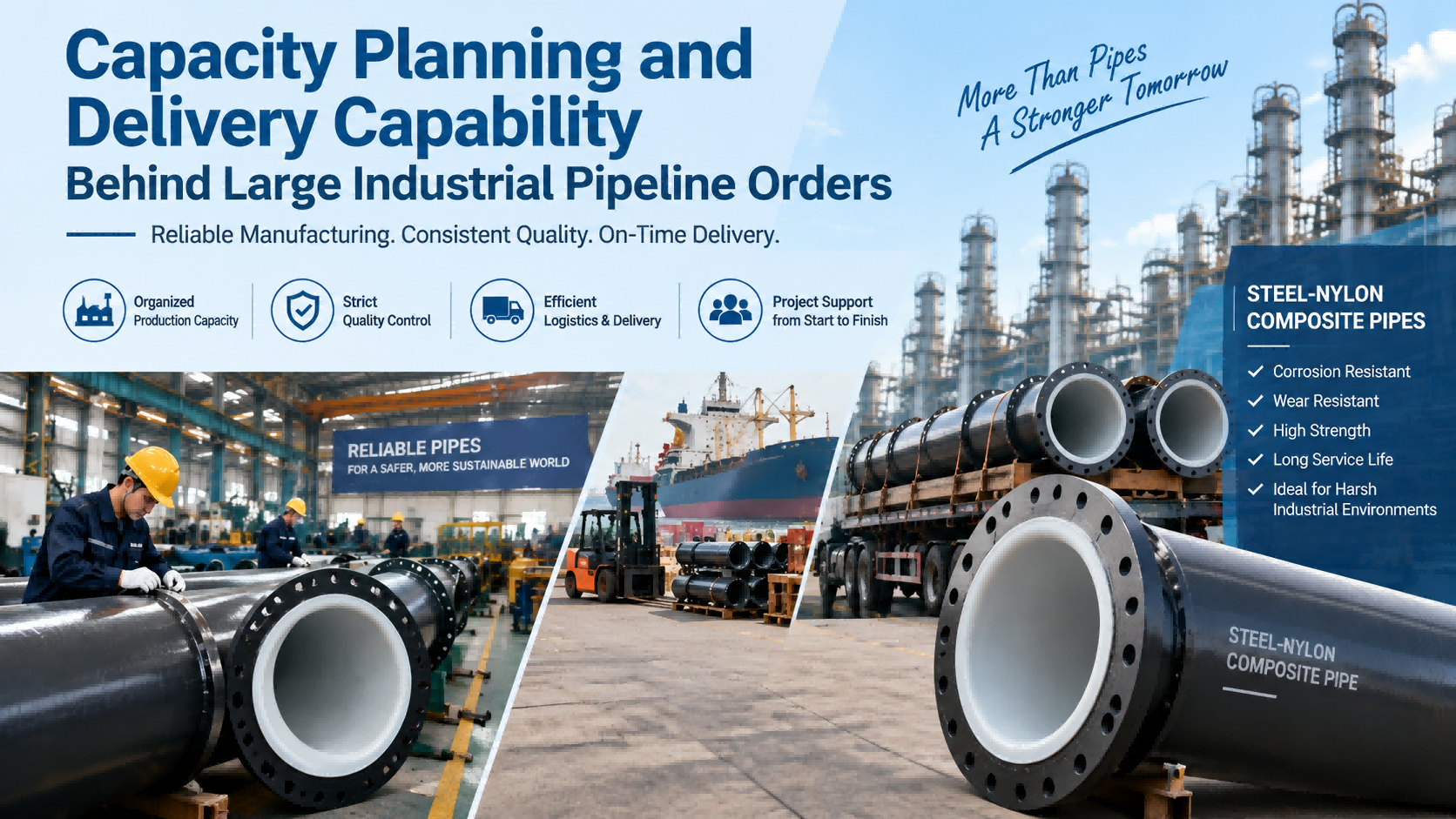
What Tests Does a Steel-Nylon Composite Pipe Undergo Before Leaving the Factory?

In chemical plants, oilfields, salt chemical facilities, soda ash plants, chlor-alkali operations, mining projects, and industrial water systems, pipelines may represent only one part of the overall process system. However, once leakage, perforation, liner failure, or connection failure occurs, the resulting losses can far exceed the original cost of the pipe itself.
For this reason, when it comes to a steel-nylon composite pipe designed for demanding industrial service, “manufacturing completed” does not mean “ready for shipment.”
A reliable industrial pipe should pass a systematic quality-control process covering raw materials, steel structure, nylon functional layer, dimensional accuracy, pressure resistance, sealing performance, final inspection, and quality documentation.
This becomes even more important in environments involving severe corrosion, abrasion, high salinity, strong alkalis, pressure, and large-diameter pipelines. A small deviation during manufacturing may develop into a much more serious reliability problem after years of operation.
So, what inspections and tests should a steel-nylon composite pipe undergo before it leaves the factory?
01. Inspection Is Not Just the Final Step — It Runs Through the Entire Manufacturing Process
When people hear the term “factory inspection,” they often think only of a hydrostatic pressure test performed after production.
In reality, a more appropriate quality-control process for industrial-grade steel-nylon composite pipes should include:
Raw Material Inspection → Manufacturing Process Inspection → Finished Product Dimensional Inspection → Structural Quality Inspection → Pressure and Leakage Testing → Visual and Marking Inspection → Final Documentation Review
In other words, quality should not simply be “tested into” a finished product.
It should be controlled throughout the manufacturing process.
If the raw materials, steel reinforcement structure, nylon forming process, and flange structure are not properly controlled, a final pressure test alone cannot fully determine whether the pipe will remain reliable over many years of service.
1. Raw Material Inspection: Pipe Quality Starts with the Materials
A steel-nylon composite pipe combines the performance advantages of different materials within one integrated structure.
In general:
-
The steel structure provides mechanical strength, rigidity, and pressure resistance.
-
The nylon functional layer provides corrosion resistance, abrasion resistance, reduced scaling tendency, and separation of the transported medium from the steel structure.
-
The flange and connection system directly influences installation accuracy and long-term sealing reliability.
For this reason, consistent raw material quality is the foundation of reliable manufacturing.
Steel Material Inspection
Before steel materials enter production, their specifications, documentation, dimensions, and surface condition should be verified according to the design requirements.
Typical inspection points include:
-
Whether the steel grade complies with the design specification
-
Whether wall thickness meets design requirements
-
Whether there is serious corrosion, cracking, lamination, or mechanical damage
-
Whether the material batch can be traced
-
Whether the required material certificates are complete
For higher-pressure or large-diameter pipelines, the steel structure is much more than a simple outer shell.
It carries an important part of the mechanical load of the entire composite pipeline.
Therefore, steel selection and manufacturing accuracy directly affect the final pressure-bearing stability of the pipe.
Nylon Raw Material Inspection
The nylon functional layer is one of the most important differences between a steel-nylon composite pipe and a conventional steel pipe.
It affects not only corrosion resistance but also:
-
Abrasion resistance
-
Temperature adaptability
-
Internal surface smoothness
-
Impact resistance
-
Long-term dimensional stability
-
Chemical compatibility
Therefore, nylon resin batches, material condition, and relevant technical parameters should be controlled before the material enters production.
This is particularly important for pipelines transporting high-salinity water, process liquor, strong alkaline media, solids-containing fluids, or oilfield produced fluids.
2. Steel Structure Inspection: The Foundation of Pressure-Bearing Reliability
One of the primary structural advantages of a steel-nylon composite pipe is the combination of the mechanical strength of steel with the corrosion and abrasion resistance of engineering nylon.
The manufacturing quality of the steel structure therefore needs to be verified first.
Pipe Dimensional Inspection
During manufacturing, critical dimensions should be inspected, including:
-
Outside diameter
-
Wall thickness
-
Pipe length
-
Roundness
-
Straightness
-
Flange dimensions
-
Bolt-hole spacing
-
Flange flatness
-
Alignment between the two end flanges
As pipe diameter increases from DN100 to DN500, DN1000, or even larger, dimensional control becomes increasingly important.
Dimensional errors do not affect only an individual pipe. They can influence the installation accuracy of the entire piping system.
For example, if flange bolt holes are significantly misaligned, installers may be forced to pull, twist, or mechanically stress the pipeline to complete the connection.
This can create additional installation stress around:
Flanges, gaskets, fittings, and equipment nozzles.
Therefore, manufacturing large-diameter industrial pipelines is also fundamentally an exercise in precision dimensional control.
3. Flange Inspection: One of the Most Underestimated Areas of Pipeline Reliability
Many industrial pipeline leaks occur not along the pipe body but at connection points.
For this reason, flange design and manufacturing quality deserve particular attention.
Our steel-nylon composite pipes adopt an integrated flange connection design, allowing pipelines to be installed mainly through flanged connections without requiring welding or heat fusion of the pipe body at the jobsite.
This provides significant advantages for chemical plants, oilfield facilities, brownfield upgrades, and industrial sites where hot work is strictly controlled.
However, it also means that:
Flange manufacturing accuracy must be carefully controlled.
Typical inspection items include:
-
Flange outside diameter
-
Number of bolt holes
-
Bolt-hole diameter
-
Bolt circle diameter
-
Sealing-face dimensions
-
Flange flatness
-
Parallelism between both end flanges
-
Alignment between the flange and pipe axis
Even if the pipe body itself is manufactured correctly, inaccurate flanges can still cause:
-
Uneven gasket compression
-
Uneven bolt preload
-
Local leakage
-
Installation difficulties
-
Long-term fatigue around connection points
Therefore, an integrated flange is not merely a connection method.
It is a system design that depends on manufacturing precision.
4. Weld Quality Inspection of the Steel Structure
Where the steel structure, flange components, or special fittings involve welded fabrication, weld quality should also be inspected.
Depending on the product structure, project requirements, and required quality level, inspection may include:
-
Visual weld inspection
-
Dimensional inspection
-
Non-destructive testing where specified
-
Inspection for welding defects
Typical defects requiring attention include:
-
Cracks
-
Incomplete penetration
-
Lack of fusion
-
Porosity
-
Slag inclusions
-
Undercut
-
Excessive welding deformation
An important distinction should be made here:
The steel structure may involve welding during factory manufacturing, but steel-nylon composite pipes are typically connected by flanges at the installation site, reducing or eliminating the need to weld the pipe body on site.
This can be particularly valuable for chemical plants, oil and gas facilities, and aging pipeline rehabilitation projects where hot-work operations are tightly controlled.
5. Nylon Functional Layer Inspection: A Major Factor in Long-Term Service Life
If the steel structure primarily addresses mechanical strength, the nylon functional layer primarily addresses:
Chemical compatibility and long-term service performance.
It is therefore one of the most important parts of steel-nylon composite pipe inspection.
Nylon Layer Surface and Integrity Inspection
The nylon layer should be inspected for defects such as:
-
Cracks
-
Significant air pockets or bubbles
-
Material shortages
-
Abnormal deformation
-
Local damage
-
Forming defects
-
Surface abnormalities that could affect service
For industrial pipelines, the internal surface deserves particular attention.
If the functional layer contains significant defects, corrosive media may create localized attack points that could reduce the service life of the overall composite structure.
Nylon Layer Thickness and Uniformity
For a nylon functional layer, thicker does not automatically mean better.
What matters is:
Meeting the designed thickness while maintaining reasonable uniformity.
Locally insufficient thickness can reduce abrasion resistance or chemical isolation performance, while excessive variation can indicate instability in the forming process.
The manufacturing process should therefore control:
-
Design thickness
-
Thickness uniformity
-
Continuity in critical areas
-
Structural integrity around pipe ends and connection areas
This is particularly important when transporting abrasive media such as salt sludge, mineral slurry, solids-containing fluids, or other erosion-prone materials.
6. Composite Structure Inspection: More Than Simply Combining Two Materials
The most important word in “composite pipe” is composite.
A high-quality steel-nylon composite pipe is not simply a steel pipe with a plastic layer placed inside it.
Its structural design must consider how different materials work together under:
-
Pressure
-
Temperature variation
-
Mechanical loading
-
Long-term operation
-
Installation stress
After manufacturing, the composite structure should therefore be inspected for abnormalities such as:
-
Local bulging
-
Abnormal gaps
-
Structural deformation
-
Separation of the functional layer
-
Abnormalities around pipe-end composite structures
In our steel-nylon composite pipe design and manufacturing process, we place considerable emphasis on the long-term stability of the steel structure and reinforced nylon functional layer.
This is one reason steel-nylon composite pipes are particularly well suited to industrial applications where conventional piping materials frequently experience:
Corrosion, abrasion, scaling, and repeated maintenance.
7. Internal Surface Inspection: A Smooth Bore Affects More Than Appearance
One frequently overlooked advantage of steel-nylon composite pipes is their relatively smooth nylon internal surface.
For pipelines transporting brine, mother liquor, industrial wastewater, high-salinity produced water, and other scaling-prone media, internal surface condition can directly affect long-term operating performance.
Before shipment, typical inspections include checking whether:
-
The internal surface is continuous
-
Significant projections or irregularities are present
-
There are structures that could interfere with fluid flow
-
Foreign objects are present inside the pipe
-
Pipe ends are clean and properly finished
A smooth internal surface can help reduce the tendency for deposition and scaling while also minimizing additional hydraulic resistance.
This means that when evaluating an industrial pipe, the question should not simply be:
“Can it transport the medium today?”
A better question is:
“After five or ten years of service, how much of its effective flow capacity can it still maintain?”
8. Hydrostatic Pressure Testing: A Direct Verification of Pressure-Bearing Capability
For pressure piping, hydrostatic testing is one of the most important finished-product inspection procedures.
Depending on the product design pressure, project specifications, and applicable inspection requirements, the pipe is pressurized to a specified test condition and maintained for a prescribed period.
The test typically checks for:
-
Leakage
-
Abnormal deformation
-
Stability around flange areas
-
Structural abnormalities
-
Ability to maintain the specified test pressure
Our steel-nylon composite pipes can be configured for different industrial applications, with pressure classes covering approximately 1.0–4.0 MPa.
However, design pressure alone should never be the only criterion used for industrial pipeline selection.
A proper evaluation should consider:
Operating Pressure + Temperature + Medium + Pipe Diameter + Support Conditions + Operating Fluctuations
This is why we emphasize application-based pipe selection, rather than simply selecting a pipe according to pressure rating alone.
9. Leakage and Sealing Inspection: System Reliability Often Depends on the Connections
In addition to verifying pressure-bearing capability, hydrostatic testing can also help identify potential sealing problems in connection structures.
For flanged pipelines, particular attention should be paid to:
-
Pipe ends
-
Flanges
-
Sealing areas
-
Special fittings
-
Structural connection areas
The real objective of an industrial project is not simply to obtain:
“A pipe that does not leak.”
The objective is to build:
“A piping system that remains leak-free over the long term.”
For this reason, our product design considers not only straight pipes but also the matching requirements of:
-
Elbows
-
Tees
-
Reducers
-
Pipe sections upstream and downstream of valves
-
Pump discharge pipe sections
-
Equipment connections
-
Flanged connection systems
The reliability of the entire piping system is ultimately more important than the performance of any single straight pipe.
10. Negative-Pressure and Special Operating Conditions
Not every industrial pipeline operates continuously under positive internal pressure.
Certain processes may experience:
-
Pump start-stop cycles
-
Drain-down conditions
-
Rapid discharge
-
Water hammer
-
Vacuum conditions
-
Temporary negative pressure
For some conventional lined pipes, negative pressure can cause the internal lining to bulge, deform, or even collapse.
Therefore, where a project involves special vacuum or negative-pressure conditions, the pipeline structure should be evaluated according to the actual design parameters.
One of the advantages of a steel-nylon composite structure is that it does not rely solely on the polymer layer for performance.
The steel structure provides mechanical strength and rigidity, while the nylon functional layer provides corrosion and abrasion resistance.
This combination of structural rigidity + functional material performance offers important advantages under complex industrial operating conditions.
11. How Is Corrosion Resistance Evaluated?
Unlike pressure testing, corrosion resistance does not mean that every finished pipe must be immersed in a chemical medium for several months before shipment.
Industrial quality assurance typically combines:
Material Verification + Process Control + Batch Quality Control + Type Testing or Special Testing Where Required
For new chemicals or special operating conditions, material suitability can be evaluated based on factors such as:
-
Chemical composition
-
Concentration
-
Temperature
-
Pressure
-
Solid particle content
-
Flow velocity
-
Presence of oxidizing components
Steel-nylon composite pipes are particularly suitable for many services where traditional steel piping is vulnerable to corrosion, including:
-
High-salinity water
-
Industrial brine
-
Strong alkaline environments
-
Soda ash process liquor
-
Oilfield produced water
-
Certain chemical wastewater streams
-
Media involving both corrosion and abrasion
However, no industrial material should be described as being universally “resistant to all corrosion” without reference to the actual service conditions.
Professional material selection must always consider the medium, concentration, temperature, pressure, and operating conditions together.
12. Why Is Abrasion Resistance Equally Important?
Many industrial pipeline failures are not caused by corrosion alone.
Media such as:
-
Salt sludge
-
Mineral slurry
-
Solid-liquid mixtures
-
Sand-containing oilfield fluids
-
Desulfurization slurry
-
Industrial wastewater
may subject pipelines to both corrosion and particle erosion.
This produces a typical combined mechanism of:
Corrosion + Erosion
If corrosion is addressed while erosion is ignored, pipeline service life may still be significantly reduced.
Reinforced nylon offers good abrasion resistance, which makes steel-nylon composite pipe particularly valuable in applications requiring a combination of:
Pressure Resistance + Corrosion Resistance + Abrasion Resistance
For applications with demanding abrasion requirements, suitability can be further verified through material testing, historical engineering data, and project-specific testing.
13. Why Do Large-Diameter Steel-Nylon Composite Pipes Require More Stringent Inspection?
As pipe diameter increases, manufacturing difficulty does not increase linearly.
For example, compared with a DN100 pipe, a DN2000-class pipe requires much greater attention to:
-
Roundness
-
Deformation under self-weight
-
Flange flatness
-
Flange alignment
-
Steel structural rigidity
-
Uniformity of the nylon layer
-
Lifting loads
-
Transportation deformation
-
Pipe support spacing in the field
Therefore, the true manufacturing capability of a large-diameter composite pipe supplier cannot be evaluated simply by asking:
“Can you manufacture DN2000 pipe?”
A more important question is:
“After manufacturing a DN2000 pipe, can the supplier consistently control its dimensional accuracy, composite quality, flange precision, and pressure-bearing performance?”
Our current steel-nylon composite pipe manufacturing capability can support DN2000 and larger diameter requirements.
Achieving this capability is not simply a matter of installing larger production equipment.
It depends on accumulated experience in materials, structural engineering, manufacturing processes, dimensional control, and large-diameter pipe production.
14. Final Visual and Dimensional Inspection
After pressure testing and other required inspections have been completed, the finished pipe should undergo a final inspection before shipment.
Typical inspection points include:
-
Pipe body appearance
-
Pipe-end condition
-
Flange condition
-
Dimensions
-
Product markings
-
Protective measures
-
Packaging
-
Quantity
For large industrial pipes, the journey from factory to project site includes:
Lifting → Loading → Long-Distance Transportation → Unloading → Storage → Secondary Lifting → Installation
Any of these stages can potentially damage pipe ends or flanges if proper protection is not provided.
Therefore, transportation and packaging protection should also be considered part of the overall quality-control process.
15. Product Identification and Traceability
Modern industrial projects increasingly emphasize quality traceability.
Each batch, and where necessary each critical pipe, should therefore be assigned appropriate identification information, such as:
-
Product specification
-
Pressure class
-
Production batch
-
Product identification number
-
Manufacturing date
-
Inspection status
If a particular pipeline section needs to be investigated years later, its product identification should make it possible to trace:
Materials → Manufacturing → Inspection → Shipment
For industrial projects expected to operate for ten years or more, this level of traceability is extremely important.
16. Final Quality Documentation Review
A complete product delivery involves more than simply shipping pipes.
It also involves supplying the relevant quality documentation.
Depending on project requirements, this may include:
-
Product certificate of conformity
-
Material certificates
-
Dimensional inspection records
-
Hydrostatic test records
-
Relevant quality inspection reports
-
Product list
-
Traceability numbers
-
Other technical documentation required by the project
For international projects, EPC contracts, and large chemical facilities, quality documentation is itself an important part of supply-chain management.
17. Factory Inspection and Type Testing Are Not the Same Thing
When purchasing steel-nylon composite pipes, it is important to understand the distinction between:
Routine Inspection
and
Type Testing / Performance Validation
For each pipe or production batch, routine inspection generally focuses on:
-
Dimensions
-
Appearance
-
Manufacturing quality
-
Sealing
-
Pressure resistance
-
Product identification
-
Documentation
Long-term performance, on the other hand, is more commonly demonstrated through:
-
Material performance testing
-
Type testing
-
Batch sampling
-
Engineering validation
-
Long-term operating experience
For example:
Long-term corrosion resistance, abrasion performance, and compatibility with different process media cannot be fully proven by a factory test lasting only a few hours.
This is why the capability of an industrial pipe supplier should not be judged solely by a single inspection certificate.
Customers should also consider:
Material System + Manufacturing Capability + Engineering Track Record + Long-Term Field Experience
18. What Should Really Be Inspected Before a Steel-Nylon Composite Pipe Leaves the Factory?
The overall quality-control process can be summarized into several key dimensions:
| Inspection Area | Key Inspection Items | Main Purpose |
|---|---|---|
| Raw Materials | Steel, nylon materials, batch records | Verify material reliability |
| Steel Structure | Dimensions, welding, structural quality | Ensure pressure-bearing capability |
| Nylon Layer | Thickness, integrity, forming quality | Ensure corrosion and abrasion resistance |
| Composite Structure | Structural stability | Support long-term operation |
| Flanges | Dimensions, flatness, bolt-hole positioning | Ensure installation and sealing reliability |
| Dimensions | Diameter, length, roundness, alignment | Ensure accurate installation |
| Hydrostatic Test | Pressure resistance, leakage, deformation | Verify pressure reliability |
| Special Conditions | Vacuum, medium, temperature, etc. | Confirm application suitability |
| Visual Inspection | Pipe body, inner surface, pipe ends | Identify manufacturing defects |
| Documentation | Identification, reports, records | Ensure traceability |
A truly reliable industrial pipe should achieve a proper balance across all of these areas.
19. Why Do We Apply Quality Control Throughout the Entire Manufacturing Process?
Our products are used in demanding industries including:
-
Oil and gas gathering and transportation
-
Oilfield produced water systems
-
Salt chemical processing
-
Soda ash production
-
Chlor-alkali plants
-
Phosphate chemical processing
-
Mining
-
Power generation
-
Industrial water systems
-
Municipal water supply and drainage
These industries share one common requirement:
Customers are not simply purchasing pipes. They need the piping system to operate reliably for the long term.
For this reason, our steel-nylon composite pipe development does not focus on solving only one performance parameter.
Instead, we consider multiple factors simultaneously:
**Corrosion Resistance
-
Abrasion Resistance
-
Pressure Strength
-
Temperature Adaptability
-
Installation Efficiency
-
Long-Term Reliability**
Our steel-nylon composite pipes can be engineered for different project conditions, with capabilities including approximately:
-
DN100–DN2000+ diameter range
-
1.0–4.0 MPa pressure classes
-
Approx. –36°C to 160°C application temperature range
The pipes also use an integrated flange design, allowing field installation mainly through flanged connections and reducing the need for on-site welding.
The steel structure provides mechanical strength and rigidity, while the reinforced nylon functional layer helps overcome the corrosion, abrasion, and scaling problems frequently encountered with traditional steel pipelines.
The objective of this composite design is not simply to extend the service life of an individual pipe.
It is to:
Reduce the lifecycle maintenance cost of the entire industrial fluid transport system.
20. Ten Questions to Ask Before Purchasing Steel-Nylon Composite Pipes
For engineering companies, EPC contractors, and end users, instead of asking only:
“What is the price per meter?”
it is more useful to first ask the supplier:
-
Can the steel and nylon raw materials be fully traced?
-
What type of composite structure is used?
-
How is the thickness and uniformity of the nylon functional layer controlled?
-
Does the pipe use an integrated flange design?
-
How are roundness and flange flatness controlled for large-diameter pipes?
-
Are pressure and quality inspections performed for each applicable batch?
-
Can complete factory quality documentation be provided?
-
Does the supplier have long-term field experience with similar media?
-
Can pipe selection be engineered according to temperature, pressure, medium, and flow conditions?
-
Can the supplier provide a complete piping system including elbows, tees, reducers, and other fittings?
These questions are often much more important than simply comparing the initial price of different pipe materials.
Because the real cost of an industrial pipeline is not merely its:
Purchase Price
but its:
Total Lifecycle Cost.
Conclusion: Reliable Industrial Pipes Are Manufactured — and Verified
From the moment raw materials enter the factory to the moment a finished pipe is loaded for shipment, a steel-nylon composite pipe should go through a series of inspections covering materials, structure, dimensions, composite quality, pressure resistance, sealing performance, and quality documentation.
These inspections may add steps to the manufacturing process, but their real purpose is to reduce uncertainty during future plant operation.
For industrial projects involving severe corrosion, high abrasion, difficult maintenance, or extremely high shutdown costs, the most important question should not simply be:
“Did this pipe pass the factory inspection?”
A better question is:
“What design, manufacturing processes, inspection procedures, and quality controls enable this piping system to remain reliable under demanding operating conditions?”
That is where the real value of steel-nylon composite pipe lies.
By combining the structural strength of steel with the corrosion resistance, abrasion resistance, and low-scaling characteristics of reinforced nylon, together with integrated flanges, large-diameter manufacturing capability, pressure testing, and comprehensive quality control, our goal is not simply to supply another batch of pipes.
Our goal is to help customers improve the long-term reliability of their industrial fluid transport systems.
For oil and gas fields, salt chemical plants, soda ash facilities, chlor-alkali operations, mining projects, and other demanding industrial applications, the ultimate measure of a high-value piping solution is simple:
Fewer Leaks. Less Maintenance. Less Downtime. Lower Total Lifecycle Cost.
How Can Industrial Pipe Manufacturers Ensure Dimensional and Performance Consistency in Mass Production?
How Are Industrial Pipes Rated for 1.0–4.0 MPa Manufactured Consistently and Reliably?