
Capacity Planning and Delivery Capability Behind Large Industrial Pipeline Orders
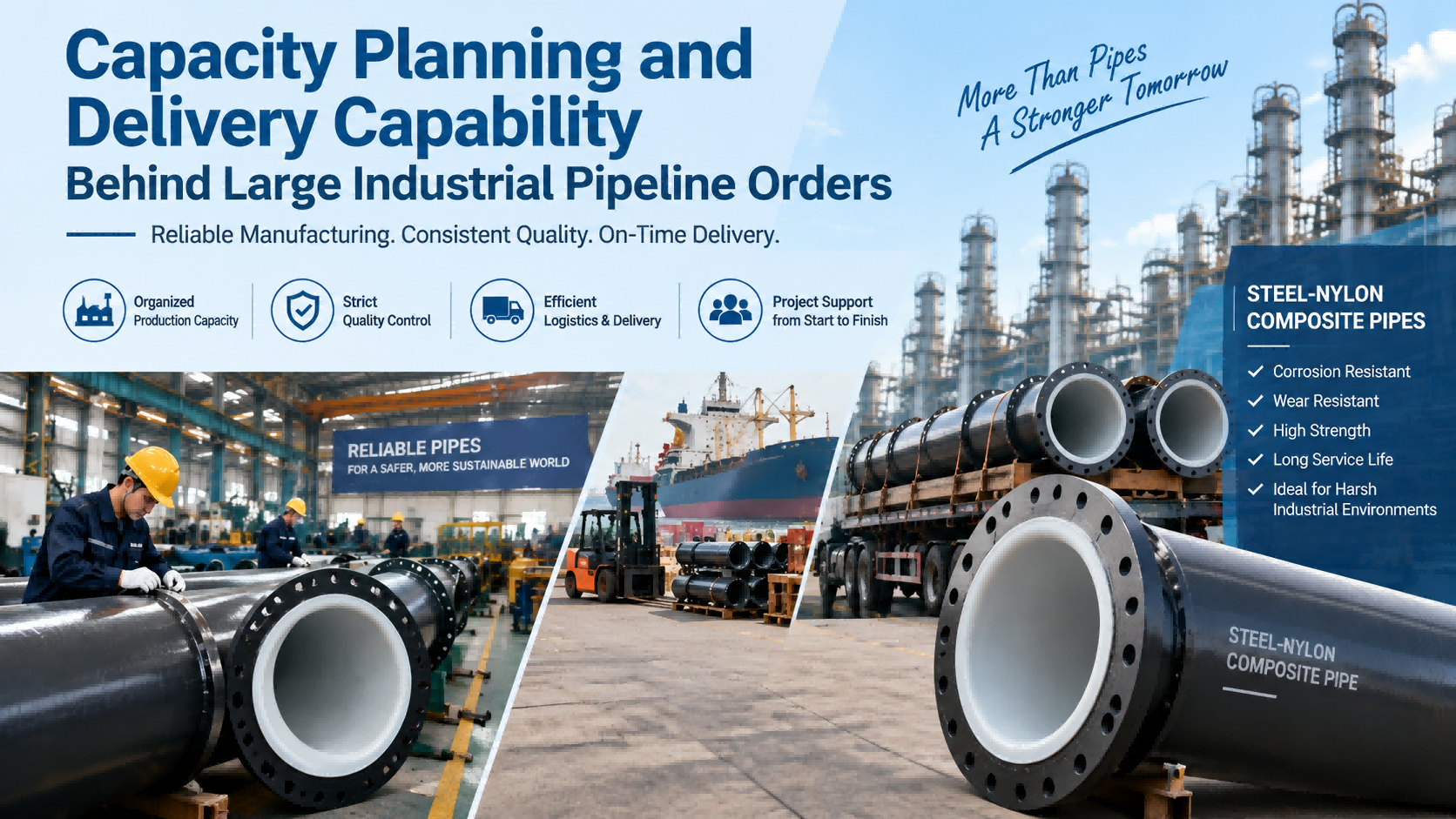
When you place a large industrial pipeline order for a chemical plant, oil and gas field, mining operation, salt chemical facility, chlor-alkali plant, or infrastructure project, you are rarely buying just a few dozen standard pipe sections.
A major project may involve:
-
Multiple pipe diameters;
-
Different pressure ratings;
-
Various wall thicknesses and structural designs;
-
Large quantities of straight pipes, elbows, tees, reducers, and other fittings;
-
Deliveries divided by project area, process unit, or construction phase;
-
Hundreds of meters or even several kilometers of pipeline;
-
Strict installation and shutdown windows;
-
Complete inspection documents and product traceability records.
Once an order reaches this scale, the purchasing decision changes.
You are no longer evaluating only the pipe itself.
You are also evaluating the manufacturer's ability to manage:
production capacity, batch consistency, project coordination, quality control, and on-time delivery.
That is why large industrial projects increasingly look beyond the price of an individual pipe. A much more important question is whether the supplier can manufacture hundreds or thousands of pipe sections to the same technical standard and deliver them in the sequence the project actually needs.
For steel-nylon composite pipes, this challenge becomes even more important.
The steel structure must meet dimensional, strength, rigidity, and pressure requirements, while the internal nylon functional layer must maintain stable thickness, integrity, forming quality, and overall composite consistency.
In other words, a large order does not simply test how fast a factory can produce.
It tests the maturity of the entire manufacturing and delivery system.
1. What Really Makes a Large Industrial Pipeline Order Difficult?
It is easy to think of a large order as simply “more pipes.”
From a manufacturing perspective, however, producing 1,000 industrial pipe sections is not the same as producing one pipe and repeating the process 999 more times.
As project volume increases, complexity increases with it.
A manufacturer may need to coordinate:
-
Multiple specifications in production at the same time;
-
Large-volume procurement of steel and nylon raw materials;
-
Fabrication of large-diameter steel structures;
-
Multiple composite forming batches;
-
Flange dimensional matching;
-
Synchronized production of straight pipes and fittings;
-
Dimensional consistency across production batches;
-
Batch-by-batch inspection;
-
Product protection and packaging;
-
Truck and shipping arrangements;
-
Coordination with the installation schedule at the jobsite.
A delay in just one area can affect the entire project.
For example, a batch of special fittings may represent only a small percentage of the total order value. But if those fittings are required to close a critical pipeline section, installation may stop even though most of the pipes have already arrived.
That is why large pipeline projects are not simply about managing production volume.
They are about coordinating:
Engineering → Procurement → Manufacturing → Inspection → Packaging → Logistics → Site Installation
The stronger that coordination is, the more predictable the project becomes.
2. Manufacturing Capacity Is More Than the Number of Machines in a Factory
When you evaluate whether a pipeline manufacturer can handle a large order, factory size and equipment numbers are useful—but they do not tell the whole story.
Real production capacity has several layers.
2.1 Equipment Capacity
This is the foundation.
For steel-nylon composite pipe production, relevant equipment may include:
-
Steel pipe body fabrication equipment;
-
Large-diameter pipe manufacturing systems;
-
Flange and structural component processing equipment;
-
Nylon forming equipment;
-
Composite molding equipment;
-
Pipe fitting manufacturing equipment;
-
Inspection and testing equipment;
-
Lifting and material handling systems.
These determine the theoretical manufacturing capacity of the factory.
But theoretical capacity and reliable project delivery are not the same thing.
2.2 Process Capacity
Two factories can own similar equipment and still achieve very different levels of stable output.
The reason is simple: industrial pipe production is a connected manufacturing process, not an isolated operation.
A typical steel-nylon composite pipe production flow may include:
Steel Structure Fabrication → Surface Preparation → Dimensional Verification → Nylon Material Preparation → Forming → Composite Processing → Cooling → Dimensional Finishing → Flange Processing → Inspection → Packaging
If one stage cannot keep pace with the others, it becomes a bottleneck.
For example, increasing steel fabrication output does not help much if composite forming capacity cannot absorb the additional volume.
A mature manufacturing system therefore focuses on balancing the entire production chain—not simply maximizing one process.
2.3 Management Capacity
Large projects usually contain many specifications rather than a single standard product.
A single order may include:
DN100, DN150, DN200, DN300, DN500, and much larger diameters.
At the same time, different sections may require pressure ratings such as:
PN1.0 MPa, PN1.6 MPa, PN2.5 MPa, or higher.
Without disciplined production planning, multiple specifications moving through the factory at the same time can create problems such as:
-
Material mix-ups;
-
Incorrect dimensions;
-
Wrong flange configurations;
-
Incorrect pressure classes;
-
Quantity discrepancies;
-
Products shipped in the wrong sequence.
This is why large-order management requires clear links between:
Order Code → Production Batch → Inspection Record → Packaging Number → Shipment Batch
That traceability becomes increasingly valuable as project size increases.
2.4 Supply Chain Capacity
A factory can have sufficient equipment and still miss a delivery schedule if raw materials are not available when needed.
Steel-nylon composite pipe production depends on two fundamental material systems:
Structural Material: Steel
and
Functional Material: Nylon
Before a large order moves into mass production, the manufacturer may need to secure:
-
Steel specifications;
-
Steel plate or steel pipe materials;
-
Flange materials;
-
Nylon raw materials;
-
Fasteners;
-
Packaging materials;
-
Customized components.
This means material planning has to begin before production reaches full capacity.
A realistic delivery schedule should therefore be based not only on machine output, but also on raw material availability and supply chain stability.
3. Why Large Pipeline Orders Should Be Managed as Projects
Standard products can sometimes be manufactured for inventory.
Large industrial pipeline systems are different.
They are better managed through:
Project-Based Manufacturing.
That means treating the order as an engineering project rather than simply sending a production quantity to the factory floor.
Stage 1: Technical Confirmation
Before production starts, the technical requirements need to be clearly defined.
These normally include:
-
Pipe diameter;
-
Pipe length;
-
Pressure rating;
-
Conveyed medium;
-
Operating temperature;
-
Flange standard;
-
Fitting type;
-
Quantity;
-
Installation environment;
-
External corrosion protection requirements;
-
Packaging requirements;
-
Transportation method.
For steel-nylon composite pipes, another question is equally important:
Is the material suitable for the actual service conditions?
Steel-nylon composite structures can be particularly valuable in applications where several challenges exist at the same time, such as:
corrosion, abrasion, scaling, and pressure requirements.
However, material selection should always be based on the actual medium, concentration, temperature, pressure, and operating conditions.
A material should never be selected solely because the chemical name appears on a general compatibility list.
4. Why Should the Design Be Frozen Before Mass Production?
Design changes are one of the most easily underestimated risks in large pipeline projects.
Imagine that 50% of an order has already been manufactured and the project suddenly requests:
-
A different flange standard;
-
Revised pipe lengths;
-
Additional branch connections;
-
Changes to tee locations;
-
A different pressure rating.
For conventional fabricated steel pipe, some changes may still be manageable.
For steel-nylon composite pipes that have already completed composite forming, significant structural modifications may require the affected sections to be manufactured again.
That is why major projects benefit from establishing a:
Technical Design Freeze
before full-scale production begins.
After the design freeze, key parameters such as:
-
Diameter;
-
Length;
-
Flange configuration;
-
Pressure rating;
-
Fitting geometry;
should remain stable.
If changes are unavoidable, they should be handled through a formal engineering change process.
Doing this helps reduce:
-
Rework;
-
Material waste;
-
Production disruption;
-
Scheduling uncertainty;
-
Delivery risk.
For large orders, controlling design changes is often just as important as controlling production speed.
5. Why Shouldn't a Large Order Simply Be Produced and Shipped All at Once?
For many major industrial projects, the model:
Finish Everything → Ship Everything
is not the most efficient approach.
A better strategy is often:
Batch Manufacturing + Batch Inspection + Batch Delivery
Suppose a project contains several kilometers of industrial pipeline.
The order could be divided into:
Batch A
Main pipeline for the first installation zone.
Batch B
Pipeline sections for the second construction zone.
Batch C
Pump station and equipment connection sections.
Batch D
Fittings and special pipe sections.
This allows site installation to begin before the entire order has been completed.
Production and construction can then proceed partly in parallel.
For customers, that can be much more valuable than simply receiving the entire order on one final delivery date.
6. The Delivery Sequence Should Match the Installation Sequence
A shipment can technically arrive on time and still be useless to the construction team.
Consider this situation:
The first truck carries materials for Installation Area 3.
The second carries materials for Area 5.
The third finally carries the products required for Area 1.
From a logistics perspective, the supplier may believe delivery is progressing normally.
From the site team's perspective, however, installation cannot proceed efficiently.
A stronger project delivery model aligns:
Manufacturing Sequence → Delivery Sequence → Installation Sequence
as closely as possible.
This can reduce:
-
Secondary material handling;
-
Long-term site storage;
-
Time spent searching for fittings;
-
Repeated lifting operations;
-
Installation delays.
The key question is not simply:
When will the products arrive?
It is:
Will the products needed for the next installation stage arrive at the right time?
That difference is fundamental in large industrial projects.
7. Why Does Batch Consistency Matter So Much for Steel-Nylon Composite Pipes?
Steel-nylon composite pipe combines two material systems to perform different functions.
External Steel Structure
The steel structure primarily provides:
-
Mechanical strength;
-
Structural rigidity;
-
Pressure-bearing capability;
-
Pipeline support;
-
Resistance to external mechanical loads.
Internal Nylon Functional Layer
The internal nylon layer primarily contributes:
-
Isolation of the conveyed medium from the steel structure;
-
Corrosion resistance;
-
Abrasion resistance;
-
Reduced scaling tendency;
-
A smoother internal flow surface.
Because both systems work together, large-scale production requires consistency in more than just the steel pipe dimensions.
Manufacturers also need to control factors such as:
-
Internal diameter;
-
Nylon layer thickness;
-
Concentricity;
-
Internal surface integrity;
-
Flange transition areas;
-
Overall composite stability.
Producing one acceptable pipe is relatively straightforward.
The real manufacturing challenge is ensuring that:
the first pipe, the hundredth pipe, and the thousandth pipe all remain within the same controlled manufacturing standard.
That is where industrial-scale manufacturing capability becomes visible.
8. Why Batch Consistency Matters More Than the Performance of the Best Individual Pipe
An industrial customer does not need one exceptional pipe.
The customer needs:
a reliable pipeline system.
Suppose a pipeline contains 1,000 pipe sections.
If 999 perform well but one section contains a serious defect, that single section may still cause leakage and interrupt the process.
For this reason, industrial manufacturing is not primarily about answering:
How good is the best pipe?
A more important question is:
How consistent is every pipe?
This is one of the biggest differences between producing a sample and reliably manufacturing a large industrial order.
9. Stable Production Starts With Raw Material Batch Control
Large-scale manufacturing becomes more difficult if the same project uses many raw material batches with significantly different characteristics.
That is why a mature manufacturing system should keep key raw material sources and specifications as stable as possible.
For steel, important factors may include:
-
Material grade;
-
Thickness;
-
Mechanical properties;
-
Dimensions;
-
Surface condition.
For nylon materials, important factors may include:
-
Material grade;
-
Batch identification;
-
Formulation consistency;
-
Forming performance;
-
Storage condition.
Incoming material inspection helps identify potential problems before those materials enter production.
This is much more efficient than discovering inconsistencies after finished products have already been manufactured.
10. Why Does Large-Diameter Manufacturing Require a Stronger Production System?
As pipe diameter increases, manufacturing complexity often increases faster than the diameter itself.
Large-diameter steel-nylon composite pipes require control over issues such as:
-
Large steel structure geometry;
-
Roundness;
-
Flange flatness;
-
Large-area nylon forming;
-
Temperature uniformity;
-
Composite structural stability;
-
Deformation during lifting;
-
Protection during long-distance transportation.
Once diameters reach DN1000 and above, even relatively small dimensional deviations can become much more noticeable during site assembly.
Large-diameter manufacturing is therefore not simply:
making a small pipe larger.
It requires coordinated capability across:
equipment, tooling, manufacturing processes, lifting, inspection, and logistics.
For a steel-nylon composite pipe manufacturer, proven large-diameter capability can be especially important when serving major chemical, mining, oil and gas, and infrastructure projects.
11. Why Are More Industrial Projects Moving Toward Factory Prefabrication?
Historically, many industrial pipeline systems relied heavily on field fabrication.
But construction sites are difficult environments in which to control manufacturing quality.
They may involve:
-
Limited working space;
-
Complex surroundings;
-
Weather exposure;
-
Variation in workforce skill;
-
Lower dimensional control;
-
Additional safety management.
For this reason, many projects increasingly favor:
Factory Prefabrication.
The goal is to complete as much work as reasonably possible under controlled factory conditions.
This may include:
-
Straight pipe sections;
-
Flange preparation;
-
Elbows;
-
Tees;
-
Reducers;
-
Customized fittings.
The site can then focus primarily on assembly.
Because steel-nylon composite pipes are typically connected through flanged joints, they can reduce the amount of on-site welding required in suitable projects.
This can be especially useful in:
-
Chemical plants;
-
Oil and gas facilities;
-
Pipeline retrofit projects;
-
Facilities where hot-work permits are tightly controlled;
-
Projects with short shutdown windows.
12. Reduced Hot Work Can Change the Entire Project Schedule
Traditional steel pipeline installation may require:
-
Welding machines;
-
Qualified welders;
-
Welding consumables;
-
Weld inspection;
-
Hot-work permits;
-
Fire protection controls;
-
Post-weld treatment.
When more fabrication is completed in the factory and steel-nylon composite pipes are assembled using flange connections, part of this work can be shifted away from the jobsite.
The project model moves from:
Construction Site
toward:
Factory
That matters because factory conditions are generally easier to control.
As a result:
-
Dimensions can be managed more consistently;
-
Quality inspection can be standardized;
-
Products can be traced more easily;
-
Scheduling becomes more predictable.
For some industrial retrofit and maintenance projects, this predictability can be highly valuable.
13. Why Does a Large Industrial Order Need Product Traceability?
For a large industrial project, receiving a product is only the beginning of its service life.
Several years later, if a particular pipe section requires investigation, you may need to know:
-
When was it manufactured?
-
Which production batch did it belong to?
-
Which raw material batch was used?
-
Which manufacturing records are associated with it?
-
What were the inspection results?
-
Which customer order did it belong to?
-
Which project and shipment included it?
This is:
Traceability.
For large steel-nylon composite pipe projects, a traceability system can link:
Project Number → Product Number → Production Batch → Inspection Record → Shipment Record
This supports both quality control during production and technical investigation after installation.
It also provides a stronger foundation for long-term after-sales support.
14. Inspection Must Move at the Same Pace as Production
One of the biggest mistakes in large-order manufacturing is to:
produce everything first and inspect everything later.
By then, a repeated process problem may already affect a large number of products.
A more effective approach is to integrate inspection into each stage of production.
For example:
Raw Material Inspection
Confirm that incoming materials meet specified requirements.
↓
Steel Structure Dimensional Inspection
Check diameter, length, flange dimensions, and other critical geometry.
↓
Composite Process Control
Verify that the forming process remains stable.
↓
Finished Product Dimensional Inspection
Check consistency across the production batch.
↓
Visual and Internal Quality Inspection
Inspect the internal surface, functional layer, and connection areas.
↓
Pressure and Performance Testing
Perform applicable testing according to project technical requirements.
↓
Final Factory Inspection
Confirm specifications, quantities, identification, and documentation before shipment.
With this approach, deviations can be detected closer to the point where they occur.
That is far more manageable than discovering a repeated problem after hundreds of pipe sections have already been completed.
15. The Biggest Risk Is Not Always Insufficient Capacity—It Can Be Uncontrolled Capacity
When a large project has a tight delivery schedule, the natural reaction is to increase production speed.
But simply pushing for maximum output can create its own problems.
For example:
-
Inspection may fall behind production;
-
Semi-finished products may accumulate between processes;
-
Different batches may become mixed;
-
Rework may increase;
-
Packaging errors may occur;
-
Shipment sequencing may become disorganized.
The factory may appear busier while the project becomes less predictable.
For this reason, major industrial orders need:
Stable Capacity
rather than only peak capacity.
A predictable manufacturing rhythm that can be maintained over time is usually more valuable than temporarily maximizing output.
16. Why Can Steel-Nylon Composite Pipes Be Valuable in Complex Industrial Pipeline Systems?
Large industrial projects often need one pipeline system to address several problems simultaneously.
These may include:
-
Structural strength;
-
Pressure requirements;
-
Corrosion;
-
Abrasion;
-
Installation complexity;
-
Long-term maintenance cost.
A single conventional material may not always balance all of these requirements effectively.
A steel-nylon composite structure takes a different approach by assigning different functions to different materials.
16.1 Steel Provides Structural Strength
The steel structure provides mechanical strength and rigidity, helping the pipe support industrial pressure and structural loads.
For appropriately designed industrial systems requiring pressure ratings in the range of approximately 1.0 to 4.0 MPa, this composite structure can provide practical engineering value.
The final design should, of course, be based on the actual pressure, temperature, diameter, support conditions, and applicable project requirements.
16.2 Nylon Helps Isolate the Steel From the Conveyed Medium
The nylon functional layer separates the conveyed medium from the internal steel surface.
This can reduce direct contact between corrosive media and the structural steel.
Suitable applications may include certain systems handling:
-
Strong alkaline media;
-
Salt-containing solutions;
-
Certain weak acids;
-
Industrial wastewater;
-
High-salinity water.
However, chemical compatibility should always be checked against the actual operating conditions.
Concentration and temperature matter.
For example, suitability in a low-concentration acidic environment should not be interpreted as suitability for concentrated strong-acid service.
16.3 Nylon Provides Useful Abrasion Resistance in Particle-Containing Fluids
Some industrial pipelines face both chemical corrosion and mechanical wear.
Typical examples include:
-
Mineral slurry;
-
Salt sludge;
-
Industrial slurry;
-
Sand-containing produced fluids;
-
Wastewater containing suspended solids.
In these environments, pipe life may be affected by both corrosion and erosion.
The abrasion-resistant characteristics of nylon make steel-nylon composite pipes particularly relevant where:
Corrosion + Abrasion
occur at the same time.
16.4 A Smooth Internal Surface Can Help Reduce Deposition and Scaling Tendencies
Certain salt solutions, alkaline liquids, industrial slurries, and wastewater systems can gradually create:
-
Corrosion products;
-
Deposits;
-
Scale accumulation.
As deposits build up, the effective internal diameter decreases and hydraulic resistance may increase.
The relatively smooth internal nylon surface can help reduce deposition and scaling tendencies in suitable operating conditions.
This can contribute to lower cleaning and maintenance requirements over the pipeline's operating life.
16.5 Flange Connections Can Simplify Site Installation
In a large pipeline project, installation time is part of the total project cost.
Steel-nylon composite pipes that are prefabricated in the factory and assembled through flange connections can reduce certain field fabrication and welding operations.
This can be particularly valuable for:
-
Chemical plant modifications;
-
Oil and gas facilities;
-
Replacement of aging pipelines;
-
Projects with restricted hot-work conditions;
-
Projects with limited shutdown periods.
The benefit is not simply easier connection.
It is greater control over the overall installation schedule.
17. A Better Metric for Large Orders: Installation-Ready Delivery
There is an important distinction in industrial projects:
Manufacturing completion is not the same as project-ready delivery.
Imagine that a supplier has completed 95% of the total order.
That sounds impressive.
But what if the remaining 5% consists of:
-
Critical tees;
-
Elbows;
-
Reducers;
-
Equipment connection sections?
The site may still be unable to complete the system.
For that reason, a more meaningful project metric is not only:
Manufacturing Completion Rate
but also:
Installation-Ready Delivery Rate
The question becomes:
Has the supplier delivered a complete group of pipes and fittings that the installation team can actually assemble?
This way of thinking reflects the transition from supplying individual products to supporting complete pipeline projects.
18. Logistics Capability Is Part of Production Capability
For smaller diameters such as DN100 or DN200, transportation is relatively straightforward.
Once pipe diameter increases to:
DN500, DN800, DN1000, or larger,
logistics becomes part of the engineering plan.
Manufacturers may need to consider:
-
Number of pipes per truck;
-
Securing methods;
-
Flange protection;
-
Internal surface protection;
-
Vehicle width restrictions;
-
Height limitations;
-
Lifting points;
-
Site unloading conditions.
This means the logistics plan cannot wait until production is complete.
For large-diameter orders, it should be developed alongside the manufacturing schedule.
Otherwise, a factory can finish producing the pipe and still be unable to deliver it efficiently.
19. Export Projects Require More Than Factory Production Capacity
International pipeline projects make the delivery chain even more complex.
A typical route may involve:
Factory → Truck → Port → Container / Breakbulk Vessel → Ocean Freight → Destination Port → Local Transport → Project Site
Each additional step creates another handling point.
That makes packaging and transport protection increasingly important.
Export-oriented pipeline manufacturers may need to plan for:
-
Seaworthy packaging;
-
Moisture protection;
-
Flange protection;
-
Internal surface protection;
-
Lifting markings;
-
Package numbering;
-
Packing lists;
-
Optimization of transport dimensions.
For large-diameter steel-nylon composite pipes, logistics may also require different shipping methods depending on product dimensions, such as open-top containers, flat racks, or breakbulk transportation.
This is why international project capability should not be measured only by:
Manufacturing Capacity
It should also include:
Global Delivery Capability.
20. How Can You Evaluate a Supplier for a Large Industrial Pipeline Order?
If you are sourcing pipes for a major project, several questions can help reveal whether a supplier has real project delivery capability.
Has the Manufacturer Completed Real Large-Volume Orders?
Samples are useful, but they do not prove that a factory can maintain the same standards across hundreds or thousands of products.
Large-order project experience is therefore important.
Does the Manufacturer Have Large-Diameter Production Capability?
If your project includes DN800, DN1000, or larger sizes—or may expand to those sizes in the future—large-diameter manufacturing experience becomes a meaningful consideration.
Can the Manufacturer Produce Both Straight Pipes and Fittings?
A complete pipeline contains much more than straight pipe.
If elbows, tees, reducers, and special sections depend heavily on external suppliers, the project may face additional coordination and delivery risks.
Is Batch Quality Control Built Into the Production Process?
Look beyond final inspection.
A strong manufacturing system should control:
-
Raw materials;
-
Manufacturing processes;
-
Dimensions;
-
Pressure-related requirements;
-
Batch consistency.
Can the Supplier Provide Traceability Documentation?
For long-life industrial systems, manufacturing records can become valuable years after commissioning.
The supplier should be able to connect products with relevant production and inspection records.
Can Deliveries Follow the Installation Schedule?
For major projects, this can matter more than a single final delivery date.
The best delivery plan supports how the project will actually be constructed.
Can the Manufacturer Handle Customized Products?
Industrial projects rarely consist entirely of standard pipe sections.
They may require:
-
Non-standard lengths;
-
Special fittings;
-
Customized flanges;
-
Special connection structures;
-
Different pressure requirements.
A supplier's ability to manage these non-standard sections often reveals whether it can truly support engineering projects rather than simply sell standard products.
21. From Supplying Pipes to Delivering Pipeline Systems
The industrial pipeline market is changing.
In the past, the purchasing conversation often started with:
How much does one pipe cost?
For many larger projects today, the more important question is:
Can you support the entire pipeline project?
Those two questions represent very different purchasing logic.
The first focuses on:
Product Price
The second focuses on:
Project Reliability
For a steel-nylon composite pipe manufacturer, long-term competitiveness therefore needs to extend beyond material performance.
A stronger capability model includes:
**Material Selection
-
Engineering Support
-
Manufacturing
-
Quality Control
-
Project Management
-
Delivery
-
After-Sales Support**
This is how a pipe manufacturer develops into an industrial pipeline solution provider.
22. Our Manufacturing Approach to Steel-Nylon Composite Pipes
Our approach starts from a simple principle:
A high-performance industrial pipe should not only work well as a sample. Its quality should also be consistently reproducible across a large industrial order.
That is why steel-nylon composite pipe manufacturing requires attention not only to individual product performance, but also to the stability of the full production system.
Key areas include:
-
Large-diameter manufacturing capability;
-
Manufacturing for pressure classes from approximately 1.0 to 4.0 MPa;
-
Coordinated design of the steel structure and nylon functional layer;
-
Standardized flange structures;
-
Integrated production of straight pipes and fittings;
-
Batch dimensional consistency;
-
In-process quality control;
-
Factory prefabrication;
-
Planned batch delivery;
-
Project traceability.
The objective is not simply to achieve the highest possible daily output.
The more important goal is to maintain a manufacturing system capable of reliably supporting:
large chemical projects, oil and gas field projects, mining operations, salt chemical plants, chlor-alkali facilities, and other complex industrial fluid transportation systems.
23. What Large Industrial Orders Ultimately Need Is Certainty
For a major industrial project, the most expensive problem is often not a small difference in pipe purchase price.
Much larger costs can come from:
-
Delivery delays;
-
Installation stoppages;
-
Missing fittings;
-
Dimensional errors;
-
Site rework;
-
Delayed commissioning.
That is why one of the most valuable things a large industrial pipeline supplier can provide is:
Certainty.
Certainty about:
when production will be completed.
Certainty about:
when inspection will take place.
Certainty about:
when each batch will be shipped.
Certainty about:
whether the next installation section will be ready.
And certainty that:
each production batch is being manufactured according to the same controlled technical requirements.
Conclusion: Real Capacity Means Turning Complex Orders Into Reliable Project Deliveries
Behind every large industrial pipeline order is much more than a production line.
There is a complete system involving:
raw materials, engineering, equipment, people, manufacturing processes, quality control, packaging, logistics, and project coordination.
For steel-nylon composite pipes, this integrated capability is particularly important.
A customer is not simply buying one composite pipe with good corrosion or abrasion performance.
The customer needs an entire pipeline system that can be manufactured consistently, delivered in the right sequence, installed efficiently, and operated reliably under demanding industrial conditions.
That is why we believe:
Industrial pipeline capacity is not simply about how many pipes a factory can produce. It is about how reliably an entire project can be delivered.
For large industrial projects, a capable supplier should offer more than pipe manufacturing.
It should connect:
material selection, engineering support, manufacturing, quality control, project coordination, and delivery
into one reliable system.
That is the foundation for turning steel-nylon composite pipe from an individual industrial product into a practical pipeline solution for complex operating environments.
Why Manufacturing Capability Is a Critical Factor When Overseas Buyers Choose a Pipeline Supplier
How Can Industrial Pipe Manufacturers Ensure Dimensional and Performance Consistency in Mass Production?


