How Can Industrial Pipe Manufacturers Ensure Dimensional and Performance Consistency in Mass Production?

For an industrial piping project, manufacturing one pipe that meets specifications is not necessarily the most difficult part.
The real challenge is this:
When a project requires dozens, hundreds, or even thousands of pipes, how can a manufacturer ensure that every pipe maintains consistent dimensions, structure, connection accuracy, and performance?
This is one of the key differences between industrial pipe manufacturing and the production of ordinary plastic products or conventional steel components.
In industries such as chemical processing, oil and gas, salt chemicals, chlor-alkali, soda ash, mining, and power plant desulfurization, pipelines are often required to operate continuously under demanding conditions involving:
-
Corrosive media
-
Suspended solid particles
-
Pressure fluctuations
-
Temperature variations
-
Continuous long-term operation
If significant differences exist between pipes within the same production batch, even if most products meet specifications, a small number of weak points may affect the reliability of the entire piping system.
Therefore, the true manufacturing capability of an industrial pipe manufacturer is not simply demonstrated by whether it can produce a certain type of pipe.
A more important question is:
Can the manufacturer repeatedly and consistently produce pipes with stable dimensions and performance over large production volumes?
For steel–nylon composite pipes, this requirement is particularly important.
Unlike conventional steel pipes or ordinary thermoplastic pipes, steel–nylon composite pipes require simultaneous control of the steel load-bearing structure, nylon functional layer, flange geometry, and the long-term relationship between the two materials.
1. Why Is Batch Consistency So Important for Industrial Pipes?
When purchasing industrial pipes, procurement teams usually focus first on several basic specifications:
-
Nominal diameter
-
Wall thickness
-
Pressure rating
-
Material
-
Operating temperature
-
Corrosion resistance
These parameters are undoubtedly important.
However, once the project enters the installation stage, another group of practical questions becomes equally important:
-
Are flange bolt holes properly aligned between different pipes?
-
Is the internal diameter consistent throughout the production batch?
-
Will pipe length tolerances affect field installation?
-
Are flange faces sufficiently flat?
-
Is the nylon lining thickness uniform?
-
Can fittings and straight pipes be connected accurately?
-
Is the performance consistent between different production batches?
-
Can the pipeline reliably maintain its specified pressure rating over time?
Poor control of these details may increase:
-
Field adjustment time
-
Installation difficulty
-
Flange misalignment risk
-
Sealing failure risk
-
Construction costs
-
Maintenance frequency
For industrial projects, therefore:
Consistency itself should be regarded as an important product performance indicator.
2. Why Does Steel–Nylon Composite Pipe Manufacturing Require Greater Process Control?
The fundamental design concept of steel–nylon composite pipe is to allow different materials to perform the functions for which they are best suited.
In general:
The steel structure provides mechanical strength, rigidity, and pressure resistance.
Meanwhile:
The nylon functional layer provides media isolation, corrosion resistance, wear resistance, and a smoother internal surface.
This structure can combine several important advantages:
-
High mechanical strength
-
Pressure resistance
-
Corrosion resistance
-
Wear resistance
-
Smooth inner surface
-
Large-diameter manufacturing capability
-
Industrial flange connections
However, this also makes the manufacturing process more complex.
A steel–nylon composite pipe manufacturer must simultaneously control:
-
The dimensional stability of the steel structure
-
The thickness consistency of the nylon layer
-
The long-term reliability of the composite structure
-
The coaxiality between the pipe body and flanges
-
Structural stability under internal pressure
-
Repeatability between different products and batches
Therefore, the real manufacturing challenge is not simply:
“combining steel and nylon.”
It is about:
Establishing a repeatable industrial manufacturing system capable of consistently reproducing the same quality.
3. The First Level of Consistency Control: Raw Materials
Batch consistency does not begin at the final manufacturing stage.
It starts with raw material control.
If raw material properties fluctuate significantly between batches, even a highly precise production process may struggle to compensate for those variations.
Steel–nylon composite pipes generally involve two key material systems:
-
Steel structural materials
-
Nylon material systems
Both require stable incoming material inspection and quality control.
Steel Material Consistency
The steel component affects the overall pipeline's:
-
Pressure-bearing capability
-
Structural rigidity
-
Flange strength
-
Long-distance installation stability
Several important parameters must therefore be controlled.
Steel Grade
The chemical composition and mechanical properties of different steel batches must comply with the design requirements.
Steel Thickness
Excessive variation in steel thickness may directly affect:
-
Pipe strength
-
Roundness
-
Welding stability
-
Overall pipe weight
Steel Surface Condition
For composite structures, the condition of the steel surface may also influence subsequent composite manufacturing processes.
The stability of the steel substrate is therefore the foundation for the stability of the entire composite pipe.
4. The Second Level of Control: Dimensional Accuracy of the Steel Structure
For a steel–nylon composite pipe, the steel structure serves as the structural foundation of the entire product.
If substantial dimensional deviations already exist in the steel substrate, subsequent nylon forming processes cannot completely compensate for them.
Several critical dimensions therefore require close control:
-
Outside diameter
-
Roundness
-
Straightness
-
Pipe length
-
Steel wall thickness
-
Flange parallelism
-
Flange coaxiality
Larger Diameters Create Greater Manufacturing Challenges
For a relatively small pipe, minor dimensional deviations may not immediately become obvious.
However, as pipe diameters increase to:
-
DN500
-
DN800
-
DN1000
-
DN1200
-
DN1600
or even larger diameters, seemingly minor manufacturing deviations can become significantly magnified.
Large-diameter pipes are particularly susceptible to:
-
Increased ovality
-
Local pipe-body deformation
-
Flange eccentricity
-
Uneven end faces
-
Transportation-related deformation
Therefore, large-diameter composite pipe manufacturing capability depends on far more than the size of the production equipment.
It also depends on whether the manufacturer has a mature system for:
forming, roundness correction, positioning, inspection, and tooling control.
5. The Third Level of Control: Nylon Layer Thickness Consistency
In steel–nylon composite pipes, the nylon functional layer plays an important role in determining long-term resistance to the conveyed medium.
If the nylon layer is too thin, it may reduce:
-
Corrosion protection allowance
-
Wear life
-
Long-term operating reliability
If thickness varies significantly around the circumference or along the pipe length, local weak points may develop.
The manufacturing process should therefore aim to maintain the nylon layer with:
-
Uniform circumferential thickness
-
Stable longitudinal thickness
-
No abnormal local thinning
-
Controlled deviation from the specified design thickness
Why Is Lining Uniformity So Important?
Industrial pipeline failures are not necessarily determined by average material performance.
They often occur at:
The weakest local point in the entire piping system.
Consider a pipeline that extends several hundred meters.
Even if most sections have sufficient corrosion or wear allowance, one significantly thinner area may become the first point of failure.
For this reason, batch manufacturing should not focus only on:
Average lining thickness.
It should also focus on:
Whether the minimum local thickness still satisfies the design requirements.
6. The Fourth Level of Control: Stability of the Composite Structure
One important difference between steel–nylon composite pipes and simple mechanically inserted liners is that the composite structure must remain stable during long-term operation.
Industrial pipelines may experience:
-
Pressure fluctuations
-
Temperature changes
-
Repeated startup and shutdown cycles
-
Mechanical vibration
-
Media erosion
-
Continuous long-term service
Steel and nylon do not have identical physical properties.
Differences may exist in areas such as:
-
Thermal expansion
-
Elastic behavior
-
Structural rigidity
One of the key challenges in composite pipe manufacturing is therefore ensuring that the two materials maintain a stable structural relationship through appropriate design and manufacturing processes.
If the composite structure is poorly controlled, long-term operation may result in:
-
Interface displacement
-
Local void formation
-
Bulging
-
Deformation
-
Local separation
A mature steel–nylon composite pipe manufacturing process should therefore consider more than the appearance of the pipe when it leaves the factory.
The more important question is:
Will the steel and nylon components continue to work together reliably after years of industrial operation?
7. The Fifth Level of Control: Flange Connection Accuracy
In industrial piping systems, many problems occur not in the middle of the pipe body but at connection points.
Steel–nylon composite pipes typically use industrial flange connections.
This offers an important engineering advantage:
Field installation can reduce the need for extensive hot work, thermal fusion, or complicated on-site welding of the pipe body.
This can be particularly valuable in:
-
Chemical plants
-
Oil and gas facilities
-
Hazardous operating areas
-
Existing plant retrofit projects
where hot-work control may be an important safety and construction consideration.
However, flange connections also require highly consistent dimensional accuracy.
Which Flange Dimensions Must Be Controlled?
Important parameters include:
-
Flange outside diameter
-
Bolt-circle diameter
-
Bolt-hole diameter
-
Bolt-hole angular position
-
Sealing-face flatness
-
Flange-to-pipe perpendicularity
-
Relative orientation of flanges at both ends of the pipe
This becomes particularly important for large-diameter pipes.
A small flange deviation at the factory can become a significant alignment problem during field installation.
For this reason, mature batch manufacturing requires standardized:
-
Positioning fixtures
-
Flange templates
-
Machining equipment
-
Inspection tools
These measures reduce dimensional variations caused by manual positioning.
8. Standardized Tooling Is the Foundation of Batch Consistency
Industrial products should not depend excessively on individual operators making decisions purely from experience.
Experience is important.
However, mature industrial manufacturing should increasingly ensure that:
Correct results are produced by standardized processes and tooling rather than relying entirely on individual craftsmanship.
For steel–nylon composite pipe manufacturing, standardized tooling may include:
-
Pipe positioning fixtures
-
Flange positioning devices
-
Forming molds
-
Roundness correction equipment
-
Forming systems
-
Dimensional inspection tools
Standardized tooling can significantly reduce:
-
Manual positioning errors
-
Batch-to-batch variation
-
Operator-dependent differences
This is one of the key differences between small-scale fabrication and stable industrial production.
9. Manufacturing Parameters Must Be Repeatable
In addition to standardized tooling, manufacturing parameters must also be controlled and repeatable.
Nylon forming, for example, may involve parameters such as:
-
Material formulation
-
Temperature
-
Processing time
-
Forming conditions
-
Cooling conditions
If every production batch relies completely on manual experience and constant ad hoc adjustment, achieving reliable batch consistency becomes difficult.
A mature manufacturing system instead focuses on establishing a defined:
Process Window.
This means clearly defining:
-
Which parameters may vary
-
How much variation is acceptable
-
When production should be stopped
-
When adjustments or corrective action are required
The goal is to transform manufacturing experience into a repeatable process.
10. Mass Production Cannot Rely Only on Final Inspection
A common misunderstanding about quality control is that products are manufactured first and inspected afterward.
For industrial pipes, this approach is insufficient.
If a problem is discovered only after an entire production batch has been completed, dozens or hundreds of pipes may already require rework.
A more mature quality control system typically follows a process such as:
Incoming Material Inspection
↓
First Article Inspection
↓
In-Process Inspection
↓
Final Product Inspection
↓
Factory Testing
This creates a complete manufacturing quality-control loop.
11. Why Is First Article Inspection So Important?
Before full-scale batch production begins, the first completed product can play an important verification role.
The first article may be checked for:
-
Overall dimensions
-
Flange position
-
Internal diameter
-
Outside diameter
-
Pipe length
-
Lining condition
-
Surface quality
-
Critical manufacturing parameters
Only after the first article has been verified should stable batch production proceed.
This helps prevent one of the most common problems in industrial manufacturing:
If the first product contains a systematic deviation, the 100th product should not still be reproducing the same error.
12. In-Process Inspection Is Often More Important Than Final Inspection
One of the fundamental principles of industrial manufacturing is:
Quality should be built into the manufacturing process, not merely inspected at the end.
For example, consider a production order for 100 pipes.
If inspection is performed only after all 100 pipes have been completed, it becomes difficult to correct process-related problems early.
A more effective approach is to inspect production progressively.
For example:
The first production stage is completed and dimensions are verified.
Production continues and periodic sampling inspections are performed.
If dimensional trends begin to shift, the process is adjusted immediately.
This approach helps identify:
-
Mold changes
-
Fixture movement
-
Temperature fluctuations
-
Raw material batch differences
-
Equipment condition changes
before they affect the entire production lot.
13. Pressure Testing Is a Key Step in Verifying Batch Stability
For pressure-bearing industrial pipelines, dimensional compliance alone does not guarantee performance.
Pressure testing is therefore an important verification process.
Steel–nylon composite pipes may be subjected to appropriate pressure performance testing according to:
-
Design pressure
-
Pipe specification
-
Project requirements
-
Applicable technical standards
Pressure testing can help verify:
-
Structural integrity of the pipe body
-
Reliability of flange regions
-
Leakage performance
-
Abnormal deformation
-
Overall manufacturing quality
For industrial piping systems in the 1.0–4.0 MPa pressure range, stable manufacturing becomes particularly important.
As pressure ratings increase, requirements become more demanding for:
-
Steel structural strength
-
Flange integrity
-
Forming quality
-
Dimensional accuracy
Therefore, pressure capability is not simply a specification printed on a product datasheet.
It must be supported by stable structural design and repeatable manufacturing.
14. Product Traceability Is Essential for Long-Term Quality Management
A mature batch manufacturing system must also answer another important question:
If a particular pipe develops a problem several years later, can the manufacturer identify when and how it was produced?
A reasonable traceability system may record information such as:
-
Product identification number
-
Pipe specification
-
Pressure rating
-
Manufacturing date
-
Raw material batch
-
Production batch
-
Inspection records
-
Key manufacturing process records
If an abnormal condition appears in a particular group of products, the manufacturer can then investigate whether:
-
The products used materials from the same batch
-
Manufacturing parameters changed
-
The products were manufactured during the same production period
Traceability is therefore an important part of long-term industrial pipeline quality management.
15. Why Does Large-Diameter Pipe Manufacturing Better Demonstrate Manufacturing Capability?
Many manufacturers can produce conventional small-diameter industrial pipes.
However, manufacturing difficulty does not increase linearly as pipe diameter increases.
Consider the progression:
DN200 → DN500 → DN1000 → DN1600
As pipe diameter increases, manufacturers must deal with increasingly complex challenges involving:
-
Mold dimensions
-
Pipe roundness
-
Pipe weight
-
Lifting and handling
-
Flange positioning
-
Large-scale forming
-
Lining thickness uniformity
-
Thermal deformation control
-
Transportation stability
Large-diameter composite pipe production is therefore a comprehensive test of a manufacturer's:
equipment, process control, engineering experience, and quality management system.
16. Why Are Steel–Nylon Composite Pipes Suitable for Demanding Industrial Applications?
Batch consistency ultimately serves one fundamental objective:
Improving the long-term reliability of the entire piping system.
The advantage of the steel–nylon composite structure is that it combines materials to address multiple engineering challenges simultaneously.
1. Steel Provides Mechanical Strength
For projects requiring:
-
Higher operating pressures
-
Large pipe diameters
-
Long-distance installation
-
Complex pipe-rack structures
the steel structure can provide stable mechanical support and pressure-bearing capability.
2. Nylon Provides Protection Against the Conveyed Medium
In many industrial environments, nylon can provide valuable:
-
Corrosion resistance
-
Wear resistance
-
Erosion resistance
-
Low-friction internal surface characteristics
This allows the nylon functional layer to help isolate the steel structural layer from direct contact with aggressive process media.
3. A Smooth Inner Surface Can Help Reduce Deposit Formation
Many industrial fluids can create internal deposits inside traditional metallic pipelines.
Typical examples include:
-
Brine sludge
-
Mother liquor
-
Mineral slurry
-
High-salinity water
-
Desulfurization slurry
A relatively smooth nylon inner surface can help reduce the tendency for material deposition and scaling under suitable operating conditions.
This may contribute to more stable internal flow conditions over long-term operation.
4. Flange Connections Are Well Suited to Industrial Installation
Flanged connections can reduce the amount of complex pipe-body welding required on site.
This can provide practical advantages for:
-
Existing pipeline replacement
-
Chemical plants
-
Oilfield facilities
-
Hazardous operating areas
where installation efficiency and hot-work management may be important considerations.
17. Batch Consistency Ultimately Reduces Pipeline Lifecycle Cost
When purchasing industrial pipelines, many buyers initially ask:
How much does the pipe cost per meter?
For a long-term industrial project, however, a more important question is:
What will the total cost be after 10 years of operation?
Poor manufacturing consistency may increase:
-
Installation adjustment costs
-
Rework costs
-
Leakage repair costs
-
Production downtime
-
Spare-parts inventory
-
Inspection and maintenance labor
Stable batch consistency is therefore not merely a manufacturing issue.
It directly affects:
Pipeline Total Lifecycle Cost.
A pipeline with a slightly lower initial purchase price may become significantly more expensive if inconsistent manufacturing leads to more maintenance, leakage, or production interruption.
18. How Do We Define Manufacturing Quality for Steel–Nylon Composite Pipes?
In our view, industrial pipe quality should not be judged by a single sample.
True manufacturing quality should include at least four levels.
Level 1: Individual Product Compliance
Each individual pipe must meet the specified design requirements.
Level 2: Consistency Within the Same Batch
Dozens or hundreds of pipes should maintain stable dimensions and performance.
Level 3: Repeatability Across Different Production Batches
If the same product specification is manufactured six months or one year later, its quality should remain consistent.
Level 4: Long-Term Reliability in Actual Operation
After installation, the pipeline should remain capable of handling actual operating conditions involving pressure, temperature, media characteristics, and environmental factors.
A mature industrial manufacturing system should aim to achieve all four levels.
19. Guangdong Kejin's Manufacturing Philosophy for Steel–Nylon Composite Pipes
Guangdong Kejin New Materials Co., Ltd. has long focused on industrial piping products including:
-
Reinforced MC nylon pipes
-
Reinforced MC nylon steel composite pipes
-
Steel–nylon composite industrial piping systems
Our products are designed primarily for demanding industrial media transportation applications.
Our manufacturing focus is not simply on developing a particular material.
Instead, we aim to build a comprehensive industrial piping capability that includes:
-
Large-diameter pipe manufacturing
-
1.0–4.0 MPa pressure-rated products
-
Flanged connection structures
-
Corrosion-resistant internal functional layers
-
Wear-resistant conveying solutions
-
Large industrial fittings
-
Reducers
-
Elbows
-
Tees
-
Customized non-standard fittings
For different projects, pipe selection and structural design can also be considered according to factors such as:
-
Conveyed medium
-
Operating temperature
-
Operating pressure
-
Pipe diameter
-
Flow velocity
-
Solid particle concentration
-
Installation environment
This allows the piping system to be matched more closely to actual operating conditions rather than relying on a one-size-fits-all material selection approach.
20. Which Industries Should Pay Particular Attention to Pipe Manufacturing Consistency?
Oil and Gas
Typical applications include:
-
Gathering pipelines
-
Water injection pipelines
-
High-salinity produced water pipelines
-
Process piping inside stations
-
Valve-group piping
These systems often operate continuously for long periods while being exposed to combinations of corrosion, pressure, abrasive particles, and complex media.
Manufacturing consistency directly influences installation efficiency and long-term operating reliability.
Chlor-Alkali Industry
Caustic soda, brine, and related chemical media can place demanding corrosion-resistance requirements on pipeline systems.
Stable lining quality and dimensional consistency are therefore particularly important.
Soda Ash Industry
Mother liquor, brine sludge, and solids-containing process streams may create a combination of:
-
Corrosion
-
Erosion
-
Scaling
This places higher requirements on the overall performance of pipeline materials and manufacturing quality.
Salt Chemical Industry
High-chloride and high-salinity environments can accelerate corrosion of conventional metallic piping systems.
A stable corrosion-resistant functional layer can therefore provide important long-term protection.
Phosphate Chemical Industry
Some phosphate slurries and chemical process media combine corrosion and abrasive wear.
This means pipeline selection cannot focus only on chemical corrosion resistance.
Wear performance and structural reliability must also be considered.
Mining
Tailings, mineral slurry, and backfill media often require pipelines with strong resistance to abrasive wear.
Consistent internal dimensions and wear-resistant layers can help improve pipeline operating life.
Power Plant Desulfurization
Flue gas desulfurization slurry may simultaneously create:
-
Corrosion
-
Abrasive wear
-
Scaling
This places demanding requirements on the combined performance of industrial pipeline materials.
21. How Can Buyers Evaluate a Supplier's Batch Manufacturing Capability?
For large industrial projects, evaluating a supplier should go beyond simply reviewing a product sample.
Buyers can also investigate whether the manufacturer has:
-
A complete incoming raw material inspection system
-
Steel structural fabrication capability
-
Standardized molds, fixtures, and tooling
-
Large-diameter pipe manufacturing experience
-
Flange dimensional control capability
-
Nylon layer thickness control capability
-
Pressure testing capability
-
In-process quality records
-
Product traceability systems
-
Long-term industrial application references
For large-diameter, higher-pressure, and combined corrosion-and-wear applications in particular, the manufacturer's actual engineering track record can often be more meaningful than product specifications alone.
A specification describes what a product is designed to achieve.
Engineering experience demonstrates whether that performance can be reproduced in real industrial projects.
22. From “Qualified Products” to “Reliable Piping Systems”
The future competition in industrial piping will increasingly move away from the simple question:
Who can manufacture a pipe?
Instead, the market will increasingly ask:
Who can consistently manufacture an entire reliable piping system?
For steel–nylon composite pipes, the real technical value does not come only from the combination of “steel + nylon.”
It comes from the integration of:
Material System + Structural Design + Manufacturing Process + Dimensional Control + Quality Inspection + Engineering Experience
These capabilities together create a complete industrial manufacturing system.
When a project requires hundreds or even thousands of pipes, small differences between individual products can eventually affect installation efficiency and long-term system reliability.
Therefore:
The true measure of industrial pipe manufacturing capability is not producing one excellent pipe occasionally. It is the ability to reproduce the same level of quality across dozens, hundreds, or even thousands of pipes.
That is the real value of consistency in industrial pipe mass production.
Conclusion
For industrial piping systems, dimensional and performance consistency is not simply a manufacturing target—it is an essential part of system reliability.
From raw material inspection and steel structure fabrication to nylon forming, flange positioning, process control, pressure testing, and product traceability, every production step contributes to the consistency of the final product.
For steel–nylon composite pipes used in demanding industrial environments, stable manufacturing is particularly important because the pipe must simultaneously provide:
-
Mechanical strength
-
Pressure resistance
-
Corrosion resistance
-
Wear resistance
-
Dimensional stability
-
Reliable flange connections
-
Long-term operational performance
As industrial projects increasingly focus on pipeline reliability, maintenance reduction, and total lifecycle cost, the ability to manufacture large quantities of pipes with stable and repeatable quality will become one of the most important indicators of a professional industrial pipeline manufacturer.
At Guangdong Kejin New Materials Co., Ltd., our objective is not simply to manufacture individual steel–nylon composite pipes.
Our goal is to develop:
Repeatable, scalable, and reliable industrial piping systems for demanding operating environments.
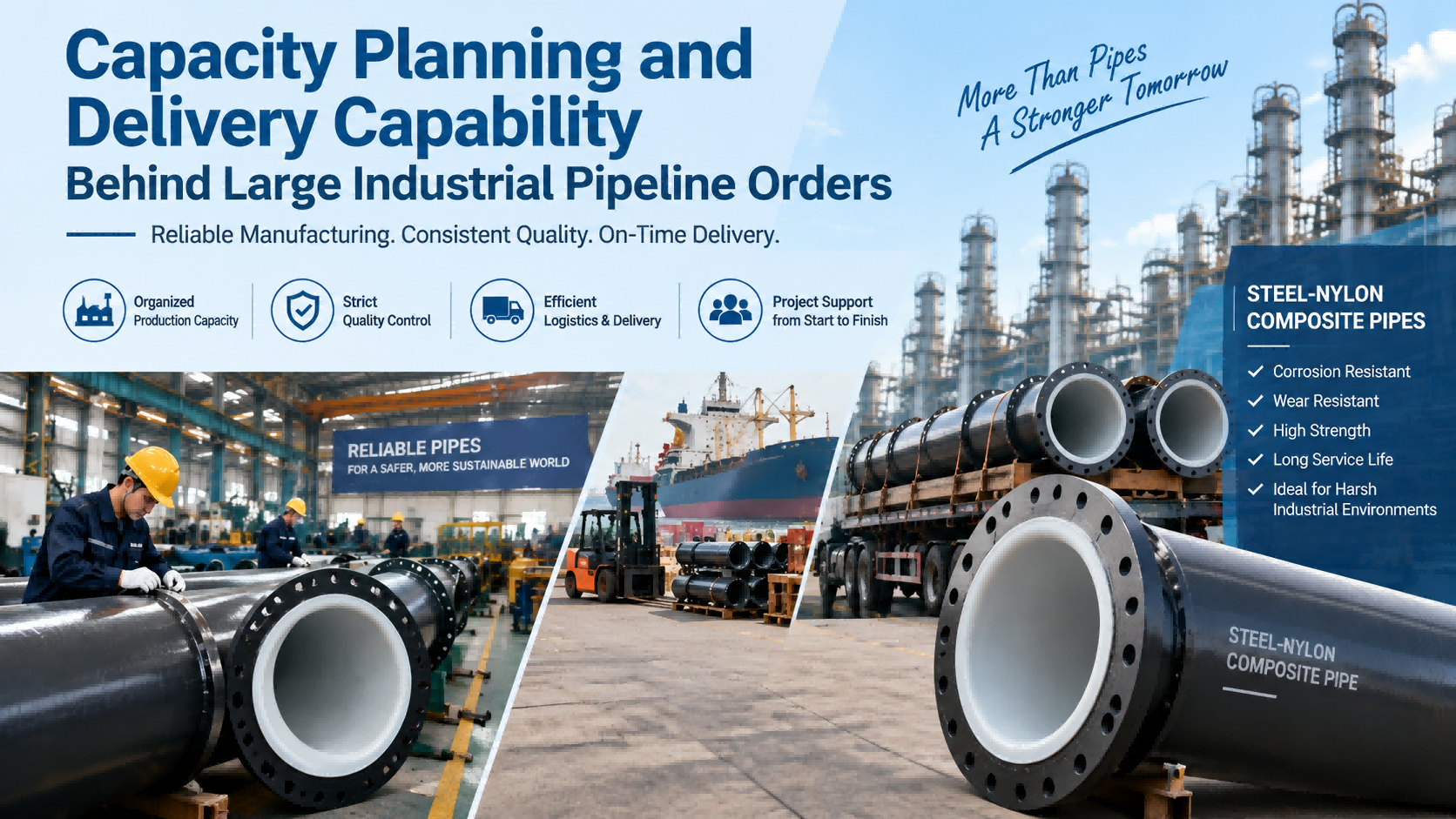
Capacity Planning and Delivery Capability Behind Large Industrial Pipeline Orders
What Tests Does a Steel-Nylon Composite Pipe Undergo Before Leaving the Factory?