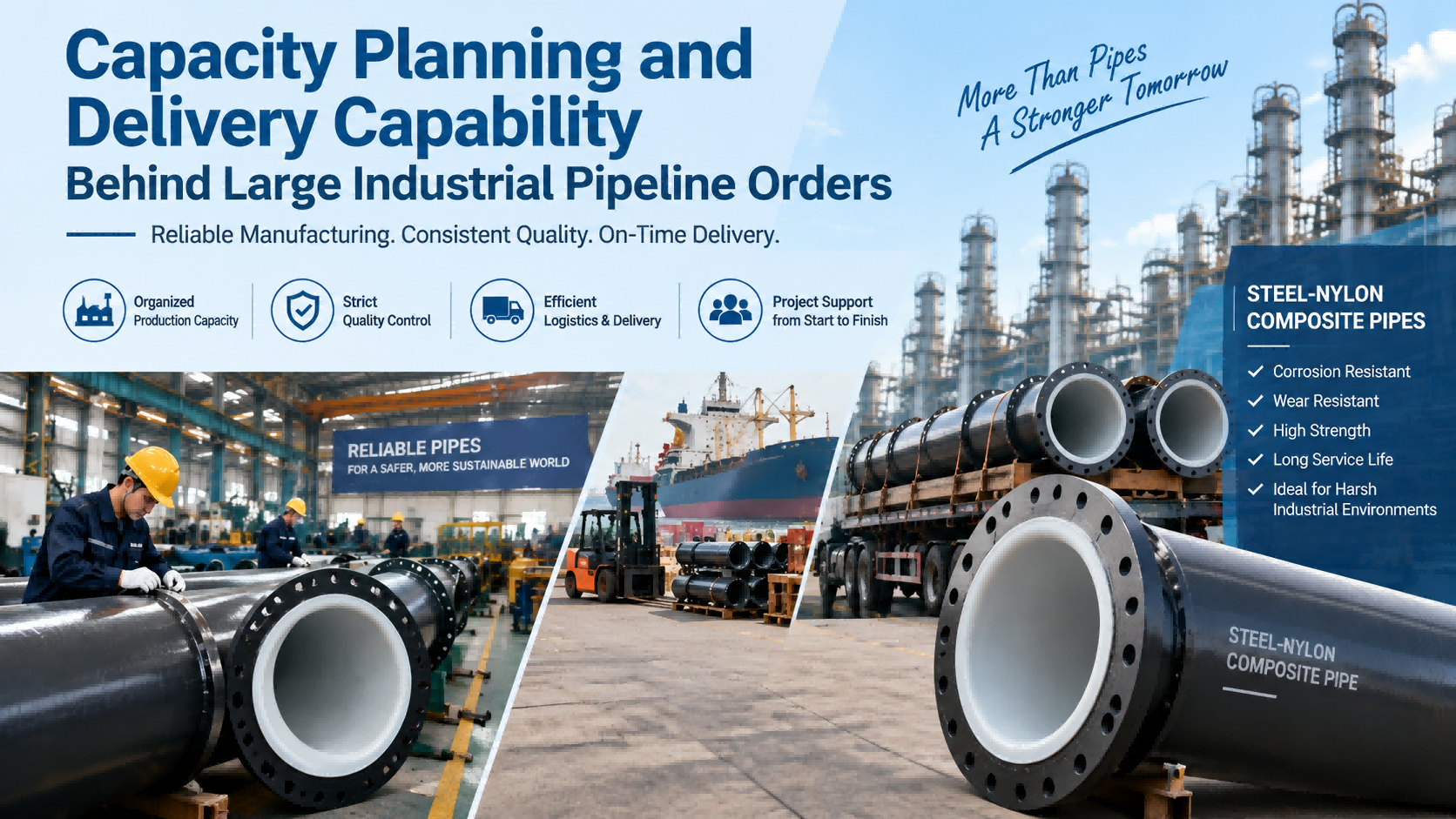
Why Manufacturing Capability Is a Critical Factor When Overseas Buyers Choose a Pipeline Supplier

In international industrial pipeline procurement, customers are rarely choosing only a pipe material or purchasing individual lengths of pipe.
What they are really choosing is whether a supplier can consistently support an industrial project over months—or even years—through engineering coordination, raw material control, large-scale manufacturing, quality inspection, packaging, logistics, and reliable delivery.
This is especially true in industries such as chemicals, oil and gas, mining, salt chemicals, chlor-alkali, soda ash, and other large industrial infrastructure projects.
Once pipeline procurement reaches project scale, competition between suppliers is no longer simply about price.
Increasingly, it becomes a competition between manufacturing systems, engineering capabilities, quality control, and delivery reliability.
That is why more international buyers are asking an increasingly important question when evaluating industrial pipeline suppliers:
Can this supplier manufacture the required products consistently and deliver them to the same quality standard throughout the entire project?
For engineering products such as steel-nylon composite pipes, manufacturing capability is particularly important.
1. What Are Overseas Buyers Really Concerned About When Purchasing Industrial Pipelines?
For ordinary consumer products, a quality problem may simply result in a return or replacement.
Industrial pipeline projects are completely different.
A chemical process pipeline, slurry transportation system, or oilfield gathering line may contain:
-
Hundreds of meters or several kilometers of pipeline
-
Multiple pipe diameters
-
Straight pipe sections
-
Elbows
-
Tees
-
Reducers
-
Flanged connections
-
Valve connection sections
-
Pump outlet sections
-
Customized fittings
If dimensional deviations, inconsistent liner quality, or connection problems occur in even one part of the system, the impact can quickly spread across the entire project.
The result may affect:
-
Pipeline installation schedules
-
Overall construction progress
-
On-site labor costs
-
Equipment commissioning
-
Plant startup dates
-
Future maintenance frequency
For this reason, international buyers evaluating an industrial pipeline supplier usually want answers to four fundamental questions:
Can the product handle the actual operating conditions?
Can the supplier maintain consistent quality during mass production?
Can large-volume orders be delivered on schedule?
Can the manufacturer handle complex specifications and customized engineering requirements?
All four questions ultimately point to one core capability:
Manufacturing Capability
2. Why a Product Datasheet Alone Cannot Prove Manufacturing Capability
Many industrial pipeline products may appear similar on paper.
Suppliers may all claim that their products offer:
-
Corrosion resistance
-
Wear resistance
-
High mechanical strength
-
Long service life
-
Chemical resistance
However, the real differences often become visible only after production begins.
There is a fundamental distinction between manufacturing one qualified sample and consistently manufacturing hundreds or thousands of qualified products for an industrial project.
A company that can successfully manufacture one DN300 composite pipe does not automatically prove that it can also achieve:
-
Stable production at DN800
-
Consistent quality at DN1200
-
Reliable large-volume manufacturing
-
Continuous production over several months
-
Consistency between different production batches
Therefore, experienced international engineering buyers increasingly ask not only:
“Can you manufacture this pipe?”
but:
“Can you manufacture it consistently at project scale?”
The difference between these two questions represents a significant gap in manufacturing capability.
3. Large-Diameter Manufacturing Capability Is an Important Indicator
One clear principle in industrial pipeline manufacturing is that production complexity generally increases as pipe diameter increases.
Many manufacturers can produce relatively small-diameter pipes.
However, as pipe diameter becomes larger, manufacturing challenges increase significantly.
These may include:
-
Pipe roundness control
-
Steel structure strength
-
Uniformity of the nylon lining
-
Lining forming stability
-
Structural integrity between steel and nylon components
-
Flange concentricity
-
Flange flatness
-
Pipe-end dimensional accuracy
-
Thermal stress control
-
Large-scale tooling accuracy
-
Lifting and transportation deformation
The manufacturing difficulty of a DN100 pipe and a DN1000-class industrial pipe is fundamentally different.
For steel-nylon composite pipe in particular, manufacturing is not simply a matter of combining two materials.
The product must simultaneously achieve:
The mechanical strength of the external steel structure
and
The corrosion resistance, wear resistance, and flow performance of the internal nylon layer.
This requires the manufacturing process to control both a metallic structural system and a polymer lining system.
As a result, large-diameter production capability can provide international buyers with an important indication of a supplier's overall industrial manufacturing strength.
For large chemical, mining, oilfield, and slurry transportation projects, a broader diameter range also means that one supplier can cover more of the complete pipeline system rather than providing only a limited portion of the required specifications.
4. Higher Pressure Ratings Require a More Mature Manufacturing System
Pressure is another critical consideration in industrial piping systems.
Many corrosive fluid transportation applications do not operate under low-pressure conditions.
Oilfield gathering systems, chemical plants, mining slurry pipelines, and industrial circulation systems may all require different operating pressure levels.
In these applications, corrosion resistance alone is not sufficient.
The pipeline must also provide:
-
Adequate structural strength
-
Reliable flanged connections
-
Consistent wall thickness
-
Structural stability
-
Long-term performance under pressure cycles
One of the major advantages of steel-nylon composite pipe is its structural concept.
The steel structure provides mechanical strength and pressure-bearing capability, while the internal nylon layer isolates the transported medium from the metal structure.
This allows the pipe to combine:
Mechanical Strength + Corrosion Resistance
For industrial projects requiring pressure classes in the range of approximately 1.0–4.0 MPa, this composite structure can offer important engineering advantages when properly designed for the specific service conditions.
However, achieving this performance depends heavily on manufacturing capability.
The manufacturer must be able to consistently control:
-
Steel structure fabrication
-
Nylon lining thickness
-
Pipe dimensional accuracy
-
Flange manufacturing
-
Overall structural integrity
Therefore, pressure rating is not merely a number printed in a product catalog.
It also reflects the manufacturer's underlying:
-
Engineering capability
-
Material control
-
Manufacturing capability
-
Testing capability
5. Large International Projects Depend on Batch Consistency
When buyers first evaluate a supplier, they may see a few product samples.
Experienced engineering procurement teams, however, are more concerned with another question:
Will pipe No. 1 and pipe No. 1,000 be manufactured to the same standard?
This is the concept of:
Batch Consistency
A major industrial pipeline project may require hundreds or thousands of pipe sections.
If significant differences occur between production batches—for example:
-
Outside diameter variations
-
Flange hole misalignment
-
Uneven liner thickness
-
Pipe-end dimensional differences
-
Concentricity deviations
installation problems can quickly arise.
For example:
Flanges may not align correctly
Additional field adjustment may be required.
Pipeline centerlines may deviate
This can introduce unnecessary installation stress.
Fittings may not match straight pipe sections
Construction becomes more complicated.
Lining quality may vary
Certain sections may fail earlier than others.
For this reason, a mature industrial pipeline manufacturer needs a standardized production and quality-control system covering areas such as:
-
Raw material specification management
-
Standardized tooling
-
Forming parameter control
-
Dimensional inspection
-
Pressure testing
-
Final inspection
-
Batch traceability
The true value of manufacturing capability is not producing one excellent pipe occasionally.
It is:
Consistently producing large quantities of products to the same engineering standard.
6. Manufacturing Capability Determines Whether Large Orders Can Be Delivered on Time
International industrial projects usually operate according to strict schedules.
Important milestones may include:
-
Plant shutdowns
-
Maintenance windows
-
Construction schedules
-
Commissioning dates
These dates may be difficult or extremely expensive to change.
If pipeline delivery is delayed, the entire project schedule can be affected.
Large industrial pipeline orders cannot simply be accelerated by adding more workers or extending working hours.
They require coordinated capacity planning.
For example:
Raw Material Supply
Steel, nylon materials, flanges, and other components must be prepared in advance.
Production Stations
Different specifications may require different tooling and manufacturing processes.
Production Scheduling
Straight pipes, fittings, flanges, and customized products must be coordinated.
Inspection Capacity
As production output increases, testing and inspection capacity must increase accordingly.
Packaging and Logistics
Transporting large-diameter industrial pipes is itself an important logistical challenge.
That is why overseas customers often pay close attention to information such as:
-
Annual production capacity
-
Monthly production capacity
-
Maximum pipe diameter
-
Maximum pressure rating
-
Large-project delivery experience
These indicators help buyers determine whether a supplier is simply capable of manufacturing a product—or capable of supporting an entire industrial project.
7. Complete Manufacturing Capability Means Supplying a Pipeline System, Not Just Straight Pipes
In many industrial pipeline projects, the most vulnerable areas are not necessarily the straight pipe sections.
They are often the connection and transition points.
These include:
-
Elbows
-
Tees
-
Reducers
-
Pump outlet sections
-
Valve connection sections
-
Flange joints
Such locations may experience a combination of:
-
Fluid erosion
-
Turbulence
-
Pressure changes
-
Installation stress
If a supplier can manufacture only straight pipes but cannot provide compatible fittings, the customer may need to coordinate multiple suppliers.
This increases the risk of:
-
Interface incompatibility
-
Material inconsistency
-
Higher procurement management costs
-
Unclear quality responsibility
For this reason, we emphasize the system-level manufacturing capability of steel-nylon composite piping.
In addition to straight pipe sections, a complete pipeline solution may include:
-
Steel-nylon composite straight pipes
-
Steel-nylon composite elbows
-
Tees
-
Reducers
-
Pump outlet sections
-
Upstream and downstream valve sections
-
Flanged pipe sections
-
Customized fittings
This allows customers to source a more integrated pipeline system from a single manufacturer.
8. Why Flanged Connections Matter in International Industrial Projects
The connection method used in an industrial piping system directly affects installation efficiency.
Steel-nylon composite pipes can be designed with flanged connection systems.
For many industrial applications, flange connections provide several practical advantages:
-
No on-site heat fusion
-
Reduced dependence on complicated field welding
-
Easier connection to valves and equipment
-
Convenient disassembly for maintenance
-
Easier partial pipeline replacement
-
Suitable for upgrading existing pipeline systems
In chemical plants, oilfields, and operating facilities, reducing the need for on-site hot work can provide significant installation and maintenance advantages.
However, flange connections may appear simple while demanding high manufacturing accuracy.
Critical factors include:
-
Flange flatness
-
Bolt-hole positioning
-
Flange concentricity
-
Pipe-end perpendicularity
These directly affect field installation.
A mature composite pipeline manufacturer must therefore manufacture not only a reliable pipe body, but also a reliable connection system.
9. Manufacturing Capability Determines Whether Material Advantages Become Real Engineering Advantages
Steel-nylon composite pipe has a clear structural concept.
External Steel Structure
The steel component primarily provides:
-
Mechanical strength
-
Pressure resistance
-
Structural stability
Internal Nylon Layer
The nylon lining is exposed to the transported medium and can provide:
-
Corrosion resistance
-
Wear resistance
-
Smooth internal surface
-
Reduced scaling tendency
-
Chemical resistance in suitable service conditions
This structure can be especially valuable in industrial applications where several challenges exist simultaneously:
Corrosion + Abrasion + Pressure
Typical applications may include:
-
Oilfield produced fluids
-
Brine
-
Mother liquor
-
Alkaline media
-
Mild acidic media under compatible conditions
-
Chemical wastewater
-
Slurries
-
Fluids containing solid particles
However, material properties alone are only the foundation.
Long-term product performance also depends on whether the manufacturing process can consistently ensure:
-
Lining continuity
-
Uniform lining thickness
-
Structural integrity
-
Consistency between pipes and fittings
-
Reliable connection interfaces
In simple terms:
Good material + unstable manufacturing = unstable product.
While:
Good material + mature manufacturing system = engineering-grade pipeline product.
10. Mature Manufacturers Understand Operating Conditions, Not Just Production
One major difference between industrial pipelines and ordinary standardized products is that:
Operating conditions determine material selection and pipeline design.
The same pipeline material may perform very differently under different operating environments.
Important project parameters can include:
-
Medium
-
Concentration
-
Temperature
-
Pressure
-
Flow velocity
-
Solid content
-
Particle size
-
Installation environment
-
External corrosion conditions
For example, even within chemical liquid transportation, low-concentration acids and highly concentrated strong acids may require completely different material solutions.
Similarly, in slurry transportation, particle size, concentration, and flow velocity can significantly affect wear rates.
Therefore, a mature industrial pipeline manufacturer should not only ask:
“What pipe diameter do you need?”
It should also ask:
“What are the actual operating conditions?”
Only after understanding the real service conditions can a supplier determine:
-
Whether steel-nylon composite pipe is suitable
-
What pressure rating is required
-
What structural configuration should be used
-
Which areas of the pipeline require additional engineering attention
This application-based approach is particularly important for industrial projects where corrosion, abrasion, pressure, temperature, and installation conditions interact.
11. Why Are Overseas Buyers Paying More Attention to Factory Audits?
Factory audits are becoming increasingly common in international industrial procurement.
Customers may evaluate suppliers through:
-
On-site factory audits
-
Video factory inspections
-
Third-party inspections
-
Quality system audits
During these evaluations, buyers often focus on several key areas.
Manufacturing Equipment
Can the equipment support the required specifications and pipe diameters?
Tooling Systems
Can the manufacturer maintain dimensional consistency during mass production?
Raw Material Management
Are raw materials properly controlled and traceable by batch?
Quality Inspection
Does the manufacturer have appropriate dimensional, pressure, and other testing capabilities?
Finished Product Management
Can different projects, batches, and specifications be clearly identified and controlled?
Production Capacity
Can the factory support the volume and schedule of a large industrial project?
The reason is simple.
Industrial procurement is not merely about buying a batch of products.
It is about:
Controlling project and supply-chain risk.
12. Manufacturing Capability Ultimately Influences Total Lifecycle Cost
Many procurement projects initially focus heavily on unit price.
However, after several years of operation, industrial companies often discover that pipeline cost is much more than the original purchase price.
The real cost should be evaluated as:
Total Lifecycle Cost
This may include:
-
Initial purchase cost
-
Installation cost
-
Maintenance cost
-
Replacement cost
-
Shutdown losses
-
Leakage risk
-
Spare parts cost
If inconsistent manufacturing quality results in frequent maintenance, the savings achieved through a lower initial purchase price can quickly disappear.
This is why more international engineering customers are shifting their procurement philosophy from:
Lowest Purchase Price
to:
Lowest Lifecycle Cost
Stable manufacturing capability is one of the foundations for reducing long-term lifecycle risk.
13. Our Manufacturing Philosophy for Steel-Nylon Composite Pipes
For steel-nylon composite pipe, we believe product competitiveness does not come from the material alone.
Real competitiveness comes from:
Material + Engineering + Manufacturing + Quality Control
Our design concept is straightforward:
Use the external steel structure to provide mechanical strength and structural support.
Use the internal nylon layer to isolate compatible corrosive or abrasive media from the metal structure.
The objective is to address corrosion, wear, scaling, and maintenance challenges found in certain conventional industrial pipeline systems.
Steel-nylon composite piping can be considered for applications in industries such as:
-
Chemical processing
-
Oil and gas fields
-
Chlor-alkali production
-
Soda ash production
-
Salt chemical processing
-
Phosphate chemical processing
-
Mining and slurry transportation
-
Industrial wastewater
-
Compatible corrosive fluid transportation
For large industrial projects, we place particular emphasis on:
-
Large-diameter manufacturing
-
Pressure-class manufacturing
-
Batch consistency
-
Flange dimensional accuracy
-
Matching fittings
-
Quality inspection
-
Large-volume delivery
Only when these manufacturing fundamentals are consistently controlled can the inherent advantages of the material be converted into real project value.
14. How Should Overseas Buyers Evaluate a Pipeline Supplier's Manufacturing Capability?
When selecting an industrial pipeline supplier, buyers can ask several practical questions.
1. What is your maximum pipe diameter?
This helps evaluate large-diameter manufacturing capability.
2. What pressure ratings can you manufacture?
This helps determine whether the supplier can support the project's pressure requirements.
3. Can you manufacture elbows, tees, and reducers?
This helps determine whether the supplier can provide a complete piping system rather than only straight pipe.
4. How do you control batch consistency?
This provides insight into production standardization and quality management.
5. What inspections are performed before delivery?
This helps evaluate the manufacturer's quality-control system.
6. What is your monthly production capacity?
This is particularly important for large-volume and time-sensitive projects.
7. Do you have experience with similar media and operating conditions?
Relevant application experience can significantly reduce material-selection and project risk.
8. Can you manufacture according to project drawings and customized requirements?
This helps determine the supplier's engineering and customization capabilities.
These questions often reveal much more about a potential supplier than simply asking:
“What is your price?”
15. The Future of Industrial Pipeline Competition Is Increasingly About Manufacturing Systems
The industrial pipeline market is undergoing an important transformation.
In the past, procurement teams might primarily ask:
“What material is this pipe made from?”
Increasingly, however, customers are also asking:
“Who can reliably manufacture and deliver the complete pipeline system?”
This shift is occurring because industrial projects are becoming:
-
Larger in scale
-
More complex in operating conditions
-
More demanding in delivery schedules
-
More focused on reliability
-
More sensitive to lifecycle costs
In this environment, product advantages alone are not enough.
A supplier capable of serving international industrial projects over the long term also needs:
Engineering Capability
Manufacturing Capability
Quality Control Capability
Delivery Capability
This is why manufacturing capability is becoming one of the most important criteria for overseas buyers selecting an industrial pipeline supplier.
Conclusion: Overseas Buyers Are Not Just Buying Pipes—They Are Buying Long-Term Reliability
For a large industrial project, the value of a pipeline is not determined only by whether it passes inspection before leaving the factory.
The real question is:
Will it continue to operate reliably years after installation?
Long-term reliability begins with the manufacturing process.
From raw material management and engineering design,
to forming and dimensional control,
and from inspection and testing to packaging and final delivery,
every stage can influence the service life and reliability of the finished piping system.
For international buyers, manufacturing capability should therefore not be treated as a secondary supplier qualification.
It is an essential part of product quality itself.
And for engineering products such as steel-nylon composite pipe:
Only stable and repeatable manufacturing capability can transform corrosion resistance, wear resistance, mechanical strength, and long service life from material characteristics into a dependable industrial pipeline system.
From Production Equipment to Quality Systems: What Capabilities Should a Modern Industrial Pipe Factory Have?
Capacity Planning and Delivery Capability Behind Large Industrial Pipeline Orders