Over 20 Years of Nylon Pipe Application Experience in the Soda Ash Industry: The Long-Term Value of Steel–Nylon Composite Pipes

20+ Years of Nylon Pipe Application in the Soda Ash Industry: Long-Term Performance and the Value of Steel–Nylon Composite Pipes
Introduction: Why Does the Soda Ash Industry Need Industrial Piping That Can Stand the Test of Time?
Soda ash (sodium carbonate) is an essential raw material used in glass manufacturing, chemical production, detergents, and numerous other industrial applications.
As soda ash production facilities continue to increase in scale, automation, and operational efficiency, manufacturers are placing greater demands on the corrosion resistance, wear resistance, operational stability, and maintenance costs of industrial piping systems.
During soda ash production, pipelines must continuously transport different process media, including brine, mother liquor, salt slurry, and alkaline wastewater.
These media present different levels of corrosion and abrasion risks. Some contain solid particles that can cause simultaneous corrosion and mechanical wear on the internal surfaces of pipelines.
Traditional metallic pipelines may experience internal corrosion, localized wear, scaling, and leakage during long-term operation.
Although certain non-metallic pipes offer corrosion resistance, their pressure-bearing capacity, structural rigidity, temperature limitations, and suitability for large-scale production facilities must also be carefully evaluated.
Therefore, selecting the right piping material for a soda ash plant requires a comprehensive assessment of material properties, engineering suitability, operational reliability, and total lifecycle costs.
Guangdong Kejin New Materials Co., Ltd. has long specialized in the research, development, and manufacturing of reinforced MC nylon pipes and steel–nylon composite pipes. Our products have been used in the soda ash industry since 2002.
Through more than two decades of industry experience, we have developed a deeper understanding of the requirements of industrial piping systems.
For continuously operating soda ash production facilities, the true value of a pipeline lies not only in its initial material properties but also in its long-term reliability, ease of maintenance, and overall economic performance.
This article explores our experience in the soda ash industry, including typical operating conditions, practical engineering applications, and the technical advantages of steel–nylon composite pipes.
1. What Special Requirements Does the Soda Ash Industry Place on Industrial Piping?
Soda ash production involves multiple processing stages, each with different requirements for piping materials.
When selecting industrial pipes, it is essential to understand the characteristics of the specific medium being transported rather than focusing solely on alkaline corrosion resistance.
1.1 Corrosion Risks Associated with High-Salinity and Alkaline Media
During soda ash production, brine, mother liquor, and alkaline wastewater typically contain varying concentrations of sodium chloride, sodium carbonate, and other dissolved salts.
Under certain temperature, concentration, and oxygen conditions, these media may accelerate the corrosion of some metallic piping materials.
Pipelines with localized deposits, crevices, or protective coating defects may be particularly vulnerable to corrosion.
Over time, corrosion can lead to localized wall thinning, perforation, and leakage.
Changes in operating temperature and chemical composition can further affect the long-term stability of piping materials.
Therefore, soda ash production facilities require pipes with chemical compatibility and corrosion resistance appropriate to their actual operating conditions.
1.2 Abrasion Caused by Salt Slurry and Solid-Containing Media
Salt slurry, mother liquor containing suspended solids, and certain types of process wastewater can cause continuous mechanical wear inside pipelines.
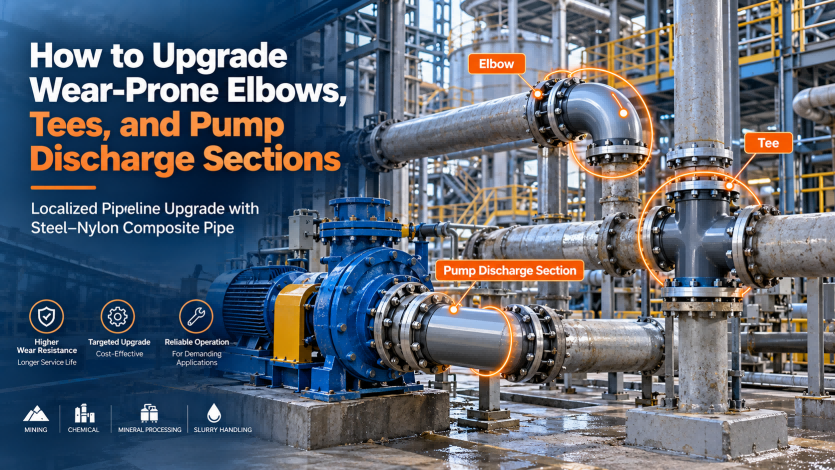
When liquids containing solid particles flow through elbows, tees, reducers, and other directional changes, variations in flow velocity and direction can increase localized particle impact.
If the piping material has insufficient wear resistance, several problems may develop:
-
Progressive wall thinning, increasing the risk of pipeline leakage.
-
Frequent maintenance or replacement of elbows, tees, and other critical components.
-
Internal surface damage and sediment accumulation that may reduce transportation efficiency.
-
Increased maintenance requirements that interfere with continuous production.
Therefore, corrosion resistance and wear resistance must often be considered together when selecting pipelines for soda ash production.
A material that performs well under corrosive conditions may not necessarily provide sufficient protection against abrasive particles.
1.3 The Impact of Temperature Changes on Pipeline Structural Stability
Soda ash production involves the transportation of process media at different temperatures.
For pipelines designed for long-term operation, temperature changes can affect not only material mechanical properties but also thermal expansion and contraction.
This is particularly important for large-diameter pipelines.
Without proper consideration of thermal displacement, pipe supports, and connection design, temperature fluctuations may introduce additional stress into the piping system.
For composite pipes, differences in thermal expansion between the constituent materials must also be considered, particularly at material interfaces, pipe ends, and connection points.
Consequently, pipeline selection for soda ash production must account for operating temperature, pressure, structural design, and connection methods.
2. Since 2002: Practical Applications of Reinforced MC Nylon Pipes in the Soda Ash Industry
For industrial pipe manufacturers, laboratory testing is an essential part of product development.
However, long-term applications under actual operating conditions also provide valuable insights into material performance and engineering suitability.
Reinforced MC nylon pipes and steel–nylon composite pipes manufactured by Guangdong Kejin New Materials Co., Ltd. have been used in soda ash production facilities since 2002.
Among these applications, the Shandong Haihua Soda Ash Plant project has provided practical experience that has helped guide our continued product development, structural optimization, and engineering solutions.
2.1 Project Background: Pipeline Applications at Shandong Haihua Soda Ash Plant
The production facilities at Shandong Haihua Soda Ash Plant require pipelines to transport different types of process media.
These applications place considerable demands on material corrosion resistance, wear resistance, and long-term operational performance.
According to our company's historical project records, reinforced MC nylon pipes and reinforced MC nylon steel composite pipes manufactured by Guangdong Kejin New Materials Co., Ltd. have been used in relevant production systems at the plant since 2002.
The applications involved several types of process media.
| Application | Transported Medium | Key Pipeline Selection Requirements |
|---|---|---|
| Soda ash calcination process | Cold mother liquor from the calcination process | Chemical compatibility, corrosion resistance, and long-term operational stability |
| Brine and salt slurry transportation | Salt slurry and related mixed media | Wear resistance, corrosion resistance, and localized erosion control |
| Environmental protection and wastewater treatment | Process wastewater associated with heavy soda ash production | Compatibility with complex media, sealing reliability, and ease of maintenance |
These operating conditions present different challenges and provide practical engineering examples of nylon piping applications in soda ash production.
2.2 What Did the 2010 Application Report Reveal?
According to our company's historical project documentation, Shandong Haihua Soda Ash Plant provided feedback on the performance of the relevant piping products as of July 2010.
The report gave positive evaluations of product quality, operational performance, and the manufacturer's service.
This historical application record demonstrates that the relevant nylon piping products have an established engineering application history in soda ash production.
It also provides a practical reference for subsequent product development and market applications.
However, it is important to distinguish between more than 20 years of industry application experience and the continuous operating life of an individual pipeline.
The original application records from 2002 and the customer report from 2010 do not, by themselves, establish that the same batch of pipes remained continuously operational for more than 20 years.
Any specific claims regarding the service life of individual pipelines should be verified against subsequent inspection records, maintenance documentation, and customer-confirmed operational data.
For soda ash manufacturers, the value of this historical project lies in the fact that these nylon piping products have been used in actual industrial production systems, providing practical experience in process media transportation, installation, operation, and maintenance.
3. Lessons from More Than 20 Years of Industry Experience: Why Are Steel–Nylon Composite Pipes Worth Considering?
As soda ash manufacturers place greater emphasis on pipeline reliability and maintenance costs, relying on the properties of a single material may not be sufficient to address every challenge associated with complex operating conditions.
Through continuous product development and practical engineering applications, we have gradually established a design approach that combines the structural advantages of steel with the functional properties of reinforced nylon.
Steel–nylon composite pipes are a practical application of this design philosophy.
Their core value lies not simply in combining two materials but in designing a composite structure in which each material performs a function suited to its properties.
3.1 Steel Provides Structural Support While Reinforced Nylon Serves as the Medium-Contact Layer
Steel–nylon composite pipes combine steel and reinforced nylon within an integrated piping structure.
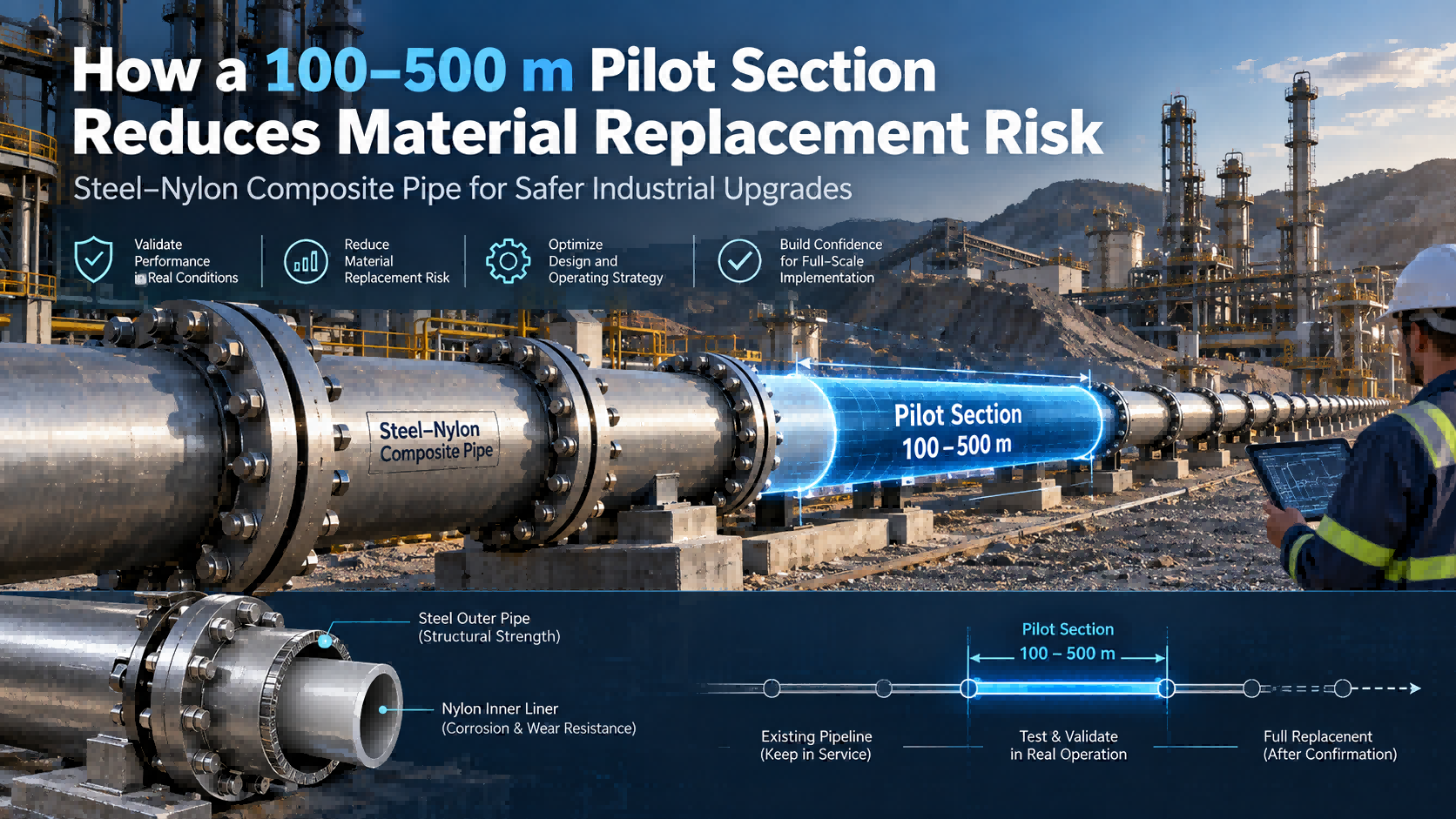
In a typical design, the steel component primarily provides structural support and pressure-bearing capacity, while the nylon layer serves as the functional surface in contact with the transported medium.
Compared with ordinary carbon steel pipes, steel–nylon composite pipes incorporate a nylon inner layer that, when compatible with the process medium, reduces direct contact between the transported fluid and the internal steel surface.
In applications involving brine, alkaline mother liquor, and certain corrosive industrial media, this structure provides an alternative approach to controlling internal corrosion of the steel component.
At the same time, the structural support provided by steel enables composite pipes to be engineered for specific pressure ratings and diameter requirements.
However, the actual pressure-bearing capacity of a composite pipe must be determined by considering the steel specifications, nylon layer design, connection structure, operating temperature, and applicable engineering standards.
The design philosophy behind steel–nylon composite pipes is to use steel to carry structural loads while utilizing the reinforced nylon contact layer to improve compatibility with specific industrial media.
3.2 Utilizing the Wear Resistance of Reinforced Nylon for Salt Slurry Transportation
Salt slurry transportation is one of the representative abrasive applications in the soda ash industry.
Solid particles suspended in salt slurry continuously interact with the internal surface of the pipeline during transportation.
This interaction can result in abrasive wear and localized erosion.
Reinforced MC nylon exhibits wear-resistant properties that make it a potential material for certain solid–liquid transportation applications, provided that material selection and engineering verification confirm its suitability.
In steel–nylon composite pipes, the nylon inner layer can withstand contact and friction between transported particles and the pipe wall within its verified operating limits.
However, the actual wear rate depends on several factors, including:
-
Particle hardness and size.
-
Solid concentration.
-
Flow velocity and flow patterns.
-
Operating temperature.
-
Pipe geometry and localized flow conditions.
For applications involving high solid concentrations, high flow velocities, or severe erosion, product suitability should be confirmed through material testing, engineering experience, and wear assessments.
In practical projects, our approach is to select appropriate nylon materials and piping structures according to the characteristics of the transported medium.
Rather than treating one material as a universal solution for every abrasive environment, we emphasize engineering-based material selection.
3.3 Steel–Nylon Composite Structures Provide Additional Options for Large-Diameter Pipelines
Modern soda ash production facilities are increasingly characterized by large-scale operations and continuous production.
As production capacity increases, certain process systems require large-diameter pipelines to accommodate higher transportation volumes.
Large-diameter pipelines must provide sufficient flow capacity while maintaining acceptable deformation, structural stress, and connection reliability.
For pipelines manufactured from a single non-metallic material, wall thickness, long-term deformation, and support design require particular attention as pipe diameter increases.
By combining the structural support of steel with the medium-contact properties of nylon, steel–nylon composite pipes provide an alternative technical solution for large-diameter, corrosion-resistant industrial piping systems.
Guangdong Kejin New Materials Co., Ltd. has developed manufacturing capabilities covering multiple pipe diameters and pressure ratings.
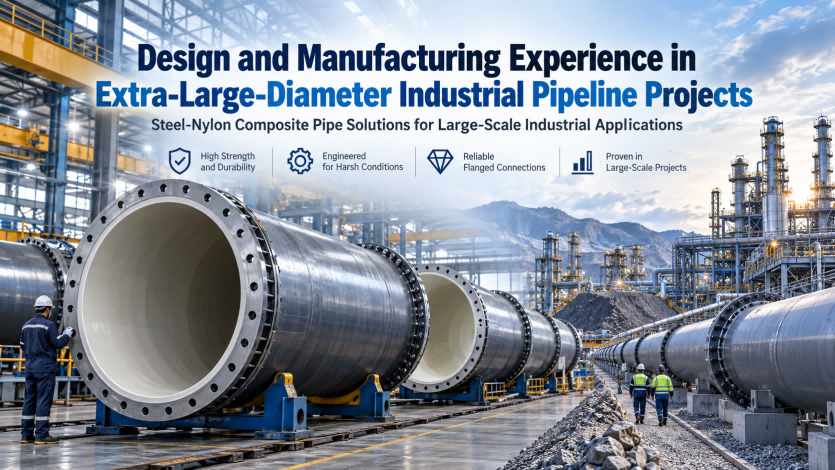
Our steel–nylon composite pipe products cover pressure classes from 1.0 to 4.0 MPa, with manufacturing capabilities for large-diameter and ultra-large-diameter industrial pipes.
Our standard manufacturing capabilities extend to DN1600, and we also possess the technical and manufacturing capabilities to produce ultra-large-diameter products of DN2000 and above.
It is important to note that the maximum manufacturable pipe diameter does not necessarily correspond to the highest allowable operating pressure at that diameter.
The rated pressure, permitted operating temperature, and connection structure of each product must be confirmed according to its specific design, inspection results, and project technical documentation.
For soda ash plants requiring large-diameter pipelines to transport brine, alkaline mother liquor, and industrial wastewater, steel–nylon composite pipes are a material option worth evaluating during the selection process.
4. Another Important Lesson from More Than 20 Years of Engineering Experience: Pipeline Connection Reliability Cannot Be Overlooked
In industrial piping systems, connection reliability is just as important as the performance of the pipe body itself.
Even when a pipe offers good corrosion and wear resistance, an unsuitable connection method may still result in flange leakage, seal failure, or damage at connection points.
In soda ash production facilities, pipelines frequently connect to pumps, valves, storage tanks, and other process equipment.
Flanged connections are therefore widely used throughout these systems.
For steel–nylon composite pipes, the structural compatibility between the pipe body and its connections, the continuity of the protective inner layer, and the sealing design are important engineering considerations.
4.1 The Technical Value of Integrally Formed Flange Design
Guangdong Kejin New Materials Co., Ltd. continues to optimize connection technologies for steel–nylon composite pipes, with integrally formed flange designs representing an important direction in our product development.
Compared with certain traditional piping systems that require on-site welding, prefabricated flanged structures can allow some connection work to be completed through bolted assembly.
This approach offers several potential advantages.
1. Reduced on-site welding requirements
Where prefabricated pipe sections and flanges meet installation requirements, on-site welding can be reduced at the corresponding connection points.
2. Easier equipment connections and pipeline replacement
Flanged connections facilitate the assembly, disassembly, and maintenance of pipelines connected to pumps, valves, and other industrial equipment.
3. Improved protection at connection points
By properly designing the nylon layer termination, flange sealing surfaces, and gasket arrangement, the risk of corrosive media reaching exposed steel at connection points can be reduced.
However, an integrally formed flange does not automatically guarantee zero leakage.
Actual sealing performance depends on flange structure, gasket selection, bolt preload, operating conditions, and correct installation and maintenance procedures.
4.2 Why Should Soda Ash Plants Consider Reducing Hot Work During Installation?
Soda ash production facilities involve multiple types of industrial equipment and continuous processing operations.
Pipeline maintenance and modification may need to be carried out near existing production equipment.
When welding is required, companies typically need to conduct hot-work risk assessments, obtain the necessary work permits, and implement appropriate isolation and safety measures.
For piping systems that can be installed using prefabricated flanged connections, some installation and replacement activities can be completed with less on-site welding.
This may reduce the complexity of certain construction procedures.
However, flanged installation does not eliminate the need for appropriate safety management.
Actual construction activities must still comply with applicable safety requirements based on the operating environment, hazards associated with the process medium, equipment isolation conditions, and plant safety procedures.
5. Why Should Soda Ash Manufacturers Look Beyond the Initial Purchase Price of Industrial Pipes?
For soda ash production facilities operating continuously, the initial purchase price represents only one component of the total cost of a piping system.
From a long-term operational perspective, pipeline costs generally include the following elements.
| Cost Category | Main Components |
|---|---|
| Initial procurement costs | Purchase of pipes, fittings, flanges, and associated components |
| Installation costs | Transportation, lifting, pipe connections, support installation, and on-site construction |
| Operating costs | Pumping energy consumption, routine inspections, and maintenance |
| Repair and replacement costs | Replacement of damaged pipe sections, gaskets, and other components |
| Unplanned downtime costs | Production interruptions and associated losses caused by pipeline failures |
| Total lifecycle costs | Combined costs incurred throughout the planned service period of the piping system |
In certain operating conditions, a pipe with a lower initial purchase price may result in higher long-term costs if frequent maintenance or replacement is required.
Conversely, if a piping material demonstrates better corrosion resistance, wear resistance, and operational stability under actual service conditions, it may improve overall project economics by reducing maintenance requirements and extending replacement intervals.
How Can Steel–Nylon Composite Pipes Help Control Long-Term Costs?
For soda ash production conditions in which the material is confirmed to be suitable, steel–nylon composite pipes may create value through several mechanisms.
1. Reducing maintenance associated with internal corrosion
By reducing direct contact between the transported medium and the internal steel surface, the nylon contact layer can help reduce the risk of internal corrosion under specific operating conditions.
2. Improving wear performance in certain solid–liquid transportation applications
In salt slurry and other particle-containing media applications where suitability has been verified, the wear-resistant properties of reinforced nylon may help reduce maintenance requirements caused by localized abrasion.
3. Reducing certain on-site welding operations
Properly designed prefabricated flanged pipe sections can reduce on-site welding requirements at selected connection points, making installation and pipeline modifications more convenient.
4. Extending pipeline replacement intervals under suitable operating conditions
When material compatibility, engineering design, manufacturing quality, and maintenance procedures are properly addressed, steel–nylon composite pipes have the potential to deliver long-term operational stability.
However, specific cost savings, maintenance intervals, and service life expectations must be evaluated using actual operating data.
They should not be calculated solely from general material properties.
For soda ash manufacturers planning pipeline upgrades, we recommend comparing different piping solutions through a total cost of ownership (TCO) model using equivalent operating conditions and the same evaluation period.
6. How Should Soda Ash Manufacturers Select Steel–Nylon Composite Pipes Based on More Than 20 Years of Industry Experience?
Our experience with industrial piping applications has reinforced an important principle: material suitability cannot be determined without considering actual operating conditions.
Even within the soda ash industry, different production facilities and processing stages may have significantly different pipeline requirements.
For practical engineering projects, we recommend evaluating five key factors.
6.1 Identify the Actual Composition of the Transported Medium
Soda ash production involves the transportation of brine, mother liquor, salt slurry, and various types of process wastewater.
When selecting piping materials, the chemical composition, concentration range, and potential impurities of the transported medium must be clearly identified.
Particular attention should be paid to media containing additional corrosive chemicals.
A pipeline should not automatically be considered suitable for a particular medium simply because it is used within a soda ash production facility.
The chemical compatibility of reinforced nylon must be verified against the actual medium composition and concentration.
6.2 Consider Operating Temperature and Pressure Together
Temperature and pressure are fundamental parameters that determine the suitability of industrial piping systems.
For steel–nylon composite pipes, engineers should assess design pressure, normal operating pressure, transient pressure, and maximum and minimum operating temperatures.
The mechanical properties, long-term deformation behavior, and chemical resistance of nylon materials may vary with temperature.
Therefore, pressure-bearing performance should not be assumed to remain unchanged across all operating temperatures.
For high-temperature applications, cyclic temperature variations, or frequent pressure fluctuations, the applicable operating limits should be established using relevant product design documentation and verification results.
6.3 Evaluate the Abrasive Effects of Solid Particles
For salt slurry and other solid-containing media, particular attention should be given to solid concentration, particle size, particle hardness, and transportation velocity.
Localized erosion risks should be assessed separately at elbows, tees, and other locations where flow direction changes.
Where necessary, high-wear areas should be protected through appropriate wall thickness design, flow velocity control, or additional protective measures.
6.4 Select Appropriate Pipe Diameters and Connection Methods
Large-diameter pipeline design must account for flow rate, flow velocity, system pressure, pipe weight, support conditions, and available installation space.
When using steel–nylon composite pipes, particular attention should also be given to flange structure, sealing surface configuration, protection of the nylon inner layer at connection points, and thermal displacement.
For equipment connections requiring frequent disassembly and maintenance, flanged connections can offer practical advantages.
However, the connection design must remain compatible with the overall piping system.
6.5 Consider Long-Term Operation and Maintenance During the Design Stage
For soda ash production facilities intended for long-term operation, the expected pipeline service period, inspection requirements, maintenance procedures, and replacement criteria should be defined at the beginning of the project.
Considering long-term maintenance during the design phase can help avoid additional costs associated with insufficient installation space, unsuitable connection methods, or difficult access for inspection and repair.
7. Our Experience: The True Value of Pipeline Technology Comes from Long-Term Engineering Practice
Since 2002, the application of reinforced MC nylon pipes and steel–nylon composite pipes in the soda ash industry has provided Guangdong Kejin New Materials Co., Ltd. with valuable engineering experience.
Through continued material development, product manufacturing, and engineering support, our understanding of industrial piping has evolved beyond individual material properties.
Today, we approach pipeline performance from a broader perspective that includes pipe structure, chemical compatibility, connection technology, manufacturing quality, and long-term maintenance.
For soda ash manufacturers, a properly engineered piping system should achieve an appropriate balance between several essential requirements.
Corrosion resistance: Select materials with suitable chemical compatibility based on the transported medium and actual operating conditions.
Wear resistance: Design the inner surface material and critical pipe sections according to the characteristics of salt slurry and other particle-containing media.
Pressure-bearing capacity: Establish a pipe design that meets engineering requirements based on diameter, temperature, system pressure, and connection method.
Connection reliability: Pay close attention to flange design, sealing components, pipe-end structures, and installation quality.
Long-term economic performance: Evaluate procurement, installation, operation, maintenance, and downtime costs rather than focusing exclusively on the initial purchase price.
Together, these factors determine whether a piping system can achieve stable long-term operation in a soda ash production facility.
For a steel–nylon composite pipe manufacturer, product innovation is not simply about improving one material property.
The ultimate objective is to develop piping solutions that better address the actual engineering requirements of specific industrial applications.
8. Looking Ahead: Future Applications of Steel–Nylon Composite Pipes in the Soda Ash Industry
As soda ash manufacturers continue to focus on production efficiency, equipment reliability, and maintenance cost control, industrial piping technology will face new development requirements.
Based on our product development and engineering application experience, several areas deserve continued exploration.
8.1 Large-Diameter Process Media Transportation
By optimizing composite structures and manufacturing processes, steel–nylon composite pipes can provide additional diameter and pressure-rating options for large-scale soda ash production facilities.
8.2 High-Salinity and Alkaline Media Transportation
For brine, mother liquor, and certain types of alkaline wastewater, continued research into nylon material compatibility and long-term stability can help improve the technical basis for material selection.
8.3 Transportation of Solid-Containing Media
Using salt slurry and other representative operating conditions as practical references, manufacturers can further optimize reinforced nylon materials, internal pipe structures, and wear-resistant designs.
8.4 Piping Systems Designed for Easier Installation and Maintenance
Prefabricated flanges and compatible pipe fittings can reduce certain on-site welding requirements and improve the convenience of pipeline installation and maintenance.
8.5 Long-Term Operational Performance Verification
Customer feedback, on-site inspections, and product testing can provide valuable information for improving material selection criteria and product designs under different operating conditions.
In our future product development, we will continue to focus on the relationship between material performance and actual engineering requirements, with the objective of providing more application-specific industrial piping solutions for the soda ash industry.
9. Conclusion: More Than 20 Years of Industry Experience Provides the Foundation for Our Continued Development of Steel–Nylon Composite Pipes
For soda ash manufacturers, industrial piping systems do more than transport process media.
They are important components that influence production continuity, maintenance costs, and overall operational reliability.
Since 2002, reinforced MC nylon pipes and steel–nylon composite pipes manufactured by Guangdong Kejin New Materials Co., Ltd. have been used in practical soda ash production applications.
Historical projects, including the Shandong Haihua Soda Ash Plant application, have provided valuable insights into pipeline requirements under different processing conditions.
Building on this experience, we continue to advance the material development, structural optimization, large-diameter manufacturing, and flange connection technology of steel–nylon composite pipes.
Our objective is to develop products that better address the challenges associated with transporting complex industrial media.
More than 20 years of industry application experience has reinforced one fundamental principle: a high-quality industrial pipeline requires more than good material properties. It must also be used under suitable operating conditions and supported by appropriate engineering design, reliable manufacturing, and proper installation to achieve long-term operational stability.
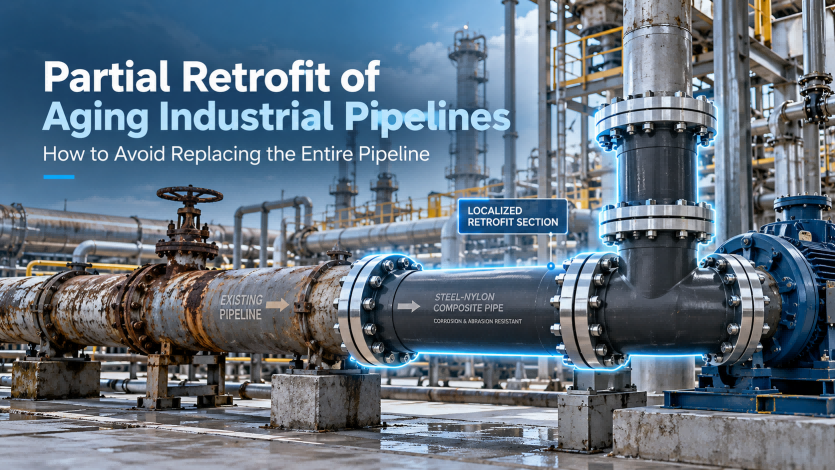
For soda ash manufacturers planning new production facilities, plant expansions, or upgrades to aging piping systems, steel–nylon composite pipes represent a material option worthy of further technical evaluation.
By comprehensively considering medium characteristics, temperature, pressure, pipe diameter, connection methods, and total lifecycle costs, manufacturers can develop piping solutions that better meet their actual engineering requirements.
Discuss Your Soda Ash Industry Piping Project with Guangdong Kejin New Materials Co., Ltd.
Looking for a Reliable Piping Solution for Your Soda Ash Plant?
Guangdong Kejin New Materials Co., Ltd. specializes in the research, development, and manufacturing of reinforced MC nylon pipes and steel–nylon composite pipes.
We are committed to providing industrial piping solutions for soda ash production, chlor-alkali processing, salt chemical manufacturing, oil and gas operations, and other industrial applications.
Our products and technical capabilities include:
-
Reinforced MC nylon pipes and steel–nylon composite pipes.
-
Industrial piping products with pressure ratings ranging from 1.0 to 4.0 MPa.
-
Large-diameter and ultra-large-diameter industrial pipe manufacturing.
-
Integrally formed flange designs and compatible pipe connection solutions.
-
Customized piping solutions based on different media, temperatures, pressures, and transportation requirements.
If you are looking for industrial piping solutions for brine, mother liquor, salt slurry, or other media involved in soda ash production, we welcome you to share your project requirements and operating parameters with our technical team.
Contact us to discuss your application and obtain technical recommendations for selecting steel–nylon composite pipes that meet your specific operating requirements.
Steel–Nylon Composite Pipes — Engineered for Corrosion Resistance, Wear Resistance, and Reliable Industrial Service.
Recommended Supporting Materials for Website Publication
To strengthen the credibility of this article on your Google-focused independent website, consider including actual engineering photographs from the Shandong Haihua Soda Ash Plant project, historical project documentation from 2002, and the customer application report issued in 2010, subject to customer authorization.
Where available, supplementary inspection records and operational data from subsequent years can further demonstrate the company's engineering experience and provide prospective customers with more concrete information about long-term pipeline performance.
These materials can help distinguish more than 20 years of industry application experience from a specific claim that an individual pipeline has remained in continuous operation for more than 20 years.
High Water-Cut Oilfield Pipeline Upgrade Projects: How to Address Corrosion and Abrasion Challenges
Long-Term Performance Review of Steel–Nylon Composite Pipes in Oilfield Gathering and Transportation Systems